Southwest China's Chongqing Municipality, also known as a "mountain city", has been refining its governance by breaking down boundaries between departments to build a unified urban management system as part of the region's broader efforts to improve the wellbeing of its residents.
Chongqing is the only municipality in the central and western region of China. Built on mountains and partially surrounded by the Yangtze and Jialing rivers, it is known as a "mountain city" and a "city on rivers".
The city has been building a comprehensive and integrated system to help improve urban management, breaking down the boundaries between different departments so as to realize unified command and coordinated responses.
In the municipal geomatics and remote sensing center, Chongqing Municipal Planning and Natural Resources Bureau completed the modeling of the buildings in the downtown areas, integrating basic information with geographical location, enabling the staff to get such details as the number of permanent residents in a single building in a given area.
During flood season, this system can offer supporting information to relevant authorities in emergency decision-making as to which areas are prone to inundation.
"We track the flood lines dynamically and we have real-time analyses of the situations in the buildings within the flood lines, including the population residing in those buildings and the population structure, whether there is a high proportion of elderly residents, which is our primary focus when launching rescue efforts and safeguards," said Liang Xing, chief engineer at the Chongqing Geomatics and Remote Sensing Center.
Currently, Chongqing has set a total of 915 "15-minute community life circles", improving facilities according to the needs of residents.
"We can have a timely grasp of the region's population and the conditions of its buildings and facilities, so that we can have a better planning of our high-quality life circles. For instance, we can know if we have enough elderly-friendly facilities, kindergartens, and schools in a region. If there is a shortfall, we will build more of them," said Liang.
Over the past five years, data has been gathered across different departments in Chongqing to a unified urban management system as the city improves its governance.
"During the past five years, we were capable of monitoring in real time the conditions of equipment with help of the Internet of Things and the AI technologies, identifying risks and launching responses in advance. We've also significantly enhanced the efficiency of response. Assisted by data sharing and platforms to coordinate works across different departments, we achieved quick response and closed-loop management. Besides, we also fully integrated workflow in urban management and our urban management work is safer, more targeted and more efficient," said Li Changliang, deputy director at the Chongqing Municipal Administration Bureau.
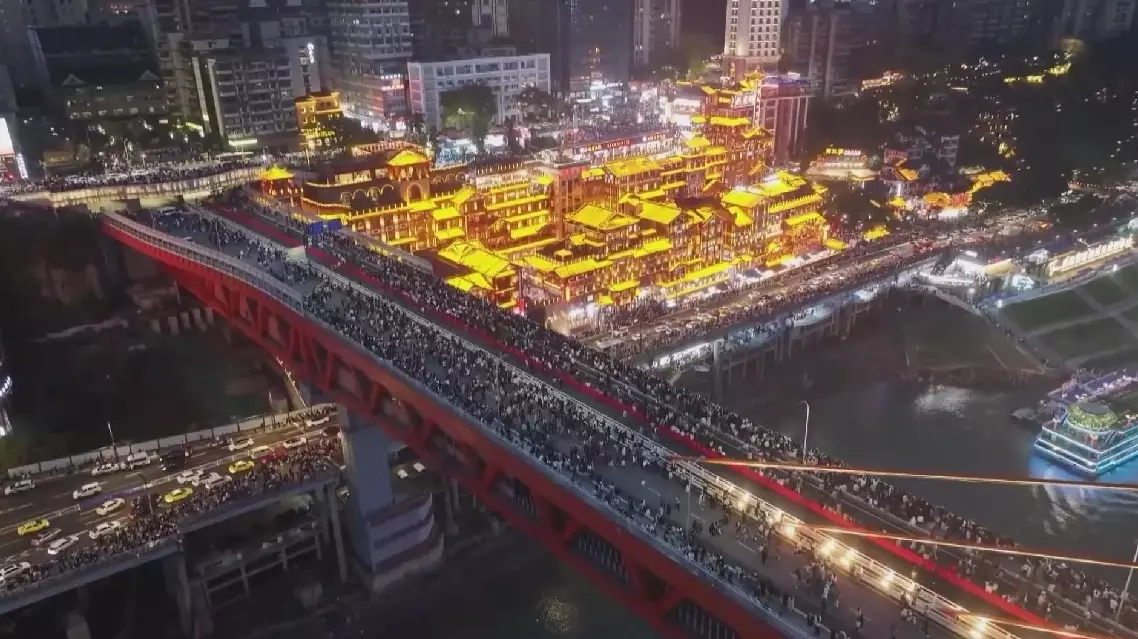
China's "mountain city" refines urban management by breaking down department boundaries