OpenAI could now be the world's most valuable startup, ahead of Elon Musk's SpaceX and TikTok's parent company ByteDance, after a secondary stock sale designed to retain employees at the ChatGPT maker.
Current and former OpenAI employees sold $6.6 billion in shares to a group of investors, pushing the privately held artificial intelligence company's valuation to $500 billion, according to a source with knowledge of the deal who was not authorized to discuss it publicly.
The investors buying the shares included Thrive Capital, Dragoneer Investment Group and T. Rowe Price, along with Japanese tech giant SoftBank and the United Arab Emirates' MGX, the source said Thursday.
The valuation reflects high expectations for the future of AI technology and continues OpenAI’s remarkable trajectory from its start as a nonprofit research lab in 2015.
But with the San Francisco-based company not yet turning a profit, it could also amplify concerns about an AI bubble if the generative AI products made by OpenAI and its competitors don't meet the expectations of investors pouring billions of dollars into research and development.
OpenAI CEO Sam Altman has sought to dismiss those concerns, most recently last week, when he toured a massive data center complex being built to run the company's AI systems in Abilene, Texas.
“Between the ten years we’ve already been operating and the many decades ahead of us, there will be booms and busts,” Altman said after being asked about a bubble. “People will overinvest and lose money, and underinvest and lose a lot of revenue.”
He added that “we’ll make some dumb capital allocations” and there will be short-term ups and downs but that "over the arc that we have to plan over, we are confident that this technology will drive a new wave of unprecedented economic growth,” along with scientific breakthroughs, improvements to quality of life and “new ways to express creativity.”
Just this week, the company launched two different business ventures, one a partnership with Etsy and Shopify for online shopping through ChatGPT and another a social media app, Sora, for generating and sharing AI videos.
OpenAI has been struggling to offer investors and staff the same perks and compensation as the publicly traded tech giants with which it competes. Facebook parent Meta Platforms, in particular, has been on a hiring spree for elite AI engineers and in June made a $14.3 billion investment in AI company Scale that recruited its CEO Alexandr Wang.
OpenAI's for-profit subsidiary, valued at $500 billion, is technically controlled by the board of OpenAI’s nonprofit and both are still bound to pursue the nonprofit’s charitable purpose.
OpenAI’s partnerships with major companies and its plans to change its corporate structure have drawn the scrutiny of regulators, including the attorneys general of California and Delaware, who oversee charitable organizations that operate or are incorporated in their states.
The company has made big deals in recent weeks with Oracle and SoftBank, its partners on a data center venture called Stargate, and with chipmaker Nvidia, which makes the specialized AI chips those data centers need. At the same time, it has lessened its reliance on longtime backer Microsoft.
In September, OpenAI announced it had reached a tentative agreement with Microsoft about the future stake of its nonprofit in its for-profit corporation but released few details.
It also opened applications for nonprofits to apply for $50 million in funding from OpenAI, an effort it launched in response to the recommendations of an advisory board. The grants will go toward projects that increase public understanding of AI, support the design of AI for uses that communities want and increase economic opportunity. The deadline to apply closes on Oct. 8.
——
AP Philanthropy Writer Thalia Beaty contributed to this report.
———-
The Associated Press and OpenAI have a licensing and technology agreement that allows OpenAI access to part of AP’s text archives.

An entrance to the Stargate artificial intelligence data center complex in Abilene, Texas on Monday, Sept. 22, 2025. (AP Photo/Matt O'Brien)

FILE - The OpenAI logo appears on a mobile phone in front of a computer screen with random binary data, March 9, 2023, in Boston. (AP Photo/Michael Dwyer, File)
After a frenetic few months of congressional redistricting efforts, President Donald Trump’s plan to reshape voting districts for partisan advantage ahead of this year’s midterm elections stands at an important juncture.
Will Republican- and Democratic-led states ramp up their remapping of U.S. House districts as new legislative sessions get underway? Or will the mid-decade redistricting frenzy fade away following Indiana’s resounding rejection of Trump’s pressure-packaged campaign?
“We’re at a crossroads to see if the mid-decade redistricting movement gains more speed or was simply an attempt by Donald Trump to impact elections that in many states fizzled,” said Jeffrey Wice, director of the Elections, Census and Redistricting Institute at New York Law School.
Virginia and Florida are two key states to watch. Democrats who lead Virginia and Republicans who lead Florida could try to swing multiple seats in their party’s favor by an aggressive redistricting. Virginia’s legislative session begins Wednesday. Florida Gov. Ron DeSantis plans to call a special session in April on congressional redistricting.
What happens next in Democratic-led Illinois and Maryland and in Kansas' Republican-led Legislature also could affect the GOP’s ability to maintain a narrow House majority in the face of political headwinds that typically favor the party out of power in midterm elections. Key lawmakers in all three of those states remain opposed to redistricting.
Trump kick-started an unusual redistricting plan in July by calling on Texas Republicans to redraw their congressional map to create more favorable districts for the party — even though there was no new census data to base it upon. That triggered a mid-decade redistricting battle the likes of which has not been common since the late 1800s.
Texas, Missouri and North Carolina all approved new Republican-friendly House districts. Ohio, which had to redistrict because of its state constitution, used the opportunity to enact a more favorable House map for Republicans.
But Ohio’s action on Oct. 31 marked a turning point. That same day, Virginia’s Democratic-led legislature took a first step toward redistricting. Then in November, California voters approved new House districts helping Democrats, Kansas Republicans dropped plans for a special session on redistricting, and a Utah judge adopted a new House map that benefits Democrats.
Trump suffered a stunning setback Dec. 11, when Indiana’s Republican-led Senate defeated a redistricting plan that could have helped the GOP win all nine of the state’s U.S. House seats, up from their current seven.
The net result from the 2025 jockeying could be three additional seats for Republicans. But even that is in question, because legal challenges remain in some states, and there is no guarantee that parties will win the districts they redrew.
When the Virginia General Assembly begins its annual session, the agenda will include a proposed constitutional amendment allowing mid-decade redistricting in response to other states.
The amendment, which received first-round approval in the fall, would also need to pass a statewide vote before the new districts could be implemented. Quick action would be necessary to get all that accomplished in time for candidates to run in redrawn districts later this year.
Democrats, who currently hold six of the state’s 11 U.S. House seats, have not unveiled what those new districts would look like. But some have talked of trying to gain as many as four additional seats.
Virginia Gov.-elect Abigail Spanberger has embraced the redistricting effort but has not committed to a particular plan.
“I will look at any map that is kind of reasonable and keeping communities compact and together,” Spanberger, a Democrat, told The Associated Press. “But ultimately, it’s up to the people of Virginia to choose whether or not to move forward with the referendum.”
Republicans currently hold 20 of Florida’s 28 U.S. House seats. That advantage could grow if districts are reshaped during a special session.
Although Florida’s regular legislative session starts Tuesday, DeSantis said he is waiting until April to call a special redistricting session to allow time for a possible U.S. Supreme Court ruling on a key provision of the federal Voting Rights Act. If the court rules in a Louisiana case that race cannot be the predominant factor in creating voting districts, it could open the way for several Republican-led states to redraw districts represented by Black or Hispanic lawmakers who are Democrats.
DeSantis said the high court's ruling could affect “at least one or two” Florida districts.
But any redistricting that aids Republicans could face a court challenge. A voter-approved Florida constitutional provision prohibits drawing district boundaries to favor or disfavor a political party or incumbent.
Some Democrats seeking to counter Trump have urged lawmakers in Illinois and Maryland to redraw their already heavily Democratic districts to try to gain one additional seat in each state. But the plans appear to lack traction as legislative sessions begin this week in both states.
Illinois House Speaker Pro Tem Kam Buckner said “there is no active push” for congressional redistricting.
“There is no appetite to reopen something that will consume enormous time, energy and, frankly, political capital without a compelling justification,” Buckner, a Democrat, told the AP.
Democratic Maryland Gov. Wes Moore has created a special commission to recommend a new congressional map. But Democratic Senate President Bill Ferguson remains opposed and insists that a majority of residents also do not want new districts.
In Kansas, some Republicans want to redraw U.S. House districts to try to gain an additional seat. But House Republicans have failed to gain the two-thirds support needed to override a likely veto by Democratic Gov. Laura Kelly.
House Speaker Dan Hawkins told reporters that he has no plans to hold a vote on congressional redistricting during the annual legislative session that starts Monday.
“I do not have the votes,” Hawkins said.
Associated Press reporters Olivia Diaz, John Hanna, Mike Schneider and Brian Witte contributed to this story.

President Donald Trump points to the crowd as he walks off stage after speaking to House Republican lawmakers during their annual policy retreat, Tuesday, Jan. 6, 2026, in Washington. (AP Photo/Evan Vucci)
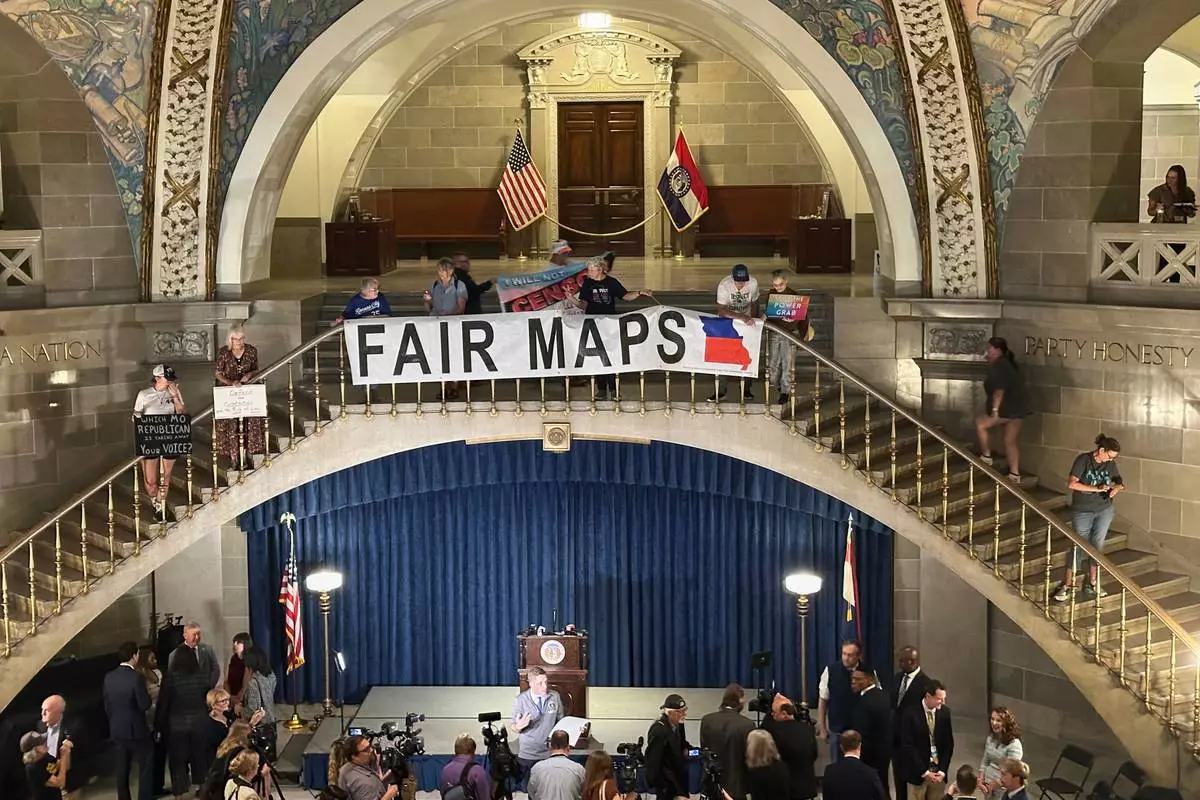
FILE - Opponents of Missouri's Republican-backed congressional redistricting plan display a banner in protest at the State Capitol in Jefferson City, Missouri, Sept. 10, 2025. (AP Photo/David A. Lieb, File)

FILE - ndiana Lt. Gov. Micah Beckwith announces the results of a vote to redistrict the state's congressional map, Dec. 11, 2025, at the Statehouse in Indianapolis. (AP Photo/Michael Conroy, File)
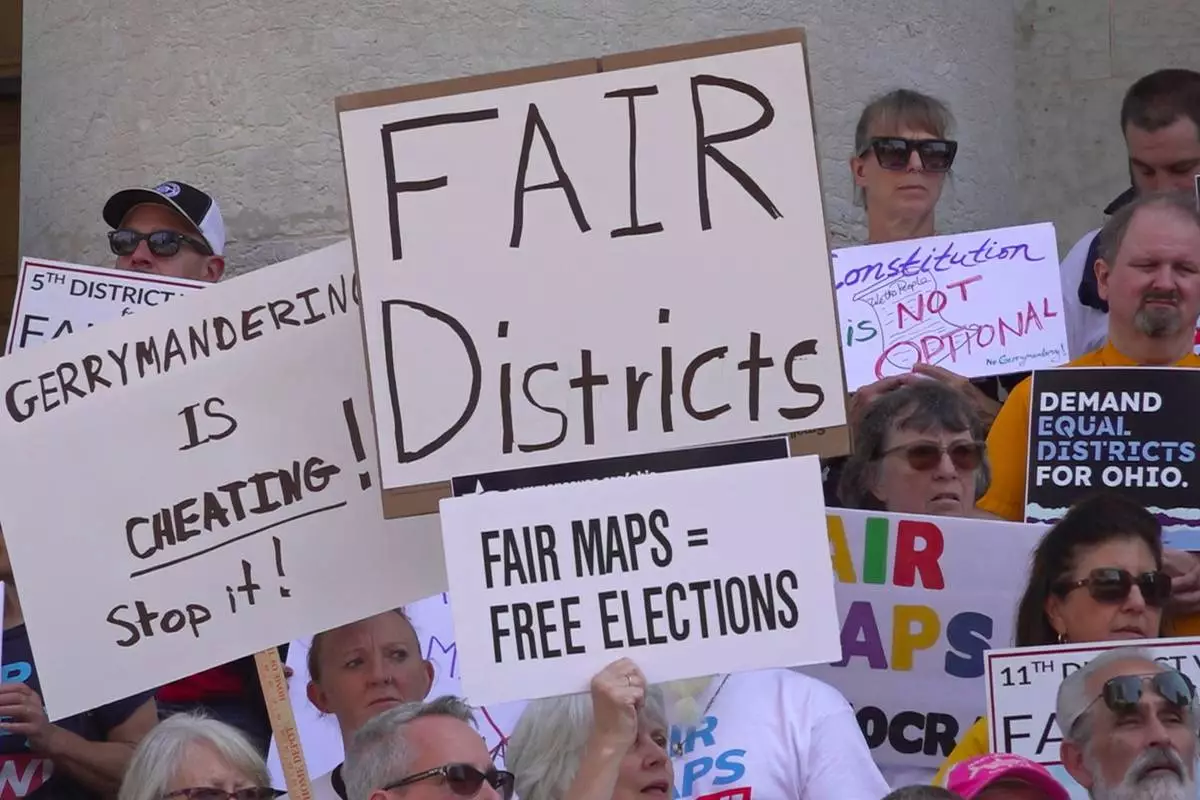
FILE - This photo taken from video shows organizers rallying outside of the Ohio Statehouse to protest gerrymandering and advocate for lawmakers to draw fair maps in Columbus, Ohio, Sept. 17, 2025. (AP Photo/Patrick Aftoora-Orsagos, File)