In a landmark achievement for China's deep-sea exploration capabilities, the submersible Jiaolong, supported by its mother ship Shenhai-1 and aided by icebreaker Xuelong-2, completed the country's first manned dive under Arctic ice during a just-concluded Arctic Ocean scientific expedition.
Preliminary findings from the dives revealed significant spatial variations in the density, biodiversity and size of benthic organisms across spans of tens to hundreds of kilometers. These discoveries provide valuable support for understanding the distribution of polar deep-sea benthos and assessing the impacts of climate change on abyssal ecosystems.
The achievement demonstrates China's growing expertise in deep-sea exploration under extreme conditions, according to the expedition team.
"In the Arctic, we encounter a variety of complex operational environments, including winds, waves, currents, ice, fog and cold. Particularly when working in extensive areas filled with ice floes, it is crucial to select an appropriate diving point while carefully considering the ice floes. This situation is different from deep diving in other maritime regions," said Qi Haibin, a diver with the National Deep Sea Center. In July, China officially launched its first polar manned deep-sea submersible voyage. In early August, the Xuelong-2 and the Shenhai-1 rendezvoused in the Arctic Ocean.
With the support of the Xuelong-2, the Shenhai-1, carrying the Jiaolong manned submersible, achieved China's first manned deep-sea dive in Arctic ice-covered waters.
"This time, the Jiaolong has successfully completed China's first manned deep-sea dive in a polar ice zone, marking a significant breakthrough in China's manned deep-sea diving from a 'full ocean depth' to a 'entire sea area.' This achievement highlights the continuous advancement of China's growing sci-tech strength in deep-sea access and exploration," said Xu Xuewei, deputy director of the National Deep Sea Center.
China's 15th scientific expedition to the Arctic Ocean concluded on Friday as the last members of the expedition team returned to Shanghai.
Carrying the mission crew, the Xuelong 2 icebreaker arrived at its home port in Shanghai on Friday morning, marking the end of China's largest-ever scientific exploration in the Arctic Ocean, according to the Ministry of Natural Resources.
The expedition was jointly carried out by four vessels of the Xuelong-2, the Jidi, the Shenhai-1 and the Tansuo-3. It further advanced China's understanding of rapid changes in the Arctic Ocean and their impact, providing crucial support for assessing and responding to global climate change, the ministry said in a statement.
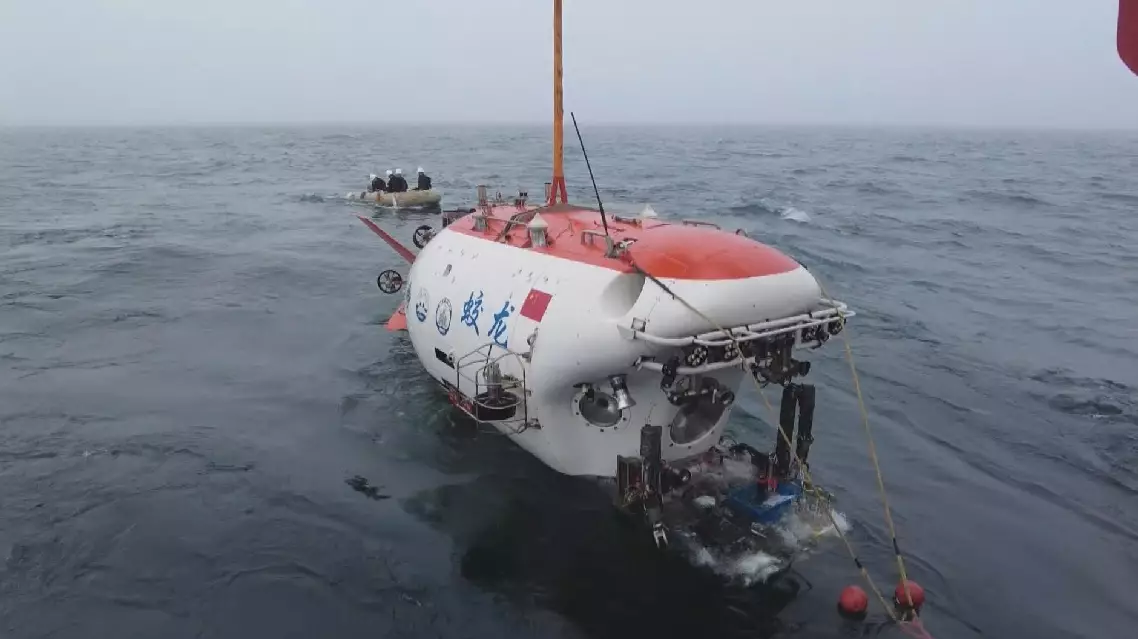
China completes 1st manned dive under Arctic ice in historic polar expedition