
THE HAGUE, Netherlands (AP) — The highest court in the Netherlands on Friday ordered the Dutch government to reevaluate its currently suspended license for exporting parts for F-35 fighter jets to Israel, in response to concerns they could be used in breaches of international law.
The Supreme Court said an export suspension remains in place while the government reassesses the license. The court's vice-president, Martijn Polak, said the government now has six weeks to reevaluate the license.
In its ruling, the Supreme Court said an appeals court in The Hague overstepped its authority when it banned the transfer of F-35 parts to Israel in February 2024, citing concerns they could be used in breaches of international law. The ruling led the government to suspend the exports.
Foreign Minister David van Weel welcomed the ruling and said he would make a decision within six weeks, but suggested that it was unlikely “given the current situation” in Gaza that exports would resume.
Michiel Servaes, director of Oxfam Novib, one of the rights groups that filed the civil case, said they were “disappointed that we haven’t been proven right on all counts, but far more importantly, the minister’s mandatory reassessment can only have one outcome: The export ban will remain in place."
The ruling comes as Israel continues its devastating offensive against Hamas in Gaza and at a time of political flux in the Netherlands, with national elections scheduled for Oct. 29 and the current government in caretaker mode.
The case was originally brought in late 2023 by three Dutch rights groups who argued that transferring the F-35 parts makes the Netherlands complicit in possible war crimes being committed by Israel in its war with Hamas. Israel denies committing war crimes in its campaign in Gaza.
The district court in The Hague initially rejected the ban, but in February 2024 an appeals panel ordered the Dutch government to halt shipments of F-35 fighter jet parts to Israel, citing a clear risk of violations of international law. The government appealed to the Supreme Court, saying that foreign policy was a matter for the government, not courts.
“The Court of Appeal was not entitled to make its own assessment of whether there is clear risk of serious violations of international humanitarian law,” the Supreme Court said in a written summary of its ruling. It added that “the Minister must reassess the license based on that criterion.”
The Netherlands is home to one of three regional warehouses for U.S.-owned F-35 parts. Dutch government lawyers argue that a ban on transfers from the Netherlands would effectively be meaningless as the United States would deliver the parts anyway.
Israel’s campaign in Gaza has killed more than 66,200 Palestinians and wounded nearly 170,000 others, according to Gaza’s Health Ministry. The ministry does not differentiate between civilians and militants in its toll, but has said women and children make up around half the dead.
The ministry is part of the Hamas-run government. U.N. agencies and many independent experts view its figures as the most reliable estimate of wartime casualties.
The war broke out on Oct. 7, 2023, after Hamas militants and others stormed into Israel and killed about 1,200 people, mostly civilians, and took about 250 people hostage. Hamas still holds 48 hostages — about 20 of them thought by Israel to still be alive.
In a largely symbolic move, Slovenia announced in August that it was banning the import, export and transit of all weapons to and from Israel, calling it the first such move by a European Union member.
Last year, the U.K. government suspended exports of some weapons to Israel because they could be used to break international law. Spain says it halted arms sales to Israel in October 2023. There also are court cases in France and Belgium around weapons trade with Israel.
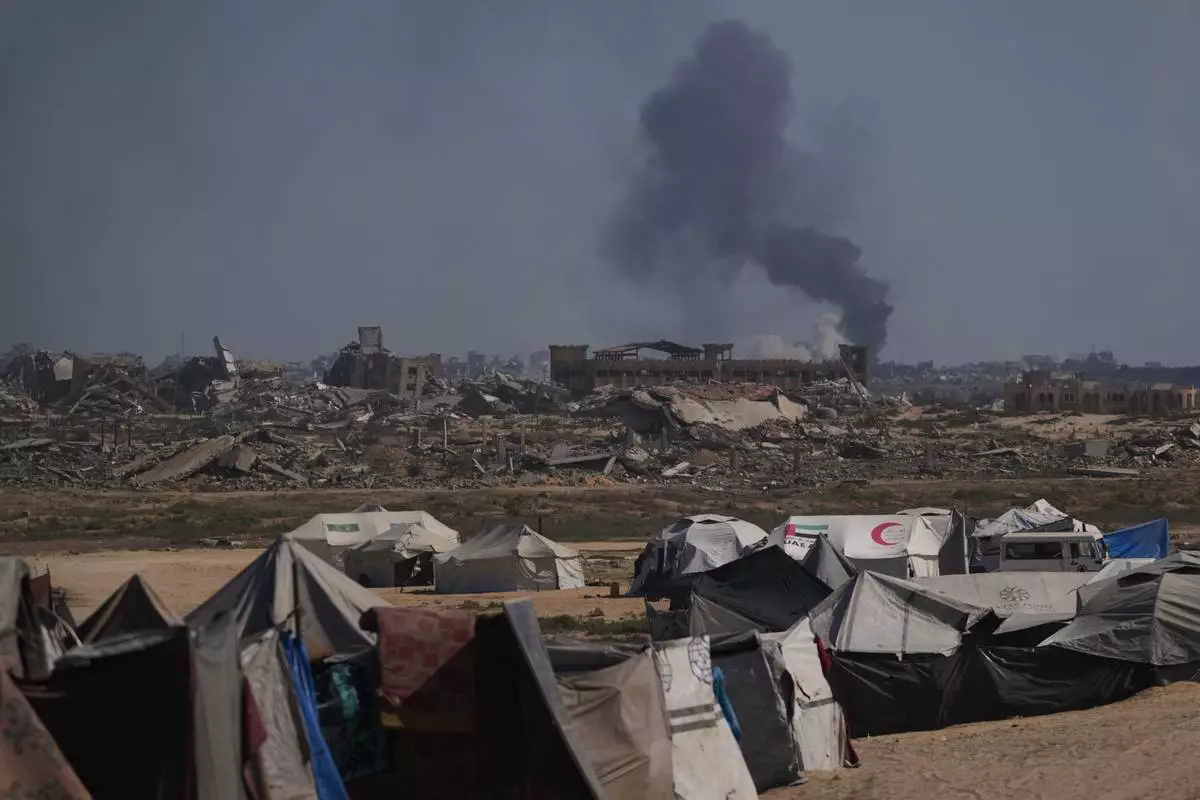
Smoke rises to the sky following an Israeli military strike in Gaza City, as seen from the central Gaza Strip, Thursday, Oct. 2, 2025. (AP Photo/Abdel Kareem Hana)