Skip to Content Facebook Feature Image

Hong Kong and Guangdong Enhance Northbound Travel Scheme for Efficient Cross-Boundary Vehicle Access.

HK

Hong Kong and Guangdong Enhance Northbound Travel Scheme for Efficient Cross-Boundary Vehicle Access.
HK

HK

Hong Kong and Guangdong Enhance Northbound Travel Scheme for Efficient Cross-Boundary Vehicle Access.

2025-10-03 19:55 Last Updated At:20:08

Streamlining procedures and enhancing Northbound Travel for Hong Kong Vehicles to make better use of Hong Kong-Zhuhai-Macao Bridge's carrying capacity

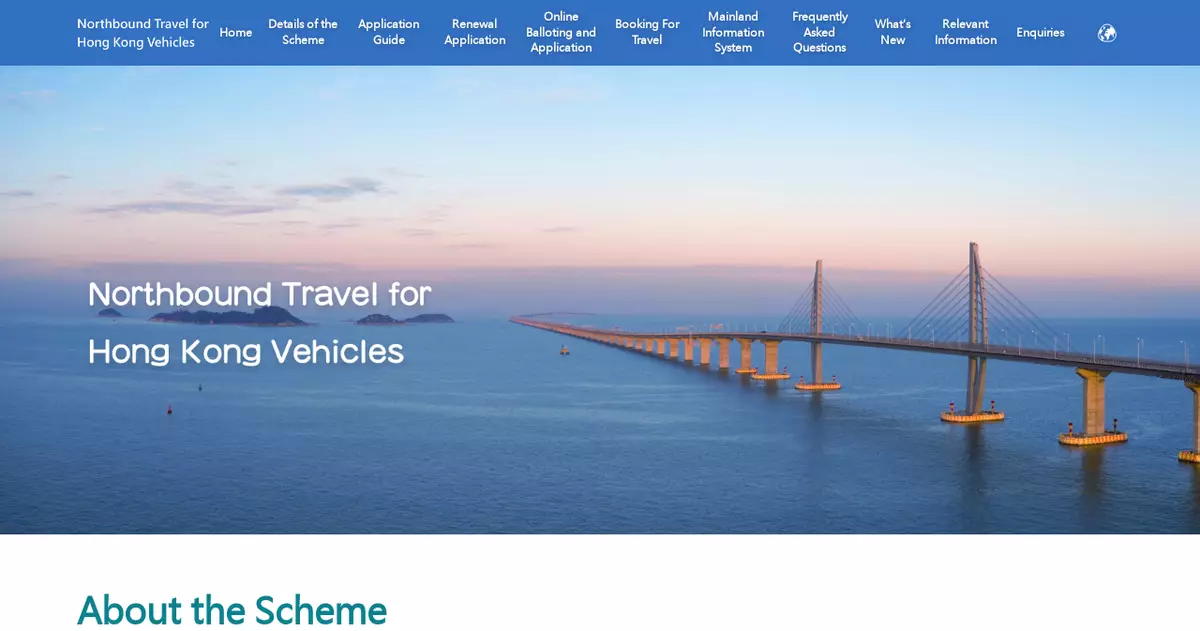
The Transport Department (TD) today (October 3) said that the Hong Kong Special Administrative Region Government and the Guangdong Provincial Government have been continuously enhancing the implementation arrangements of the Northbound Travel for Hong Kong Vehicles (NBT) scheme based on the principles of streamlining procedures and improving the experience. This aims to facilitate efficient cross-boundary travel and make better use of the carrying capacity of the Hong Kong-Zhuhai-Macao Bridge (HZMB) further, thereby promoting the integrated development of the Guangdong-Hong Kong-Macao Greater Bay Area.

A spokesman for the TD said that the Government published in the Gazette today that, starting from October 13, applicants approved to participate in NBT need not apply for Closed Road Permits (CRPs) and pay permit fees. Upon receipt of the "electronic approval letters" issued by the TD, they can proceed to book their trips online or travel directly on days with no bookings required. This new arrangement will provide more convenience and attract more people to apply for NBT, enhancing their travel experience.

Since its implementation in July 2023, NBT has become popular among Hong Kong citizens. Both passenger and vehicle flows between Guangdong and Hong Kong via the HZMB have been on the rise, and over 100 000 Hong Kong private cars have participated in NBT to date. The governments of the two places have been enhancing NBT from applications, vehicle inspection and booking arrangements to provide additional convenience for Hong Kong residents to drive to Guangdong Province for work, business, sight-seeing and visiting families. Such measures include:

(1) Increasing the number of applications accepted: The number of applications for NBT accepted on each working day has been gradually increased from 200 at the beginning to 500 from January 2025. Unused quotas from applications not submitted within the assigned period are allocated to the next round, making full use of resources;

(2) Adjustments to booking arrangements: Since October 2023, the travel booking time slots have been adjusted from six sessions to four sessions to allow greater flexibility for travel; and since February 2024, the deadlines for making and cancelling travel booking were adjusted from two days and three days before the travelling date, respectively, to 12 noon on the day before travelling;

(3) Enhancing vehicle inspection arrangements: Following the establishment of a dedicated NBT vehicle inspection centre in Hong Kong, applicants need not undergo vehicle inspection on the Mainland. From March 2024, vehicle inspection was exempted if the applicant re-submits NBT applications within two years upon passing the vehicle inspection within the validity of the Mainland Electronic Vehicle Licence and with the applicant and vehicle remaining unchanged;

(4) Renewal convenience: From May 2024, if the applicant, vehicle (including vehicle registration mark, colour and chassis/vehicle identification number) and the designated drivers remain unchanged, computer balloting was not required and applicants can submit their renewal applications online within the assigned period. Besides, if the renewal applicants do not conform to the above renewal qualifications, they should re-register for the ballot and submit their applications afresh within the designated period. In addition, the ballot registration period has been relaxed from 30 to 60 days prior to the expiry of their CRPs for better convenience;

(5) Extending application period: Since April 2025, the designated application period for new and renewal applicants has been extended from three and six calendar days, respectively, to 13 days for both, providing sufficient time for applicants to prepare the necessary documents;

(6) Waiving booking prior to travel: From September 1, 2025, bookings are not required for vehicles travelling via the HZMB under NBT on Tuesdays and Wednesdays, except specified dates. Among the Tuesdays and Wednesdays in the first three weeks of September, the number of vehicle trips to Guangdong Province under NBT has significantly increased compared to that in August before the implementation of the new arrangement, providing convenience for more flexible travel; and

(7) No need to apply for CRP: From October 13, 2025, approved applicants under NBT are not required to make an application for CRP and pay permit fees. They may make travel booking immediately after receiving the "electronic approval letter" issued by the TD with a better travelling experience.

The governments of the two places will continue to review the effectiveness of enhancement measures. Applicants may refer to NBT's thematic website (www.hzmbqfs.gov.hk) for details.
Source: AI-found images


Source: AI-found images

Advance Decision on Life-sustaining Treatment Ordinance comes into effect today

The Advance Decision on Life-sustaining Treatment Ordinance (Cap. 651) (the Ordinance) comes intoeffect today (July 31), providing a legal framework for advance medical directives (AMDs) and do-not-attempt cardiopulmonary resuscitation (DNACPR) orders, as well as legal protection for healthcare professionals and rescuers when complying with the directives and orders.

A spokesperson for the Health Bureau (HHB) said, "The Government's policy objective is to ensure that terminally ill patients and their families receive appropriate end-of-life care services and support. The purpose of AMDs and DNACPR orders under the Ordinance is to respect patients' autonomous choices regarding life-sustaining treatment (LST), allowing them to conclude their life's voyage with peace and dignity. The commencement of the Ordinance marks a new milestone in Hong Kong's end-of-life care services."

An AMD allows an adult patient suffering from an advanced and irreversible disease, while he/she is mentally capable of deciding on an LST, to indicate in advance the LST(s) (for example, cardiopulmonary resuscitation, artificial ventilation, and artificial nutrition and hydration) that he/she wishes to refuse should he/she subsequently lose mental capacity and the preconditions specified in the AMD are met. An AMD does not, however, allow the refusal of basic care or palliative care. In line with the principle of "cautious making, easy revoking", the maker must, before making an AMD, fully understand and carefully weigh the implications of each instruction for his/her own condition to make an informed decision, and the AMD must comply with a number of statutory requirements. The maker may also revoke the AMD at any time in the manner specified in the Ordinance.

A DNACPR order, made by registered medical practitioners for a patient who has met the specified preconditions, seeks to ensure that, in settings outside hospitals and even when no healthcare professionals are present, rescuers will act in accordance with the relevant DNACPR order and will not perform cardiopulmonary resuscitation on the patient.

Upon commencement of the Ordinance, healthcare professionals and rescuers are required to act in accordance with the patient's AMD or DNACPR order when they have notice of it and the preconditions specified in the Ordinance are met. Under the principle of"if in doubt, save lives first", the Ordinance provides legal protection for healthcare professionals and rescuers, exempting them from the relevant legal liability where, for example, they administer an LST to a patient because they do not have notice of a valid and applicable AMD or DNACPR order, or they withhold an LST from a patient because they honestly and reasonably believe that the patient has a valid and applicable AMD or DNACPR order.

The Ordinance was passed by the Legislative Council in November 2024. The Government subsequently provided a preparatory period of about one and a half years for stakeholders to get ready for its implementation, and gazetted on May 22, 2026, appointing July 31 as the date on which the Ordinance comes into operation. In preparation for the commencement of the Ordinance, the HHB has worked in collaboration with relevant stakeholders, including policy bureaux and departments, public and private healthcare institutions, residential care homes (RCHs), professional bodies and emergency rescue service organisations, to take forward a range of preparatory work. This includes organising professional training seminars for the personnel concerned (such as healthcare professionals of public and private healthcare institutions, frontline rescue and management staff of government departments and organisations involved in emergency rescues, and staff of RCHs), and updating the relevant service and operational guidelines. The Government has also promoted public understanding of the Ordinance through interdepartmental and cross-sectoral public education and publicity activities, and will continue with these efforts.

Members of the public who wish to learn more about AMDs and DNACPR orders, or who are considering making an AMD, may discuss the matter with a doctor familiar with their condition, who will offer suitable advice having regard to the patient's circumstances. Further information on the Ordinance is available on the HHB's thematic webpage at www.healthbureau.gov.hk/en/press_and_publications/otherinfo/241100_adlto/index.html.

Source: AI-found images

Source: AI-found images

Recommended Articles