Skip to Content Facebook Feature Image

Czech author and anti-communist dissident Ivan Klíma dies at 94

ENT

Czech author and anti-communist dissident Ivan Klíma dies at 94
ENT

ENT

Czech author and anti-communist dissident Ivan Klíma dies at 94

2025-10-04 16:44 Last Updated At:16:50

PRAGUE (AP) — Ivan Klíma, a Czech author and anti-communist dissident whose work and life were shaped by Europe’s 20th-century totalitarian regimes, has died.

His son Michal told the Czech ČTK news agency that Klíma died on Saturday morning at home after battling a long illness. He was 94.

A prolific author, Klima published novels, plays, short story collections and essays as well as children’s books, becoming an internationally known writer whose works were translated into more than 30 languages.

Born Ivan Kauders on Sept 14, 1931, in Prague, Klima faced his first repressive regime during World War II when his Jewish family was transported to the Nazis' Theresienstadt concentration camp. Against the odds, they all survived.

The new Communist regime that took power in Czechoslovakia in 1948 looked promising at first for Klima and many others who had been persecuted.

Klima belonged to a group of talented writers — including Milan Kundera, Pavel Kohout and Ludvik Vaculík — who turned to communism with high hopes after the war only to be bitterly disappointed by its totalitarian nature and its ruthless liquidation of opponents.

Klíma joined the Communist Party in 1953, the same year his father was imprisoned for political reasons. He was expelled from the party in 1967 after criticizing the Communist regime in a speech at a writers’ meeting.

A year later, his writings were banned after a Soviet-led military invasion in 1968 crushed the liberal reforms of Alexander Dubček’s government and ended a more liberal era known as the “Prague Spring.”

“The craziness of the 20th century that I write about has to do with the totalitarian ideologies which were responsible for unbelievable crimes,” Klíma told Czech public radio in 2010 about his two-volume memoirs “My Crazy Century.”

“And that happened despite the fact that those countries belonged to our civilization, they were the countries with a rich cultural tradition,” he said.

After studying Czech language and literary theory at Charles University in Prague in the 1950s, Klíma worked as an editor for several literary journals and began writing for magazines. His multi-layered stories and novels, including his highly acclaimed “Judge on Trial,” captured the situation of individuals facing the machinery of the totalitarian state.

“The main character is dealing with a key topic for him,” Klíma said about his masterpiece, which was first published in German in Switzerland in 1979. “Has the society a right to take anyone’s life? And what has a judge who opposes capital punishment to do in the society that demands it?”

After returning from a teaching stint at the University of Michigan in 1969-1970, Klíma joined the Czech dissident movement. His books at the time were released at home only in underground publications.

Still, unlike many other opponents of communism, Klíma mostly did not have to do menial jobs just to make ends meet because of the support he received from author Philip Roth. The American writer visited Czechoslovakia repeatedly in the 1970s to help Klíma, Kundera and other banned authors, and oversaw the publication of their works in the United States.

After the 1989 Velvet Revolution led by the late Václav Havel ousted communist rule in his homeland, Klima focused full-time on writing. In addition to “Judge on Trial,” his other well-known works include “Love and Garbage,” “My Golden Trades” and “The Spirit of Prague and Other Essays.”

Unlike his complicated, Kafkaesque adult fiction, Klíma’s books for children were more playful. They included a screenplay for several episodes featuring the famed Czech cartoon hero the Little Mole.

In 2002, Havel — by then the country’s president — awarded Klima the Medal for Outstanding Service to the Czech Republic. That same year, Klíma also won the prestigious Franz Kafka Prize.

Of all the turbulent times he saw, Klíma said the moment he left the Nazi concentration camp free and alive was his most vivid experience.

“There’s only life or death,” he said. “Nothing else matters.”
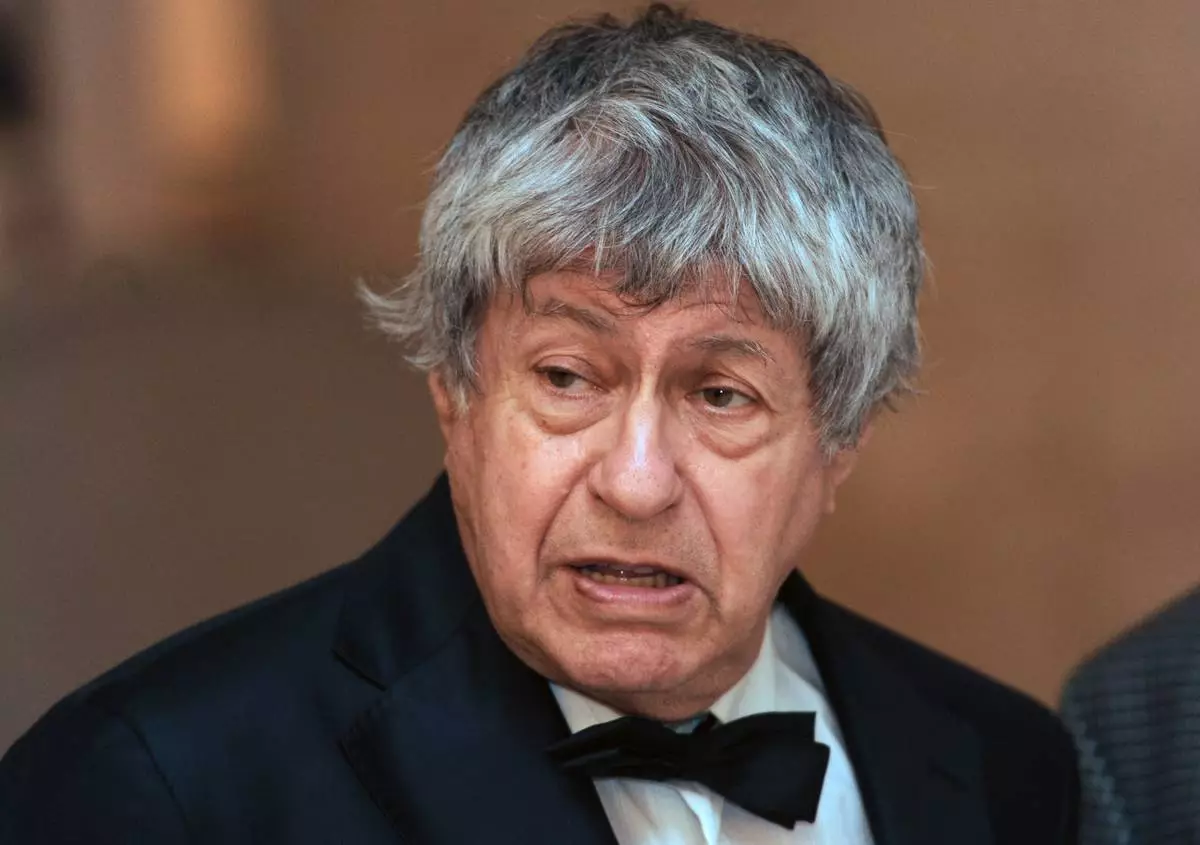
Czech author Ivan Klima is pictured after receiving the Ferdinand Peroutka Journalism Prize in Prague, Czech Republic, on Feb. 6, 2014. (Michal Dolezal/CTK via AP)

Czech author Ivan Klima is pictured after receiving the Ferdinand Peroutka Journalism Prize in Prague, Czech Republic, on Feb. 6, 2014. (Michal Dolezal/CTK via AP)

CAIRO (AP) — Palestinian President Mahmoud Abbas turns 90 on Saturday, still holding authoritarian power in tiny pockets of the West Bank, but marginalized and weakened by Israel, deeply unpopular among Palestinians, and struggling for a say in a postwar Gaza Strip.

The world’s second-oldest serving president — after Cameroon’s 92-year-old Paul Biya — Abbas has been in office for 20 years, and for nearly the entire time has failed to hold elections. His weakness has left Palestinians leaderless, critics say, at a time when they face an existential crisis and hopes for establishing a Palestinian state, the centerpiece of Abbas’ agenda, appear dimmer than ever.

Palestinians say Israel’s campaign against Hamas that has decimated Gaza amounts to genocide. Israel denies the accusation and has tightened its lock on the West Bank, where Jewish settlements are expanding and attacks by settlers on Palestinians are increasing. Right-wing allies of Israeli Prime Minister Benjamin Netanyahu are pressing for outright annexation, a step that would doom any remaining possibility for statehood.

For now, the U.S. has bent to Israel’s refusal to allow Abbas’ Palestinian Authority to govern postwar Gaza. With no effective leader, critics fear Palestinians in the territory will be consigned to live under an international body dominated by Israel’s allies, with little voice and no real path to statehood.

Abbas “has put his head in the sand and has taken no initiative,” said Khalil Shikaki, head of the People’s Company for Polls and Survey Research, a Palestinian pollster.

“His legitimacy was depleted long ago," Shikaki told The Associated Press. "He has become a liability to his own party, and for the Palestinians as a whole.”

Within the pockets of the West Bank that it administers, the PA is notorious for corruption. Abbas rarely leaves his headquarters in the city of Ramallah, except to travel abroad. He limits decision-making to his tight inner circle, including Hussein al-Sheikh, a longtime confidant whom he named as his designated successor in April.

An October poll by Shikaki’s organization found that 80% of Palestinians in the West Bank and Gaza want Abbas to resign. Only a third want the PA to have full or shared governance of the Gaza Strip. The survey of 1,200 people had a margin of error of 3.5 percentage points.

It’s a long way from 20 years ago, when Abbas was elected president after the death of Palestinian leader Yasser Arafat amid hopes he could negotiate an independent state.

The first blow came in 2007, when Hamas drove the PA out of the Gaza Strip in a violent takeover. Hamas’ rule entrenched a split between Gaza and the West Bank, the Israeli-occupied territories that the Palestinians seek for a state.

Abbas was left in charge of pockets around the West Bank’s main population centers. But his power is crippled because Israel has a chokehold on the economy, controlling the West Bank’s resources, most of its land and its access to the outside world.

Netanyahu, who took power in 2009, rejects the creation of a Palestinian state. His “strategy from Day 1” has been to weaken the PA, said Ehud Olmert, who preceded Netanyahu as prime minister and perhaps came the closest to reaching a peace deal with Abbas shortly before being forced from office.

Netanyahu’s aim, Olmert said, is to “prevent any genuine chance to come along with some compromise that could have been implemented into a historical agreement.”

The campaign of weakening the PA comes even though Abbas has abided by a major role demanded by Israel and the international community: security cooperation with Israel. The PA trades intelligence with Israel on militants and often cracks down on armed groups.

To many Palestinians, that makes the PA a subcontractor of the occupation, suppressing opponents while Israel swallows up an increasing amount of the West Bank.

“It has chosen to put itself hand-in-hand with the Israeli occupation, even as (Israel) acts to make it more fragile and weaker,” said Abdaljawad Omar, an assistant professor of philosophy and cultural studies at the West Bank’s Bir Zeit University.

Netanyahu frequently accuses Abbas of not genuinely seeking peace and of inciting violence against Israel. Netanyahu's government has repeatedly withheld transfers of tax money that Israel collects for the PA, because of stipends paid to families of those imprisoned or killed by Israel.

Despite reforms to the stipend system, Israel is withholding some $3 billion, according to the PA. That has worsened an ongoing economic crisis in the West Bank.

Israel’s campaign against the PA is “pushing it to the edge of collapse,” said Ghassan Khatib, who was Palestinian planning minister under Abbas in 2005-06.

Khatib defended what Abbas’ supporters call his policy of “practical realism." By working to prevent violence, Abbas has stayed credible on the international stage, he said, trying to build international backing and winning official recognition of a Palestinian state by a growing list of countries.

But that hasn’t brought any successful pressure from the U.S. or Europe against Israel to stop settlement expansion or reach a peace deal.

At a time when Israel's far right is pushing for “the eradication of the Palestinians,” Omar said, Abbas' pragmatic realism is “a form of national suicide.”

Fearing rivals, Abbas has prevented widescale participation in government, alternative leadership or popular movements even for significant non-violent resistance or civil disobedience against Israel, he said.

“Politics has been removed as a way for young people to engage, to stand against occupation,” said Omar, who was 17 when Abbas came to office.

Shikaki said Abbas' inaction only fuels support for Hamas, which portrayed its Oct. 7, 2023, attack on southern Israel as aimed at ending Israel’s occupation.

Even if some Palestinians believe the attack was disastrous, “they see Hamas as trying to do something on behalf of the Palestinian people," he said. "They see Abbas is doing nothing.”

U.S. President Donald Trump's plan calls for an international council to run the Gaza Strip after Hamas is removed, with a Palestinian administration carrying out day-to-day services. It holds out the possibility of the PA taking control if it carries out unspecified reforms to the council’s satisfaction.

Abbas has made some gestures toward change.

He has promised legislative and presidential elections within a year after the war in Gaza ends. This week, meeting with French President Emmanuel Macron, he announced a Palestinian-French commission to draw up a new constitution. In a high-profile move against corruption, the transport minister was removed in October and put under investigation on allegations of bribery, according to local media.

Palestinians are skeptical. In the PCPSR poll, 60% of respondents said they doubted Abbas will hold elections. It found that if a vote were held, the clear winner would be Marwan Barghouti, a senior figure from Abbas’ Fatah faction imprisoned by Israel since 2002. Abbas would come a distant third behind any Hamas candidate.

Ines Abdel Razak, co-director of Palestine Institute for Public Diplomacy advocacy group, said the U.S. and Israel don't have an interest in real democratization..

“That would mean all Palestinians would actually have a voice,” she said. “Any effective ruler would confront the Israeli occupation.”

Khatib said Israel will likely be able to keep the PA out of Gaza, since uniting it with the West Bank would only boost Palestinian demands for statehood.

“Israel is the party that is calling the shots on the ground,” he said.

AP correspondent Josef Federman in Jerusalem contributed.

FILE.- President Donald Trump greets Palestinian President Mahmoud Abbas during a summit to support ending the more than two-year Israel-Hamas war in Gaza after a breakthrough ceasefire deal, Monday, Oct. 13, 2025, in Sharm El Sheikh, Egypt. (AP Photo/Evan Vucci, File)

FILE.- President Donald Trump greets Palestinian President Mahmoud Abbas during a summit to support ending the more than two-year Israel-Hamas war in Gaza after a breakthrough ceasefire deal, Monday, Oct. 13, 2025, in Sharm El Sheikh, Egypt. (AP Photo/Evan Vucci, File)

FILE.- Palestinians chant national slogans and carry posters with pictures of President Mahmoud Abbas and read "you kept your promise," during a rally in support for Gaza and celebrating the latest western nations recognitions of the Palestinian state ahead of the United Nations General Assembly meetings, in the West Bank city of Ramallah Tuesday, Sept. 23, 2025. (AP Photo/Nasser Nasser,File)

FILE.- Palestinians chant national slogans and carry posters with pictures of President Mahmoud Abbas and read "you kept your promise," during a rally in support for Gaza and celebrating the latest western nations recognitions of the Palestinian state ahead of the United Nations General Assembly meetings, in the West Bank city of Ramallah Tuesday, Sept. 23, 2025. (AP Photo/Nasser Nasser,File)

FILE - Interim Palestinian leader Mahmoud Abbas, is carried by the Al Aqsa Martyrs' Brigades leader in West Bank, Zakaria Zubeidi, center left, during a campaign visit to the Jenin refugee camp Dec. 30, 2004.(AP Photo/Enric Marti, File)

FILE - Interim Palestinian leader Mahmoud Abbas, is carried by the Al Aqsa Martyrs' Brigades leader in West Bank, Zakaria Zubeidi, center left, during a campaign visit to the Jenin refugee camp Dec. 30, 2004.(AP Photo/Enric Marti, File)

FILE.- Palestinian leader Yasser Arafat makes the victory sign as he leaves the confidence vote session of the Palestinian Legislative Council accompanied by Prime Minister-designate Mahmoud Abbas, right, at his headquarters in the West Bank town of Ramallah Tuesday, April 29, 2003. (AP Photo/Ricardo Mazalan, File)

FILE.- Palestinian leader Yasser Arafat makes the victory sign as he leaves the confidence vote session of the Palestinian Legislative Council accompanied by Prime Minister-designate Mahmoud Abbas, right, at his headquarters in the West Bank town of Ramallah Tuesday, April 29, 2003. (AP Photo/Ricardo Mazalan, File)

FILE.- Interim Palestinian leader and the front-runner in the upcoming Jan. 9, 2005 presidential election Mahmoud Abbas talks during his first official campaign speech in the West Bank town of Ramallah, Saturday Dec. 25, 2004.(AP Photo/Nasser Nasser, File)

FILE.- Interim Palestinian leader and the front-runner in the upcoming Jan. 9, 2005 presidential election Mahmoud Abbas talks during his first official campaign speech in the West Bank town of Ramallah, Saturday Dec. 25, 2004.(AP Photo/Nasser Nasser, File)

Recommended Articles