Skip to Content Facebook Feature Image

Journalists work in dire conditions to tell Gaza's story, knowing that could make them targets

ENT

Journalists work in dire conditions to tell Gaza's story, knowing that could make them targets
ENT

ENT

Journalists work in dire conditions to tell Gaza's story, knowing that could make them targets

2025-10-05 02:11 Last Updated At:02:20

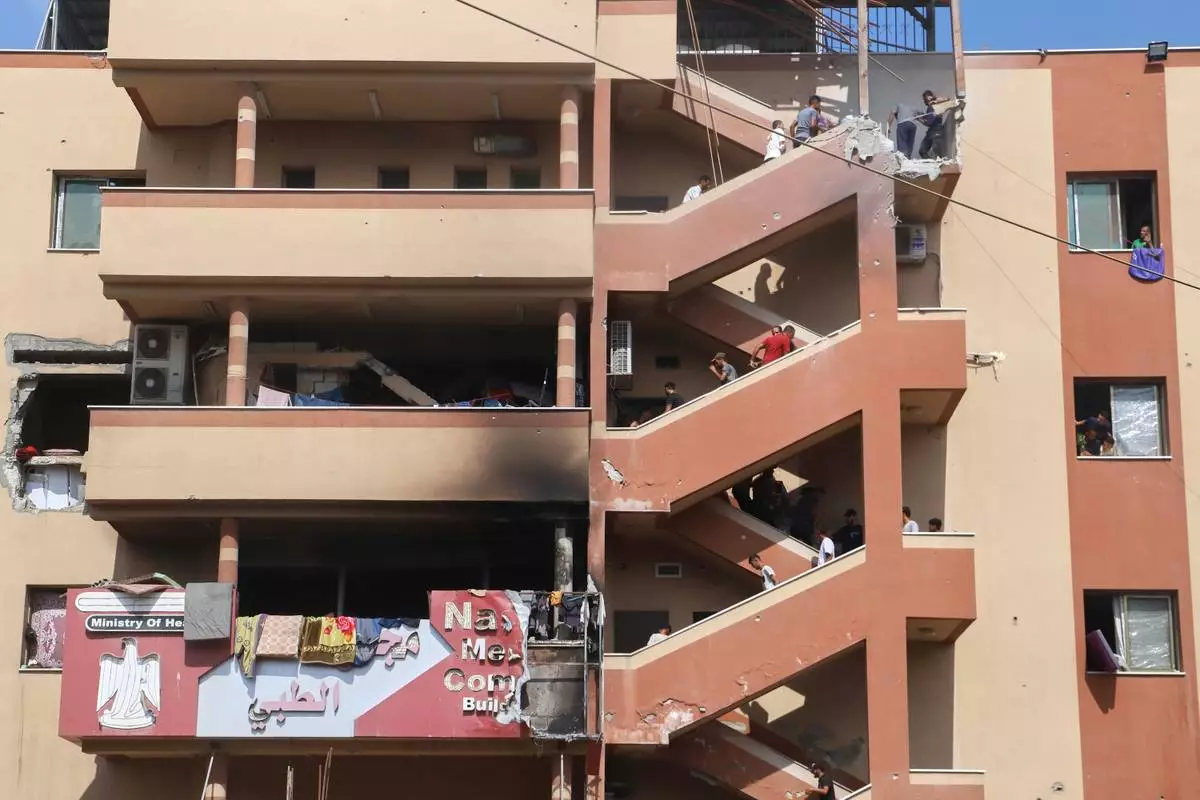
BEIRUT (AP) — Minutes after journalists gathered outside a Gaza hospital to survey the damage of an Israeli strike, Ibrahim Qannan pointed his camera up at the battered building as the others climbed its external stairs. Then Qannan watched in horror — while broadcasting live — as a second strike killed the friends and colleagues he knew so well.

“We live side by side with death,” Qannan, a correspondent for the Cairo-based Al-Ghad TV said in an interview.

More Images
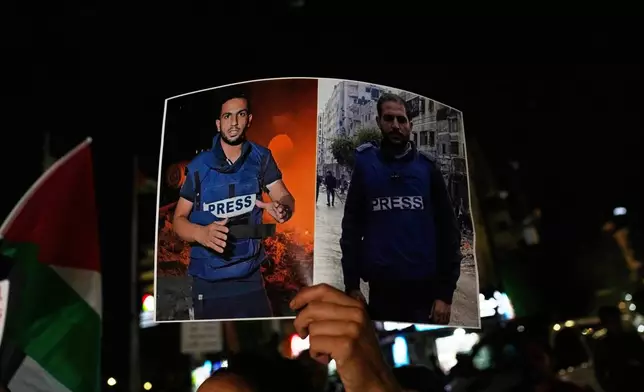
FILE - A woman holds a poster showing Palestinian journalists Anas al-Sharif, left, and Mohamed Qreiqeh, during a protest in the West Bank city of Ramallah Monday, Aug. 11, 2025, after they were killed in an Israeli airstrike late Sunday in Gaza. (AP Photo/Nasser Nasser, File)
FILE - A woman holds a poster showing Palestinian journalists Anas al-Sharif, left, and Mohamed Qreiqeh, during a protest in the West Bank city of Ramallah Monday, Aug. 11, 2025, after they were killed in an Israeli airstrike late Sunday in Gaza. (AP Photo/Nasser Nasser, File)

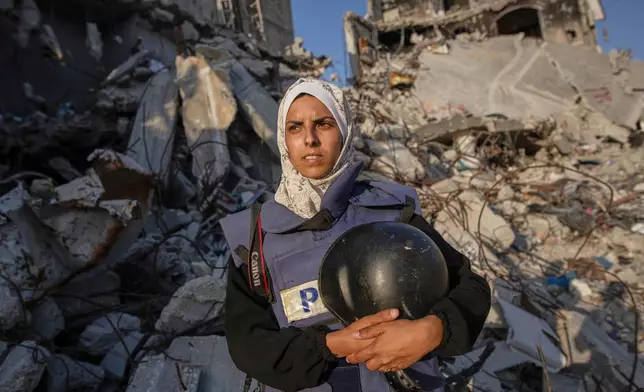
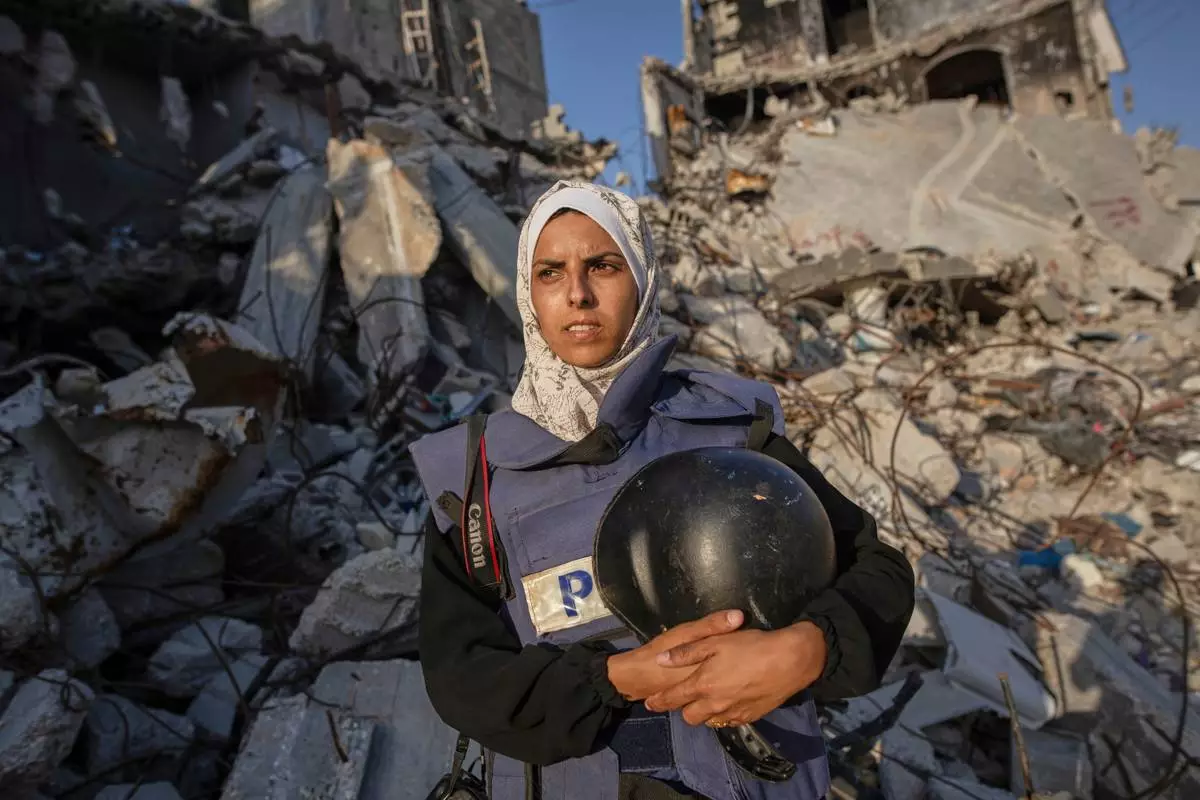
FILE - Freelance journalist Mariam Dagga, 33, who had been working with the Associated Press and other outlets during the Gaza war, poses for a portrait in Khan Younis, southern Gaza Strip, on June 14, 2024. (AP Photo/Jehad Alshrafi, File)
FILE - Freelance journalist Mariam Dagga, 33, who had been working with the Associated Press and other outlets during the Gaza war, poses for a portrait in Khan Younis, southern Gaza Strip, on June 14, 2024. (AP Photo/Jehad Alshrafi, File)

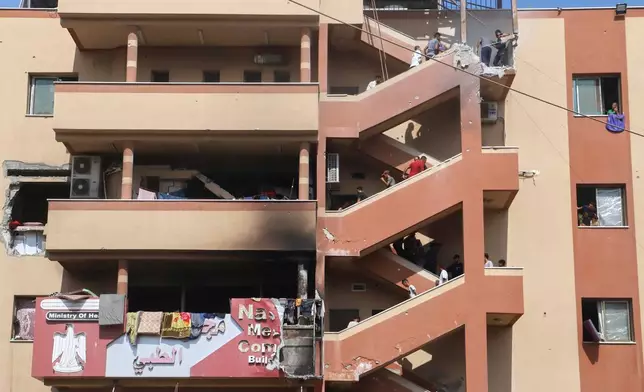
FILE - People walk up stairs to the site of an Israeli strike at Nasser Hospital, minutes before a second round of strikes hit the same spot in Khan Younis, Gaza Strip, Monday, Aug. 25, 2025. This was one of the last photos taken by journalist Mariam Dagga, who freelanced for The Associated Press and other outlets, before she walked to the site and was killed. (AP Photo/Mariam Dagga, File)
FILE - People walk up stairs to the site of an Israeli strike at Nasser Hospital, minutes before a second round of strikes hit the same spot in Khan Younis, Gaza Strip, Monday, Aug. 25, 2025. This was one of the last photos taken by journalist Mariam Dagga, who freelanced for The Associated Press and other outlets, before she walked to the site and was killed. (AP Photo/Mariam Dagga, File)

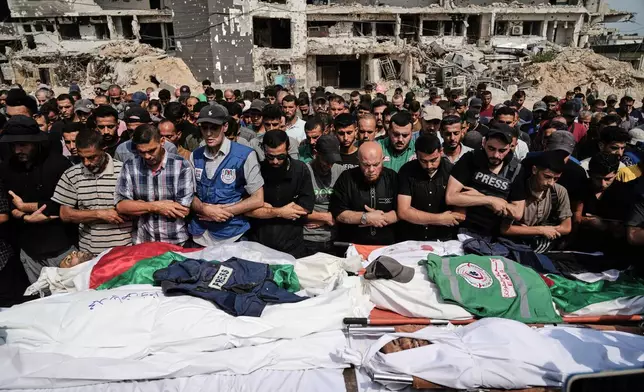
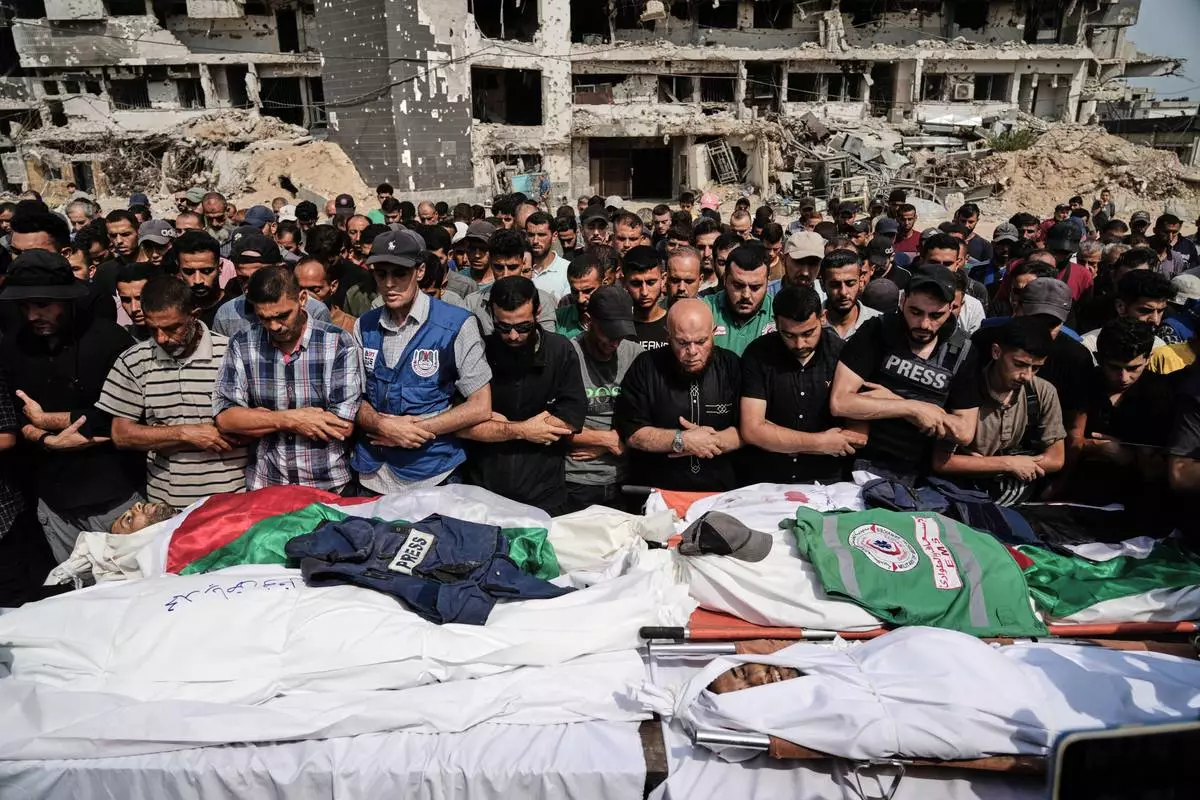
FILE - Palestinians pray over the bodies of journalists, including Al Jazeera correspondents Anas al-Sharif and Mohamed Qreiqeh, who were killed in an Israeli airstrike, during their funeral outside Gaza City's Shifa hospital complex, Monday, Aug. 11, 2025. (AP Photo/Jehad Alshrafi, File)

FILE - Palestinians pray over the bodies of journalists, including Al Jazeera correspondents Anas al-Sharif and Mohamed Qreiqeh, who were killed in an Israeli airstrike, during their funeral outside Gaza City's Shifa hospital complex, Monday, Aug. 11, 2025. (AP Photo/Jehad Alshrafi, File)

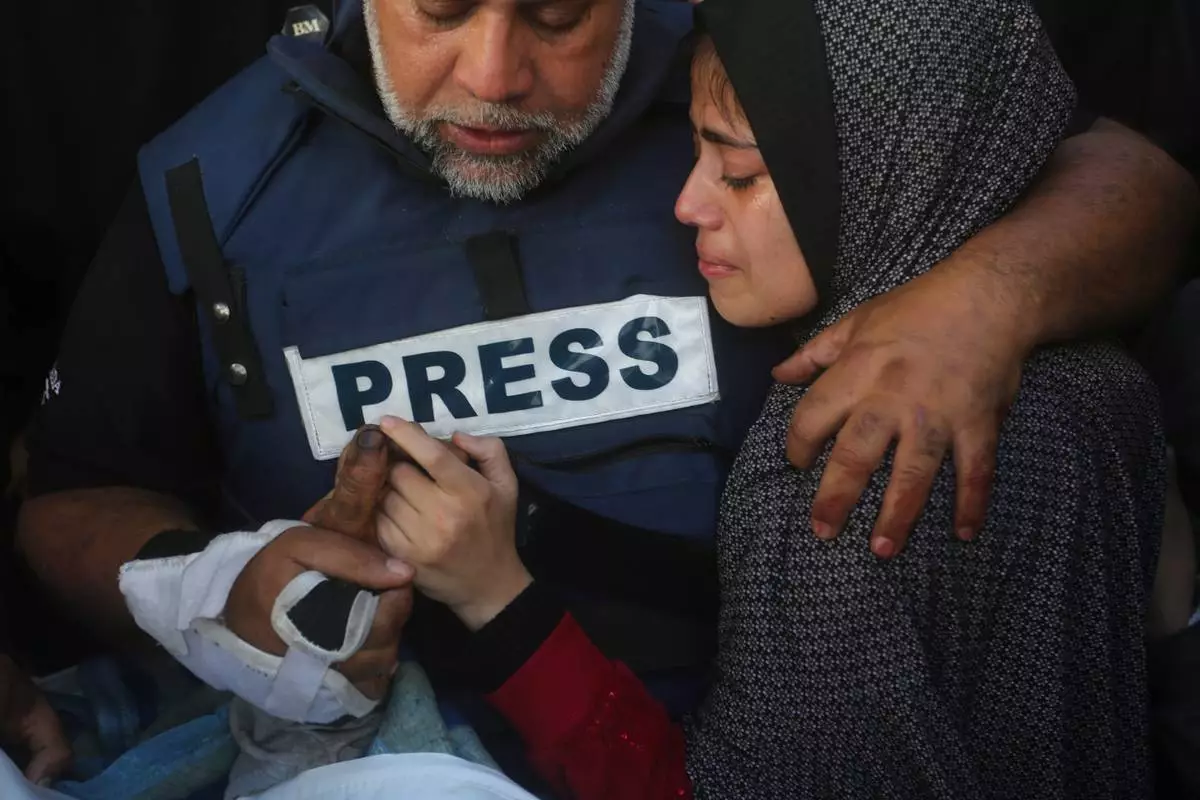
FILE - Al Jazeera journalist Wael Dahdouh holds the hand of his son, Hamza, who also worked for Al Jazeera and was killed in an Israeli airstrike, in Rafah, Gaza Strip, Jan. 7, 2024. (AP Photo/Hatem Ali, File)
FILE - Al Jazeera journalist Wael Dahdouh holds the hand of his son, Hamza, who also worked for Al Jazeera and was killed in an Israeli airstrike, in Rafah, Gaza Strip, Jan. 7, 2024. (AP Photo/Hatem Ali, File)

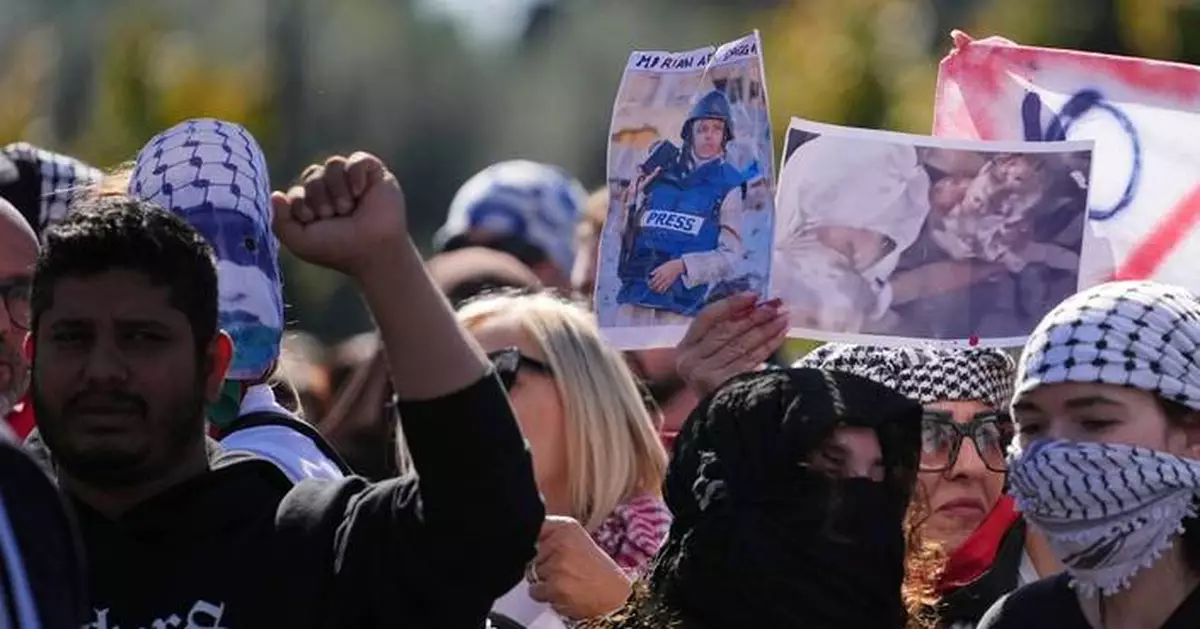
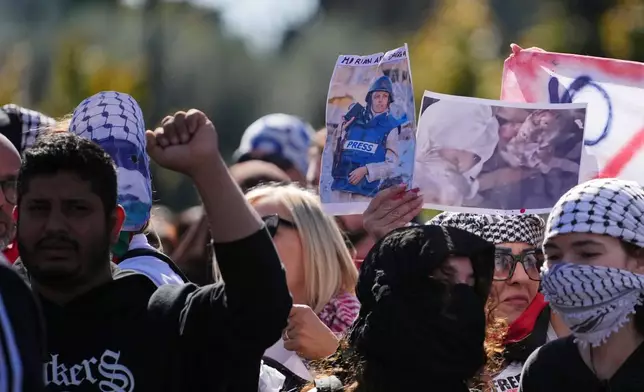
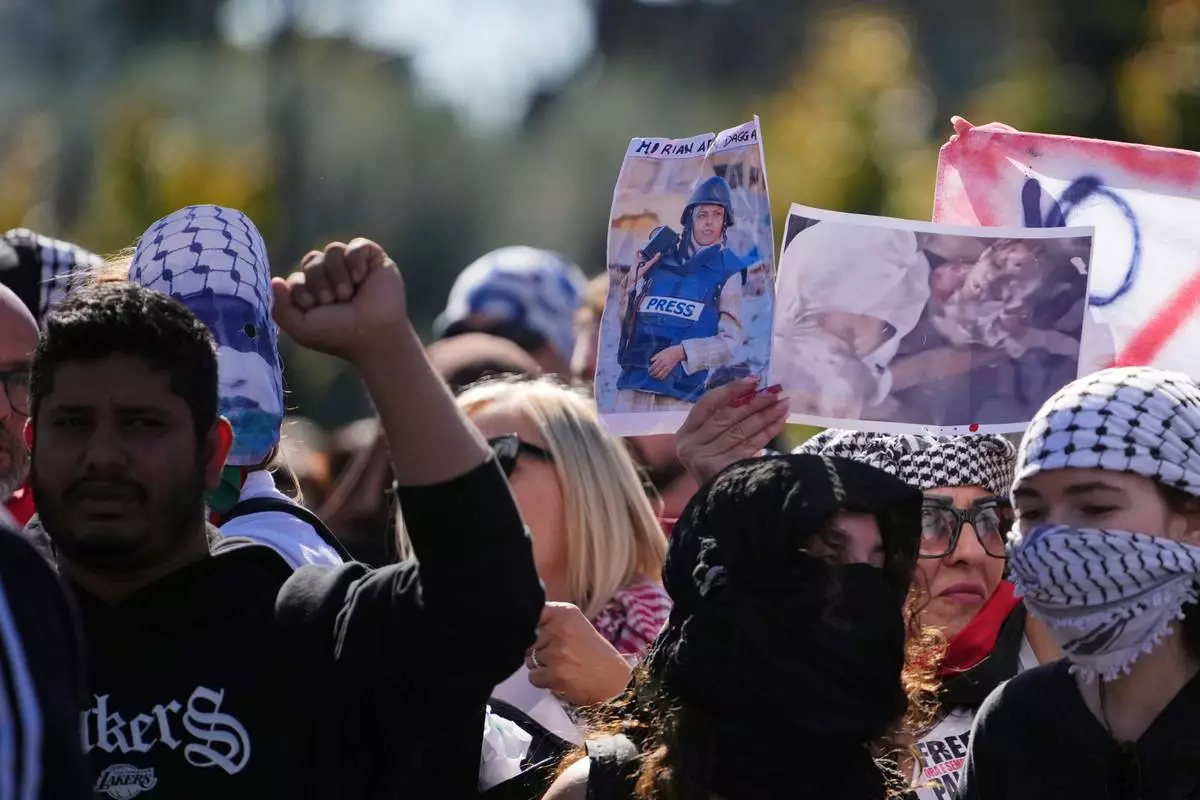
Pro Palestinian demonstrators hold up a photograph of Mariam Dagga, a visual journalist who freelanced for The Associated Press, killed in an Israeli strike in August, as they march during a national demonstration in support of the population of Gaza, in Rome, Saturday, Oct. 4, 2025. (AP Photo/Alessandra Tarantino)

Pro Palestinian demonstrators hold up a photograph of Mariam Dagga, a visual journalist who freelanced for The Associated Press, killed in an Israeli strike in August, as they march during a national demonstration in support of the population of Gaza, in Rome, Saturday, Oct. 4, 2025. (AP Photo/Alessandra Tarantino)

“I still cannot believe that five of our colleagues were struck in front of me on camera and I try to hold up and look strong to carry the message. May no one feel such feelings. They are painful feelings.”

The deaths of the five journalists in the Aug. 25 strikes on Nasser Hospital add to a toll of nearly 200 news workers killed by Israeli forces while working to bring Gaza’s story to the world. Those killed in the attack, which left a total of 22 people dead, included Mariam Dagga, 33, a visual journalist who freelanced for The Associated Press and other outlets.

Like the vast majority of Gaza’s population, most of its journalists have seen their homes destroyed or damaged during the war and have been repeatedly displaced after evacuation orders by Israel’s military. Many have mourned the deaths of family members.

But journalists and advocates say the trials go well beyond. Every workday, they say, is shadowed by an awareness that covering the news in Gaza makes them singularly visible in the conflict, putting them at extraordinary risk.

For journalists in Gaza, “it’s about dying or living, escaping violence or not. It’s something we cannot compare (to other wartime journalism) at any level,” said Mohamed Salama, a former reporter in Egypt who is now an academic, researching the life of news workers in the Strip.

After the August strikes, Israeli Prime Minister Benjamin Netanyahu insisted that the military was not deliberately targeting journalists and called the killings a “tragic mishap.” After a preliminary review, the military said the attack had targeted what it believed to be a Hamas surveillance camera and that six of the people killed were militants, but offered no evidence.

Late last month, the AP and Reuters — which lost a cameraman and a freelancer in the attack on the hospital — demanded that Israel provide a full account of what happened and “take every step to protect those who continue to cover this conflict.” The news organizations issued their statement on the one-month anniversary of the strikes.

Israeli officials have previously accused some journalists in Gaza of being current or former militants. They include Anas al-Sharif, a well-known correspondent for Al Jazeera who was killed in an early August strike on a media tent outside another Gaza hospital. Four other journalists were also killed in the attack.

The Israeli military, citing documents it purportedly found in Gaza, as well as other intelligence, had long claimed that al-Sharif was a member of Hamas. He was killed after what press advocates said was an Israeli “smear campaign” stepped up when al-Sharif cried on air over starvation in the territory.

There is a long, sometimes tragic history of journalists risking personal safety to cover conflicts. But the risks, trials and toll of doing so have never been higher than they are in Gaza right now, experts say.

Since the war was ignited by the Hamas attack on Israel nearly two years ago, 195 Palestinian media workers have been killed by Israeli forces in Gaza, according to the Committee to Protect Journalists.

The toll recently prompted Brown University’s Costs of War project to label Gaza a “news graveyard.” Journalist deaths in Gaza have now surpassed the combined number killed during the U.S. Civil War, World Wars I and II, the Vietnam and Korean wars, the war in Yugoslavia that ended in 2001 and the Afghanistan War, the project said in a report issued earlier this year.

In a separate survey of Gaza news workers last year by Arab Reporters for Investigative Journalism, nine in 10 said their homes had been destroyed in the war. About one in five said they had been injured and about the same number had lost family members. That was before Israel resumed fighting in March after a brief ceasefire.

One Gaza journalist, Nour Swirki, told the AP in an interview that since her home was destroyed early in the war she has been displaced seven times. Swirki and her husband, who is also a journalist, arranged for their son and daughter to exit Gaza in 2024 and stay with family in Egypt while the couple continued to work.

“I preferred their safety to my motherhood,” said Swirki, who works for the Saudi-based Asharq News and was a friend of Dagga's.

“Death is there (in Gaza) every moment, every second and everywhere,” Swirki said. She is reminded of that reality whenever she skims through photos and videos stored on her phone and is met by the faces and voices of the many colleagues and friends who have been killed in the war.

“We get afraid and terrified and we work under the harshest conditions," she said, "but we still stand up and work.”

Qannan, who saw his colleagues killed in the August strike, said Israel’s refusal to let foreign reporters enter Gaza puts tremendous pressure on local journalists, many of whom see their work as a duty to their fellow Palestinians.

He recounted working without a break since the war’s start, grabbing sleep between live broadcasts. His family has been displaced seven times. Now he and other journalists struggle to find food. In a recent social media post, he and fellow journalists gathered to cook a kilogram (2.2 pounds) of pasta that had cost them the equivalent of $60.

Yet when he goes on camera, Qannan said he makes an effort to appear strong in hopes of reassuring viewers. In fact, he and others journalists are exhausted and scared, he said.

Qannan says his fears have increased since he aired video of his colleagues being killed in the hospital attack, because it could draw the attention of the Israeli military. “The situation is terrifying more than the human brain can imagine,” he said. “The fear that we are living and fear of being targeted are worse than is being described.”

Another Gaza journalist, Mohammed Subeh, said the Israeli strike that killed the Al Jazeera reporter earlier in August left him with shrapnel lodged in his back and an injury to his foot. But hospitals are so overwhelmed with critical cases that he’s been unable to get treatment.

“A journalist in Gaza lives between covering the war on the ground, following the news and at the same time trying to take care of his safety and the safety of his family,” said Subeh, who reports for Al-Ekhbariya, a Saudi Arabian news channel.

Salama, who together with colleagues interviewed more than 20 Gaza journalists for their academic research, said that unlike foreign correspondents covering a war, Palestinian reporters have experienced decades of conflict firsthand. That experience makes them uniquely capable of telling Gaza’s story, he said — but they can never step away from it.

“You don’t have the luxury to break your soul away from what is happening on the ground,” said Salama, now a doctoral student at the University of Maryland.

Subeh, who works for the Saudi news channel, said he’d thought repeatedly of quitting and trying to flee. But, despite the extreme difficulties and dangers, he can’t bring himself to do it.

“I feel that my presence here is important and that the voice of Gaza should be sent to the world from its own residents,” he said. “Journalism is not only a job for me, but a mission.”

Mroue reported from Beirut and Geller from New York.
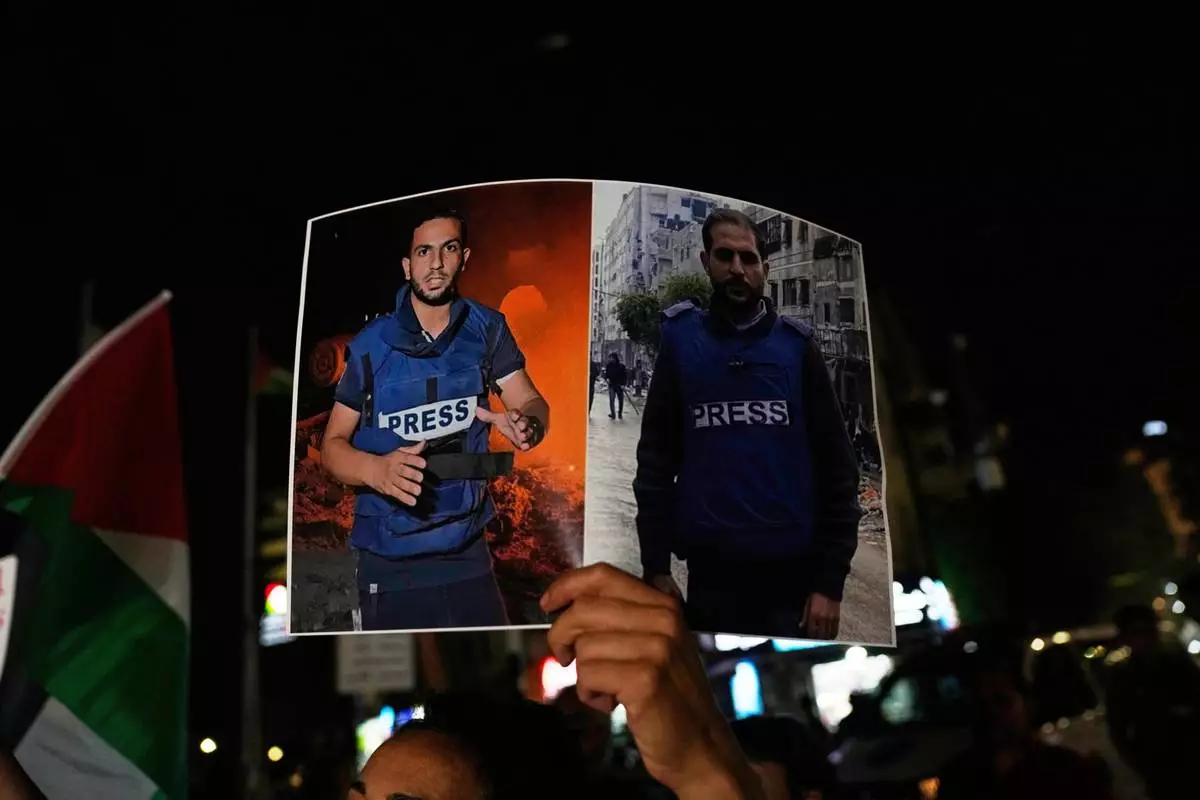
FILE - A woman holds a poster showing Palestinian journalists Anas al-Sharif, left, and Mohamed Qreiqeh, during a protest in the West Bank city of Ramallah Monday, Aug. 11, 2025, after they were killed in an Israeli airstrike late Sunday in Gaza. (AP Photo/Nasser Nasser, File)
FILE - A woman holds a poster showing Palestinian journalists Anas al-Sharif, left, and Mohamed Qreiqeh, during a protest in the West Bank city of Ramallah Monday, Aug. 11, 2025, after they were killed in an Israeli airstrike late Sunday in Gaza. (AP Photo/Nasser Nasser, File)

FILE - Freelance journalist Mariam Dagga, 33, who had been working with the Associated Press and other outlets during the Gaza war, poses for a portrait in Khan Younis, southern Gaza Strip, on June 14, 2024. (AP Photo/Jehad Alshrafi, File)
FILE - Freelance journalist Mariam Dagga, 33, who had been working with the Associated Press and other outlets during the Gaza war, poses for a portrait in Khan Younis, southern Gaza Strip, on June 14, 2024. (AP Photo/Jehad Alshrafi, File)

FILE - People walk up stairs to the site of an Israeli strike at Nasser Hospital, minutes before a second round of strikes hit the same spot in Khan Younis, Gaza Strip, Monday, Aug. 25, 2025. This was one of the last photos taken by journalist Mariam Dagga, who freelanced for The Associated Press and other outlets, before she walked to the site and was killed. (AP Photo/Mariam Dagga, File)
FILE - People walk up stairs to the site of an Israeli strike at Nasser Hospital, minutes before a second round of strikes hit the same spot in Khan Younis, Gaza Strip, Monday, Aug. 25, 2025. This was one of the last photos taken by journalist Mariam Dagga, who freelanced for The Associated Press and other outlets, before she walked to the site and was killed. (AP Photo/Mariam Dagga, File)

FILE - Palestinians pray over the bodies of journalists, including Al Jazeera correspondents Anas al-Sharif and Mohamed Qreiqeh, who were killed in an Israeli airstrike, during their funeral outside Gaza City's Shifa hospital complex, Monday, Aug. 11, 2025. (AP Photo/Jehad Alshrafi, File)
FILE - Palestinians pray over the bodies of journalists, including Al Jazeera correspondents Anas al-Sharif and Mohamed Qreiqeh, who were killed in an Israeli airstrike, during their funeral outside Gaza City's Shifa hospital complex, Monday, Aug. 11, 2025. (AP Photo/Jehad Alshrafi, File)

FILE - Al Jazeera journalist Wael Dahdouh holds the hand of his son, Hamza, who also worked for Al Jazeera and was killed in an Israeli airstrike, in Rafah, Gaza Strip, Jan. 7, 2024. (AP Photo/Hatem Ali, File)
FILE - Al Jazeera journalist Wael Dahdouh holds the hand of his son, Hamza, who also worked for Al Jazeera and was killed in an Israeli airstrike, in Rafah, Gaza Strip, Jan. 7, 2024. (AP Photo/Hatem Ali, File)

Pro Palestinian demonstrators hold up a photograph of Mariam Dagga, a visual journalist who freelanced for The Associated Press, killed in an Israeli strike in August, as they march during a national demonstration in support of the population of Gaza, in Rome, Saturday, Oct. 4, 2025. (AP Photo/Alessandra Tarantino)
Pro Palestinian demonstrators hold up a photograph of Mariam Dagga, a visual journalist who freelanced for The Associated Press, killed in an Israeli strike in August, as they march during a national demonstration in support of the population of Gaza, in Rome, Saturday, Oct. 4, 2025. (AP Photo/Alessandra Tarantino)
MEXICO CITY (AP) — The almighty eagle perched on a cactus while devouring a serpent on Mexico’s flag hints at the myth behind the foundation of the country’s capital.

It's a divine sign in an ancient legend, according to which the god Huitzilopochtli asked a group called the Mexica — who founded what was later known as the Aztec Empire — to leave their homeland in search of a place to establish a new city.

It took some 175 years before they spotted the sacred omen and established the city of Tenochtitlan in 1325 where Mexico City stands today.

How the eagle, the cactus and the serpent became an emblem and endured through the European conquest is the focus of a new exhibition. “A coat of arms, an emblem, a symbol of identity,” runs through Dec. 15 at the Old City Hall in downtown Mexico City.

The exhibit is among the government’s activities marking the 700th anniversary of the founding of the Mexica capital.

“Recognizing Tenochtitlan doesn’t mean recalling a dead past, but rather the living heartbeat that still beats beneath our city,” President Claudia Sheinbaum said during an official ceremony in July. “It was the center of an Indigenous world that built its own model of civilization — one in harmony with the Earth, the stars, and its gods and goddesses.”

Fragments of that civilization lie underneath the Old City Hall, the current seat of Mexico City’s government.

Built by order of Spanish conqueror Hernán Cortés in 1522, its construction used stones from ancient Mexica sacred sites. The building has been renewed over time, but its halls have witnessed centuries of governance and symbolism.

“Holding the exhibition in this City Hall, a place of decisions and memory, is a way to recognize the history of those who once inhabited it and how its transformations still echo in Mexico City’s identity,” said Mariana Gómez Godoy, Director of Mexico City’s Cultural Heritage, during the exhibit’s inauguration in November.

The Mexica themselves recorded their story after Tenochtitlan fell to the Europeans. Several codices depict the path that led them to fulfill their deity’s task.

Eduardo Matos Moctezuma — an acclaimed archaeologist from Mexico’s National Institute of Anthropology and History — has argued that the legend is a symbolic retelling of historical events, rather than a literal claim about divine prophecy.

Still, according to the Templo Mayor Museum, the region's pre-Hispanic people preserved the origin story of a long journey that led to the founding of Tenochtitlan as a cornerstone of their traditions.

They honored a small island in Lake Texcoco, now central Mexico City, as the place where the Mexica found the eagle foretold by Huitzilopochtli.

The new exhibit offers a historical overview of how the image evolved — from its establishment as the city’s coat of arms in 1523 under Emperor Charles V to its transformation into an emblem of Mexico as an independent nation.

Curated by researcher Guadalupe Lozada, it also displays images portraying how it was adopted by the religious orders in charge of converting the Indigenous people to Catholicism.

While the eagle and cactus were already adopted by Europeans in the mid-16th century, the Jesuits introduced the serpent decades later. “From then on, it would remain a symbol of the city’s identity — one that would also spread throughout the rest of New Spain,” Lozada said.

According to her, plenty of monasteries dating back to the 17th century attest to how friars displayed the eagle and cactus in their sanctuaries. Even today, the emblem can still be seen above the façade of Mexico City’s cathedral and inside one of its chapels.

“Such was the strength of Mexica culture that the evangelizers sought to adopt it rather than exclude it,” she said. “It was like saying, ‘I acknowledge your history.’”

The same logic applied with the European conquerors. Even as they ordered the destruction of the Mexica religious complexes, the representation of the foundational myth was not erased from history.

“For them, conquering a city like Tenochtitlan was a matter of pride and therefore they never intended to deny its existence,” Lozada said. “This meant that the strength of the city buried beneath the new one underlies it and resurfaces — as if it had never disappeared.”

Associated Press religion coverage receives support through the AP’s collaboration with The Conversation US, with funding from Lilly Endowment Inc. The AP is solely responsible for this content.

Protesters gather in front of the Legislative Palace of San Lazaro in Mexico City, where the Mexican coat of arms is visible on the building's façade, Thursday, Nov. 13, 2025. (AP Photo/Claudia Rosel)

Protesters gather in front of the Legislative Palace of San Lazaro in Mexico City, where the Mexican coat of arms is visible on the building's façade, Thursday, Nov. 13, 2025. (AP Photo/Claudia Rosel)

People sit on benches in Plaza del Aguilita, where the evolution of the Mexican coat of arms is showcased, Mexico City, Thursday, Nov. 13, 2025. (AP Photo/Claudia Rosel)

People sit on benches in Plaza del Aguilita, where the evolution of the Mexican coat of arms is showcased, Mexico City, Thursday, Nov. 13, 2025. (AP Photo/Claudia Rosel)

The entrance of Mexico City's National Museum of Anthropology features Mexico's national emblem on its façade, Friday, Nov. 14, 2025. (AP Photo/Claudia Rosel)

The entrance of Mexico City's National Museum of Anthropology features Mexico's national emblem on its façade, Friday, Nov. 14, 2025. (AP Photo/Claudia Rosel)

The Teocalli of the Sacred War, the only archaeological piece bearing the carved symbol of Tenochtitlan's founding, an eagle perched on a cactus, is on display at the National Museum of Anthropology in Mexico City, Friday, Nov. 14, 2025. (AP Photo/Claudia Rosel)

The Teocalli of the Sacred War, the only archaeological piece bearing the carved symbol of Tenochtitlan's founding, an eagle perched on a cactus, is on display at the National Museum of Anthropology in Mexico City, Friday, Nov. 14, 2025. (AP Photo/Claudia Rosel)

People at the square of Aguilita in Mexico City walk past a central sculpture depicting Mexico's coat of arms which shows an eagle perched on a cactus devouring a rattlesnake, Thursday, Nov. 13, 2025. (AP Photo/Claudia Rosel)

People at the square of Aguilita in Mexico City walk past a central sculpture depicting Mexico's coat of arms which shows an eagle perched on a cactus devouring a rattlesnake, Thursday, Nov. 13, 2025. (AP Photo/Claudia Rosel)

Rosalba Sanchez Flores, a historian at the National Museum of Anthropology in Mexico City, points to the details of Mexico's coat of arms as depicted in the Codex Mendoza, Friday, Nov. 14, 2025. (AP Photo/Claudia Rosel)

Rosalba Sanchez Flores, a historian at the National Museum of Anthropology in Mexico City, points to the details of Mexico's coat of arms as depicted in the Codex Mendoza, Friday, Nov. 14, 2025. (AP Photo/Claudia Rosel)

People sit on benches in Plaza del Aguilita, where the evolution of the Mexican coat of arms is showcased, Mexico City, Thursday, Nov. 13, 2025. (AP Photo/Claudia Rosel)

People sit on benches in Plaza del Aguilita, where the evolution of the Mexican coat of arms is showcased, Mexico City, Thursday, Nov. 13, 2025. (AP Photo/Claudia Rosel)

People sit at a rooftop bar overlooking Mexico City's Fine Arts Palace, where the Mexican coat of arms is visible atop the building's dome, Thursday, Nov. 13, 2025. (AP Photo/Claudia Rosel)

People sit at a rooftop bar overlooking Mexico City's Fine Arts Palace, where the Mexican coat of arms is visible atop the building's dome, Thursday, Nov. 13, 2025. (AP Photo/Claudia Rosel)

Mexico's coat of arms decorates a large flag in the city's Zocalo square, Mexico City, Thursday, Nov. 13, 2025. (AP Photo/Claudia Rosel)

Mexico's coat of arms decorates a large flag in the city's Zocalo square, Mexico City, Thursday, Nov. 13, 2025. (AP Photo/Claudia Rosel)

Recommended Articles