SOUTH BEND, Ind. (AP) — Leonard Moore had two of Notre Dame's four interceptions in his return from injury and the 21st-ranked Fighting Irish beat Boise State 28-7 on Saturday.
CJ Carr was 15-of-23 passing for 189 yards and threw touchdowns to Will Pauling and Malachi Fields.
Moore, a preseason All-America selection at cornerback, missed Notre Dame’s previous two games with a high ankle sprain. Tae Johnson and Luke Talich had the other two interceptions for the Fighting Irish (3-2).
Notre Dame star running back Jeremiyah Love briefly left the game in the first half, but returned and finished with 103 yards rushing and a 4-yard TD run. Jadarian Price rushed for 83 yards and scored on a 49-yard run.
Notre Dame's four picks matched the Fighting Irish total through its first four games.
“To think where that defense was and how they felt two weeks ago, so after week two, A&M, after week three versus Purdue, to think about how … it was a low point for us all," said Notre Dame coach Marcus Freeman, whose team led the nation in takeaways (33) last season.
“And to see the way (the Notre Dame defense) stayed committed, stayed together. They worked tirelessly to come up with a better output. And I’m so proud of them. They worked hard.”
Moore had three career interceptions entering Saturday's game.
“It comes down to technique and practice reps,” Moore said of the interceptions. “It definitely feels good. Seeing anybody get an interception on the team unites the team.
“I feel like we’re just getting our identity, going out there and playing fast, playing violent,” Moore said of the improvement by the Notre Dame defense.
Maddux Madsen, who threw the four picks, scored the lone touchdown for Boise State (3-2) on a 1-yard plunge in the second quarter.
“Early on, we got explosive plays given up on defense,” Boise State coach Spencer Danielson said. “Offensively, we were moving the ball very similar to South Florida (a 34-7 loss), but we shot ourselves in the foot. We get explosive plays, get a penalty. We had four turnovers … you can’t beat hardly any team when you have four turnovers and they have none.”
This was the first football game between Boise State and Notre Dame. The Broncos rank No. 1 in all-time winning percentage in the FBS (76.7%) and the Fighting Irish rank No. 5 (72.5%). Both schools qualified for the College Football Playoff last season, making this matchup the third time two returning CFP participants played the following season in a nonconference game.
Notre Dame’s defense took heat in its first three games for allowing 32.7 points a game. In their last two, the Fighting Irish have held their opponents to 13 points (Arkansas) and now seven.
Notre Dame: The Fighting Irish defense slowed down what had been a high-octane Broncos offense in their past three games. Despite this, the Irish probably will not see much improvement in the AP poll this week.
Boise State: The Broncos hurt themselves with double-digit penalties. They racked up 13 penalties for 112 yards.
Notre Dame hosts N.C. State next Saturday.
Boise State hosts New Mexico next Saturday.
Get poll alerts and updates on the AP Top 25 throughout the season. Sign up here and here (AP News mobile app). AP college football: https://apnews.com/hub/ap-top-25-college-football-poll and https://apnews.com/hub/college-football

Boise State wide receiver Latrell Caples (3) rushes against Notre Dame's Jalen Stroman (7) after catching a pass during the first quarter of an NCAA football game Saturday, Oct. 4, 2025, in South Bend, Ind. (AP Photo/Paul Beaty)
PARK CITY, Utah (AP) — A Utah woman was convicted Monday of aggravated murder after poisoning her husband with fentanyl and self-publishing a children’s book about coping with grief.
Prosecutors say Kouri Richins slipped five times the lethal dose of the synthetic opioid into a cocktail that Eric Richins drank in March 2022 at their home outside the ski town of Park City. They say Richins was $4.5 million in debt and falsely believed that when her husband died, she would inherit his estate worth more than $4 million. They also say she was planning a future with another man she was seeing on the side.
Richins stared at the floor and took deep breaths as the judge read the verdict.
The jury deliberated for less than three hours. Afterward, family members on both sides of the case left the courtroom hugging and crying.
She was also convicted of other felony charges, including an attempted murder charge in what authorities alleged was another effort to poison her husband weeks earlier on Valentine’s Day with a fentanyl-laced sandwich that made him break out in hives and black out. Jurors also found Richins guilty of fraudulently claiming insurance benefits after his death.
Sentencing was scheduled for May 13, the day her husband would have turned 44.
“Honestly I feel like we’re all in shock. It’s been a long time coming,” said Eric Richins' sister, Amy Richin, adding that the family can now focus on honoring her brother and supporting his sons. “So just very happy that we got justice for my brother.”
Richins’ defense attorney said Eric Richins was addicted to painkillers and had asked his wife to procure opioids for him. Kouri Richins, however, told police earlier in a video that her husband had no history of illicit drug use.
“She wanted to leave Eric Richins but did not want to leave his money,” said Summit County prosecutor Brad Bloodworth.
The most serious charge — aggravated murder — carries a sentence of 25 years to life in prison.
What was scheduled to be a five-week trial was cut short last week when Richins waived her right to testify, and her legal team abruptly rested its case without calling any witnesses. Richins’ attorneys said they were confident that prosecutors did not produce enough evidence over the past three weeks to convict her of murder.
“They haven't done their job, and now they want you to make inferences based on paper-thin evidence,” defense attorney Wendy Lewis told the jury on Monday.
Prosecutors said Richins, a real estate agent focused on flipping houses, was deep in debt and planning a future with another man. She had opened numerous life insurance policies on her husband without his knowledge, with benefits totaling about $2 million, prosecutors alleged.
They showed the jury text messages between Richins and Robert Josh Grossman, the man with whom she was allegedly having an affair, in which she fantasized about leaving her husband, gaining millions in a divorce and marrying Grossman.
The internet search history from Richins’ phone included “what is a lethal.dose.of.fetanayl (sic),” “luxury prisons for the rich America” and “if someone is poisned (sic) what does it go down on the death certificate as,” a digital forensic analyst testified.
Bloodworth replayed for the jury a clip of Richins’ 911 call from the night of her husband’s death. That’s “not ‘the sound of a wife becoming a widow,’” he said, quoting the defense’s opening statement. “It’s the sound of a wife becoming a black widow.”
Lewis responded that the prosecution “looks at facts one way and sees a witch, but if you look at those facts another way, you see a widow.”
The defense focused on trying to discredit the prosecution's star witness, Carmen Lauber, a housekeeper for the family who claimed to have sold Richins fentanyl on multiple occasions.
Lewis argued Lauber did not deal fentanyl and was motivated to lie for legal protection. Lauber said in early interviews that she never dealt the synthetic opioid, but later said she did after investigators informed her that Eric Richins died of a fentanyl overdose, the defense noted.
Richins had asked Lauber for “the Michael Jackson stuff,” which Bloodworth said likely refers to the drug combination that killed the singer.
“She knows she wants it because it is lethal,” he argued.
The housekeeper was already in a drug court program as an alternative to incarceration on other charges when authorities arrested her in connection with the Richins case, investigators said. She had also violated some conditions of drug court.
The defense showed a video of law enforcement warning Lauber that they could pull her drug court deal and that she could face a lengthy prison sentence.
“Give us the details that will ensure Kouri gets convicted of murder,” a man in the video said.
Lauber was granted immunity for her cooperation in the case. She testified that she felt a need to “step up and take accountability of my part in this.”
Shortly before her arrest in May 2023, Richins self-published the book “Are You with Me?” She promoted it on local TV and radio stations, which prosecutors pointed to in arguing that Richins planned the killing and tried to cover it up.
Summit County Sheriff’s detective Jeff O’Driscoll, the lead investigator on the case, testified that Richins paid a ghostwriting company to write the book for her.
Prosecutors showed the jury excerpts of a letter found in Richins’ jail cell that they said appeared to outline testimony for her mother and brother. In the six-page letter, Richins instructed her brother to tell her former attorney that Eric Richins confided in him about getting fentanyl from Mexico and “gets high every night.”
Defense attorneys said the letter contains a fictional story Richins was working on. They argued that Eric Richins was addicted to painkillers and asked his wife to procure opioids for him.
However, Richins told police on the night of her husband's death that he had no history of illicit drug use, according to body camera footage shown in court.
Associated Press reporters Jacques Billeaud in Phoenix and Hallie Golden in Seattle contributed.

Defendant Kouri Richins, accused of poisoning her husband in March 2022, listens to closing arguments in Third District Court, Monday, March 16, 2026, in Park City, Utah. (David Jackson/Pool Photo via AP)

Judge Richard Mrazik listens to closing arguments in the Kouri Richins trial where she is accused of poisoning her husband in March 2022, in Third District Court, Monday, March 16, 2026, in Park City, Utah. (David Jackson/Pool Photo via AP)

Defendant Kouri Richins, left, accused of poisoning her husband in March 2022, listens to closing arguments in Third District Court, Monday, March 16, 2026, in Park City, Utah. (David Jackson/Pool Photo via AP)
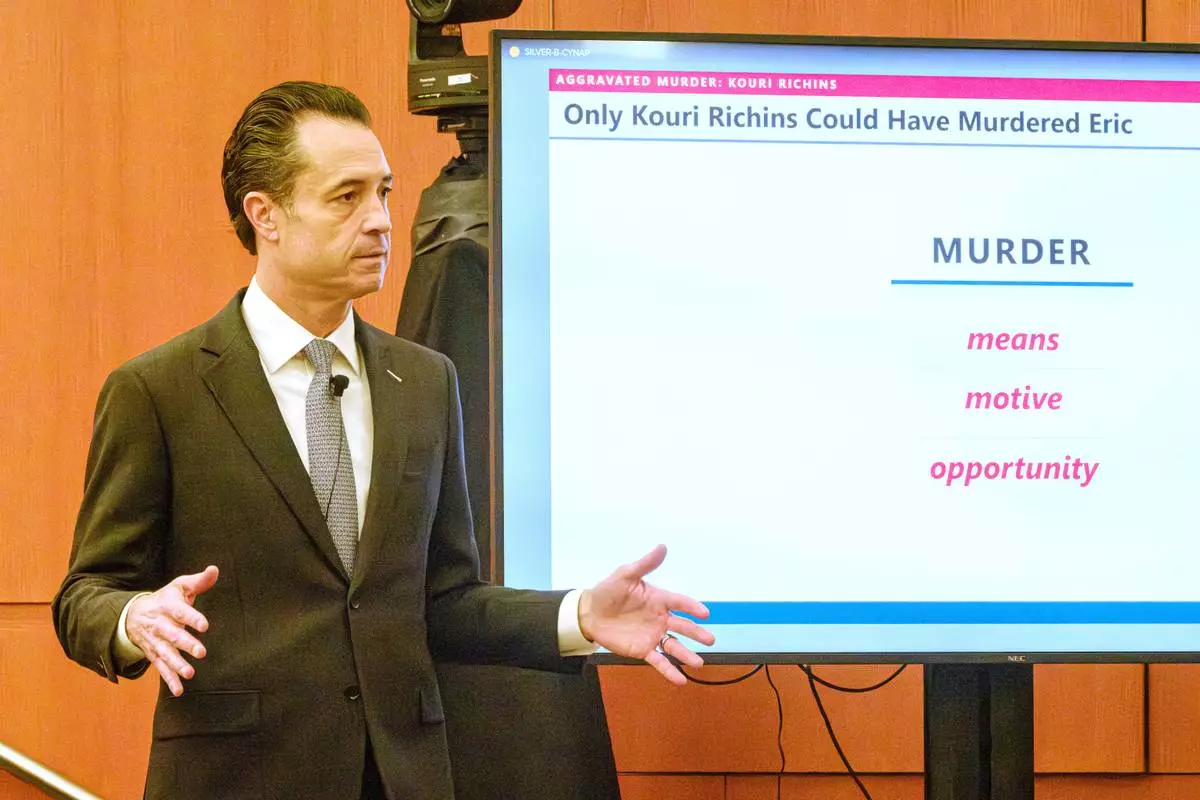
Summit County Prosecutor Brad Bloodworth presenting the state's final arguments in the trial of Kouri Richins, accused of poisoning her husband in March 2022, Monday, March 16, 2026, in Third District Court in Park City, Utah. (David Jackson/Pool Photo via AP)

Defendant Kouri Richins, left, accused of poisoning her husband in March 2022, listens to closing arguments in Third District Court, Monday, March 16, 2026, in Park City, Utah. (David Jackson/Pool Photo via AP)