PARIS (AP) — French President Emmanuel Macron is running out of wiggle room. The abrupt resignation of his prime minister Monday — Macron's fourth in more than a year of almost ceaseless political upheaval — puts the French leader in a bind.
None of the options now look appealing for Macron, from his perspective at least. And for France, the road ahead promises more of the political uncertainty that is eroding investor confidence in the European Union's second-largest economy and is frustrating efforts to rein in France's damaging state deficit and debts.
Click to Gallery
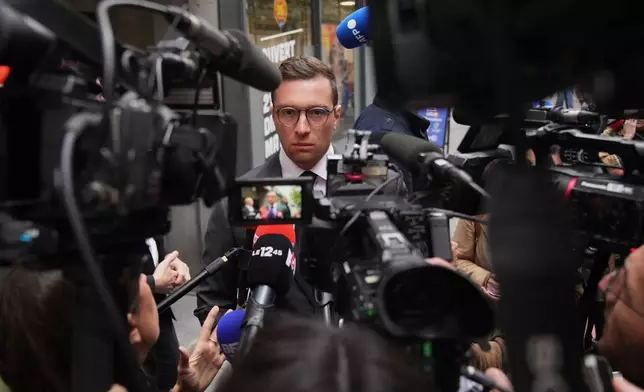
French far right National Rally party president Jordan Bardella answers reporters following a meeting, after France's prime minister Sebastien Lecornu resigned plunging the country into a deep political crisis. Monday, Oct. 6, 2025 in Paris. (AP Photo/Christophe Ena)
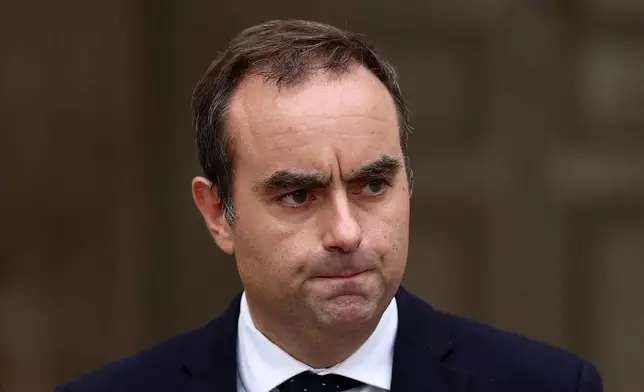
French outgoing Prime Minister Sebastien Lecornu, who resigned just a day after naming his government, arrives to deliver his statement at the Hotel Matignon in Paris, Monday, Oct. 6, 2025. (Stephane Mahe/Pool via AP)
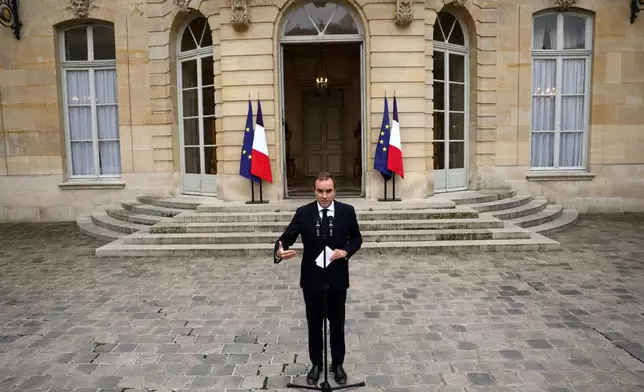
French outgoing Prime Minister Sebastien Lecornu, who resigned just a day after naming his government, delivers his statement at the Hotel Matignon in Paris, Monday, Oct. 6, 2025. (Stephane Mahe/Pool via AP)
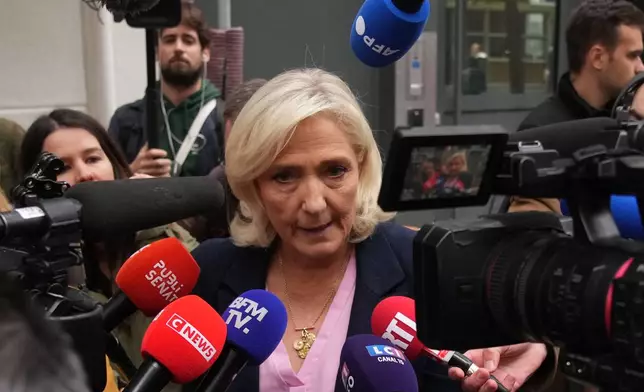
French far right leader Marine Le Pen talks to the media following a meeting at the National Rally party headquarters, after France's prime minister Sebastien Lecornu resigned plunging the country into a deep political crisis. Monday, Oct. 6, 2025 in Paris. (AP Photo/Christophe Ena)
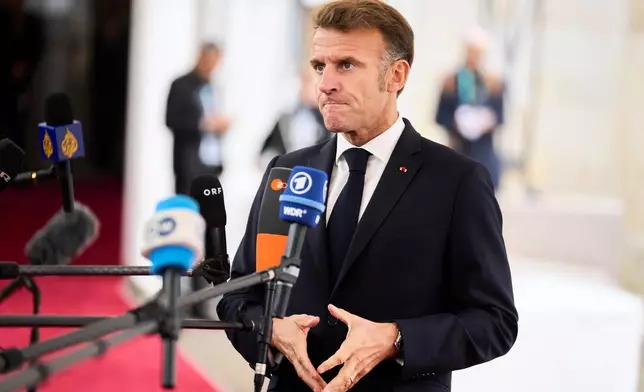
French President Emmanuel Macron arrives at an informal summit in the Danish parliament at Christiansborg Castle in Copenhagen, Wednesday, Oct. 1, 2025. (Thomas Traasdahl/Ritzau Scanpix via AP)
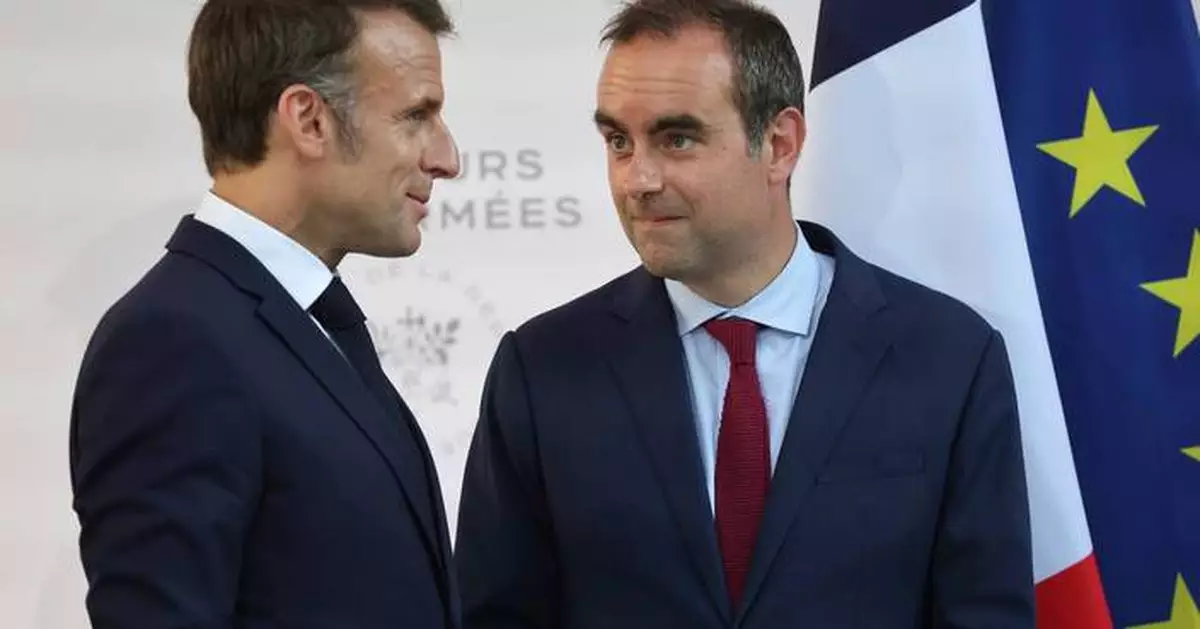
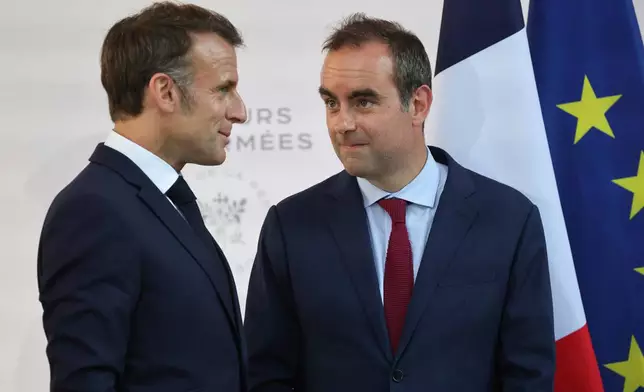
FILE - Then French Defense minister Sebastien Lecornu, right, and France's President Emmanuel Macron talk at the end of an address by the president to army leaders in Paris Sunday July 13, 2025, (Ludovic Marin, Pool via AP, File)
Domestic turmoil also risks diverting Macron's focus from pressing international issues — wars in Gaza and Ukraine, security threats from Russia, and the muscular use of American power by U.S. President Donald Trump, to name just a few.
Here’s a closer look at the latest act in the unprecedented political drama that’s been roiling France since Macron stunned the nation by dissolving the National Assembly in June 2024, triggering fresh legislative elections that then stacked Parliament’s powerful lower house with his opponents:
When Prime Minister Sébastien Lecornu tendered his resignation on Monday morning, he pulled the rug from under the new Cabinet that he'd named less than 14 hours earlier, on Sunday night. The collapse of the blink-and-you-missed-it government — with ministers out of a job before they'd even had a chance to settle in — was a bad look for Macron, bordering on farcical for his critics.
It reinforced the impression that Macron — who in 2017 famously described himself as “the master of the clocks,” firmly in control, on his way to winning the French presidency for the first time — is no longer in full command of France's political agenda and that his authority is ebbing away.
One of Macron's loyal supporters, the just-reappointed but now outgoing ecology minister, Agnès Pannier-Runacher, captured the mood, posting: “Like many of you, I despair of this circus.”
Perhaps more damaging for Macron were the reasons that Lecornu subsequently gave for his resignation, in an address on the front steps of L’Hôtel de Matignon, the 18th-century office of France's prime ministers that, at this rate, may soon need fitting with a revolving door.
The 39-year-old Lecornu explained that the job Macron had given him less than one month ago, after the previous prime minister was tossed out by a National Assembly vote, had proven to be impossible.
Lecornu said three weeks of negotiations with political parties from across the political spectrum, unions and business leaders had failed to build consensus behind France's top domestic priority: agreeing on a budget for next year.
“Being prime minister is a difficult task, doubtless even a bit harder at the moment, but one cannot be prime minister when the conditions aren't fulfilled,” Lecornu said.
France, he appeared to be signaling, is verging on ungovernable.
When the snap legislative elections called by Macron backfired, delivering a hung Parliament since July 2024, the French leader held to the belief that his centrist camp could continue to govern effectively, despite having no stable majority, by building alliances in the National Assembly.
But the voting mathematics in the 577-seat chamber have been a recipe for turmoil, with lawmakers broadly split into three main blocs — left, center and far-right — and none with enough seats to form a government alone.
France, unlike Germany, the Netherlands and some other countries in Europe, doesn't have a tradition of political coalitions governing together.
Macron's political opponents in the National Assembly, particularly those on the far left and far right, have been in no mood to play ball.
Despite their own bitter ideological differences, they have repeatedly teamed up against the president's prime ministers and their minority governments, toppling them one after another — and now seemingly convincing Lecornu that he'd be next if he didn't resign first.
The left was mustering efforts to topple Lecornu's new government as soon as this week, and the far right was signaling that it could vote against him, too.
Having burned since September 2024 through Gabriel Attal, Michel Barnier, François Bayrou and now close ally Lecornu as prime ministers, any successor Macron chooses will be on similarly shaky ground.
On Monday evening, Macron gave Lecornu another 48 hours to seek some sort of exit from the deadlock, buying himself a little more time.
The unpalatable alternative for Macron would be dissolving parliament again, ceding to pressure from the far right in particular for another unscheduled cycle of legislative elections.
Macron has previously ruled out resigning himself, vowing to see out his second and last presidential term to its end in 2027.
But new elections for the National Assembly would be fraught with risk for the French leader.
The far-right National Rally party of Marine Le Pen, already the largest single party, could come out on top, an outcome that Macron has long sought to avoid. That could leave Macron having to share power for the remainder of his time in office with a far-right prime minister.
Macron's unpopularity could also deliver a crushing defeat to his centrist camp, giving him even less sway in parliament than he has now and possibly having to make deals and share power with a stronger coalition of left-wing parties.
Or France could get more of the same: political deadlock and turmoil that weakens Macron at home but that doesn't tie his hands on the world stage.
“It's not a very good image of stability but the central institution remains the president of the Republic,” said Luc Rouban, a political science researcher at Sciences Po university in Paris.
“I don't think Emmanuel Macron is going to resign. He remains the leader on international affairs. So he'll stick to his positions on the situation in Ukraine, or the Middle East and relations with the United States.”
John Leicester has reported from France for The Associated Press since 2002.
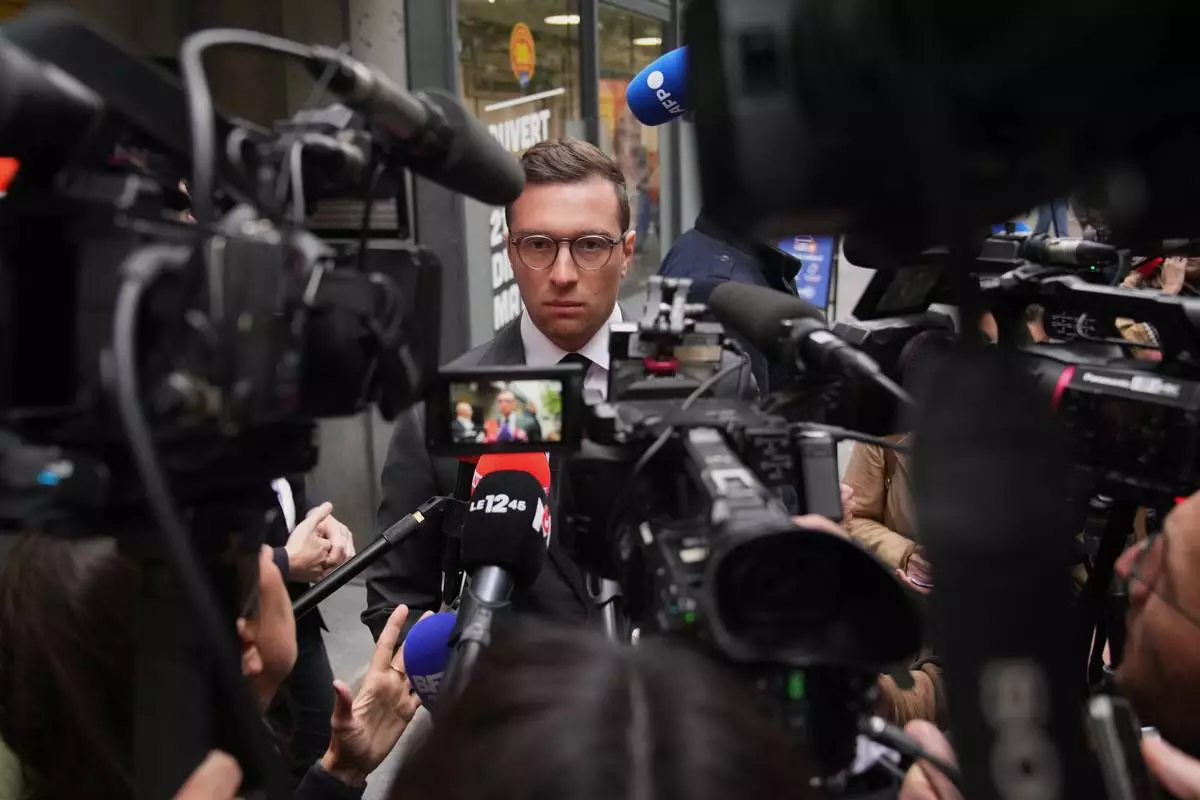
French far right National Rally party president Jordan Bardella answers reporters following a meeting, after France's prime minister Sebastien Lecornu resigned plunging the country into a deep political crisis. Monday, Oct. 6, 2025 in Paris. (AP Photo/Christophe Ena)
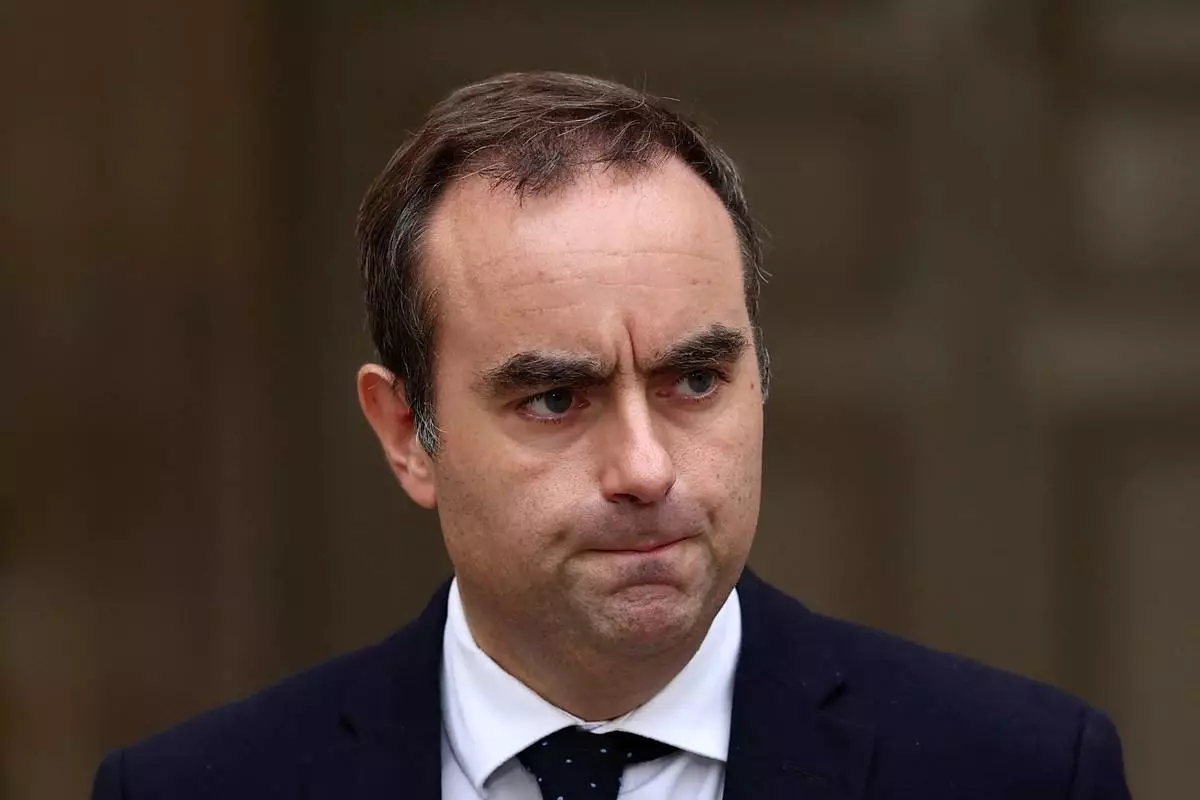
French outgoing Prime Minister Sebastien Lecornu, who resigned just a day after naming his government, arrives to deliver his statement at the Hotel Matignon in Paris, Monday, Oct. 6, 2025. (Stephane Mahe/Pool via AP)
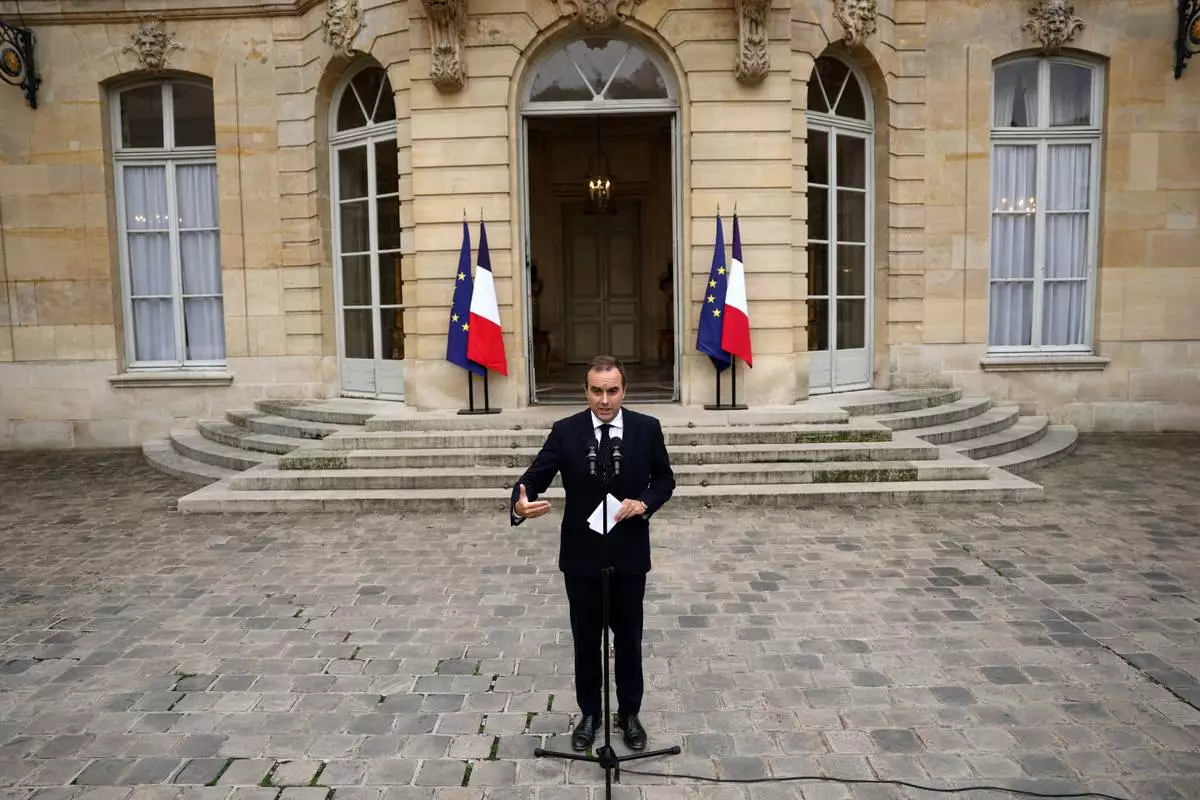
French outgoing Prime Minister Sebastien Lecornu, who resigned just a day after naming his government, delivers his statement at the Hotel Matignon in Paris, Monday, Oct. 6, 2025. (Stephane Mahe/Pool via AP)

French far right leader Marine Le Pen talks to the media following a meeting at the National Rally party headquarters, after France's prime minister Sebastien Lecornu resigned plunging the country into a deep political crisis. Monday, Oct. 6, 2025 in Paris. (AP Photo/Christophe Ena)
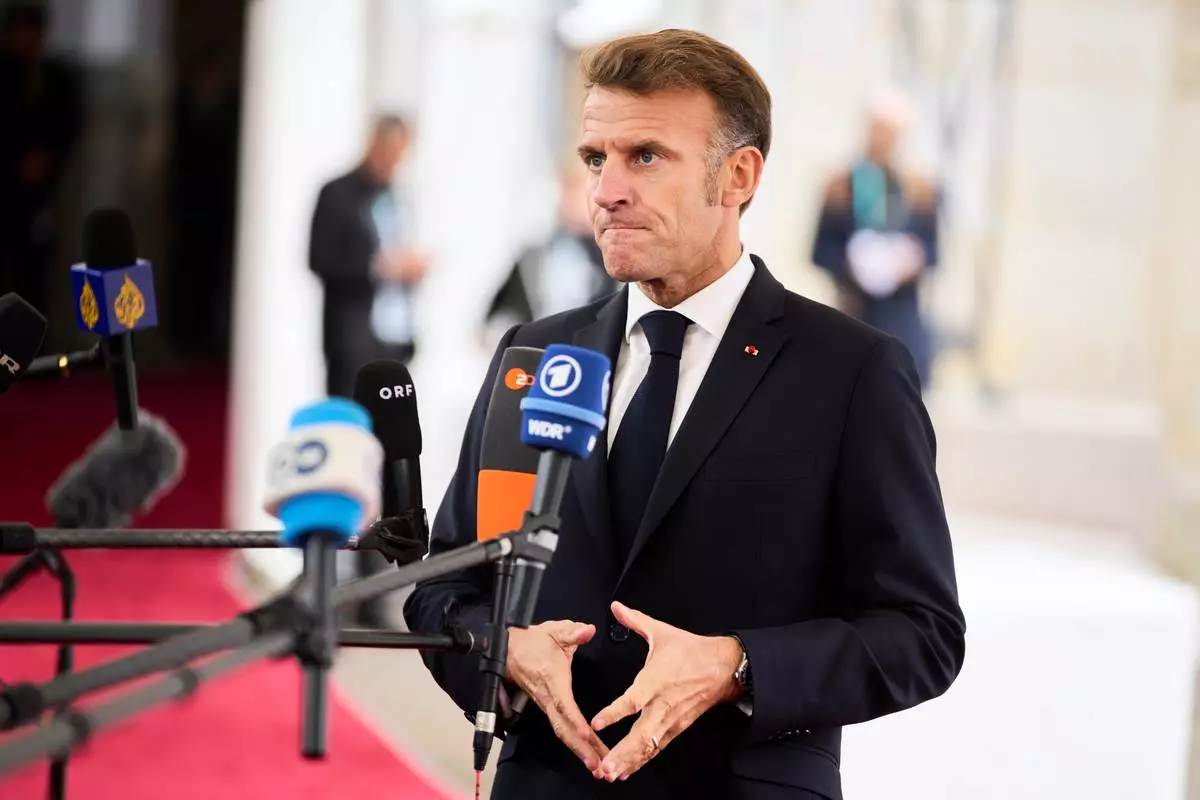
French President Emmanuel Macron arrives at an informal summit in the Danish parliament at Christiansborg Castle in Copenhagen, Wednesday, Oct. 1, 2025. (Thomas Traasdahl/Ritzau Scanpix via AP)
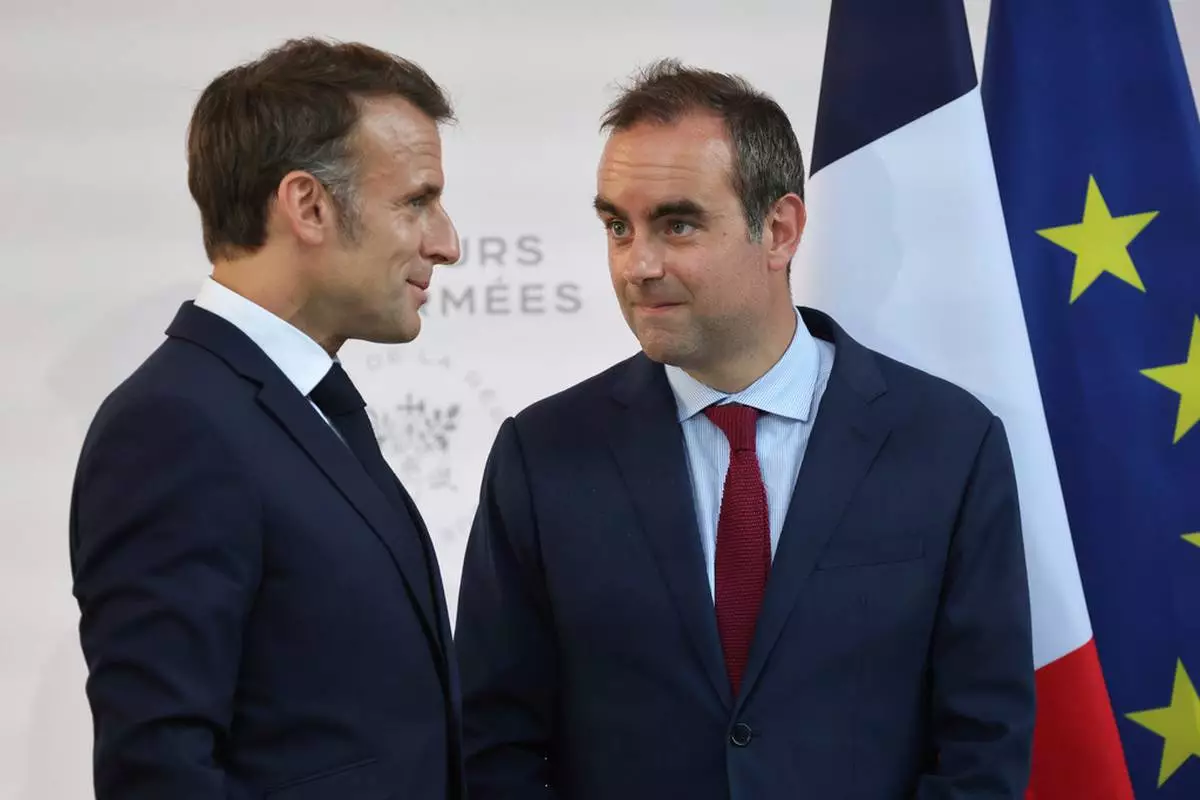
FILE - Then French Defense minister Sebastien Lecornu, right, and France's President Emmanuel Macron talk at the end of an address by the president to army leaders in Paris Sunday July 13, 2025, (Ludovic Marin, Pool via AP, File)
The U.N. Security Council in an emergency meeting Thursday discussed Iran's deadly protests at the request of the United States, even as President Donald Trump left unclear what actions he would take against the Islamic Republic.
Tehran appeared to make conciliatory statements in the lead up to the meeting in an effort to defuse the situation after Trump threatened to take action to stop further killing of protesters, including the execution of anyone detained in Tehran’s bloody crackdown on nationwide protests.
White House press secretary Karoline Leavitt said before the meeting, “All options remain on the table for the president.”
Iran’s crackdown on the demonstrations has killed at least 2,615, the U.S.-based Human Rights Activists News Agency reported. The death toll exceeds any other round of protest or unrest in Iran in decades and recalls the chaos surrounding the country’s 1979 Islamic Revolution.
The sound of gunfire faded Thursday in the capital, Tehran. The country closed its airspace to commercial flights for hours without explanation early Thursday and some personnel at a key U.S. military base in Qatar were advised to evacuate. The U.S. Embassy in Kuwait also ordered its personnel to “temporary halt” travel to the multiple military bases in the small Gulf Arab country.
Here is the latest:
The U.N. warns possible military strikes on Iran would add “volatility to an already combustible situation” in an emergency meeting of the U.N. Security Council Thursday.
U.N. Secretary-General António Guterres “urges maximum restraint at this sensitive moment and calls on all actors to refrain from any actions that could lead to further loss of life or ignite a wider regional escalation,” Assistant Secretary-General Martha Pobee said at the meeting.
Guterres urges maximum restraint and remains convinced that all issues regarding Iran, including its nuclear program, should be addressed through diplomacy and dialogue, she said.
The U.N. chief reaffirms the U.N. Charter’s principles that disputes must be settled peacefully and prohibit the threat or use of force, Pobee said.
Masih Alinejad, one of the most vocal Iranian dissidents in the U.S., accused the United Nations and the Security Council of failing “to respond with the urgency this moment demands” at the emergency U.N. Security Council meeting Thursday.
In October, two purported Russian mobsters were each sentenced to 25 years behind bars for hiring a hitman to kill Alinejad at her Brooklyn home on behalf of the Iranian government.
Sitting across the table from the Iranian ambassador to the U.N., Alinejad, who came after an invitation from the U.S., said that “the members of this body have forgotten the privilege and responsibility of sitting in this room.”
Ahead of the emergency U.N. Security Council meeting Thursday, Iranian Foreign Minister Abbas Araghchi and Secretary-General António Guterres
spoke by phone to discuss the recent deadly protests and Iran’s request for the world body to do more to condemn what they call foreign influence in the Islamic Republic, according to a readout of the call posted on Iranian state TV.
The semiofficial Tasnim news agency reported that Araghchi implored the top U.N. official to live up to the “serious expectation” that Iran’s government and its people have of the U.N.s’ role in condemning what the officials called “illegal U.S. interventions against Iran.”
White House press secretary Karoline Leavitt said that U.S. President Donald Trump and his team had communicated to Iranian officials that there would be “grave consequences” if killing continues against protesters in Iran.
“The president understands today that 800 executions that were scheduled and supposed to take place yesterday, were halted,” she said.
But Trump continues closely watching the situation, she said.
“All options remain on the table for the president,” Leavitt said.
Abdul Malik al-Houthi, leader of the Iran-backed Yemeni rebel group, said on Thursday that “criminal gangs” were responsible for the situation in Iran, accusing them of carrying out an “American-Israeli” scheme.
“Criminal gangs in Iran killed Iranian citizens, security forces and burned mosques,” he said without providing evidence. “What’s being committed by criminal gangs in Iran is horrific, bearing an American stamp as it includes slaughter and burning some people alive.”
He also said that the U.S. imposed economic sanctions on Iran to create a crisis leading to the current issues in the country with the end goal of controlling Iran.
Yet he said the U.S. has “failed in Iran” and that Iranians “will not yield to America.”
The president of the European Union’s executive arm says the 27-member bloc is looking to strengthen sanctions against Iran as ordinary Iranians continue their protests against Iran’s theocratic government.
Commission President Ursula von der Leyen said Thursday following a meeting of the EU’s commissioners in Limassol, Cyprus that current sanctions against Iran are “weakening the regime.”
Von der Leyen said that the EU is looking to sanction individual Iranians —apart from those who belong to Iran’s Islamic Revolutionary Guard — who “are responsible for the atrocities.”
She added that the people of Iran who are “bravely fighting for a change” have the EU’s “full political support.”
Canada’s foreign minister says a Canadian citizen has died in Iran “at the hands of the Iranian authorities.”
“Peaceful protests by the Iranian people — asking that their voices be heard in the face of the Iranian regime’s repression and ongoing human rights violations — has led the regime to flagrantly disregard human life,” Canadian Foreign Affairs Minister Anita Anand posted on social media Thursday.
“This violence must end. Canada condemns and calls for an immediate end to the Iranian regime’s violence,” she added.
Anand said consular officials are in contact with the victim’s family in Canada. She did not provide details.
The International Federation of Red Cross and Red Crescent Societies announced Thursday that a local staff member was killed and several others were wounded during the deadly protests in Iran over the weekend.
Amir Ali Latifi, an Iranian Red Crescent Society worker, was working in the country’s Gillan province on Jan. 10 when he was killed “in the line of duty,” the organization said in a statement.
“The IFRC is deeply concerned about the consequences of the ongoing unrest on the people of Iran and is closely monitoring the situation in coordination with the Iranian Red Crescent Society,” the statement continued.
U.S. President Donald Trump has hailed as “good news” reports that the death sentence has been lifted for an Iranian shopkeeper arrested in a violent crackdown on protests.
Relatives of 26-year-old Erfan Soltani had said he faced imminent execution.
Trump posed Thursday on his Truth Social site: “FoxNews: ‘Iranian protester will no longer be sentenced to death after President Trump’s warnings. Likewise others.’ This is good news. Hopefully, it will continue!”
Iranian state media denied Soltani had been condemned to death. Iranian judicial authorities said Soltani was being held in a detention facility outside of the capital. Alongside other protesters, he has been accused of “propaganda activities against the regime,” state media said.
Trump sent tensions soaring this week by pledging that “help is on its way” to Iranian protesters and urging them to continue demonstrating against authorities in the Islamic Republic.
On Wednesday Trump signaled a possible de-escalation, saying he had been told that “the killing in Iran is stopping.”
In a joint statement, the foreign ministers of Canada, France, Germany, Italy, Japan, the United Kingdom, the United States and the European Union’s main foreign policy chief said the G7 members were “gravely concerned” by the developments surrounding the protests, and that they “strongly oppose the intensification of the Iranian authorities’ brutal repression of the Iranian people.”
The statement, published on the EU’s website Thursday, said the G7 were “deeply alarmed at the high level of reported deaths and injuries” and condemned “the deliberate use of violence” by Iranian security forces against protesters.
The G7 members “remain prepared to impose additional restrictive measures if Iran continues to crack down on protests and dissent in violation of international human rights obligations,” the statement said.
China’s Foreign Minister Wang Yi has spoken with his counterpart in Iran, who said the situation was “now stable,” China’s Ministry of Foreign Affairs said.
Abbas Araghchi said “he hoped China will play a greater role in regional peace and stability” during the talks, according to the statement from the ministry.
“China opposes imposing its will on other countries, and opposes a return to the ‘law of the jungle’,” Wang said.
“China believes that the Iranian government and people will unite, overcome difficulties, maintain national stability, and safeguard their legitimate rights and interests,” he added. “China hopes all parties will cherish peace, exercise restraint, and resolve differences through dialogue. China is willing to play a constructive role in this regard.”
“We are against military intervention in Iran,” Turkish Foreign Minister Hakan Fidan told journalists in Istanbul on Thursday. “Iran must address its own internal problems… They must address their problems with the region and in global terms through diplomacy so that certain structural problems that cause economic problems can be addressed.”
Ankara and Tehran enjoy warm relations despite often holding divergent interests in the region.
Fidan said the unrest in Iran was rooted in economic conditions caused by sanctions, rather than ideological opposition to the government.
Iranians have been largely absent from an annual pilgrimage to Baghdad, Iraq, to commemorate the death of Imam Musa al-Kadhim, one of the twelve Shiite imams.
Many Iranian pilgrims typically make the journey every year for the annual religious rituals.
Streets across Baghdad were crowded with pilgrims Thursday. Most had arrived on foot from central and southern provinces of Iraq, heading toward the shrine of Imam al-Kadhim in the Kadhimiya district in northern Baghdad,
Adel Zaidan, who owns a hotel near the shrine, said the number of Iranian visitors this year compared to previous years was very small. Other residents agreed.
“This visit is different from previous ones. It lacks the large numbers of Iranian pilgrims, especially in terms of providing food and accommodation,” said Haider Al-Obaidi.
Europe’s largest airline group said Thursday it would halt night flights to and from Tel Aviv and Jordan's capital Amman for five days, citing security concerns as fears grow that unrest in Iran could spiral into wider regional violence.
Lufthansa — which operates Swiss, Austrian Airlines, Brussels Airlines and Eurowings — said flights would run only during daytime hours from Thursday through Monday “due to the current situation in the Middle East.” It said the change would ensure its staff — which includes unionized cabin crews and pilots -- would not be required to stay overnight in the region.
The airline group also said its planes would bypass Iranian and Iraqi airspace, key corridors for air travel between the Middle East and Asia.
Iran closed its airspace to commercial flights for several hours early Thursday without explanation.
A spokesperson for Israel’s Airport Authority, which oversees Tel Aviv’s Ben Gurion Airport, said the airport was operating as usual.
Iranian state media has denied claims that a young man arrested during Iran’s recent protests was condemned to death. The statement from Iran’s judicial authorities on Thursday contradicted what it said were “opposition media abroad” which claimed the young man had been quickly sentenced to death during a violent crackdown on anti-government protests in the country.
State television didn’t immediately give any details beyond his name, Erfan Soltani. Iranian judicial authorities said Soltani was being held in a detention facility outside of the capital. Alongside other protesters, he has been accused of “propaganda activities against the regime,” state media said.
New Zealand’s Foreign Minister Winston Peters said Thursday that his government was “appalled by the escalation of violence and repression” in Iran.
“We condemn the brutal crackdown being carried out by Iran’s security forces, including the killing of protesters,” Peters posted on X.
“Iranians have the right to peaceful protest, freedom of expression, and access to information – and that right is currently being brutally repressed,” he said.
Peters said his government had expressed serious concerns to the Iranian Embassy in Wellington.
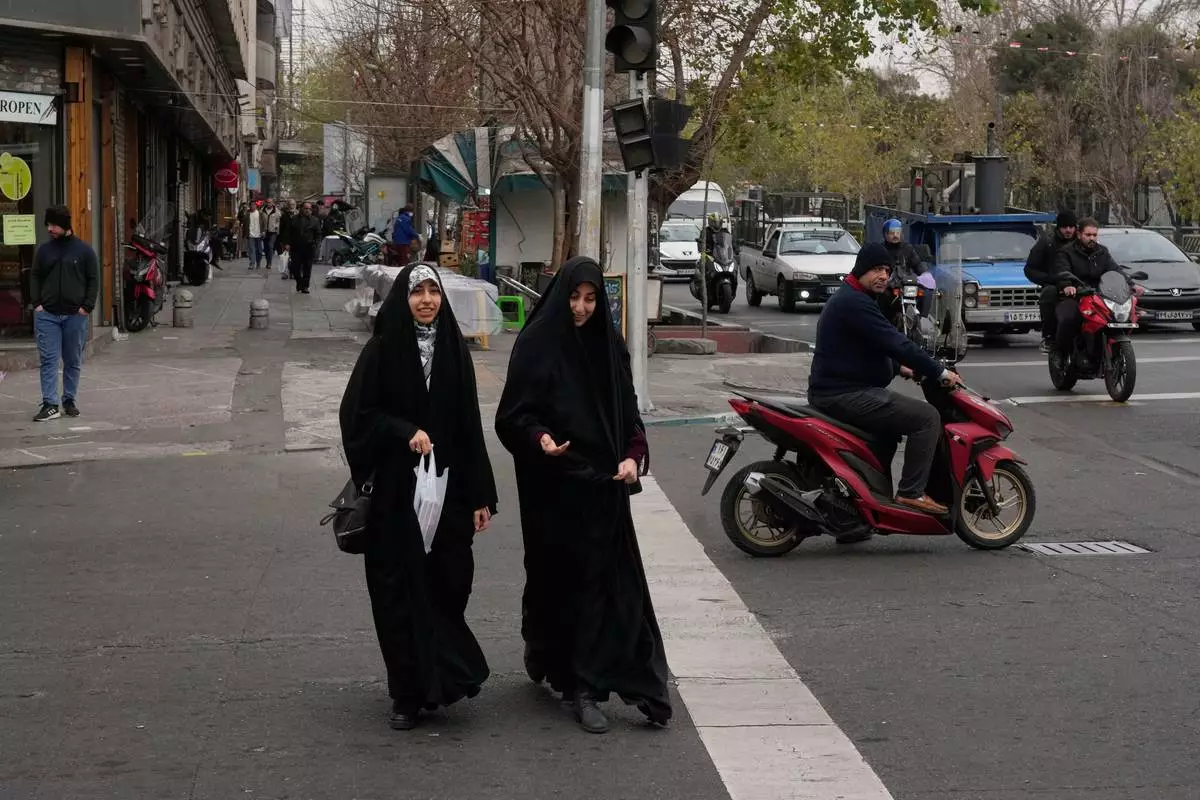
Women cross an intersection in downtown Tehran, Iran, Thursday, Jan. 15, 2026. (AP Photo/Vahid Salemi)
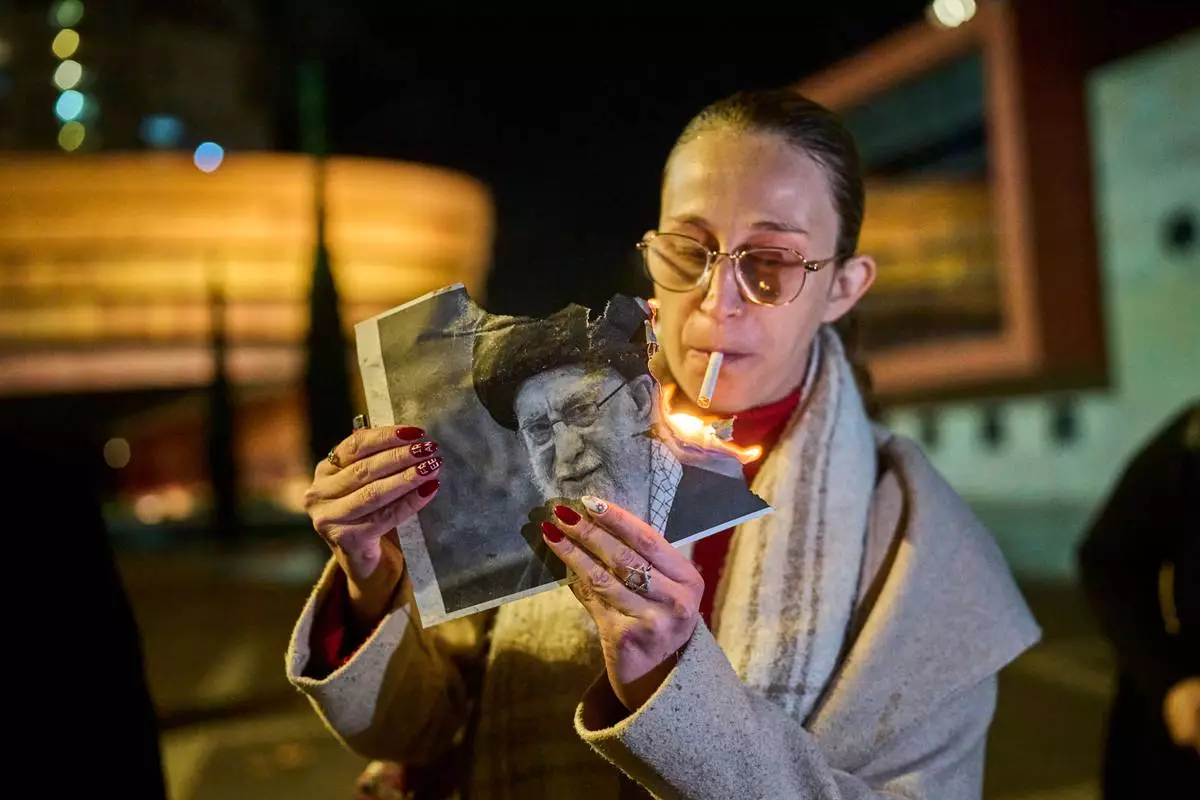
A demonstrator lights a cigarette with a burning poster depicting Supreme Leader Ayatollah Ali Khamenei during a rally in support of Iran's anti-government protests, in Holon, Israel, Wednesday, Jan. 14, 2026. (AP Photo/Ohad Zwigenberg)
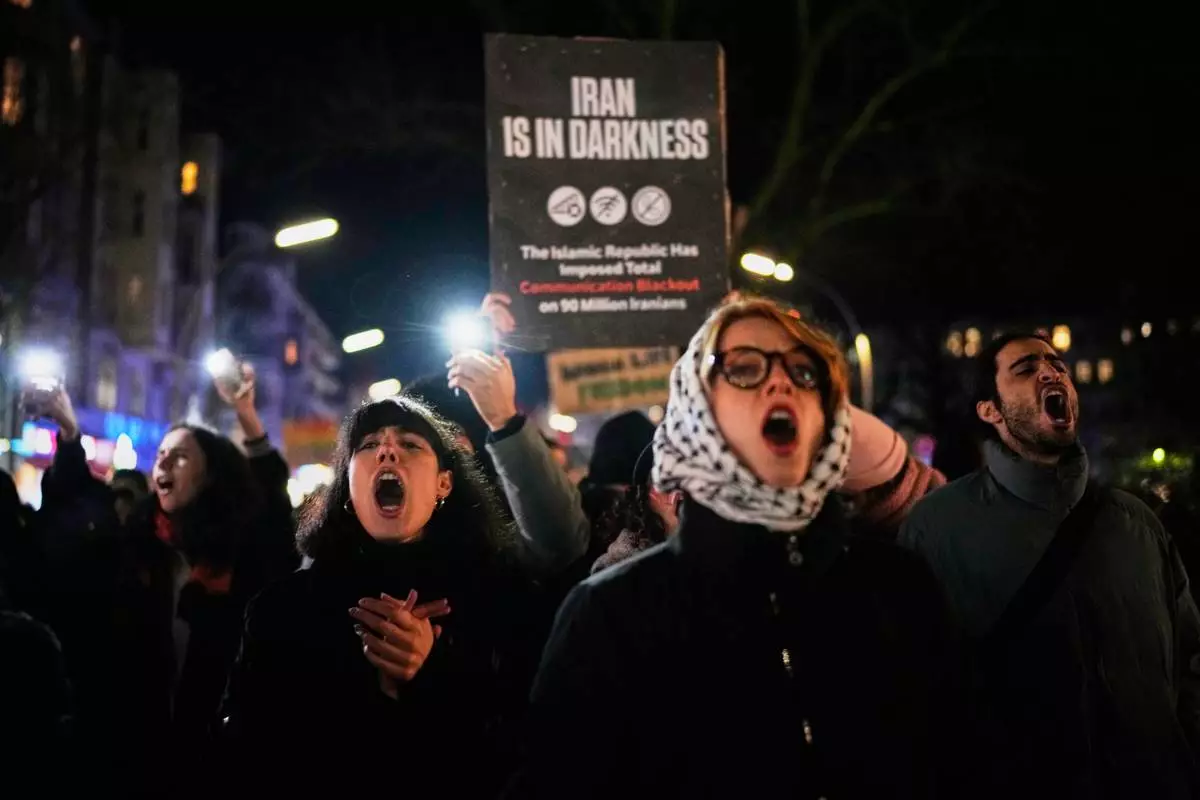
Protesters participate in a demonstration in support of the nationwide mass protests in Iran against the government, in Berlin, Germany, Wednesday, Jan. 14, 2026. (AP Photo/Ebrahim Noroozi)
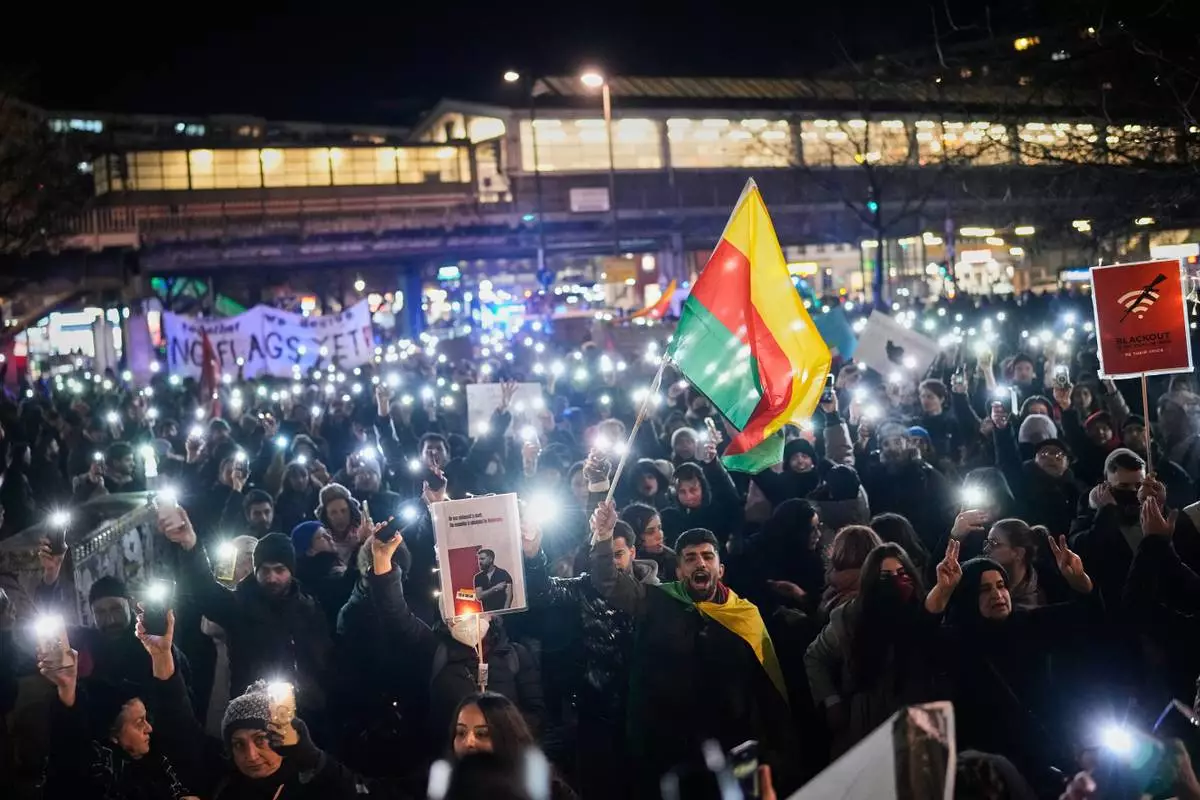
Protesters participate in a demonstration in support of the nationwide mass protests in Iran against the government, in Berlin, Germany, Wednesday, Jan. 14, 2026. (AP Photo/Ebrahim Noroozi)