SANTIAGO, Chile (AP) — FIFA is employing an alternative review system that allows coaches to appeal two referee’s decisions per match at the Under-20 soccer World Cup in Chile
The football video support (FVS) is a “simplified version” of VAR and has transformed the youth tournament into a testing ground for new technologies.
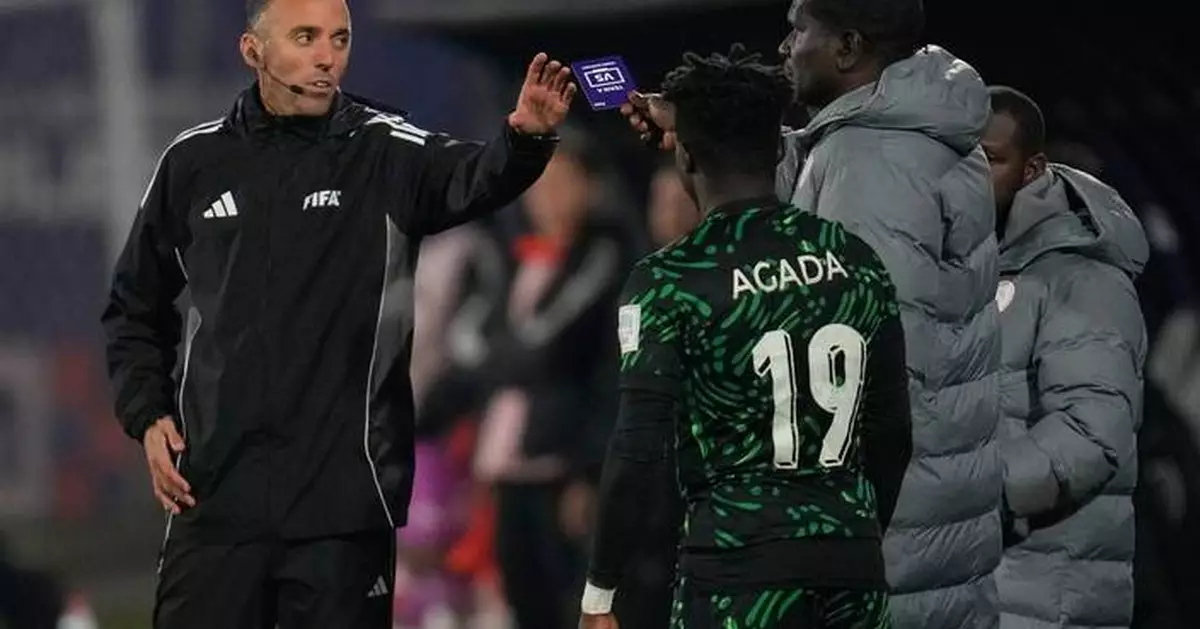
Cards that vary between blue and purple are held by coaches, who are in charge of requesting reviews.
During the group stage, its use has proven crucial, defining the course of several matches played in the cities of Santiago, Valparaíso, Rancagua and Talca. The system was deployed in more than a dozen matches in the early part of the tournament.
FVS was first used when South Korea coach Lee Chang-Won used a card for the first time during the opening match against Ukraine. He challenged a penalty, but the request was ultimately ruled out by the referee.
Since then, the review system has had a role in several matches. Of the 12 games in the first round of the group stage, the “light VAR” was used in seven.
It proved decisive in Norway’s 1-0 victory over Nigeria after a review of a handball by Nigeria defender Ahmed Akinyele, which American referee Joe Dickerson had ignored.
FVS also disallowed a goal in Argentina's 4-1 win against Australia — the review denying a tying goal for the Socceroos.
Mexico's use of the system helped it overturn a penalty decision in a match they ended up tying 2-2 against Spain. It also led to Paraguay winger Enso González being red-carded after kicking South Korea striker Hyeon-oh Kim.
Unlike VAR, which uses special cameras and a supporting team of officials, FVS referees review their decisions based on images captured by the television broadcast, without further assistance.
According to world soccer's ruling body FIFA, the FVS system aims to “democratize football by introducing video review technology as a complementary option,” not only for top-level competitions but also for those that “could not afford VAR infrastructure,” thanks to its low cost and simplified operation.
Coaches can only appeal in four specific situations: whether or not there was a goal; whether or not there was a penalty, over a direct red card, or in case of suspicion that a card was not shown to the correct offender.
The system had already been tested by FIFA in other competitions, such as the 2024 Youth Championship/Blue Stars in Switzerland and the 2024 Under-20 Women’s World Cup in Colombia, and it is expected to be expanded to other youth categories.
Some have praised the system, but others have expressed reluctance.
“It’s a good tool to avoid constantly stopping the game,” said Chile coach Nicolás Córdova after a 2-0 loss against Japan.
Some fans, however, have criticized the long waiting periods until a decision is made.
“In a game like this, we had 10 extra minutes because they stopped the whole time to review things that clearly hadn’t happened,” Brazilian fan Tiago Dias said after his country lost 2-1 against Morocco.
Some coaches, such as Morocco’s Mohamed Ouahbi, said they would make extensive use of the tool, regardless of whether there was a violation or not.
“I’m going to use the card because the option is there. We have two cards and we have to use them," Ouahbi said.
AP soccer: https://apnews.com/hub/soccer
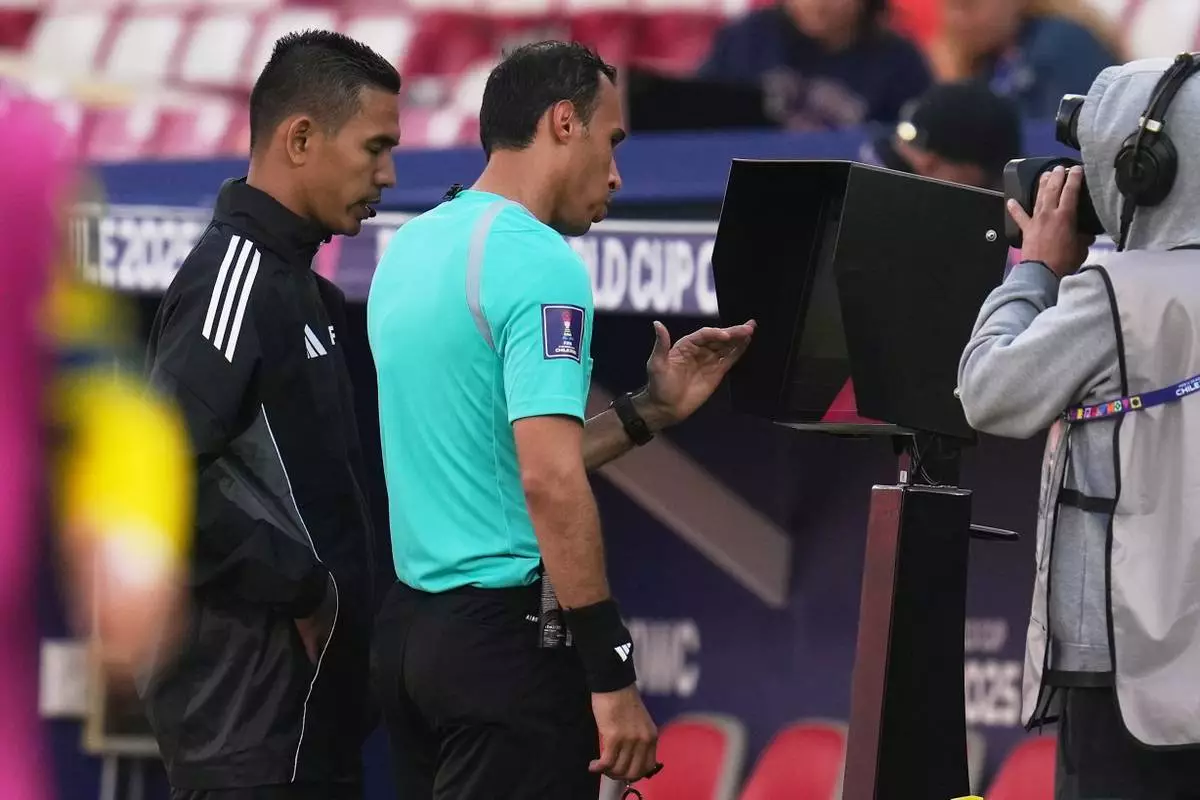
Referee Khalid Saleh Alturais checks the VAR screen during a FIFA U-20 World Cup Group B soccer match between Ukraine and Paraguay at National Stadium in Santiago, Chile, Friday, Oct. 3, 2025. (AP Photo/Esteban Felix)

Panama's coach Jorge Dely holds out a blue card to request VAR revision, during a FIFA U-20 World Cup Group B soccer match against South Korea at Elias Figueroa Brander stadium in Valparaiso, Chile, Friday, Oct. 3, 2025. (AP Photo/Andre Penner)
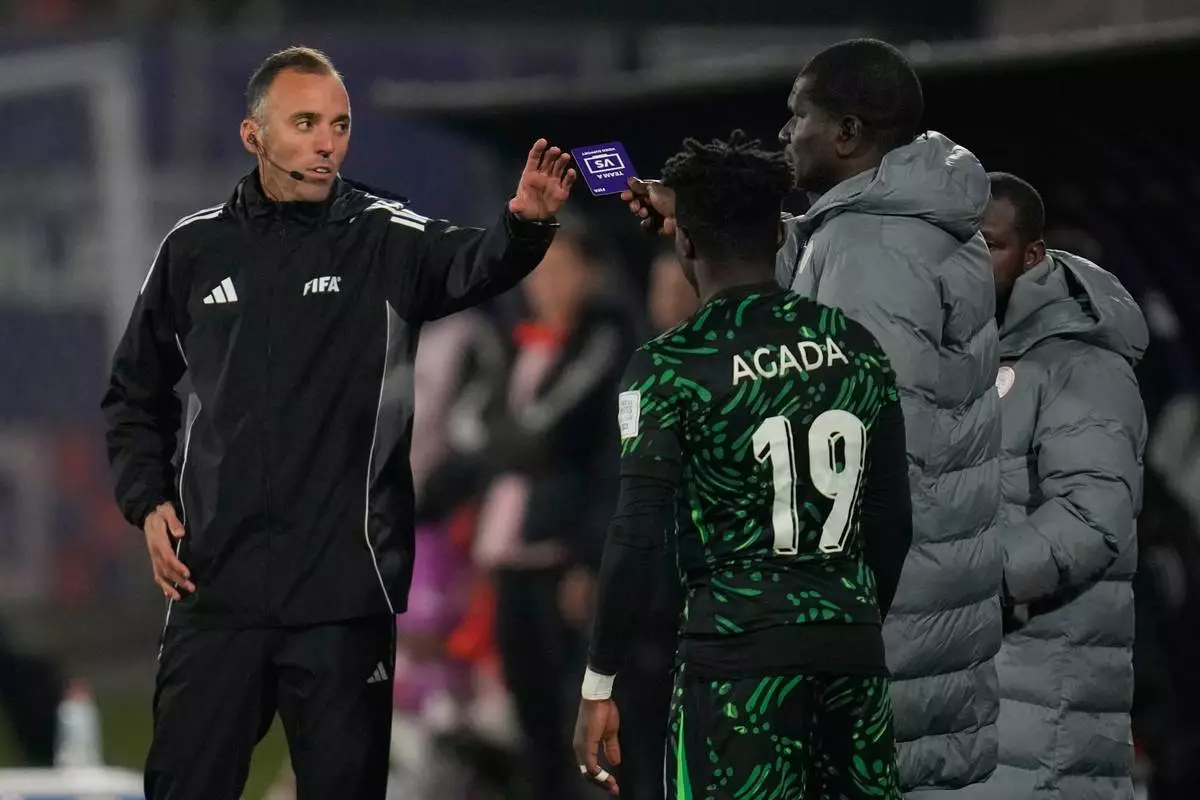
Nigeria's coach Aliyu Zubair asks for a VAR review to referee Joao Pinheiro, of Portugal, during a FIFA U-20 World Cup Group F soccer match against Colombia at Fiscal Stadium in Talca, Chile, Sunday, Oct. 5, 2025. (AP Photo/Matias Delacroix)
President Donald Trump is testing his midterm message on the economy in a toss-up congressional district in New York, even as voters largely disapprove of his stewardship. The event's promoted focus is the tax law Trump signed last year, which quadrupled the federal deduction for state and local taxes, a critical change for high-tax states like New York.
Meanwhile, Republicans are struggling to find the votes to keep supporting Trump's war with Iran. In Havana, a huge crowd of Cubans is taunting Trump while protesting the U.S. indictment former President Raúl Castro amid Trump's pressure campaign. And in Europe, Secretary of State Marco Rubio is facing NATO allies confused by contradictory Trump administration statements.
The Latest:
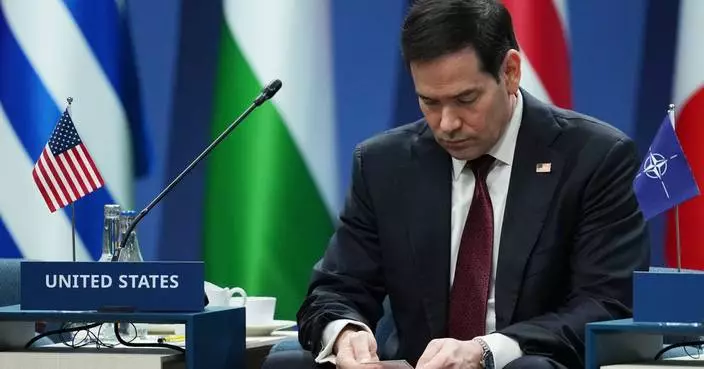
The secretary of state said he and other foreign ministers discussed the issue of reopening the critical waterway, and that he reiterated the need for a “Plan B” if a deal isn’t reached between Washington and Tehran.
“Someone’s going to have to do something about it, okay?” Rubio said. “They’re not just going to voluntarily reopen the straits in that scenario.”
Rubio said he received lots of “nods” from European allies when he brought it up Friday. In the same breath, Rubio confirmed what Iranian officials had been saying, that progress is being made in the negotiations.
“I wouldn’t exaggerate it and I wouldn’t diminish it,” he said. “But there’s more work to be done.”
Rubio says America’s NATO allies understand that eventually there will be a reduction in the U.S. troop presence in Europe as the Trump administration evaluates its force posture globally.
“I think there’s a broad recognition that there are going to be eventually less U.S. troops in Europe than there has historically been for a variety of reasons,” Rubio told reporters.
NATO allies have been confused by contradictory statements coming from Trump and his top aides, including an announcement last week that troop levels would be reduced in Poland that Trump appeared to reverse on Thursday. A previously announced troop reduction in Germany appears to be going ahead but Rubio noted that the Germans “didn’t freak out about it” because it brought the numbers back to where they were three years ago.
The U.S. secretary of state has met with his NATO foreign minister counterparts in Sweden and reiterated U.S. demands for Europe and Canada to increase their defense spending and military industrial capabilities.
In meetings with his colleagues in Helsingborg on Friday, Rubio said the U.S. remains committed to NATO but said the force posture of American troops in Europe is contingent on what allies contribute. The alliance has been jolted by Trump’s abrupt decisions on troop deployments.
Trump has expressed strong dissatisfaction with some allies and their reluctance or refusal to assist in the war with Iran. Rubio said the president’s views and “frankly, disappointment at some of our NATO Allies and their response to our operations in the Middle East, they are well documented” and need to be addressed by NATO leaders at their summit in Turkey in July.
While the president’s handpicked candidates are winning GOP primaries, many are untested heading into general elections this fall. Trump’s own approval rating sits at a low point, and he’s spending his political capital, alienating would-be allies and threatening to detail GOP priorities.
Trump’s announcement of nearly $1.8 billion “anti-weaponization” fund for people he believes were wrongly prosecuted blindsided senators already fuming over his push for $1 billion to provide security for his new White House ballroom. The audacity of the arrangement proved too toxic for the Senate to bear.
Sen. Thom Tillis of North Carolina called it “stupid on stilts” and a “payout for punks.”
“So the nation’s top law enforcement official is asking for a slush fund to pay people who assault cops? Utterly stupid, morally wrong — Take your pick,” said Sen. Mitch McConnell of Kentucky, the former majority leader.
Voting on a roughly $70 billion budget package that would fuel Trump’s immigration and deportation operations for the remainder of his presidential term, into 2029, was postponed until Congress resumes next month. That blows Trump’s June 1 deadline to have it on his desk.
Trump shrugged when asked during an Oval Office event if he was losing control of the Senate.
“I really don’t know,” the president said.
And it wasn’t just the Senate. For the first time this year, enough Republican House members broke ranks to signal support for a war powers resolution from Democrats that’s designed to halt Trump’s military action in Iran. House Speaker Mike Johnson postponed the voting to avoid confronting the president.
Trump’s political revenge tour met its potential match this week as angry Republican senators, pushed to a breaking point by his seemingly insatiable and outlandish demands — particularly a $1.776 billion fund for Jan. 6 rioters and others he believes were wrongly prosecuted — did the unthinkable.
They simply refused, closed up shop, and went home.
The moment was as rare as it was daring, a sudden flex from the Congress that has become a shell of its former self as a coequal branch, the Republican majority almost always more willing to accommodate the Republican president than to confront him.
▶ Read more:
Rubio says America’s NATO allies understand that eventually there will be a reduction in the U.S. troop presence in Europe as the Trump administration evaluates its force posture globally.
“I think there’s a broad recognition that there are going to be eventually less U.S. troops in Europe than there has historically been for a variety of reasons,” Rubio told reporters.
NATO allies have been confused by contradictory statements coming from Trump and his top aides, including an announcement last week that troop levels would be reduced in Poland that Trump appeared to reverse on Thursday. A previously announced troop reduction in Germany appears to be going ahead but Rubio noted that the Germans “didn’t freak out about it” because it brought the numbers back to where they were three years ago.
The U.S. secretary of state has met with his NATO foreign minister counterparts in Sweden and reiterated U.S. demands for Europe and Canada to increase their defense spending and military industrial capabilities.
In meetings with his colleagues in Helsingborg on Friday, Rubio said the U.S. remains committed to NATO but said the force posture of American troops in Europe is contingent on what allies contribute. The alliance has been jolted by Trump’s abrupt decisions on troop deployments.
Trump has expressed strong dissatisfaction with some allies and their reluctance or refusal to assist in the war with Iran. Rubio said the president’s views and “frankly, disappointment at some of our NATO Allies and their response to our operations in the Middle East, they are well documented” and need to be addressed by NATO leaders at their summit in Turkey in July.
“Who do they think they are to judge Raúl?” Gerardo Hernández asked as the crowd cheered. He’s one of five Cubans accused of being a spy who was imprisoned and later released by the U.S. in 2014.
“For the United States, the law is a tailor-made suit,” he said before punching the air with this fist, to a shout of “Viva Raúl!”
The crowd responded to his call: “Homeland or death, we will vanquish!”
Thousands of people have crowded along Havana’s famed seawall to decry the U.S. indictment. Attendees include daughter, Mariela Castro, and his grandson, Raúl Guillermo Rodríguez Castro. Salsa songs with biting anti-Trump lyrics are booming across the old city.
The Castro indictment has many thinking the Trump administration is following a playbook it used to capture then-Venezuelan President Nicolás Maduro in a military operation in January. Maduro is now imprisoned in the U.S. on federal drug trafficking charges and has pleaded not guilty.
The U.S. military touted the arrival of the USS Nimitz aircraft carrier group for maritime exercises in the Caribbean Sea as the charges against Castro were announced. But professor William LeoGrande, a Latin America specialist at American University, warned against assumptions that a Maduro-like extraction would succeed in Cuba.
“The United States certainly has the military capability to seize Raúl Castro, just as they seized Maduro, although it would probably be more costly,” LeoGrande said. But Castro has been retired for almost a decade. “He still has influence and the leadership seeks his opinion on major decisions, but he is not running the government on a day-to-day basis. If the US were to abduct him, it would not change the operations of government, unlike what happened in Venezuela.”
A huge crowd of Cubans rallied Friday outside the U.S. Embassy in Havana to honor former President Raúl Castro and to protest the Trump administration’s criminal indictment.
“The Cuban people reaffirm that neither threats, nor blockade, nor energy embargo, nor false accusations will be able to break the will of an entire people in defense of their Revolution,” read a statement published by state media.
Raúl Castro has rarely appeared in public since stepping down and handing over to President Miguel Díaz-Canel, who was joined by military leaders at the rally.
Castro was last seen surrounded by tens of thousands of people at a state-organized rally on May 1.
The Trump administration has approved a modest $108 million arms sale to Ukraine that will help the country maintain and sustain its midrange air defense missile system.
The State Department announced the sale of ground-to-air Hawk missile components, spare parts and logistic support late Thursday. The administration has notably reduced military support for Ukraine over the past 18 months as it seeks to mediate an agreement with Russia to end the conflict.
The sale “will improve Ukraine’s capability to meet current and future threats by further equipping it to conduct self-defense and regional security missions with a more robust integrated air defense capability,” the department said in a statement.
Republicans struggled Thursday to find the votes to dismiss legislation that would compel President Donald Trump to withdraw from the war with Iran, delaying planned votes on the matter into June.
The House had scheduled a vote on a war powers resolution, brought by Democrats, that would rein in Trump’s military campaign. But as it became clear that Republicans would not have the numbers to defeat the bill, GOP leaders declined to hold a vote on it. It was the latest sign of the slipping support in Congress for a war that Trump launched more than two months ago without congressional approval.
Republicans in the Senate are also working to ensure they have the votes to dismiss another war powers resolution that advanced to a final vote earlier this week, when four GOP senators supported the resolution and three others were absent from the vote.
The actions by congressional leaders showed Republicans are struggling to maintain political backing for Trump’s handling of the war.
▶ Read more
NATO allies and defense officials expressed bewilderment at Trump’s decision to send 5,000 U.S. troops to Poland.
“It is confusing indeed, and not always easy to navigate,” Swedish Foreign Minister Maria Malmer Stenergard told reporters at a meeting she was hosting of her NATO counterparts, including U.S. Secretary of State Marco Rubio.
U.S. defense officials were also confused. “We just spent the better part of two weeks reacting to the first announcement. We don’t know what this means either,” said one of two officials who spoke on condition of anonymity to discuss sensitive military matters.
NATO allies have been blindsided, despite a U.S. pledge to coordinate troop deployments. “We’re going to stay well-synchronized with our allies moving forward,” NATO’s top military officer, U.S. Lt. Gen. Alex Grynkewich, promised on Wednesday.
▶ Read more
Trump on Thursday said the U.S. will send an additional 5,000 troops to Poland, stirring confusion following weeks of changing statements from Trump and his administration about reducing — not increasing — the American military footprint in Europe.
The Trump administration has said it was reducing levels in Europe by about 5,000 troops, and U.S. officials confirmed about 4,000 service members were no longer deploying to Poland. Trump’s social media announcement raises more uncertainty for European allies that have been blindsided by the changes, as the administration has complained about NATO members not shouldering enough of the burden of their own defense and failing to do more to support the Iran war.
Trump and the Pentagon have said in recent weeks that they were drawing down at least 5,000 troops in Germany after Chancellor Friedrich Merz said the U.S. was being “humiliated” by the Iranian leadership and criticized what he called a lack of strategy in the war.
▶ Read more
Trump is heading to a toss-up congressional district in New York on Friday to test his midterm message on the economy, even as voters largely disapprove of his stewardship of it.
Trump will travel to the Hudson Valley area to appear with Republican Rep. Mike Lawler, who is up for reelection in what will be one of the most closely watched House races this November. The focus of the event is to promote the tax law Trump signed last year, particularly the quadrupling of the deduction for state and local taxes, which is critical in a high-tax state like New York.
The White House has been looking for more opportunities to highlight Trump’s economic accomplishments as his approval rating on the economy has slumped. About one-third of U.S. adults approve of how Trump is handling the economy, according to a new AP-NORC poll, down slightly from 40% at the start of Trump’s second term.
▶ Read more
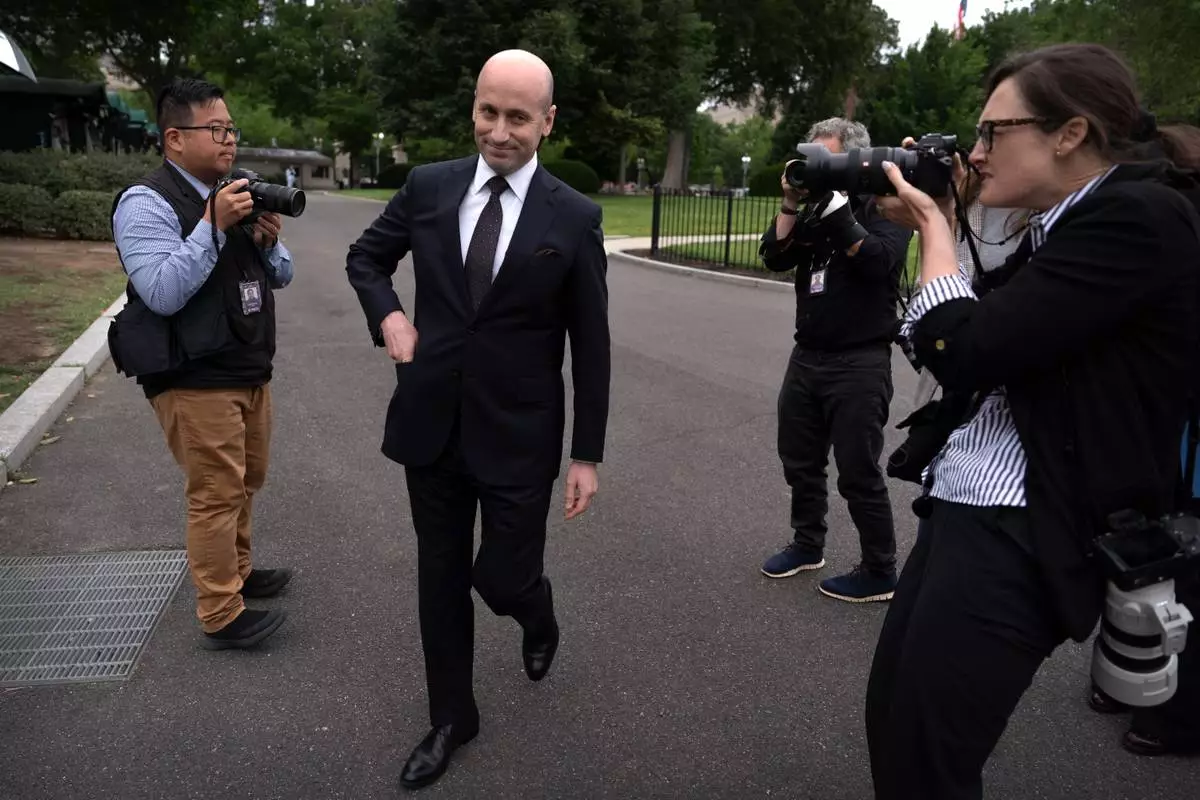
Stephen Miller, White House deputy chief of staff, leaves after speaking to reporters outside the White House, Thursday, May 21, 2026, in Washington. (AP Photo/Mark Schiefelbein)

Work continues on the construction of the ballroom at the White House, Thursday, May 21, 2026, in Washington, where the East Wing once stood, as work also begins for the upcoming UFC fight on the South Lawn. (AP Photo/Pablo Martinez Monsivais)
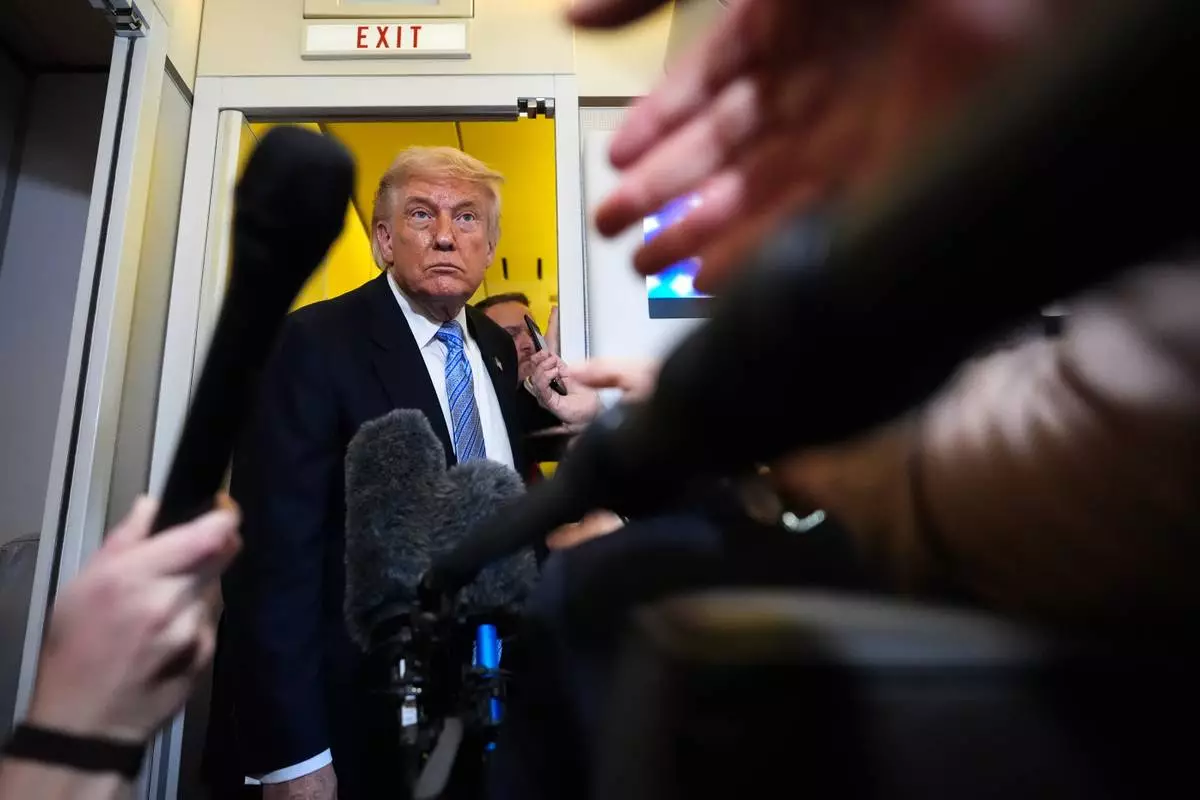
President Donald Trump speaks to reporters aboard Air Force One, Friday, May 15, 2026, as he returns from a trip to Beijing, China. (AP Photo/Mark Schiefelbein)