DEIR AL-BALAH, Gaza City (AP) — When Israeli bombs began falling, Mohammad al-Najjar, his wife and six children fled their house in southern Gaza in the dead of night, dispersing in terror alongside hundreds of others from their neighborhood.
When the dust settled and al-Najjar huddled with his family in a shelter miles away, his son Ahmad, 23, was missing. After daybreak, the family searched nearby hospitals and asked neighbors if they had seen him.
Click to Gallery

Ruins of apartments destroyed by Israeli strikes litter the area next to Khaled Nassar's home in the Jabaliya refugee camp in Gaza City Feb. 9, 2025. Nassar's daughter, Dalia, and his son, Mahmoud, were killed in separate airstrikes, leaving both buried under their homes. (AP Photo/Abdel Hana)
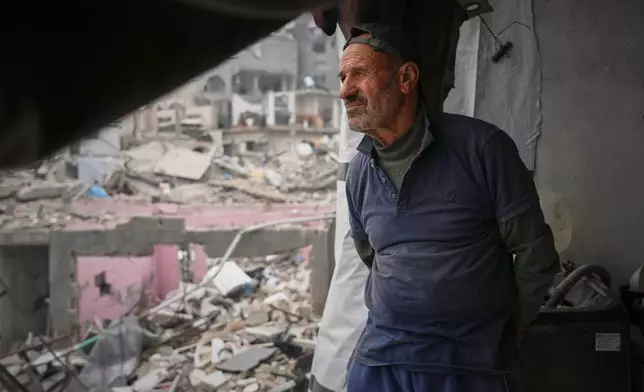
Khaled Nassar looks over the destruction at his apartment in the Jabaliya refugee camp in Gaza City Feb. 9, 2025. Nassar's daughter, Dalia, and his son, Mahmoud, were killed in separate airstrikes, leaving both buried under their homes. (AP Photo/Abdel Kareem Hana)
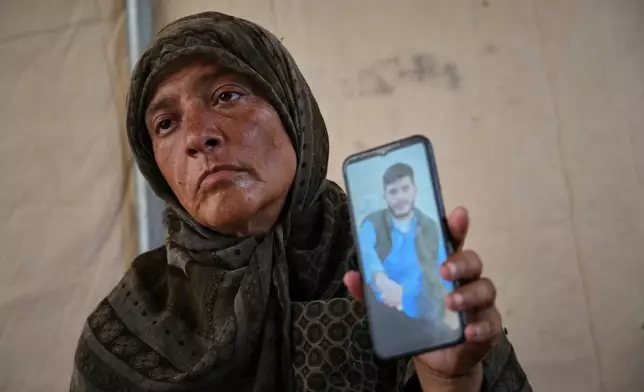
Fadwa al-Ghalban holds a cellphone showing a photo of her son, Mosaab, at her tent in Muwasi, along Gaza's southern coast, Oct. 3, 2025. She has had no word from him since July, when his cousins last saw him near their house as an Israeli strike destroyed it in the southern town of Maan. (AP Photo/Jehad Alshrafi)
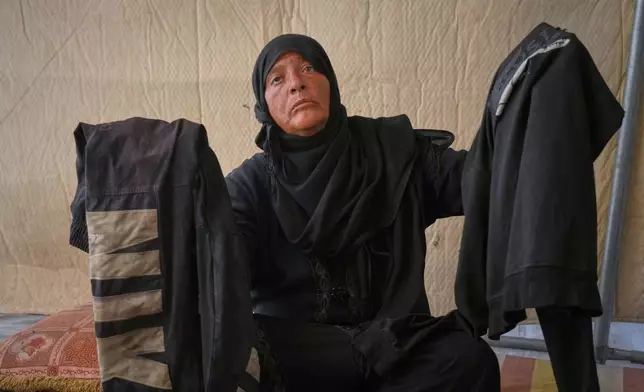
Fadwa al-Ghalban holds clothes belonging to her son, Mosaab, at her tent in Muwasi, along Gaza's southern coast, Oct. 3, 2025. Fadwa has had no word from Mosaab since July, when his cousins last saw him near their house as an Israeli strike destroyed it in the southern town of Maan. (AP Photo/Jehad Alshrafi)
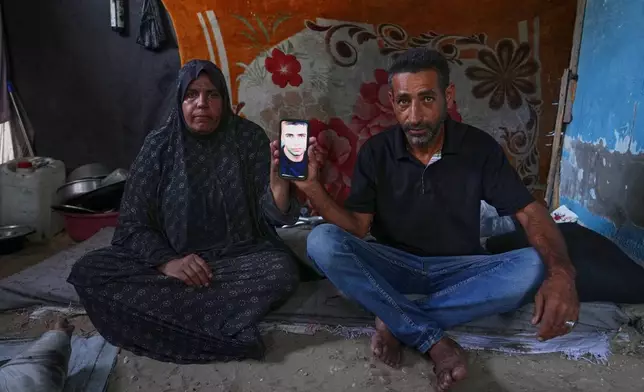
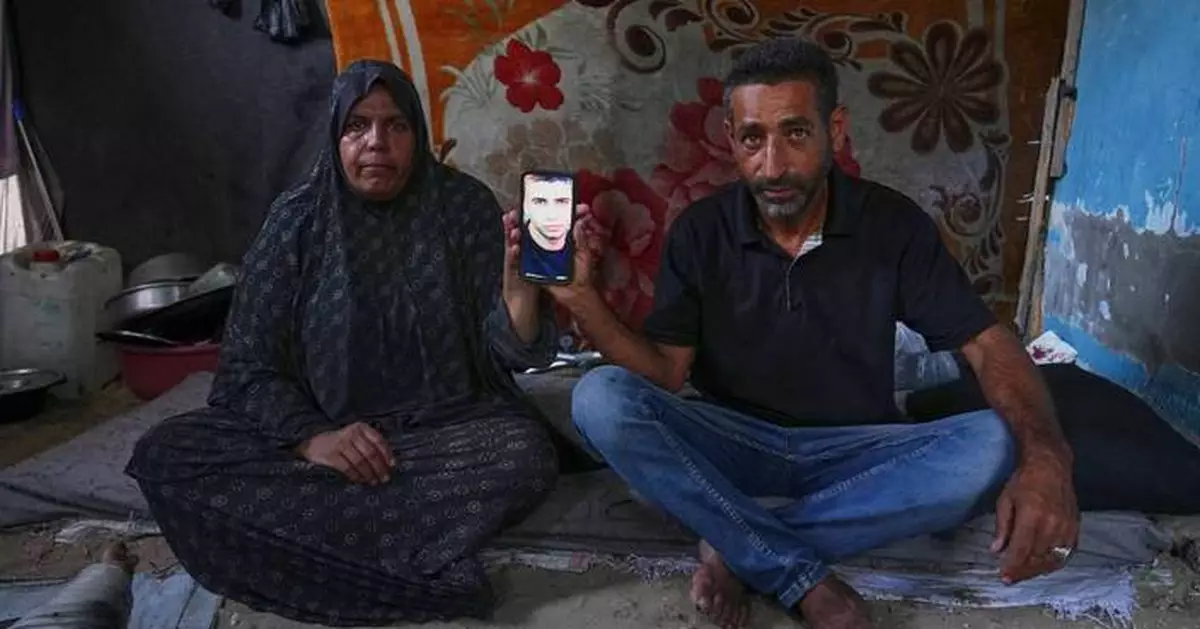
Mohammad and Tahani al-Najjar hold a cellphone showing a picture of their son, Ahmad, at their family's tent in Muwasi, along Gaza's southern coast, Feb. 22, 2025. Nearly two years after Ahmad went missing following Israeli bombardment, the al-Najjars are still searching for him. (AP Photo/Jehad Alshrafi)
There was no trace. Nearly two years later, they are still looking.
“It is as if the earth has swallowed him,” said Mohammad al-Najjar. He spoke from the family’s tent in Muwasi, along Gaza’s southern coast, their ninth displacement camp since that fateful night in December 2023.
Thousands in Gaza are looking for relatives who are missing in one of the most destructive wars of the past decades. Some are buried under destroyed buildings. Others, like al-Najjar’s son, simply disappeared during Israeli military operations.
In a war where the true number of the dead is unknown, “what the accurate number (of missing persons) is, nobody knows," said Kathryne Bomberger, director general of the International Commission on Missing Persons.
The al-Najjar family has searched through the rubble of their bombed-out home. They went to morgues and checked with the International Committee for the Red Cross.
“Is he a prisoner (in Israel), is he dead?” the 46-year-old father said. “We are lost. We are tormented by everything.”
The Israeli Prison Services and the military said they could not release identifying details about specific prisoners and refused to comment on al-Najjar’s status.
Some 6,000 people have been reported by relatives to still be buried under rubble, according to Gaza's Health Ministry. The true number is likely thousands higher because in some cases entire families were killed in a single bombing, leaving no one to report the missing, said Zaher al-Wahidi, the ministry official in charge of data.
Separately, the ministry received reports from families of some 3,600 others missing, al-Wahidi said, their fate unknown. So far, it has only investigated over 200 cases. Of them, seven were found detained by Israel. The others were not among those known to be dead or buried under rubble.
The ministry is part of the Hamas-run government. The U.N. and many independent experts consider its figures to be reliable.
The ICRC has its own separate list of missing — at least 7,000 cases still unresolved, not including those believed to be under rubble, said chief spokesman Christian Cardon.
There have been many ways to disappear during the chaos of offensives, strikes on buildings and mass displacements of almost all of Gaza's 2.3 million people. Hundreds have been detained at Israeli checkpoints or were rounded up in raids with no notification to their families. Experts commissioned by a U.N. body and major rights groups have accused Israel of genocide, charges it vehemently denies.
During Israeli ground assaults, bodies have been left in the streets. Palestinians have been shot when they came too close to Israeli military zones and their bodies are found weeks or months later, decomposed.
The Israeli military has taken an unknown number of bodies, saying it is searching for Israeli hostages or Palestinians it identifies as militants. It has returned several hundred corpses with no identification to Gaza, where they were buried in anonymous mass graves.
Investigating the missing requires advanced DNA technology, samples from families and unidentified bodies, and aerial imagery to locate burial sites and mass graves, said Bomberger. “It is such an enormous undertaking,” she said.
But Israel has restricted DNA-testing supplies from entering Gaza, according to Gaza's Health Ministry. Israeli military authorities would not immediately comment when asked if they were banned.
Bomberger said it is the state’s responsibility to find missing persons — in this case, Israel, as the occupying power. “So it would depend on the political will of the Israeli authorities to want to do something about it.”
Fadwa al-Ghalban has had no word about her 27-year-old son Mosaab since July, when he went to get food from their family house, believing Israeli troops had already left the area near the southern town of Maan.
His cousins nearby saw Mosaab lying on the ground. They shouted his name, but he didn’t answer, and with Israeli troops nearby it was too unsafe to approach him and they left. They presumed he was dead.
Returning later, family members found no body, only his slippers.
Her family has put up notices on social media, hoping someone saw Mosaab in Israeli detention or buried him.
Al-Ghalban lives off hope. Another relative had been presumed dead, then four days after the family formally received those giving condolences, they learned he was in an Israeli prison.
Whatever her son's fate, “there is a fire in my heart,” al-Ghalban said. “Even if someone buried him, it is much easier than this fire.”
Rights groups say Israel is “disappearing” hundreds of Palestinians from Gaza, detaining them without charges or trial, often incommunicado.
Israel does not make public the number being held, except through Freedom of Information Act requests. Under a wartime revision to Israeli law, detainees from Gaza can be held without any judicial review for 75 days and denied lawyers for even longer. Appearances before a judge usually take place in secret via video.
The Israeli human rights group Hamoked obtained records showing that, as of September, 2,662 Palestinians from Gaza were held in Israeli prisons, in addition to a few hundred others detained in army facilities where rights groups, the U.N. and detainees have reported routine abuse and torture.
All al-Ghalban has left of her son is his last change of clothes. She refuses to wash them.
“I keep smelling them. I want a scent of him,” she said, her voice cracking into tears. “I keep imagining him coming, walking toward me in the tent. I say he is not dead.”
With most of Gaza's bulldozers destroyed, families must search on their own through wreckage, hoping to find even the bones of lost loved ones.
Khaled Nassar’s daughter, Dalia, 28, and his son, Mahmoud, 24, were killed in separate airstrikes, leaving both buried under their homes in the Jabaliya refugee camp.
Rescue workers have largely been unable to access Jabaliya, which was hit by repeated strikes, raids and ground offensives and is now under Israeli military control and off-limits.
Dalia and her husband were killed in their home on Oct. 9, 2023, the third day of the war. Her children survived. They now live with their grandfather.
“We searched and we could not find her,” Nassar said. “She seemed to have evaporated with the rocket.”
A year later, Israel struck the family’s home, burying Mahmoud, who had returned to shower in the house after the family had evacuated.
When the ceasefire began in January, Nassar and his wife Khadra went to search for him. Every day, the 60-year-old father of 10, a former construction worker, used a hammer, shovel and small tools to chip away at the rubble. His wife carried away buckets of sand and debris.
They dug through half the house and found nothing. Then Israel broke the ceasefire in March and they had to flee.
Khadra refuses to despair. If there is a new ceasefire, she will resume digging, she said, “even if I only find (Mahmoud’s) ring on his finger or some bones to put in a grave to call it my son’s.”
This story was first published on Oct. 7, 2025. It was updated on Oct. 10, 2025 to correct that Kathryne Bomberger, director general of the International Commission on Missing Persons, did not say that Israel has restricted DNA-testing supplies from entering Gaza. It was the Gaza Health Ministry that said that.
El Deeb reported from Beirut. AP correspondents Mel Lidman in Tel Aviv, Israel, Julia Frankel in New York, Jamey Keaten in Geneva, and Toqa Ezzidin in Cairo contributed to this report.
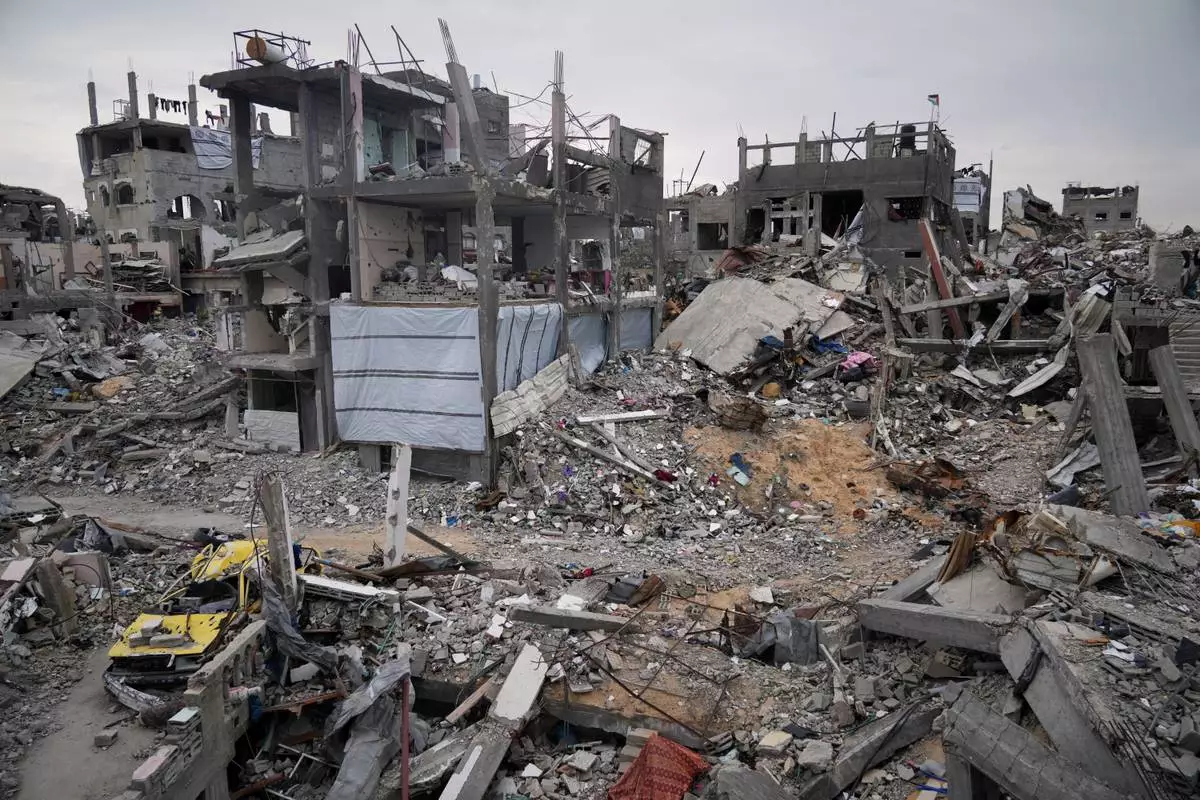
Ruins of apartments destroyed by Israeli strikes litter the area next to Khaled Nassar's home in the Jabaliya refugee camp in Gaza City Feb. 9, 2025. Nassar's daughter, Dalia, and his son, Mahmoud, were killed in separate airstrikes, leaving both buried under their homes. (AP Photo/Abdel Hana)
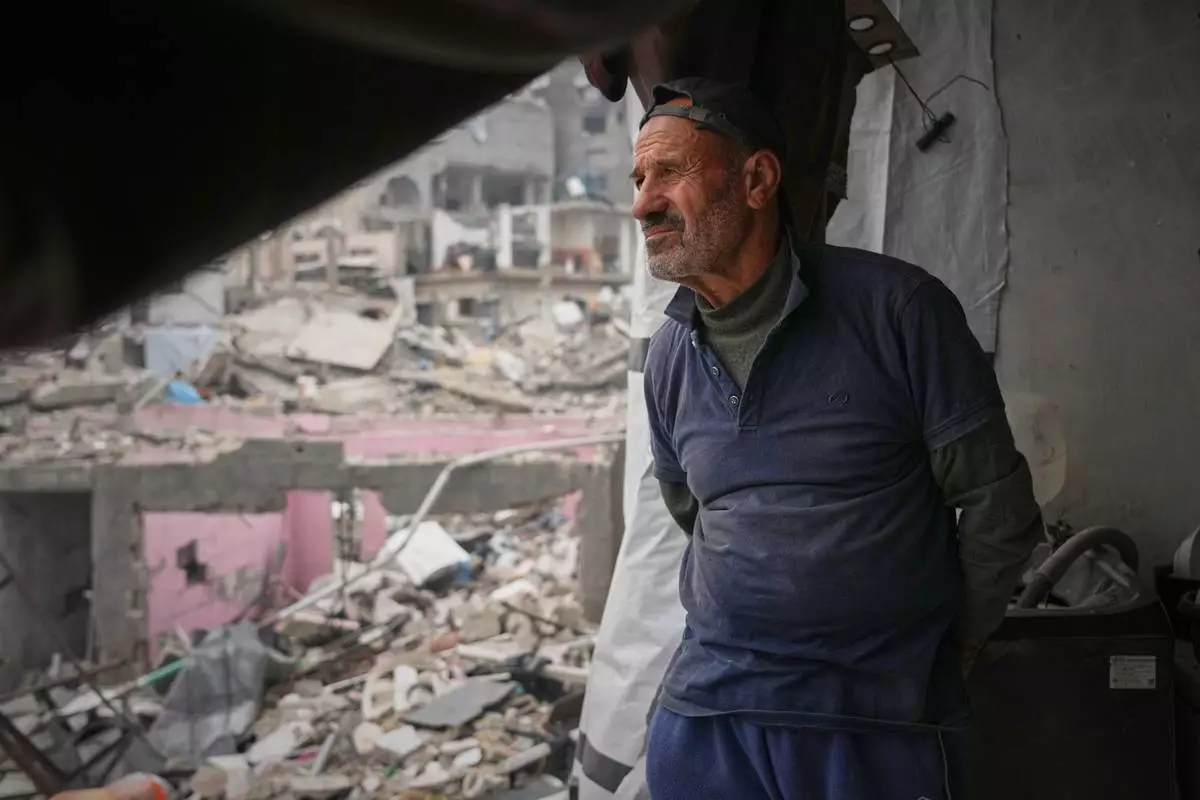
Khaled Nassar looks over the destruction at his apartment in the Jabaliya refugee camp in Gaza City Feb. 9, 2025. Nassar's daughter, Dalia, and his son, Mahmoud, were killed in separate airstrikes, leaving both buried under their homes. (AP Photo/Abdel Kareem Hana)
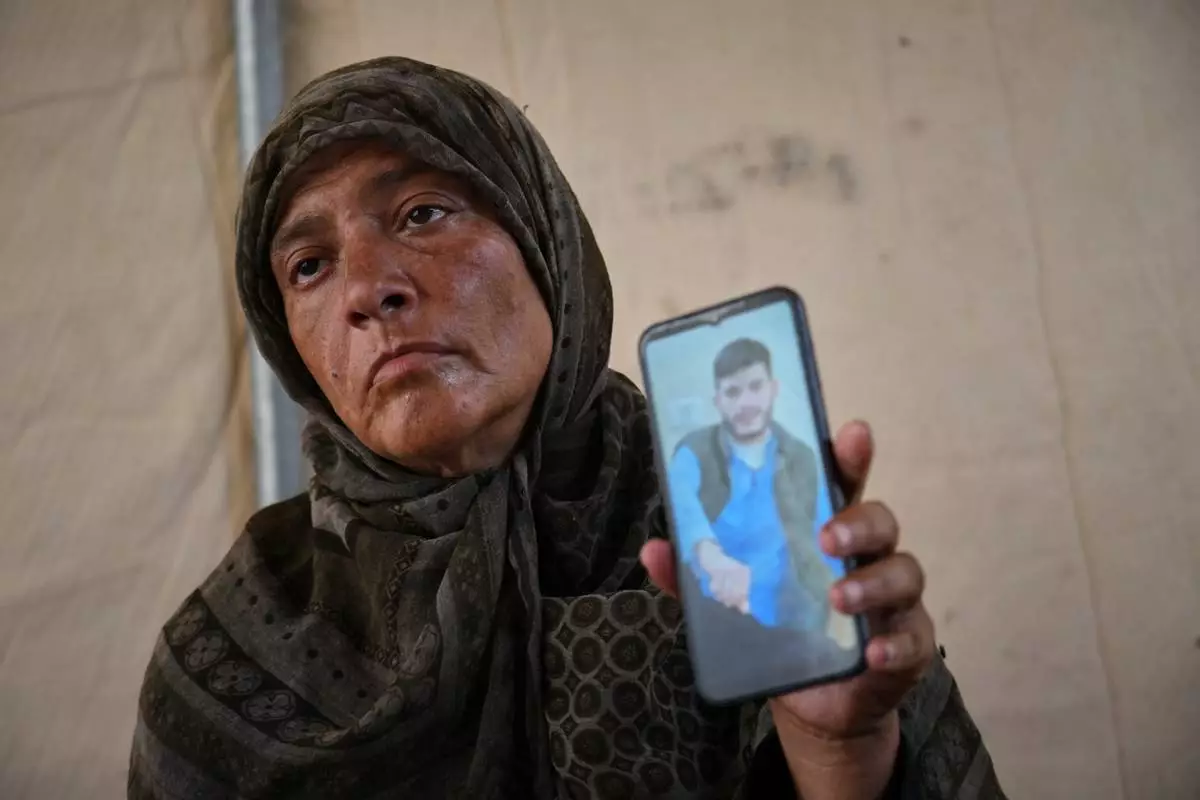
Fadwa al-Ghalban holds a cellphone showing a photo of her son, Mosaab, at her tent in Muwasi, along Gaza's southern coast, Oct. 3, 2025. She has had no word from him since July, when his cousins last saw him near their house as an Israeli strike destroyed it in the southern town of Maan. (AP Photo/Jehad Alshrafi)
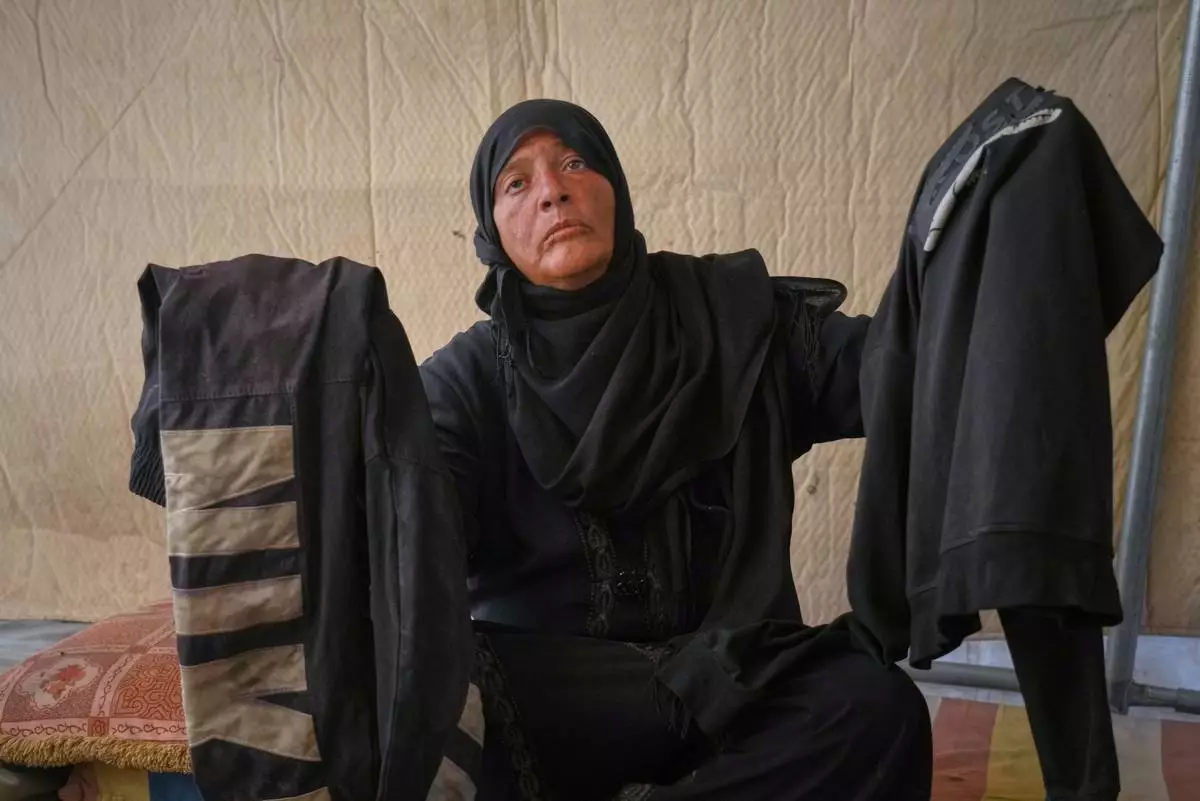
Fadwa al-Ghalban holds clothes belonging to her son, Mosaab, at her tent in Muwasi, along Gaza's southern coast, Oct. 3, 2025. Fadwa has had no word from Mosaab since July, when his cousins last saw him near their house as an Israeli strike destroyed it in the southern town of Maan. (AP Photo/Jehad Alshrafi)
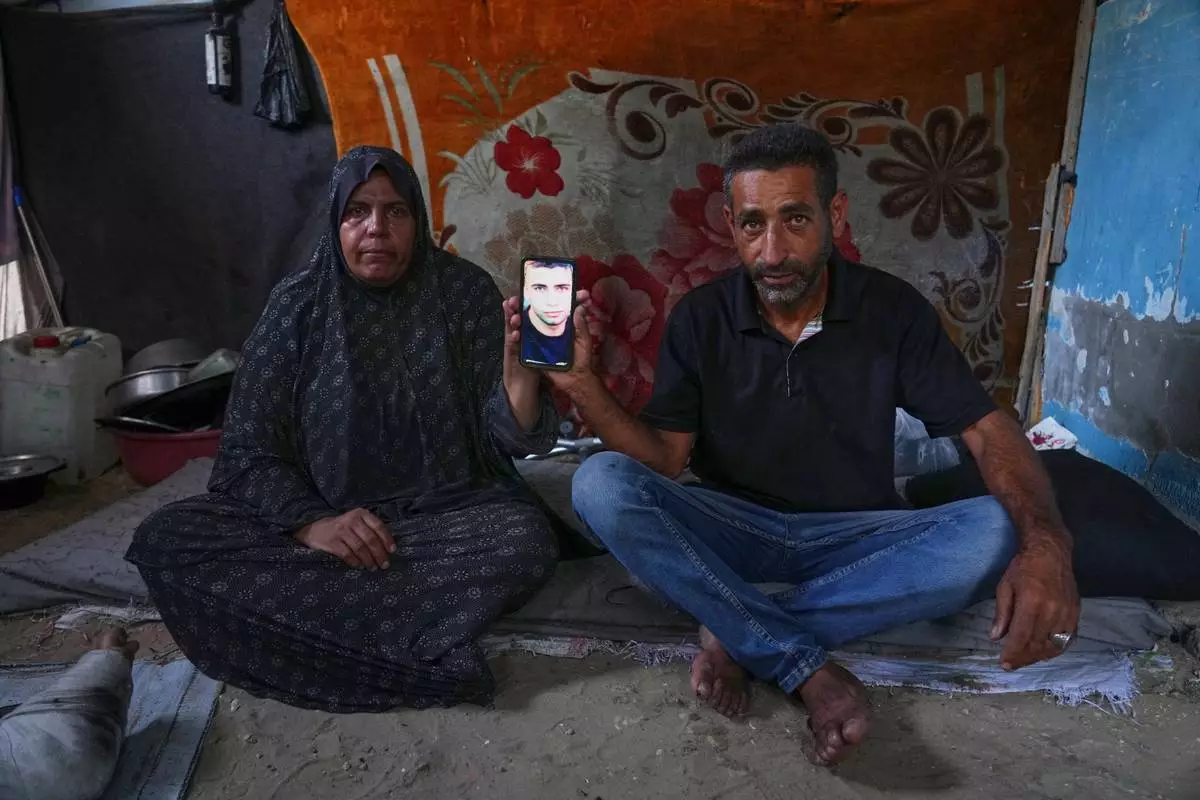
Mohammad and Tahani al-Najjar hold a cellphone showing a picture of their son, Ahmad, at their family's tent in Muwasi, along Gaza's southern coast, Feb. 22, 2025. Nearly two years after Ahmad went missing following Israeli bombardment, the al-Najjars are still searching for him. (AP Photo/Jehad Alshrafi)