Skip to Content Facebook Feature Image

Three scientists at US universities win Nobel Prize in physics for advancing quantum technology

News

Three scientists at US universities win Nobel Prize in physics for advancing quantum technology
News

News

Three scientists at US universities win Nobel Prize in physics for advancing quantum technology

2025-10-08 05:55 Last Updated At:06:00

STOCKHOLM (AP) — Three scientists won the Nobel Prize in physics Tuesday for research on the strange behavior of subatomic particles called quantum tunneling that enabled the ultra-sensitive measurements achieved by MRI machines and laid the groundwork for better cellphones and faster computers.

The work by John Clarke, Michel H. Devoret and John M. Martinis, who work at American universities, took the seeming contradictions of the subatomic world — where light can be both a wave and a particle and parts of atoms can tunnel through seemingly impenetrable barriers — and applied them in the more traditional physics of digital devices. The results of their findings are just starting to appear in advanced technology and could pave the way for the development of supercharged computing.

More Images
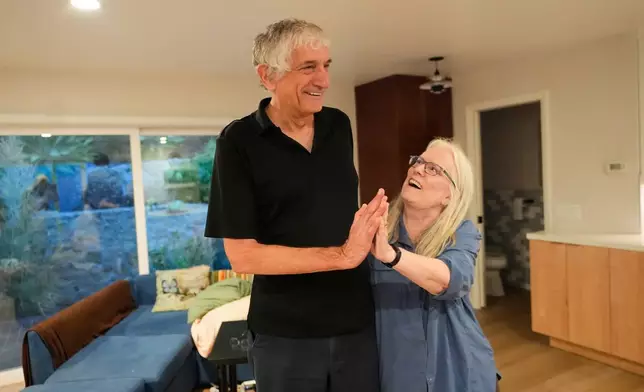
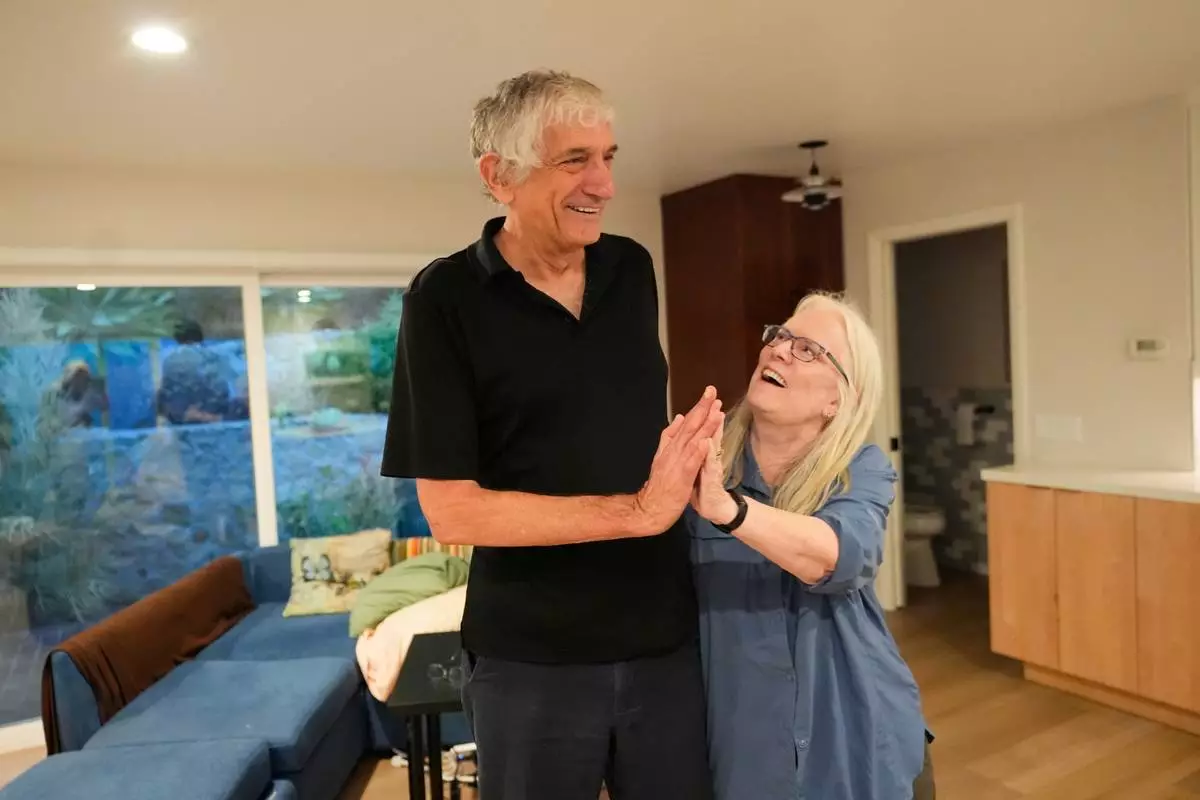
John Martinis stands with his wife Jean in their living room after winning the Nobel Prize in Physics for his work on quantum tunneling on Tuesday, Oct. 7, 2025, in Santa Barbara, Calif. (AP Photo/Mark J. Terrill)
John Martinis stands with his wife Jean in their living room after winning the Nobel Prize in Physics for his work on quantum tunneling on Tuesday, Oct. 7, 2025, in Santa Barbara, Calif. (AP Photo/Mark J. Terrill)
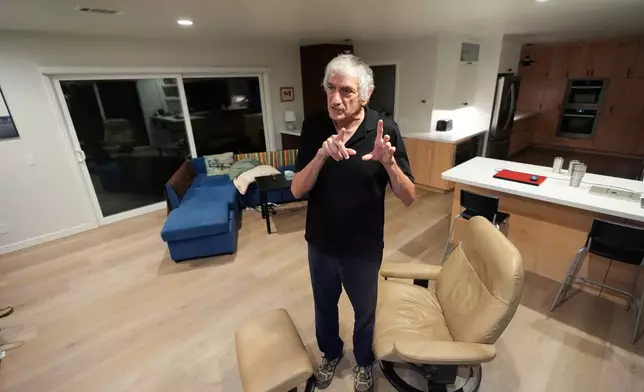
John Martinis stands in his living room after winning the Nobel Prize in Physics for his work on quantum tunneling on Tuesday, Oct. 7, 2025, in Santa Barbara, Calif. (AP Photo/Mark J. Terrill)
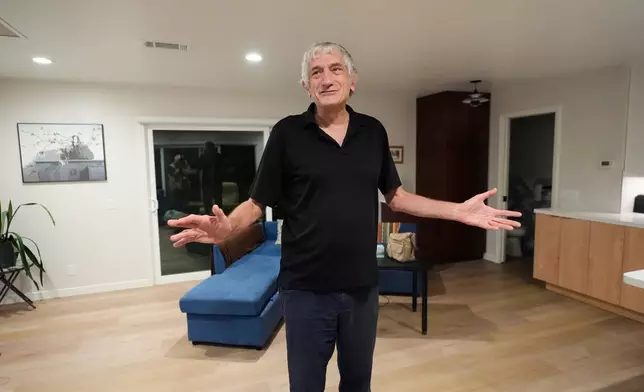
John Martinis stands in his living room after winning the Nobel Prize in Physics for his work on quantum tunneling on Tuesday, Oct. 7, 2025, in Santa Barbara, Calif. (AP Photo/Mark J. Terrill)

John Martinis stands in his living room after winning the Nobel Prize in Physics for his work on quantum tunneling on Tuesday, Oct. 7, 2025, in Santa Barbara, Calif. (AP Photo/Mark J. Terrill)

John Martinis stands in his living room after winning the Nobel Prize in Physics for his work on quantum tunneling on Tuesday, Oct. 7, 2025, in Santa Barbara, Calif. (AP Photo/Mark J. Terrill)

A bicyclist rides past the Becton Engineering and Applied Science Center at Yale University where Yale Professor Emeritus of Applied Physics Michel Devoret has an office and laboratory, Tuesday, Oct. 7, 2025, in New Haven, Conn. (AP Photo/Jessica Hill)
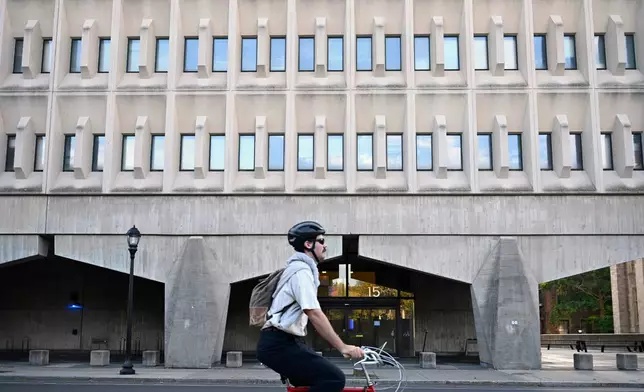
A bicyclist rides past the Becton Engineering and Applied Science Center at Yale University where Yale Professor Emeritus of Applied Physics Michel Devoret has an office and laboratory, Tuesday, Oct. 7, 2025, in New Haven, Conn. (AP Photo/Jessica Hill)

Member of the Nobel Committee for Physics Goran Johansson explains this year's Nobel Prize in Physics, awarded to John Clarke, Michel H Devoret and John M. Martinis, at the Nobel Assembly of the Karolinska Institutet, in Stockholm, Sweden, Tuesday, Oct. 7, 2025. (Christine Olsson/TT News Agency via AP)
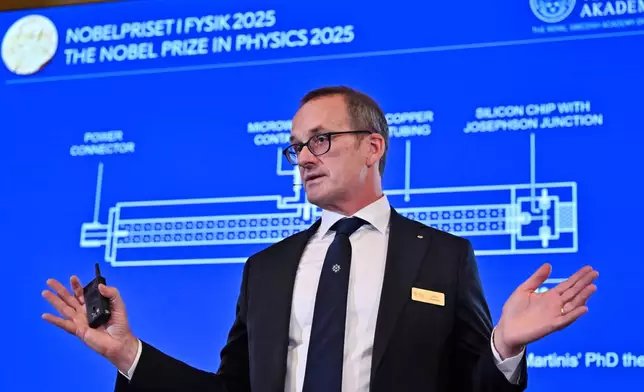
Member of the Nobel Committee for Physics Goran Johansson explains this year's Nobel Prize in Physics, awarded to John Clarke, Michel H Devoret and John M. Martinis, at the Nobel Assembly of the Karolinska Institutet, in Stockholm, Sweden, Tuesday, Oct. 7, 2025. (Christine Olsson/TT News Agency via AP)
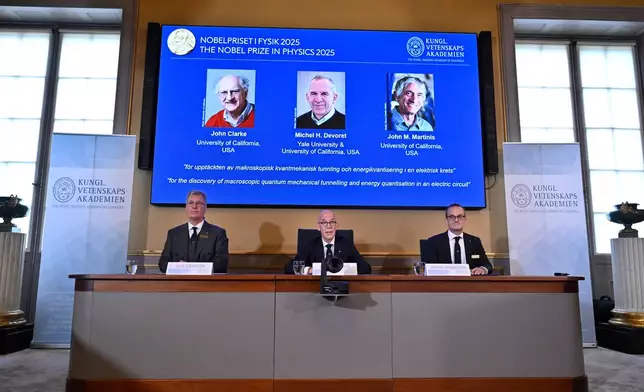
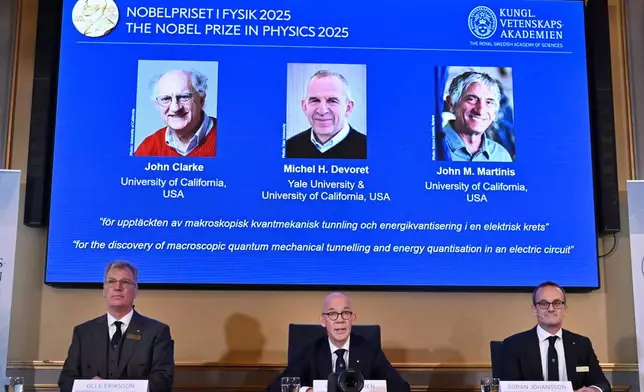
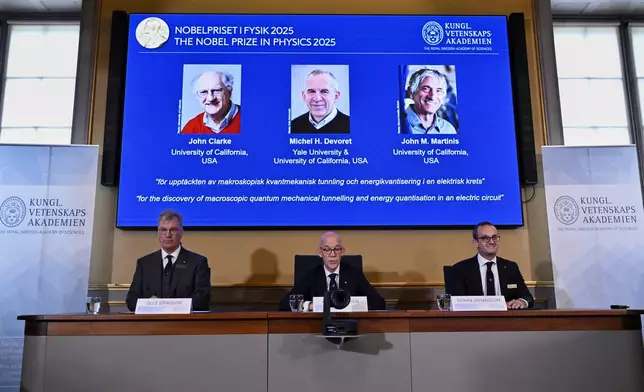
From left, Chair of the Nobel Committee for Physics Chair Olle Eriksson, Secretary General of the Swedish Academy of Sciences Hans Ellegren and Member of the Nobel Committee for Physics Goran Johansson announce John Clarke, Michel H Devoret and John M. Martinis, on screen behind, as the recipients the Nobel Prize in Physics, at the Nobel Assembly of the Karolinska Institutet, in Stockholm, Sweden, Tuesday, Oct. 7, 2025. (Christine Olsson/TT News Agency via AP)
From left, Chair of the Nobel Committee for Physics Chair Olle Eriksson, Secretary General of the Swedish Academy of Sciences Hans Ellegren and Member of the Nobel Committee for Physics Goran Johansson announce John Clarke, Michel H Devoret and John M. Martinis, on screen behind, as the recipients the Nobel Prize in Physics, at the Nobel Assembly of the Karolinska Institutet, in Stockholm, Sweden, Tuesday, Oct. 7, 2025. (Christine Olsson/TT News Agency via AP)
From left, Chair of the Nobel Committee for Physics Chair Olle Eriksson, Secretary General of the Swedish Academy of Sciences Hans Ellegren and Member of the Nobel Committee for Physics Goran Johansson announce John Clarke, Michel H Devoret and John M. Martinis, on screen behind, as the recipients the Nobel Prize in Physics, at the Nobel Assembly of the Karolinska Institutet, in Stockholm, Sweden, Tuesday, Oct. 7, 2025. (Christine Olsson/TT News Agency via AP)
From left, Chair of the Nobel Committee for Physics Chair Olle Eriksson, Secretary General of the Swedish Academy of Sciences Hans Ellegren and Member of the Nobel Committee for Physics Goran Johansson announce John Clarke, Michel H Devoret and John M. Martinis, on screen behind, as the recipients the Nobel Prize in Physics, at the Nobel Assembly of the Karolinska Institutet, in Stockholm, Sweden, Tuesday, Oct. 7, 2025. (Christine Olsson/TT News Agency via AP)

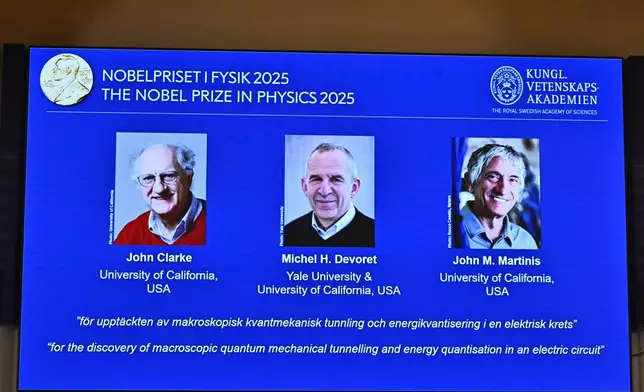
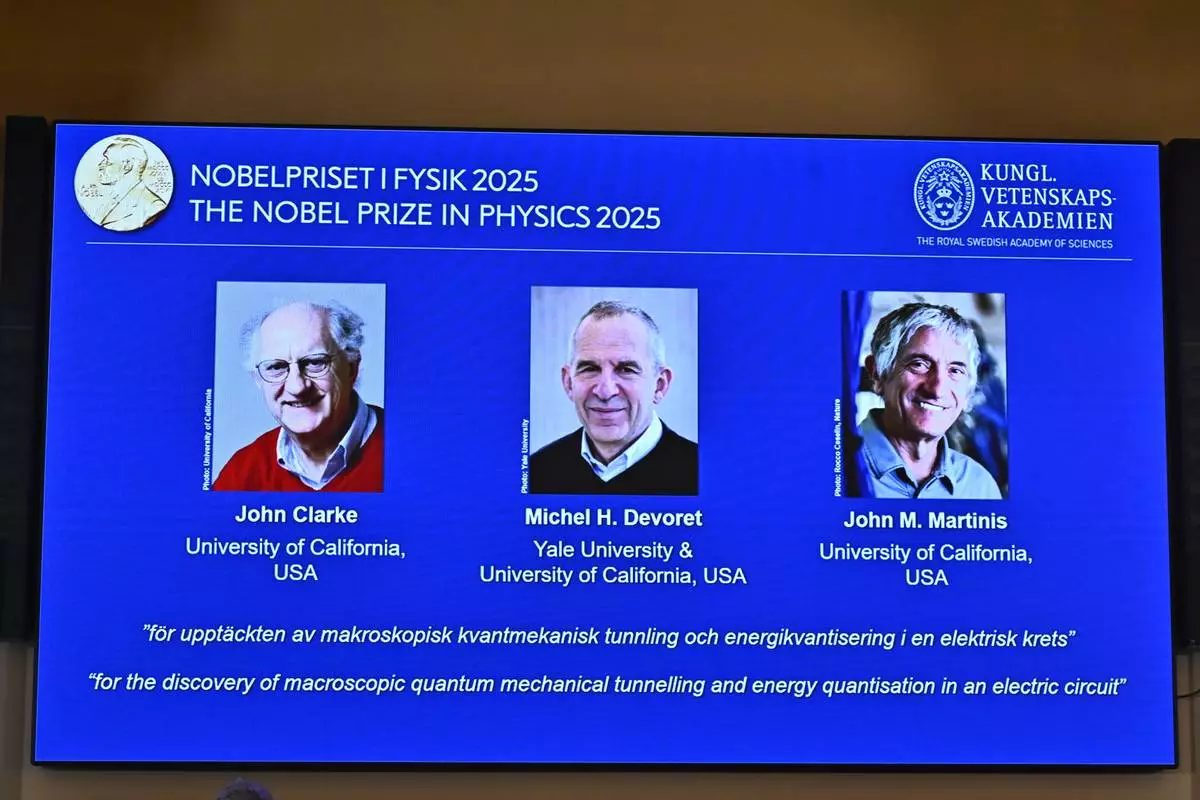
Photos of John Clarke, Michel H Devoret and John M. Martinis are pictured on a screen after they were announced as winners of the Nobel Prize in Physics, at the Nobel Assembly of the Karolinska Institutet, in Stockholm, Sweden, Tuesday, Oct. 7, 2025. (Christine Olsson/TT News Agency via AP)

Photos of John Clarke, Michel H Devoret and John M. Martinis are pictured on a screen after they were announced as winners of the Nobel Prize in Physics, at the Nobel Assembly of the Karolinska Institutet, in Stockholm, Sweden, Tuesday, Oct. 7, 2025. (Christine Olsson/TT News Agency via AP)

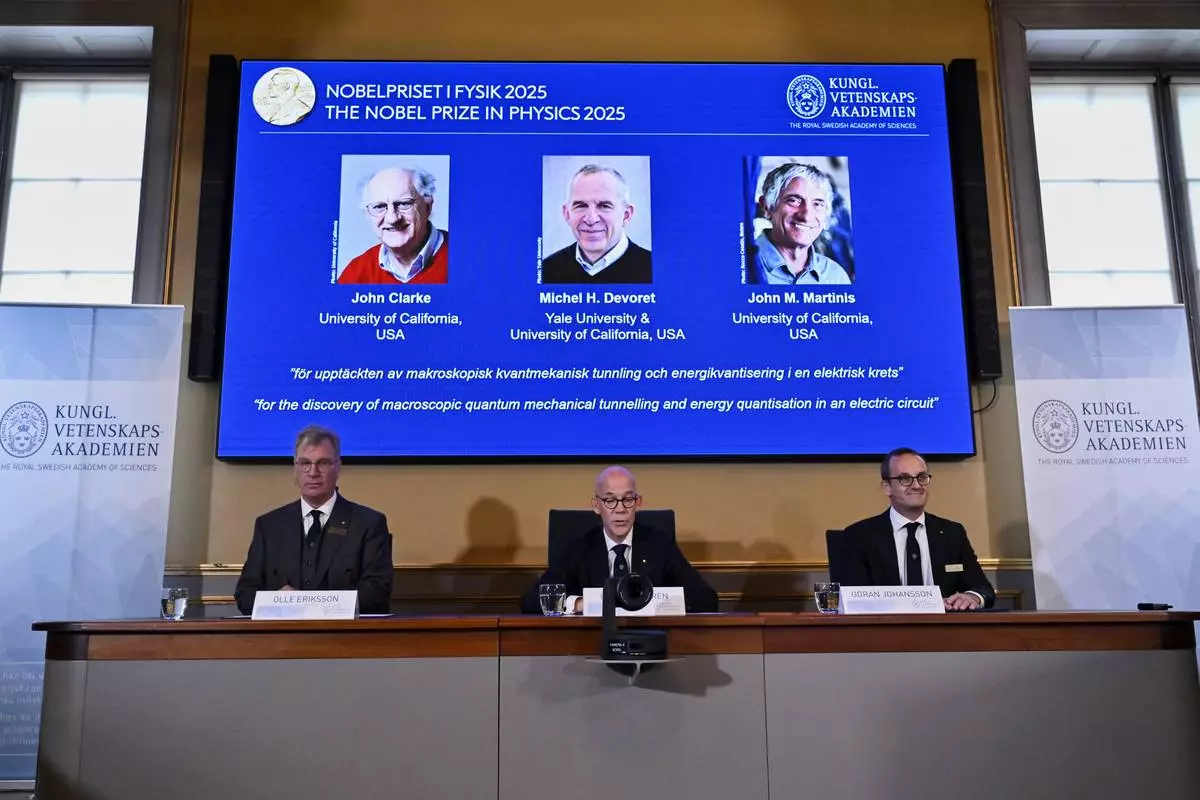
From left, Chair of the Nobel Committee for Physics Chair Olle Eriksson, Secretary General of the Swedish Academy of Sciences Hans Ellegren and Member of the Nobel Committee for Physics Goran Johansson announce John Clarke, Michel H Devoret and John M. Martinis, on screen behind, as the recipients the Nobel Prize in Physics, at the Nobel Assembly of the Karolinska Institutet, in Stockholm, Sweden, Tuesday, Oct. 7, 2025. (Christine Olsson/TT News Agency via AP)

From left, Chair of the Nobel Committee for Physics Chair Olle Eriksson, Secretary General of the Swedish Academy of Sciences Hans Ellegren and Member of the Nobel Committee for Physics Goran Johansson announce John Clarke, Michel H Devoret and John M. Martinis, on screen behind, as the recipients the Nobel Prize in Physics, at the Nobel Assembly of the Karolinska Institutet, in Stockholm, Sweden, Tuesday, Oct. 7, 2025. (Christine Olsson/TT News Agency via AP)

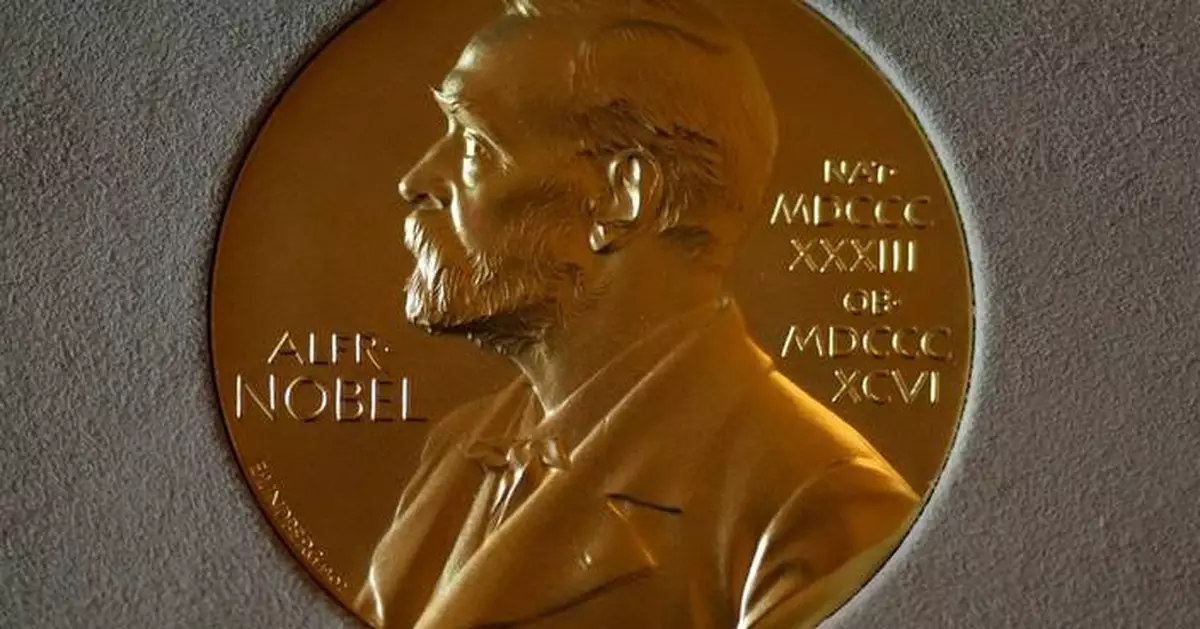
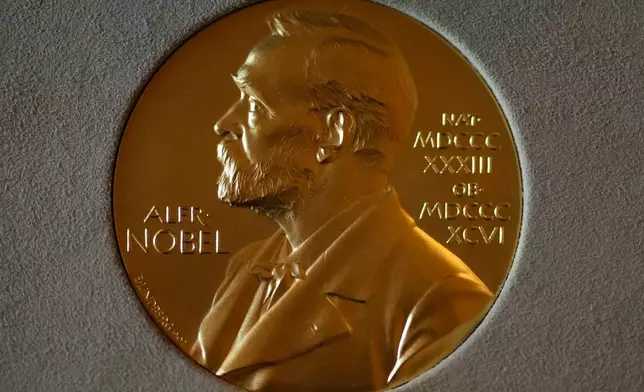
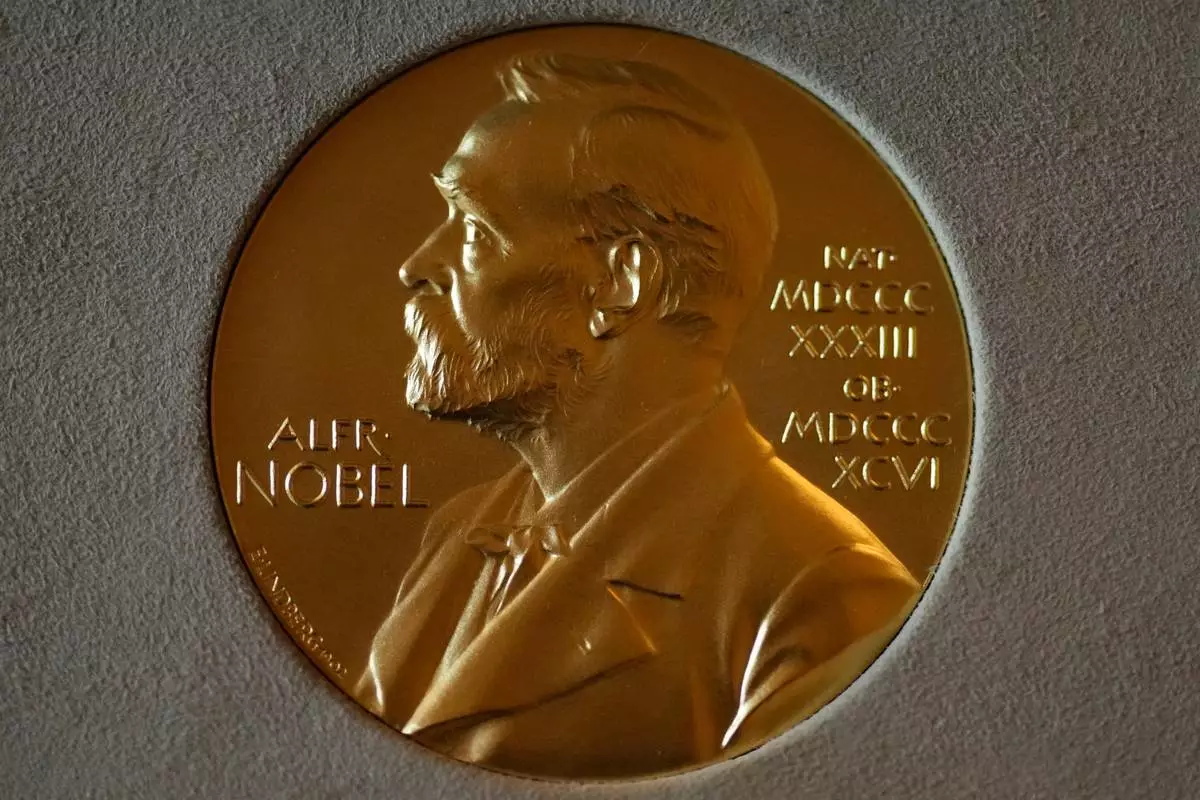
FILE - A Nobel Prize medal is displayed before a ceremony at the Swedish Ambassador's Residence in London, Monday, Dec. 6, 2021. (AP Photo/Matt Dunham, File)

FILE - A Nobel Prize medal is displayed before a ceremony at the Swedish Ambassador's Residence in London, Monday, Dec. 6, 2021. (AP Photo/Matt Dunham, File)

The prizewinning research in the mid-1980s took the subatomic “weirdness of quantum mechanics” and found how those tiny interactions can have real-world applications, said Jonathan Bagger, CEO of the American Physical Society. The experiments were a crucial building block in the fast-developing world of quantum mechanics.

Speaking from his cellphone, Clarke, who spearheaded the research team, said: “One of the underlying reasons that cellphones work is because of all this work."

When quantum mechanics first came to light in 1926, a prominent physicist sought to illustrate its many paradoxes with the example of a cat in a box that was both alive and dead at the same time. The three Nobel winners showed that science can put such principles to work, said Physics Today Editor-in-Chief Richard Fitzgerald, who was in a competing research group in the 1990s.

“They didn’t take it that far, but they showed that it can be done,” Fitzgerald said.

The winning physicists took “the scale of something that we can’t see, we can’t touch, we can’t feel" and brought it “up to the scale of something recognizable” and made it "something you can build upon,” Fitzgerald said.

Clarke, 83, conducted his research at the University of California, Berkeley. Martinis, 67, worked at the University of California, Santa Barbara. Devoret, 72, is at Yale and also at the University of California, Santa Barbara.

Martinis’ wife, Jean, told Associated Press reporters who called at his home hours after the announcement that he was still asleep and did not yet know. In the past, she said, they stayed up on the night of the physics award, but at some point they decided that sleep was more important.

When his wife woke him and told him about the journalists seeking an interview, the new Nobel laureate remembered that the prizes were being announced this week. He opened his computer, looked at the announcement and saw his picture along with the other winners.

"So I was kind of in shock,” he said.

Clarke said it never occurred to him that he would win a Nobel Prize.

“I practically collapsed,” Clarke told AP. “I was completely stunned. I mean, it’s something that I had never, ever dreamed of in my entire life.”

Martinis — who was a senior Google scientist working toward quantum computing before co-founding his own company, Qolab — said the big future goal is quantum computing, which would be a giant leap in speed and sophistication by relying on the power of the contradictory states in that subatomic world.

That is still eight to 10 years away. But he said the team’s experiments showed "a computer could be much, much more powerful.”

Devoret is now chief scientist for Google’s quantum computing efforts.

Quantum computers are “one very sort of obvious use,” but the research could also help develop sensors that detect and measure faint phenomena, such as magnetic fields, and advance cryptography to encode information, said Mark Pearce, a professor of astrophysics and Nobel physics committee member.

And through better understanding of precision chemistry, it could develop better materials for daily living and even give an added boost to artificial intelligence, Martinis said.

Before the work at Berkeley, scientists knew single electrons or pairs of tiny electrons could tunnel through an impenetrable barrier. What Clarke said his team learned was “if you design the circuity properly, you could actually have tunneling" of objects larger and more useful than just a couple of electrons.

That discovery “can be used to make very sophisticated things that would not otherwise be able to work out,” Clarke said at a news conference, mentioning his iPhone and quantum computers.

He also criticized the Trump administration for its deep cuts to science funding, saying they would “cripple science.”

“If this continues … it may take a decade to get back to where we were half a year ago,” Clarke said.

Martinis, Bagger and Fitzgerald said it’s a bit of a stretch to say cellphones now use the breakthrough made by Clarke and colleagues. But ultra-sensitive measuring devices rely on the team’s work, including MRI machines, which would be far less useful without their advances, Bagger said.

“Quantum mechanics is everywhere in everything we do, from the cellphone to the satellite communications that are connected to the cellphones, to the screens on which we watch our videos on our cellphones,” Bagger said.

Tuesday's award was the 119th time the prize has been given. Last year, artificial intelligence pioneers John Hopfield and Geoffrey Hinton won the physics prize for helping create the building blocks of machine learning.

On Monday, Mary E. Brunkow, Fred Ramsdell and Dr. Shimon Sakaguchi won the Nobel Prize in medicine on Monday for discoveries about how the immune system knows to attack germs and not our bodies.

Nobel announcements continue with the chemistry prize on Wednesday and literature on Thursday. The Nobel Peace Prize will be announced Friday followed by the Nobel Memorial Prize in economics on Monday.

The award ceremony will be held Dec. 10, the anniversary of the 1896 death of Alfred Nobel, the wealthy Swedish industrialist and the inventor of dynamite who founded the prizes.

The prizes carry priceless prestige and a cash award of 11 million Swedish kronor (nearly $1.2 million).

Corder reported from The Hague, Netherlands, and Borenstein from Washington. Associated Press journalist Adithi Ramakrishnan in New York contributed to this report.
John Martinis stands with his wife Jean in their living room after winning the Nobel Prize in Physics for his work on quantum tunneling on Tuesday, Oct. 7, 2025, in Santa Barbara, Calif. (AP Photo/Mark J. Terrill)
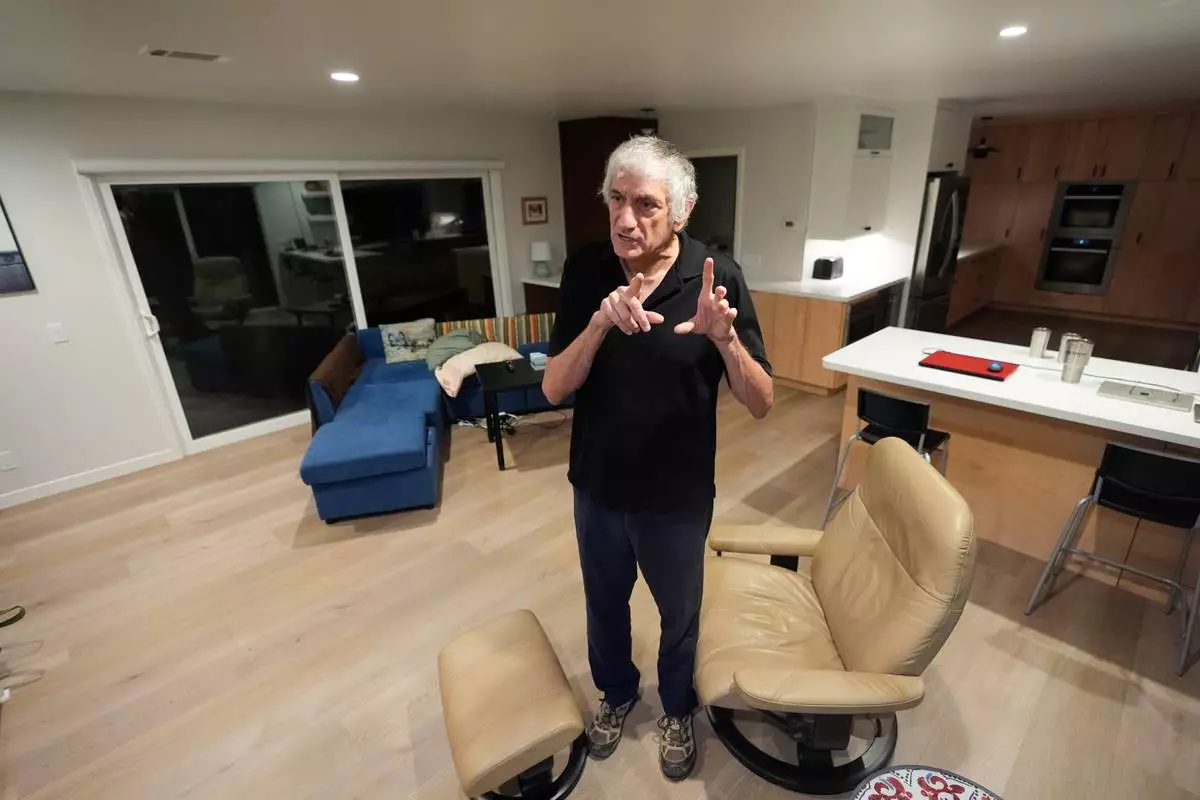
John Martinis stands with his wife Jean in their living room after winning the Nobel Prize in Physics for his work on quantum tunneling on Tuesday, Oct. 7, 2025, in Santa Barbara, Calif. (AP Photo/Mark J. Terrill)
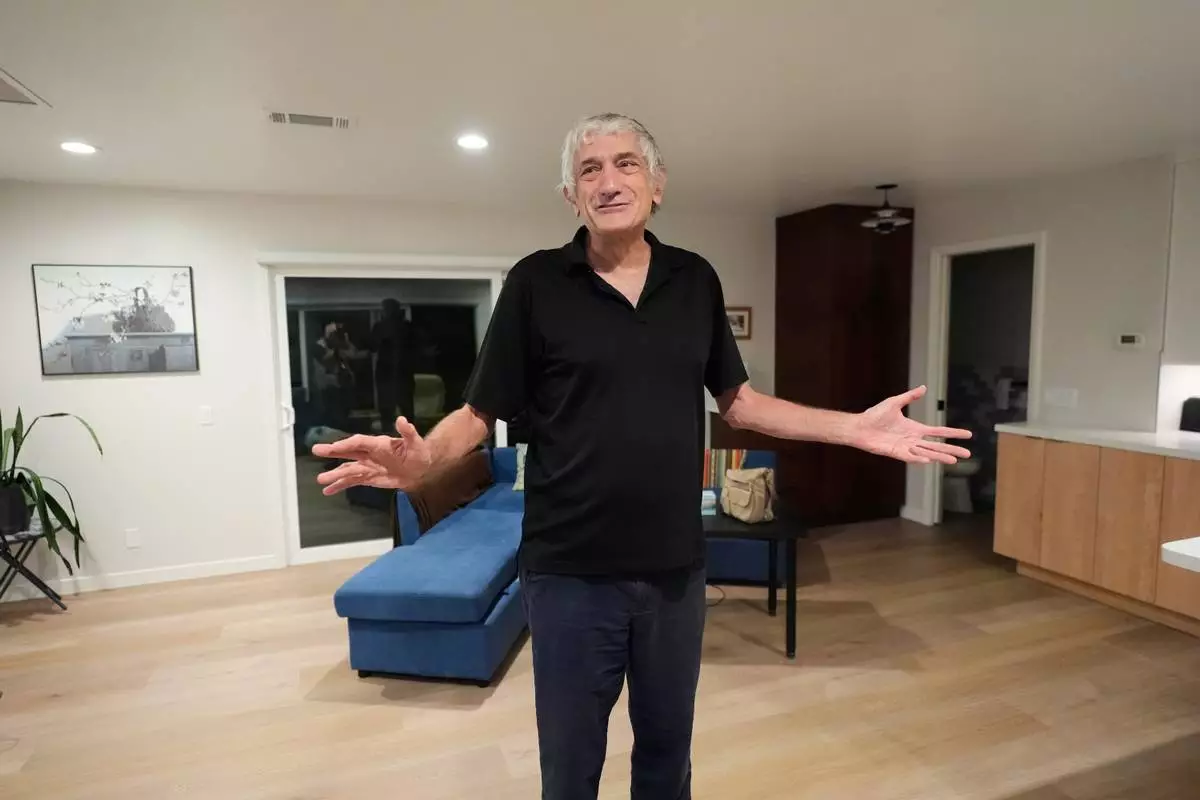
John Martinis stands in his living room after winning the Nobel Prize in Physics for his work on quantum tunneling on Tuesday, Oct. 7, 2025, in Santa Barbara, Calif. (AP Photo/Mark J. Terrill)

John Martinis stands in his living room after winning the Nobel Prize in Physics for his work on quantum tunneling on Tuesday, Oct. 7, 2025, in Santa Barbara, Calif. (AP Photo/Mark J. Terrill)

John Martinis stands in his living room after winning the Nobel Prize in Physics for his work on quantum tunneling on Tuesday, Oct. 7, 2025, in Santa Barbara, Calif. (AP Photo/Mark J. Terrill)

John Martinis stands in his living room after winning the Nobel Prize in Physics for his work on quantum tunneling on Tuesday, Oct. 7, 2025, in Santa Barbara, Calif. (AP Photo/Mark J. Terrill)

A bicyclist rides past the Becton Engineering and Applied Science Center at Yale University where Yale Professor Emeritus of Applied Physics Michel Devoret has an office and laboratory, Tuesday, Oct. 7, 2025, in New Haven, Conn. (AP Photo/Jessica Hill)
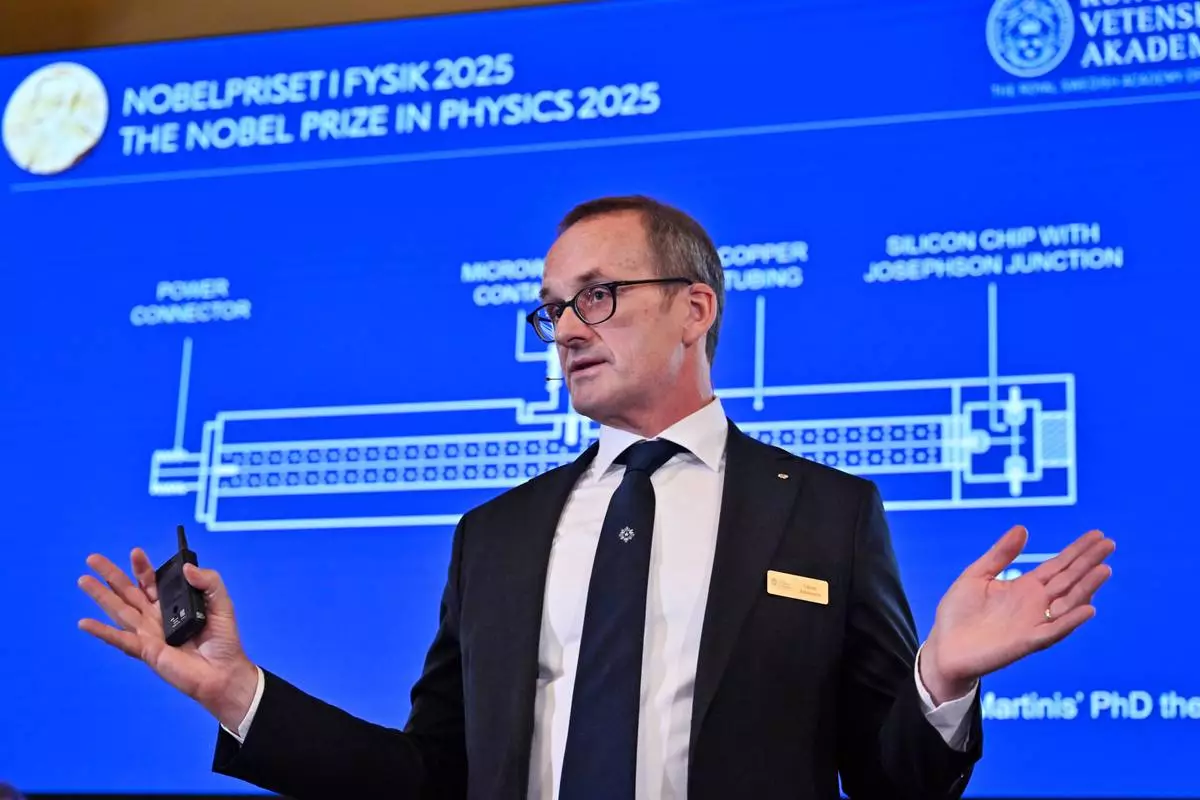
A bicyclist rides past the Becton Engineering and Applied Science Center at Yale University where Yale Professor Emeritus of Applied Physics Michel Devoret has an office and laboratory, Tuesday, Oct. 7, 2025, in New Haven, Conn. (AP Photo/Jessica Hill)

Member of the Nobel Committee for Physics Goran Johansson explains this year's Nobel Prize in Physics, awarded to John Clarke, Michel H Devoret and John M. Martinis, at the Nobel Assembly of the Karolinska Institutet, in Stockholm, Sweden, Tuesday, Oct. 7, 2025. (Christine Olsson/TT News Agency via AP)
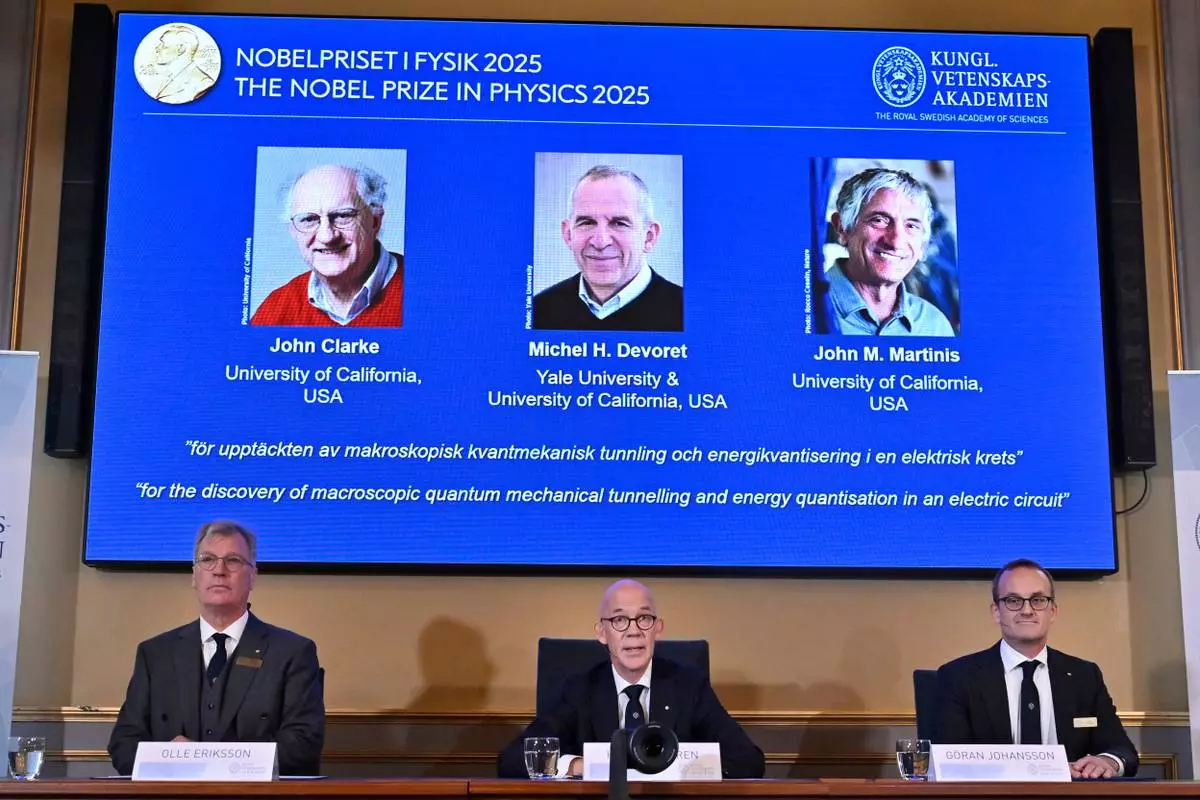
Member of the Nobel Committee for Physics Goran Johansson explains this year's Nobel Prize in Physics, awarded to John Clarke, Michel H Devoret and John M. Martinis, at the Nobel Assembly of the Karolinska Institutet, in Stockholm, Sweden, Tuesday, Oct. 7, 2025. (Christine Olsson/TT News Agency via AP)
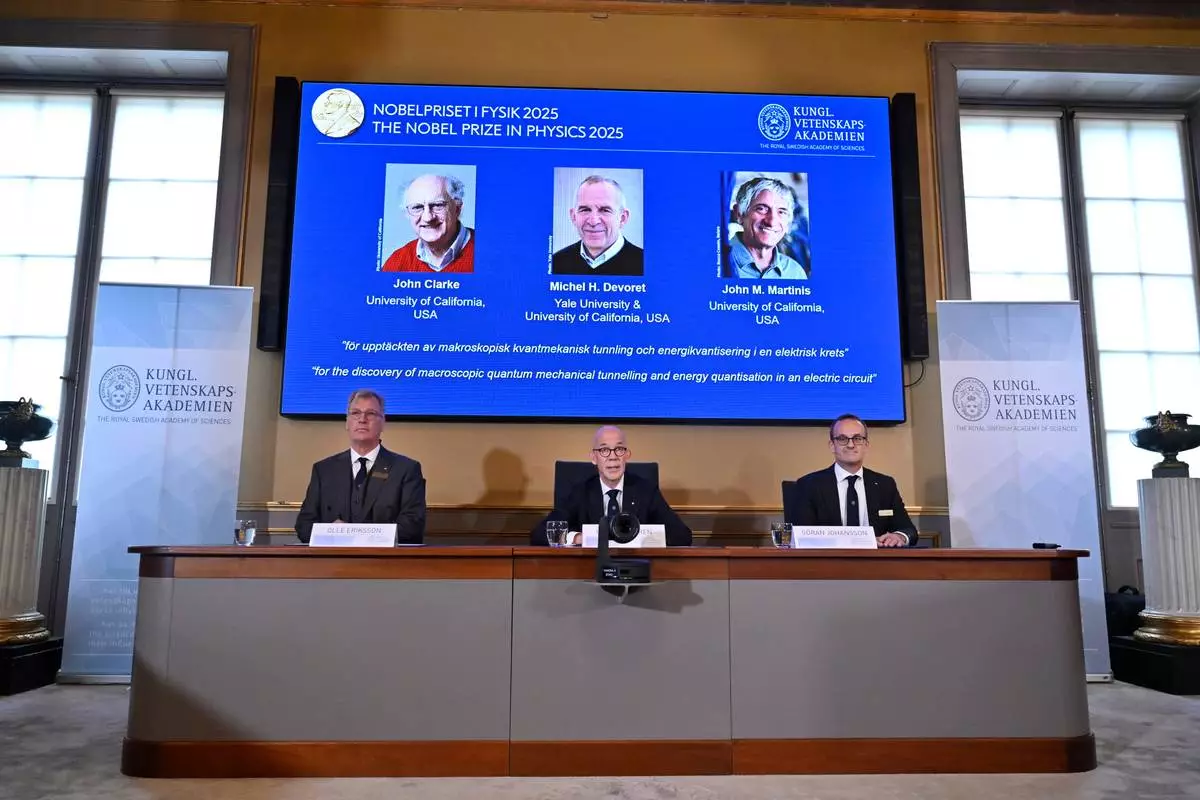
From left, Chair of the Nobel Committee for Physics Chair Olle Eriksson, Secretary General of the Swedish Academy of Sciences Hans Ellegren and Member of the Nobel Committee for Physics Goran Johansson announce John Clarke, Michel H Devoret and John M. Martinis, on screen behind, as the recipients the Nobel Prize in Physics, at the Nobel Assembly of the Karolinska Institutet, in Stockholm, Sweden, Tuesday, Oct. 7, 2025. (Christine Olsson/TT News Agency via AP)
From left, Chair of the Nobel Committee for Physics Chair Olle Eriksson, Secretary General of the Swedish Academy of Sciences Hans Ellegren and Member of the Nobel Committee for Physics Goran Johansson announce John Clarke, Michel H Devoret and John M. Martinis, on screen behind, as the recipients the Nobel Prize in Physics, at the Nobel Assembly of the Karolinska Institutet, in Stockholm, Sweden, Tuesday, Oct. 7, 2025. (Christine Olsson/TT News Agency via AP)
From left, Chair of the Nobel Committee for Physics Chair Olle Eriksson, Secretary General of the Swedish Academy of Sciences Hans Ellegren and Member of the Nobel Committee for Physics Goran Johansson announce John Clarke, Michel H Devoret and John M. Martinis, on screen behind, as the recipients the Nobel Prize in Physics, at the Nobel Assembly of the Karolinska Institutet, in Stockholm, Sweden, Tuesday, Oct. 7, 2025. (Christine Olsson/TT News Agency via AP)
From left, Chair of the Nobel Committee for Physics Chair Olle Eriksson, Secretary General of the Swedish Academy of Sciences Hans Ellegren and Member of the Nobel Committee for Physics Goran Johansson announce John Clarke, Michel H Devoret and John M. Martinis, on screen behind, as the recipients the Nobel Prize in Physics, at the Nobel Assembly of the Karolinska Institutet, in Stockholm, Sweden, Tuesday, Oct. 7, 2025. (Christine Olsson/TT News Agency via AP)

Photos of John Clarke, Michel H Devoret and John M. Martinis are pictured on a screen after they were announced as winners of the Nobel Prize in Physics, at the Nobel Assembly of the Karolinska Institutet, in Stockholm, Sweden, Tuesday, Oct. 7, 2025. (Christine Olsson/TT News Agency via AP)

Photos of John Clarke, Michel H Devoret and John M. Martinis are pictured on a screen after they were announced as winners of the Nobel Prize in Physics, at the Nobel Assembly of the Karolinska Institutet, in Stockholm, Sweden, Tuesday, Oct. 7, 2025. (Christine Olsson/TT News Agency via AP)

From left, Chair of the Nobel Committee for Physics Chair Olle Eriksson, Secretary General of the Swedish Academy of Sciences Hans Ellegren and Member of the Nobel Committee for Physics Goran Johansson announce John Clarke, Michel H Devoret and John M. Martinis, on screen behind, as the recipients the Nobel Prize in Physics, at the Nobel Assembly of the Karolinska Institutet, in Stockholm, Sweden, Tuesday, Oct. 7, 2025. (Christine Olsson/TT News Agency via AP)

From left, Chair of the Nobel Committee for Physics Chair Olle Eriksson, Secretary General of the Swedish Academy of Sciences Hans Ellegren and Member of the Nobel Committee for Physics Goran Johansson announce John Clarke, Michel H Devoret and John M. Martinis, on screen behind, as the recipients the Nobel Prize in Physics, at the Nobel Assembly of the Karolinska Institutet, in Stockholm, Sweden, Tuesday, Oct. 7, 2025. (Christine Olsson/TT News Agency via AP)

FILE - A Nobel Prize medal is displayed before a ceremony at the Swedish Ambassador's Residence in London, Monday, Dec. 6, 2021. (AP Photo/Matt Dunham, File)

FILE - A Nobel Prize medal is displayed before a ceremony at the Swedish Ambassador's Residence in London, Monday, Dec. 6, 2021. (AP Photo/Matt Dunham, File)

BANGKOK (AP) — Myanmar’s parliament on Friday elected Min Aung Hlaing, a general who ousted Aung San Suu Kyi’s civilian government in 2021 and kept an iron grip on power for the past five years, as the country’s new president.

The move marks a nominal return to an elected government but is widely considered as an effort to keep the army in power after an election organized by the military that opponents and independent observers deemed neither free nor fair, and as civil war rages.

Transitioning to an elected government is also seen as a way to improve frosty relations with some Southeast Asian neighbors following the military takeover. China and Russia have supported the military administration, while Western powers imposed sanctions.

Min Aung Hlaing was one of three nominees for the president’s post, but was virtually guaranteed the job as lawmakers from military-backed parties and appointed members from the army hold a commanding majority in parliament.

The vote was held in the newly renovated parliament building in the capital, Naypyitaw, which was damaged in last year’s earthquake.

Aung Lin Dwe, speaker of parliament’s combined upper and lower house, announced that Min Aung Hlaing won 429 out of the 584 votes.

The two runners-up become vice presidents. Nyo Saw, a former general, had served as an adviser to Min Aung Hlaing, and Nan Ni Ni Aye, an ethnic Karen politician from the pro-military Union Solidarity and Development Party, will be the country’s first female vice president. All three are expected to be inaugurated next week.

Min Aung Hlaing, who holds the rank of senior general, earlier this week relinquished his post of commander-in-chief because the constitution prohibits the president from simultaneously holding the top military position. A close aide, Gen. Ye Win Oo, took over the powerful job.

Meanwhile, much of the country remains enmeshed in a bloody civil war.

Nay Phone Latt, a spokesperson for the National Unity Government — Myanmar’s main opposition organization, which views itself as the country’s legitimate government — charged that Min Aung Hlaing is responsible for numerous war crimes, and his easy assumption of the presidency proved that the political change some countries had hoped for will not materialize.

“Myanmar people do not accept it. The revolution will continue with great momentum,” he told The Associated Press..

The 69-year-old Min Aung Hlaing had been the military chief since 2011. Under the military-imposed constitution, he held significant powers even before overthrowing Suu Kyi’s government.

Parliament members were elected in three phases in December and January. Major opposition parties, including Suu Kyi’s former ruling National League for Democracy, were either blocked from running or refused to compete under conditions they deemed unfair. Suu Kyi, 80, is serving a 27-year prison term on charges widely viewed as politically motivated.

Myanmar was under military rule from 1962 to 2016, when Suu Kyi’s party won a landslide election victory. It won an even greater mandate in the 2020 polls, but the army staged a takeover in 2021 before the new parliament could convene.

Peaceful protests against military rule were then put down with deadly force, pushing pro-democracy activists to turn to armed resistance and ally themselves with ethnic minority groups who have been battling for greater autonomy for decades.

Security concerns meant voting in the recent election could be held in only 263 of the country’s 330 townships.

Nearly 8,000 activists and civilians have been killed since the 2021 army takeover, and some 22,872 political detainees are imprisoned, according to the Assistance Association for Political Prisoners, an independent group that tracks rights violations.

The military’s major reliance on airstrikes — 1,140 strikes in 2025 alone, according to the U.S.-based Armed Conflict Location & Event Data Project — accounts for hundreds of civilian casualties.

“If Min Aung Hlaing thinks that an official civilian title will shield him from prosecution for the many grave violations of international law that he is accused of overseeing as head of the military, that is not how international justice works," Amnesty International Myanmar researcher Joe Freeman said in statement.

The International Criminal Court in The Hague in 2024 began an investigation into charges of crimes against humanity after the chief prosecutor applied for an arrest warrant for Min Aung Hlaing over the military’s brutal persecution of the Rohingya minority.

At long-awaited hearings at the International Court of Justice in January this year, Myanmar defended itself against accusations that it was responsible for genocide against the Rohingya. The West African country of Gambia first filed the case in 2019.

Parliament chairman Aung Lin Dwe, center, arrives for a session of Union Parliament in Naypyitaw, Myanmar, Friday, April 3, 2026. (AP Photo/Aung Shine Oo)

Parliament chairman Aung Lin Dwe, center, arrives for a session of Union Parliament in Naypyitaw, Myanmar, Friday, April 3, 2026. (AP Photo/Aung Shine Oo)

FILE - Senior Gen. Min Aung Hlaing, head of Myanmar's military council, inspects officers during a parade to commemorate Myanmar's 78th Armed Forces Day in Naypyitaw, Myanmar, March 27, 2023. (AP Photo/Aung Shine Oo, File)

FILE - Senior Gen. Min Aung Hlaing, head of Myanmar's military council, inspects officers during a parade to commemorate Myanmar's 78th Armed Forces Day in Naypyitaw, Myanmar, March 27, 2023. (AP Photo/Aung Shine Oo, File)

Myanmar's military representatives and lawmakers arrive to attend a session at Union parliament in Naypyitaw, Myanmar, Friday, April 3, 2026.(AP Photo/Aung Shine Oo)

Myanmar's military representatives and lawmakers arrive to attend a session at Union parliament in Naypyitaw, Myanmar, Friday, April 3, 2026.(AP Photo/Aung Shine Oo)

Myanmar's military representatives arrive for a session at Union parliament in Naypyitaw, Myanmar, Thursday, April 2, 2026. (AP Photo/Aung Shine Oo)

Myanmar's military representatives arrive for a session at Union parliament in Naypyitaw, Myanmar, Thursday, April 2, 2026. (AP Photo/Aung Shine Oo)

Myanmar's military representatives arrive for a session at Union parliament in Naypyitaw, Myanmar, Friday, April 3, 2026. (AP Photo/Aung Shine Oo)

Myanmar's military representatives arrive for a session at Union parliament in Naypyitaw, Myanmar, Friday, April 3, 2026. (AP Photo/Aung Shine Oo)

Parliament chairman Aung Lin Dwe arrives for a session of Union Parliament in Naypyitaw, Myanmar, Friday, April 3, 2026. (AP Photo/Aung Shine Oo)

Parliament chairman Aung Lin Dwe arrives for a session of Union Parliament in Naypyitaw, Myanmar, Friday, April 3, 2026. (AP Photo/Aung Shine Oo)

Parliament chairman Aung Lin Dwe, center, arrives for a session of Union Parliament in Naypyitaw, Myanmar, Friday, April 3, 2026. (AP Photo/Aung Shine Oo)

Parliament chairman Aung Lin Dwe, center, arrives for a session of Union Parliament in Naypyitaw, Myanmar, Friday, April 3, 2026. (AP Photo/Aung Shine Oo)

Recommended Articles