Villages in Haining City, east China's Zhejiang Province, are riding the wave of Qiantang River's tidal bore tourism, launching entertainment and leisure activities to attract visitors and boost local business.
The Qiantang River is known for the world's largest tidal bore. The tides usually reach their peak on the 18th day of the eighth lunar month.
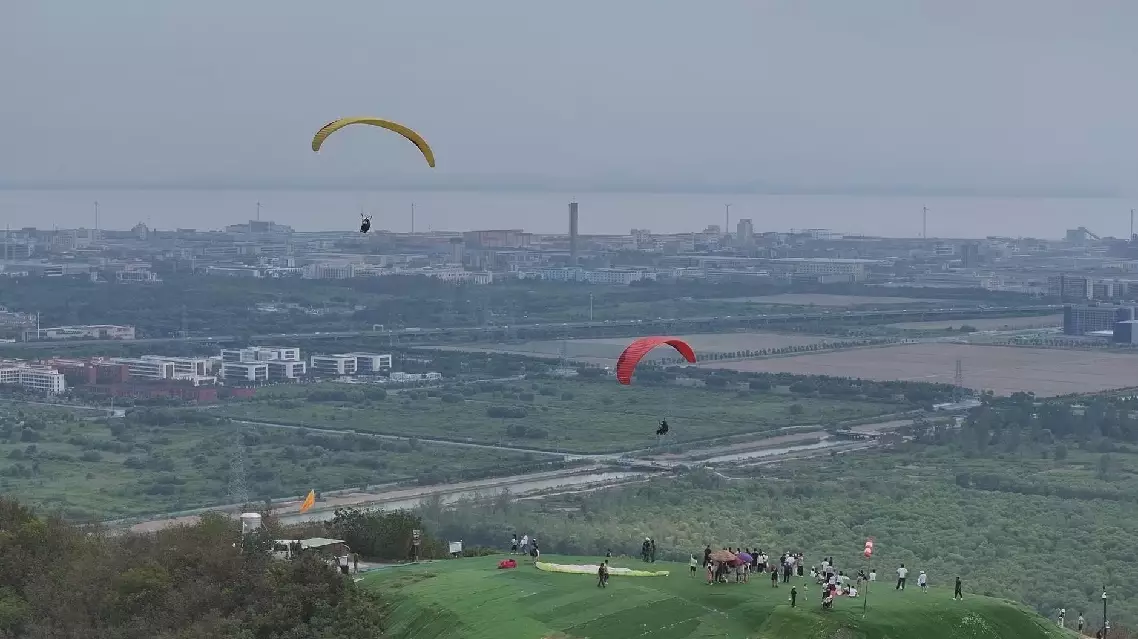
Recently, Haining has seen an influx of tourists eager to witness the breathtaking sight of the peak tides. While many choose the traditional method of watching from the shore, Jianshan Village has introduced a thrilling alternative --paragliding.
"When the tide comes in, our tourist numbers surge, particularly from Shanghai and Hangzhou. During peak times, we can handle around 200 flights daily. It's not just our flying base that attracts more visitors; many nearby water activities also experience a surge in tourists," said Jiang Kai, a coach at the paraglider base.
In Jianshan Village, water sports such as motorboating and power surfing have become popular among adventure enthusiasts from surrounding areas.
"I drove an hour from Hangzhou just to experience this. It's incredibly thrilling and full of fun," said Jiang Xiaojie, a tourist.
In Haichao Village, located at one of the most popular tide-watching locations, a charming riverside cafe has emerged as a key attraction.
"It's very beautiful here. Sitting here puts me in a very relaxed state, and I feel so close to nature," said Zhao Mengyi, a tourist.
In addition, tourists can explore local farms and orchards, indulging in delicious regional cuisines after enjoying the spectacular tidal bores.
The tidal bore is mainly caused by the gravitational pull of the moon. The centrifugal force produced by the rotation of the Earth and the trumpet shape of the Hangzhou Bay in Zhejiang makes it easy for the tide to come in, but difficult to ebb, thus giving rise to the largest tidal bore.
Tidal bore tourism surges in east China city as villages launch leisure attractions