PARIS (AP) — French President Emmanuel Macron said Wednesday that he will name a new prime minister in the next 48 hours, for now rejecting other options in the face of a political storm.
The naming of a replacement for outgoing Prime Minister Sébastien Lecornu, who abruptly resigned on Monday, will — at least for now — move France away from the likelihood of snap legislative elections, another possibility that is available to the French leader but which could plunge the European Union’s second-largest economy into even greater uncertainty.
Click to Gallery
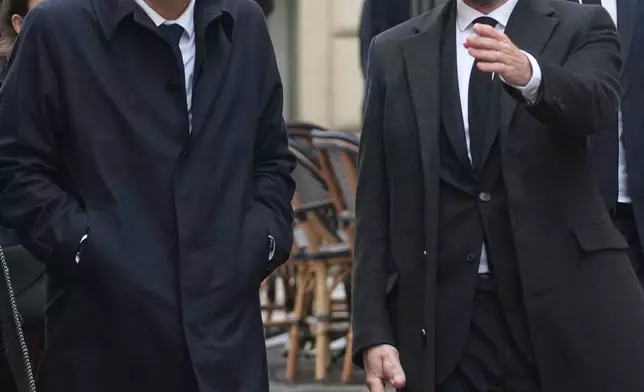
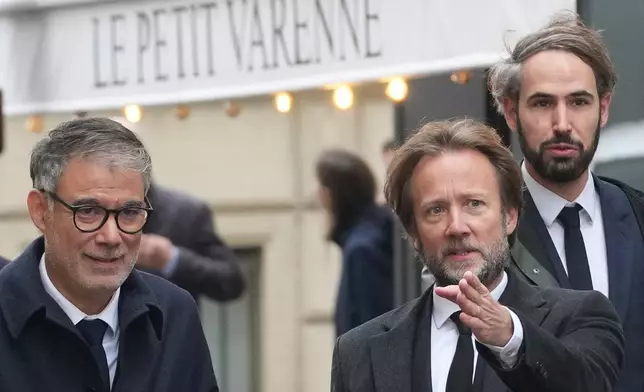
French socialist party secretary general Olivier Faure, left, and Boris Vallaud, president of the socialist parliament members at the National Assembly, arrive for a meeting with outgoing Prime Minister Sebastien Lecornu, Wednesday, Oct. 8, 2025 in Paris. (AP Photo/Christophe Ena)
French socialist party secretary general Olivier Faure, center left, and Boris Vallaud, center right, president of the socialist parliament members at the National Assembly, arrive for a meeting with outgoing Prime Minister Sebastien Lecornu, Wednesday, Oct. 8, 2025 in Paris. (AP Photo/Christophe Ena)
French socialist party secretary general Olivier Faure, left, and Boris Vallaud, president of the socialist parliament members at the National Assembly, arrive for a meeting with outgoing Prime Minister Sebastien Lecornu, Wednesday, Oct. 8, 2025 in Paris. (AP Photo/Christophe Ena)
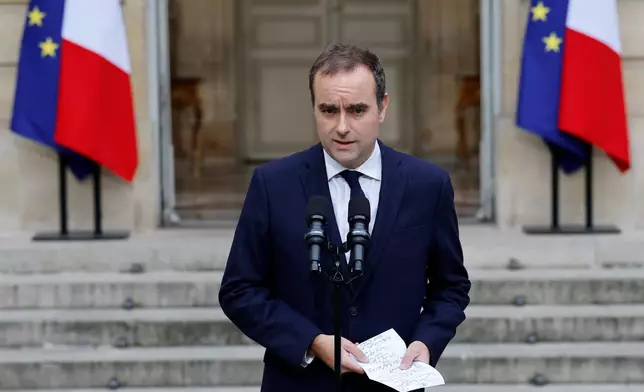
French outgoing Prime Minister Sebastien Lecornu makes a statement at the Hotel Matignon, the Prime Minister's residence, Wednesday, Oct. 8, 2025. (Stephanie Lecocq, Pool via AP)
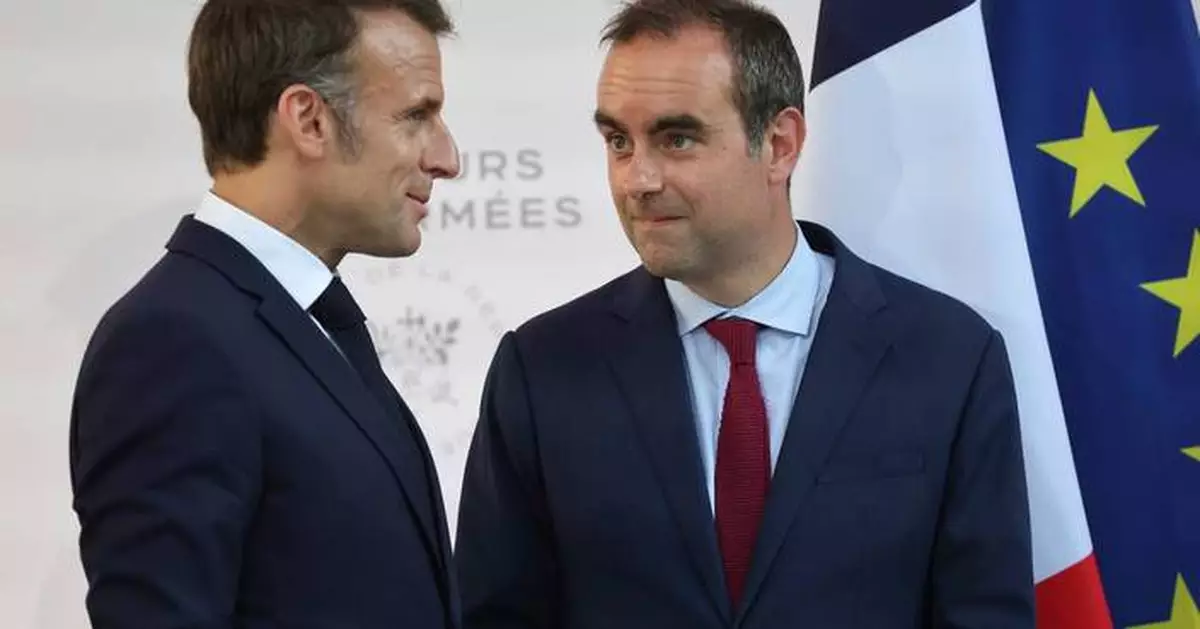
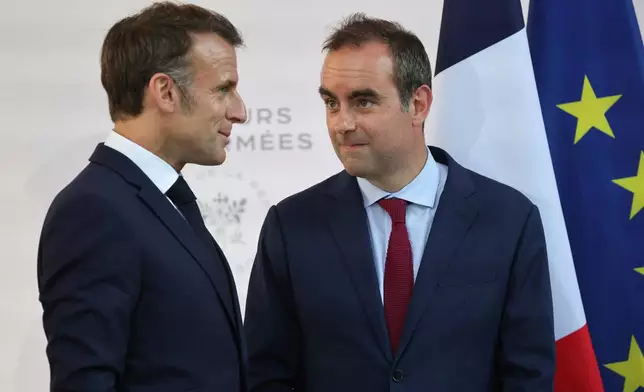
FILE - Then French Defense minister Sebastien Lecornu, right, and France's President Emmanuel Macron talk at the end of an address by the president to army leaders in Paris Sunday July 13, 2025, (Ludovic Marin, Pool via AP, File)
The announcement from Macron's office of a prime ministerial appointment before the weekend came after Lecornu — at the president’s request — spent the two days after his resignation taking the temperature in Parliament, to see whether there was enough support in the powerful but fractured lower house to form a new government.
Lecornu concluded that there was, even though Macron's camp and its allies don't have a majority in the National Assembly and the French leader's prime ministerial appointments, leading minority governments, have tumbled one after another in quick succession over the past year.
The presidential statement said that in the wake of his talks with political parties, Lecornu determined that a majority of National Assembly lawmakers don't want snap legislative elections and that it's “possible” that they could agree on a 2026 budget for France by the end of the year.
“On this basis, the president of the Republic will name a prime minister within 48 hours,” the statement said, without a hint of who Macron will choose.
Lecornu signaled that it won't be him again.
“I’m not chasing the job,” he said. “My mission is finished.”
In an interview with broadcaster France Télévisions before Macron's announcement, the outgoing prime minister said his 48 hours of talks with all parties except those on the far left and far right that refused negotiations had made progress and that “an absolute majority” of lawmakers don't for now see a need to dissolve the National Assembly, a move that backfired on Macron when he last did that.
Lecornu said Macron’s centrist camp and its allies in the Parliament, plus some opposition parties, could still come together to form a new government.
“There’s a majority that can govern,” Lecornu said. “I feel that a path is still possible. It is difficult."
The result from the elections triggered by Macron's stunning National Assembly dissolution in June 2024 was a hung Parliament. No one group has enough lawmakers in the 577-seat chamber to form a government alone. The ensuing political deadlock has rattled investors, infuriated many voters and frustrated efforts to agree on a budget to tackle France's mounting state deficit and damaging debts.
Without a stable majority, Macron's minority governments have lurched from crisis to crisis, collapsing as they sought lawmakers' support for unpopular cuts to public spending. Lecornu's resignation on Monday morning came just 14 hours after he'd named a new Cabinet the night before, with his fragile coalition shattering in the face of political and personal rivalries.
To buy more time to weigh his options, Macron then asked the 39-year-old Lecornu — a close ally who had previously served as defense minister — to reach out again to parties in the National Assembly, to try to build consensus behind France’s next budget, an urgent national priority.
Lecornu said the political parties he consulted all feel that agreement on a 2026 budget is a priority.
“They all said that we must not take the risk of not having a budget on the 31st of December,” he said.
Samuel Petrequin reported from London.

French socialist party secretary general Olivier Faure, left, and Boris Vallaud, president of the socialist parliament members at the National Assembly, arrive for a meeting with outgoing Prime Minister Sebastien Lecornu, Wednesday, Oct. 8, 2025 in Paris. (AP Photo/Christophe Ena)

French socialist party secretary general Olivier Faure, center left, and Boris Vallaud, center right, president of the socialist parliament members at the National Assembly, arrive for a meeting with outgoing Prime Minister Sebastien Lecornu, Wednesday, Oct. 8, 2025 in Paris. (AP Photo/Christophe Ena)

French socialist party secretary general Olivier Faure, left, and Boris Vallaud, president of the socialist parliament members at the National Assembly, arrive for a meeting with outgoing Prime Minister Sebastien Lecornu, Wednesday, Oct. 8, 2025 in Paris. (AP Photo/Christophe Ena)

French outgoing Prime Minister Sebastien Lecornu makes a statement at the Hotel Matignon, the Prime Minister's residence, Wednesday, Oct. 8, 2025. (Stephanie Lecocq, Pool via AP)

FILE - Then French Defense minister Sebastien Lecornu, right, and France's President Emmanuel Macron talk at the end of an address by the president to army leaders in Paris Sunday July 13, 2025, (Ludovic Marin, Pool via AP, File)
HONG KONG (AP) — About a third of Hong Kong 's registered voters elected a new 90-member legislature Sunday, a turnout that avoided an embarrassment for the government but fell short of a ringing endorsement of an electoral system revamp that eliminated the once feisty opposition in the Chinese territory.
The turnout rate reached 31.9%, surpassing the 30.2% in the 2021 election, the first held under the new system. It was much lower than before the electoral changes, when turnout topped 50%.
Many of the city’s 4.1 million eligible voters, especially democracy supporters, have turned away from politics since a crackdown that has stifled dissent. Candidates must now go through a vetting process that ensures they are patriots who are loyal to the Chinese government. The government says the changes were needed to bring stability after massive anti-government protests in 2019.
The government launched a major campaign to drive up turnout, adding polling stations, extending voting hours and holding candidate forums. But public anger over government accountability in an apartment fire that killed at least 159 people late last month threatened to keep some potential voters at home.
In the end, enough came out to nudge up the turnout rate from 2021, the lowest since the former British colony returned to Chinese rule in 1997.
Ahead of the vote, Chinese authorities called foreign media to a rare meeting to warn them that they need to comply with the city's national security laws.
Election campaigning was suspended after the fire and remained subdued in the final days out of respect for the victims.
Government efforts to drive up turnout, seen as a referendum on the new electoral system, had been in full swing before the blaze. Promotional banners and posters were hung throughout the city and subsidies offered to centers for older people and people with disabilities to help them vote.
Authorities arrested people who allegedly posted content that incited others not to vote or cast invalid votes.
Hong Kong's deadliest fire in decades has raised questions over government oversight and suspected bid-rigging in building maintenance projects. The 1980s-era apartment complex was undergoing renovations.
Some candidates pledged to combat bid-rigging.
City leader John Lee said in a statement on Monday that holding a smooth election during a difficult period for Hong Kong “carries profound significance," saying he expected the lawmakers would work with the government to drive systemic reforms following the fire.
Even before the 2021 electoral changes, only half of what had been a 70-member legislature was chosen by the general electorate.
Now, that has been reduced to 20 out of 90 seats and 40 others are chosen by a largely pro-Beijing election committee. The remaining 30 represent various groups — mainly major industries such as finance, health care and real estate — and are elected by their members.
The “patriots” requirement for all candidates has pushed out the opposition parties, which advocated for making the system more democratic.
“I’m performing my civic duty as a citizen to vote … but I’m not too certain which candidate is hardworking and which is not,” retiree Kwan Lam said outside a polling station. “I chose the one who cares for the elderly.”
Olympic fencing champion Vivian Kong on Monday won in the tourism sector, despite lacking industry experience.
The candidate pool seems to reflect Beijing's desire to have more lawmakers who are more in tune with its agenda, some observers said, in what they see as signs of Beijing’s tightening control even over its loyalists.
Lee has said that personnel changes are normal during an election. He criticized attempts to “distort” these changes to smear the new election system.
Ho-fung Hung, professor of political economy at Johns Hopkins University, said voter turnout was far lower than the 2016 election despite the vast resources the government had mobilized to boost turnout. The actual number of people who voted was also down from 2016 due to a shrinking electorate, he said.
The fire also contributed to the low turnout, Hung said.
“But it may work toward the government’s advantage, as they can blame the tragedy for the poor performance, or even say that the not-so-drastic drop in voting number despite the fire is an achievement,” he said.
John Burns, an honorary professor of politics and public administration at the University of Hong Kong, said the election shows that the city remains polarized with pro-establishment and opposition camps.
“The fire ... played a role because it exposed various governance problems that no resident could be happy about," he said.
But Electoral Affairs Commission chairperson David Lok found it encouraging that 1.3 million people voted, saying the current atmosphere made holding the election difficult as many were affected by the blaze.
Beijing's office on Hong Kong affairs hailed the increase in turnout rate in a WeChat statement, saying it reflected Hong Kong society's support for the poll.
Beijing’s national security arm in Hong Kong summoned representatives of several foreign news outlets, including The Associated Press, on Saturday.
Some foreign media had spread false information and smeared the government's disaster relief efforts after the fire, as well as attacked and interfered with the legislative elections, the Office for Safeguarding National Security said in a statement.
“No media outlet may use ‘freedom of the press’ as a pretext to interfere in China’s internal affairs or Hong Kong affairs,” the statement said.
Authorities have warned the general public against using the fire to try to undermine the government and have arrested at least one person on suspicion of inciting hatred against government officials.
Moritsugu reported from Beijing. Associated Press writer Chan Ho-him in Hong Kong contributed to this report.

Gary Chan, candidates of the Legislative Council Election, center, campaigns on the street during the Legislative Council General Election in Hong Kong on Sunday, Dec. 7, 2025. (AP Photo/Chan Long Hei)
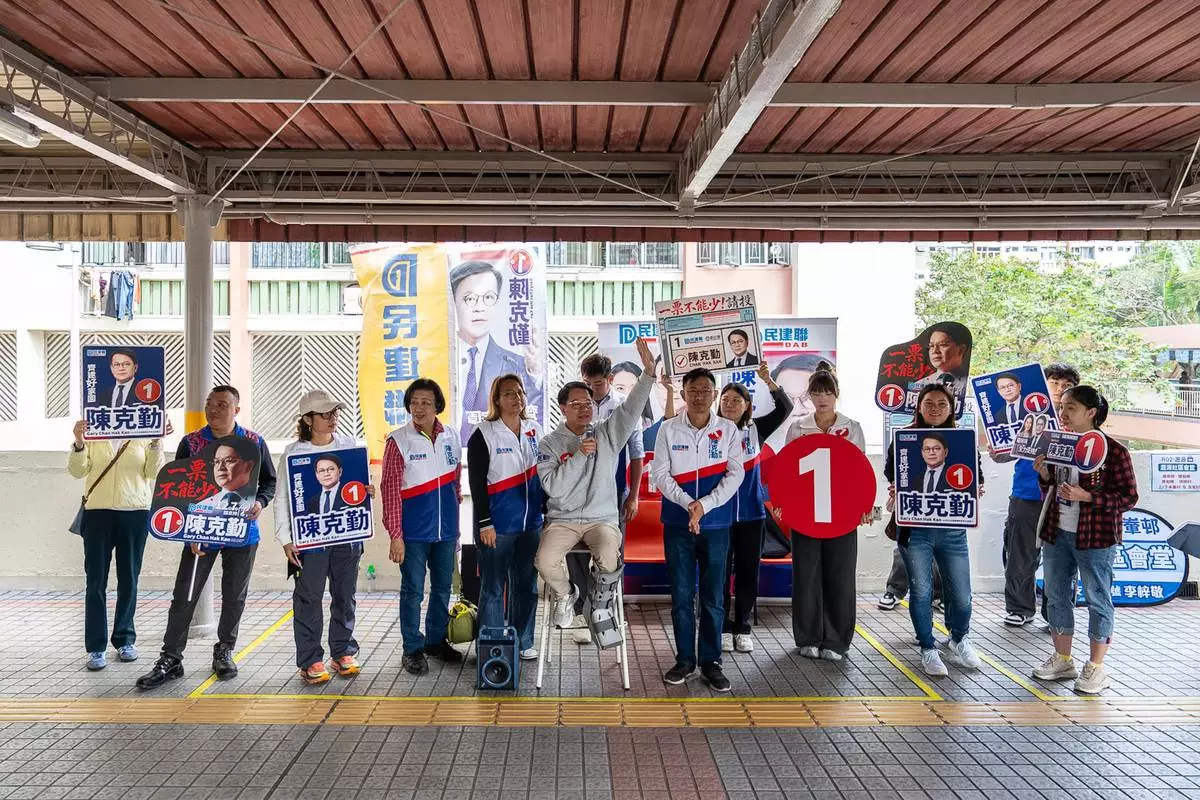
Gary Chan, candidates of the Legislative Council Election, center, campaigns on the street during the Legislative Council General Election in Hong Kong on Sunday, Dec. 7, 2025. (AP Photo/Chan Long Hei)
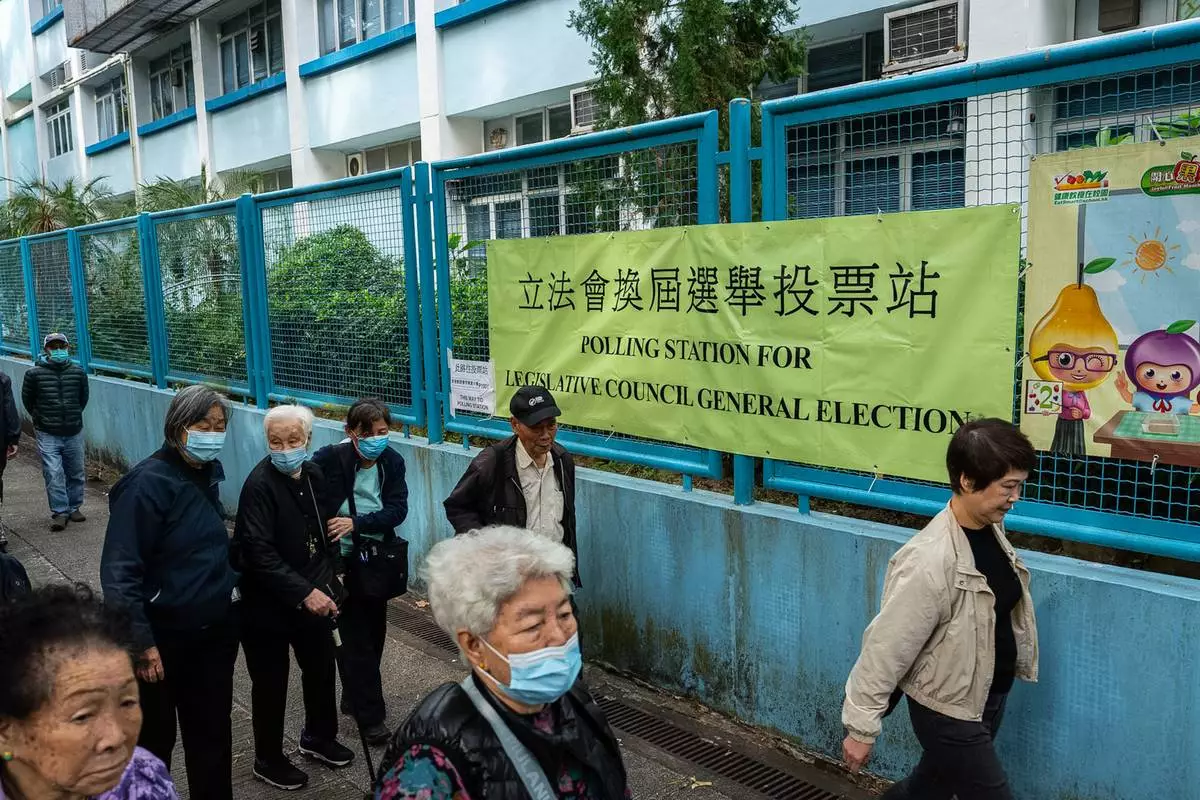
People walk past a polling station near the site of the fire at Wang Fuk Court in the Tai Po district during the Legislative Council General Election in Hong Kong on Sunday, Dec. 7, 2025. (AP Photo/Chan Long Hei)
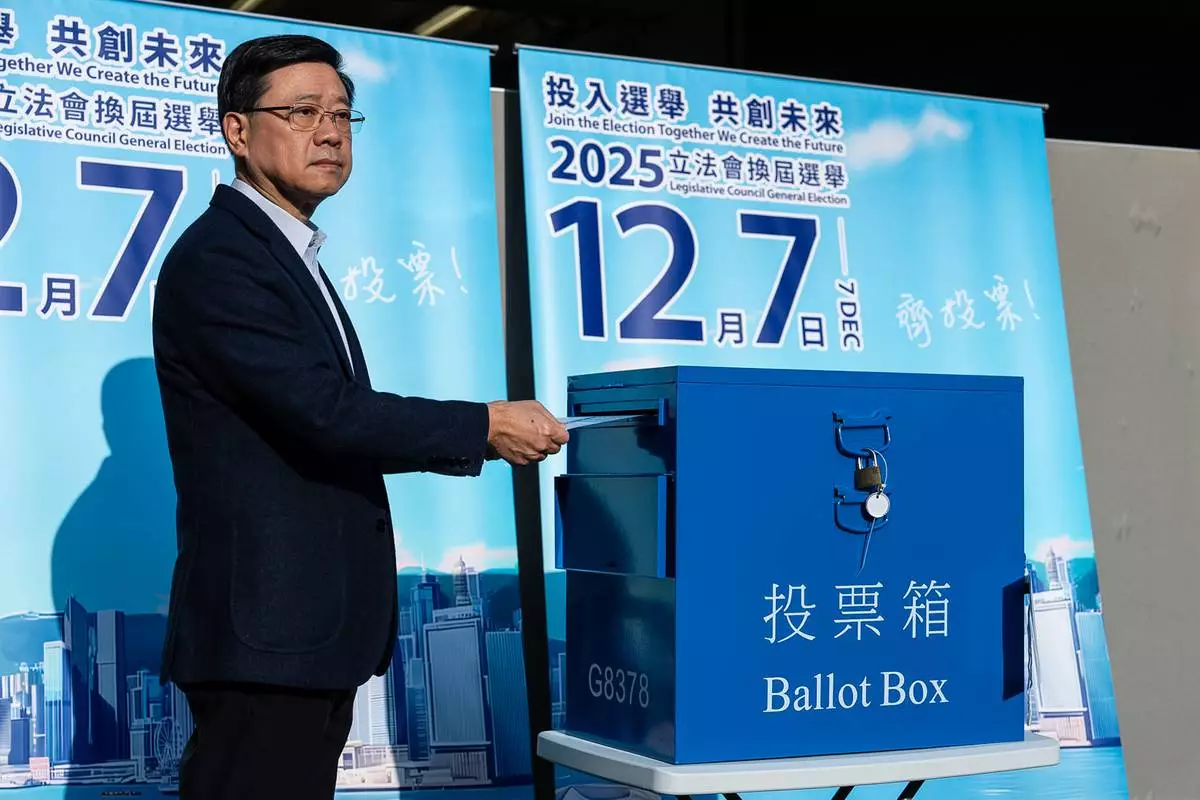
Hong Kong's Chief Executive, John Lee casts his ballot at a polling station during the Legislative Council General Election in Hong Kong on Sunday, Dec. 7, 2025. (AP Photo/Chan Long Hei)
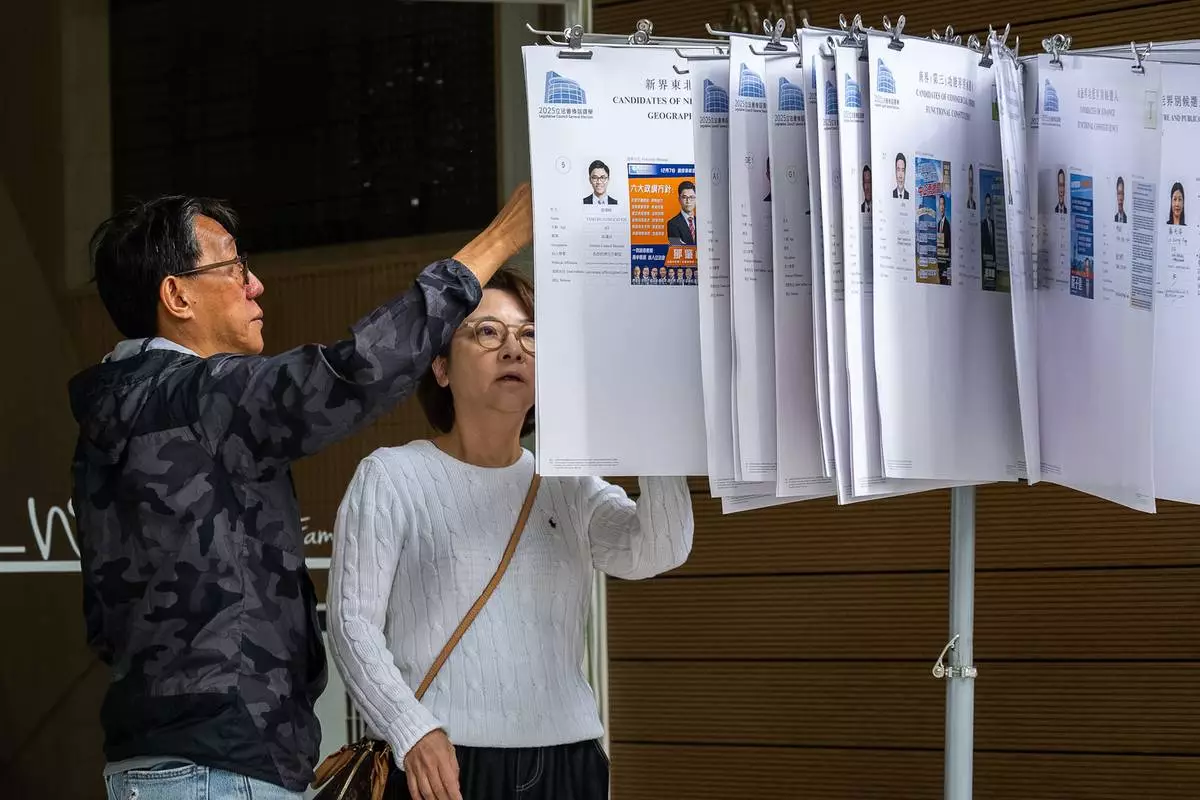
People read the candidates information at a polling station near the site of the fire at Wang Fuk Court in the Tai Po district during the Legislative Council General Election in Hong Kong on Sunday, Dec. 7, 2025. (AP Photo/Chan Long Hei)
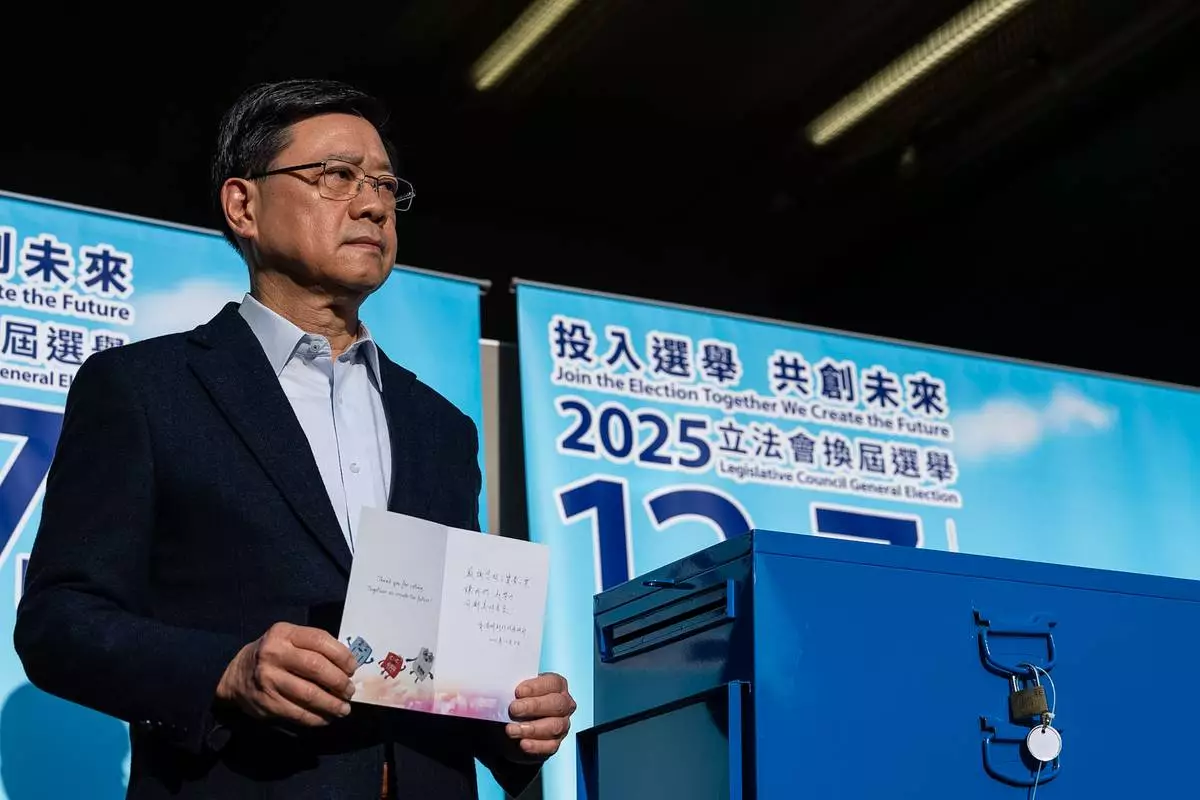
Hong Kong's Chief Executive John Lee, poses for photos at a polling station during the Legislative Council General Election in Hong Kong on Sunday, Dec. 7, 2025. (AP Photo/Chan Long Hei)
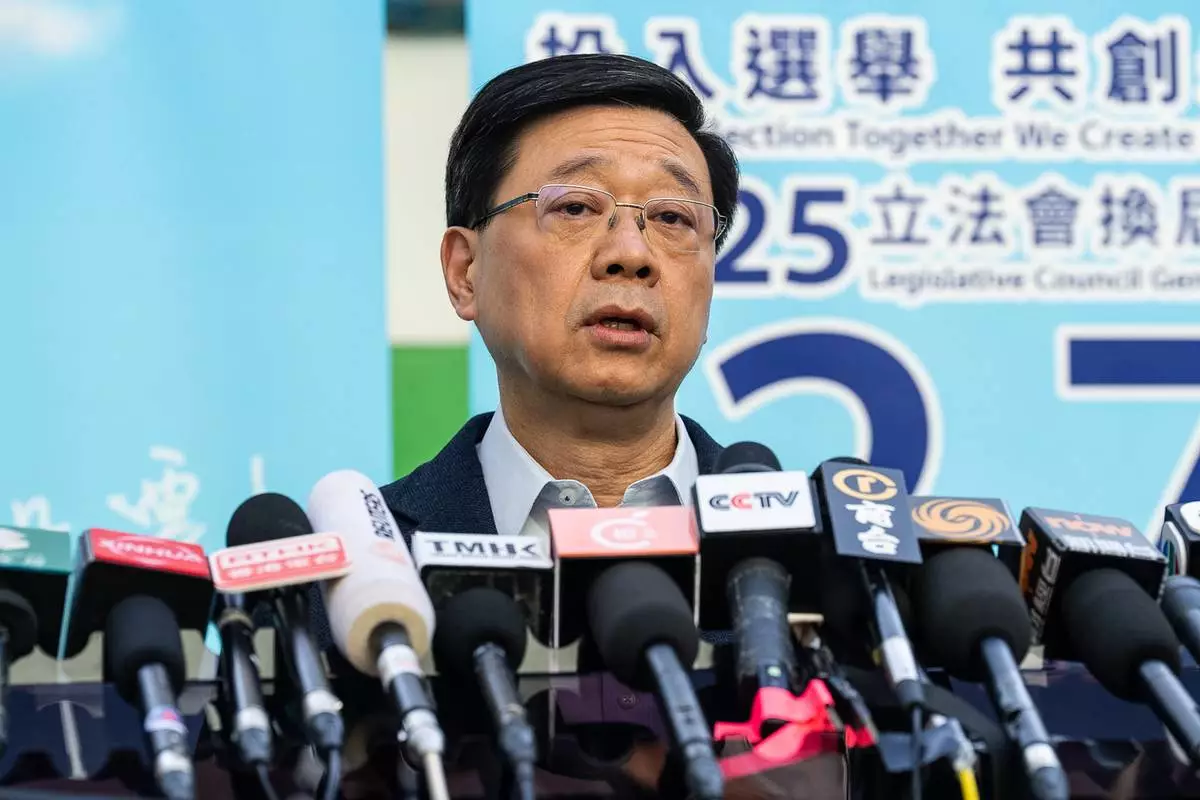
Hong Kong's Chief Executive John Lee speaks to the media at a polling station during the Legislative Council General Election in Hong Kong on Sunday, Dec. 7, 2025. (AP Photo/Chan Long Hei)

Hong Kong's Chief Executive John Lee casts his ballot at a polling station during the Legislative Council General Election in Hong Kong on Sunday, Dec. 7, 2025. (AP Photo/Chan Long Hei)
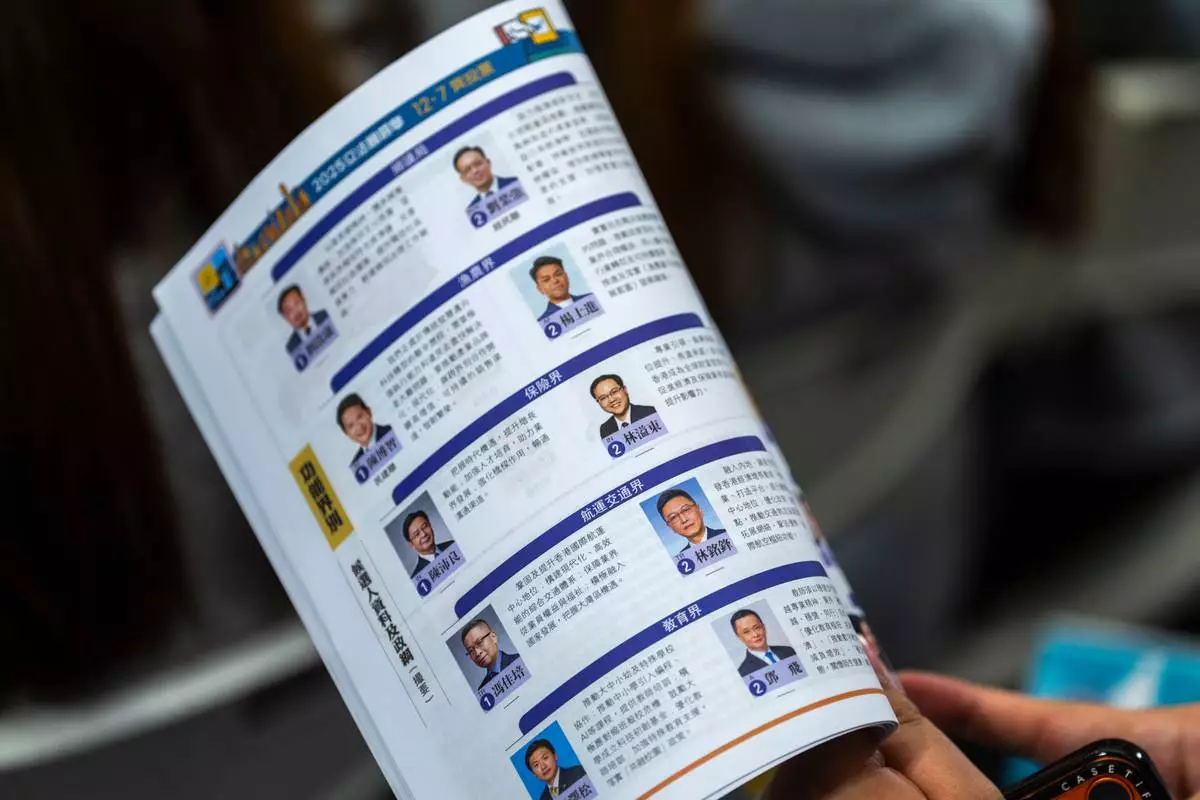
People look at a candidate brochure of the Hong Kong Legislative Council General Election at a forum in Hong Kong on Wednesday, Dec. 3, 2025. (AP Photo/Chan Long Hei)
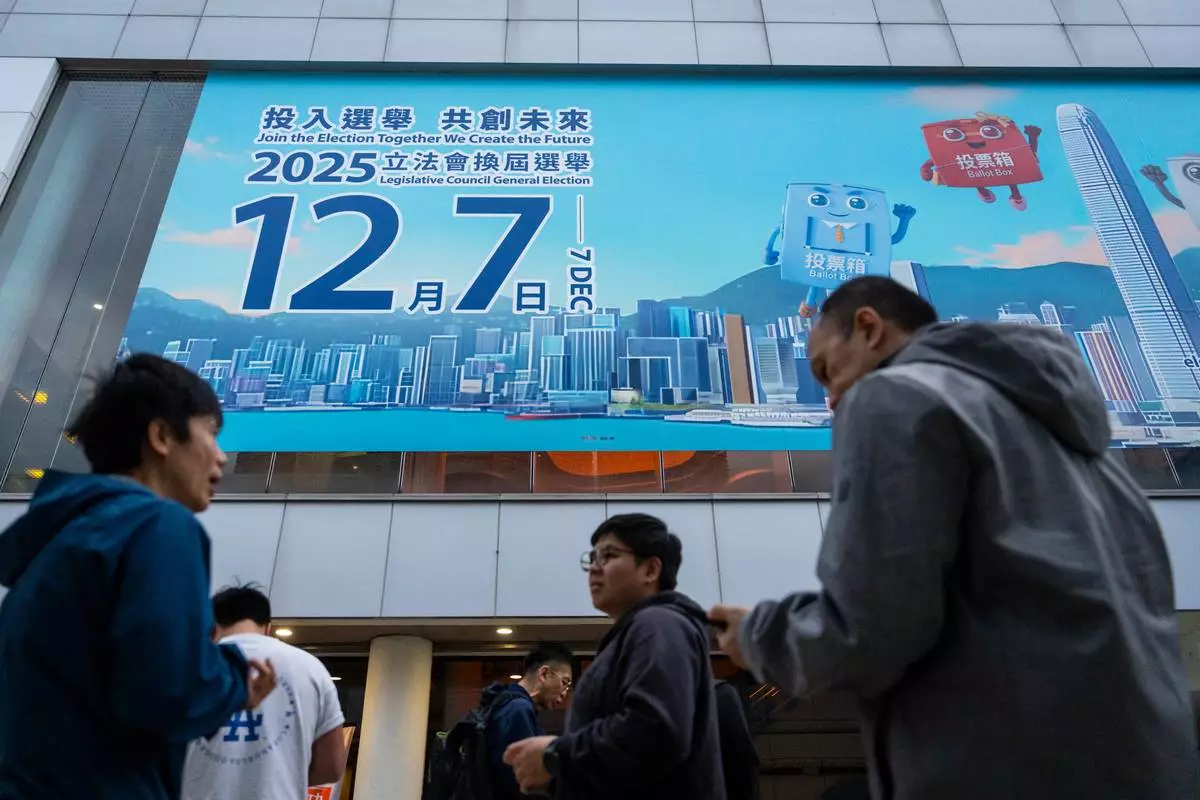
Pedestrians walk past the banner promoting the Hong Kong Legislative Council General Election in Hong Kong on Wednesday, Dec. 3, 2025. (AP Photo/Chan Long Hei)