A healthcare worker from the war-ravaged Gaza Strip, in an exclusive interview with China Media Group (CMG), has shared his and other peers' struggle to save lives during the two years of Hamas-Israeli conflict in the Palestinian enclave.
In Gaza, hospitals are no longer sanctuaries -- they have become part of the battlefield. Two years of war and blockade have pushed the healthcare system in Gaza to the brink of collapse with power cuts, medicine shortages, and Israeli attacks on hospitals. Yet amid the ruins, countless medical workers remain at their posts, working day and night to save lives while struggling to hold their own lives together amid fear and loss.
Each day, Sulaiman al-Darby, a medical worker from Rafah in southern Gaza, leaves his tent at dawn carrying a worn medical bag and walks to Nasser Hospital in the south. With fuel shortages and transport disruptions, his only options are walking or riding a wooden cart pulled by livestock -- all under the constant threat of Israeli airstrikes. Arriving at Nasser Hospital, he puts on his familiar white coat and begins another intense and demanding day.
"We are facing extreme shortages of resources, inadequate equipment, insufficient medicines, and a severe lack of anesthetics. We are forced to resort to methods we never used before the war, simply because we have no other choice," said al-Darby
A UN report revealed that over 70 percent of medical facilities in Gaza have been destroyed or are out of service, with less than a third of hospitals still partially functioning. Even Nasser Hospital, one of the main medical centers in southern Gaza, faces chronic shortages of staff and supplies.
Yet what torments medical workers more than the lack of resources is the psychological trauma of witnessing the horrors of war every day.
"Once two critically injured patients were brought to the emergency room -- a young boy and his father. The boy was placed in one room, his father in another. An orthopedic surgeon came to us, saying they needed the father's consent to amputate the child's leg. Yet at that very moment, the father was in the next room, himself preparing for amputation surgery. Can you imagine that scene? They only had each other left," said al-Darby.
Since the Hamas-Israeli conflict broke out on October 7, 2023, the young medical worker's life has changed drastically. Stability has been replaced by displacement, and the fear of death follows him like a shadow. Outside his heavy and demanding work, he must also line up for water, collect relief supplies, and light fires to cook -- constantly moving to provide for his family.
"Once, right after I finished a surgery, I checked the news on my phone and found out that the area where I live had been attacked. I was instantly overwhelmed with anxiety and couldn't focus on my work -- all I could think about was my family. I tried to reach them, but there was no signal, no internet. For a full hour, I couldn't concentrate, until I finally got through to them and confirmed they were safe," he said.
Despite the dangers of the journey to work, Sulaiman al-Darby closes the door of his tent day after day and walks toward the hospital. What keeps him going is a simple yet profound hope -- for the war to end, and for the chance to return home.
"We long for the war to end. There has been enough slaughter. We yearn to return to our homes, even though they are no longer the homes we once knew. We desperately want to plan our futures and find a way to continue living," he said.
Data released on Tuesday by Gaza's health authorities show that Israeli military operations in Gaza over the past two years have killed 67,173 Palestinians, including 20,179 children, 10,427 women, and 4,813 elderly people.
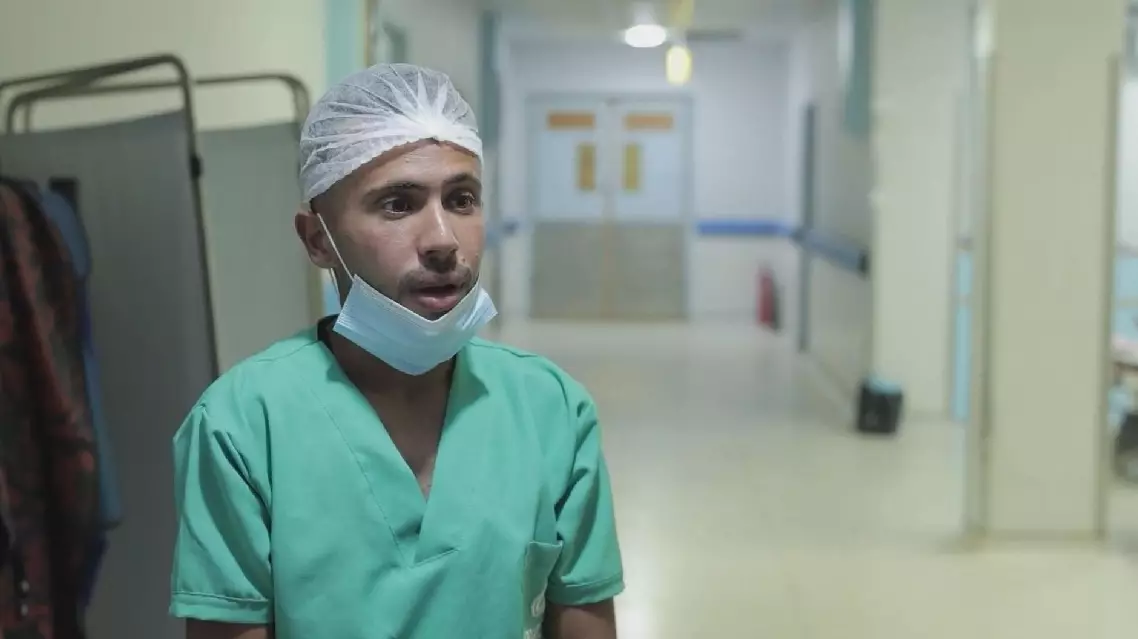
Gaza healthcare worker shares story of daily struggle to heal amid ruins