COLOMBO, Sri Lanka (AP) — Beth Mooney hit one of the most memorable centuries ever in women's one-day cricket as defending champion Australia overcame a top-order collapse and thumped Pakistan by 107 runs at the Women’s Cricket World Cup on Wednesday.
Mooney made a masterful 109 off 114 balls to raise her first World Cup hundred after Australia had wobbled to 76-7 against Pakistan's spin trio of Nashra Sandhu, Rameen Shamim and Sadiq Iqbal.
Click to Gallery
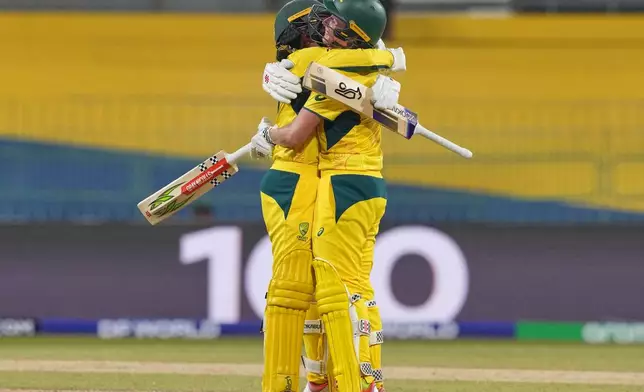
Australia's Beth Mooney, right, celebrates her century with Alana King during the ICC Women's Cricket World Cup match between Australia and Pakistan at Premadasa Stadium in Colombo, Sri Lanka, Wednesday, Oct, 8, 2025. (AP Photo/Eranga Jayawardena)
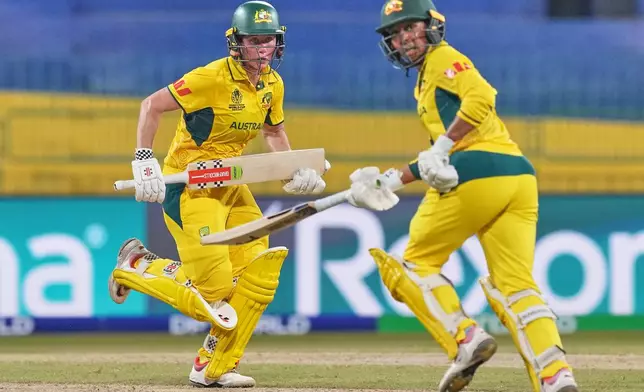
Australia's Beth Mooney, left, and Alana King run between the wickets to score during the ICC Women's Cricket World Cup match between Australia and Pakistan at Premadasa Stadium in Colombo, Sri Lanka, Wednesday, Oct, 8, 2025. (AP Photo/Eranga Jayawardena)
Australia's Beth Mooney, right, celebrates her as Alana King watches during the ICC Women's Cricket World Cup match between Australia and Pakistan at Premadasa Stadium in Colombo, Sri Lanka, Wednesday, Oct, 8, 2025. (AP Photo/Eranga Jayawardena)
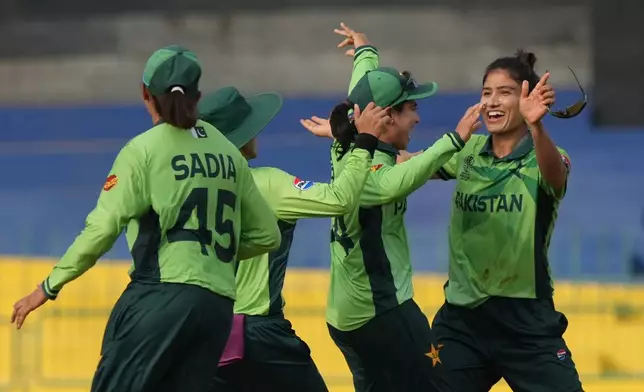
Pakistan's Nashra Sundhu celebrates the wicket of Australia's Tahlia McGrath during the ICC Women's Cricket World Cup match between Australia and Pakistan at Premadasa Stadium in Colombo, Sri Lanka, Wednesday, Oct, 8, 2025. (AP Photo/Eranga Jayawardena)
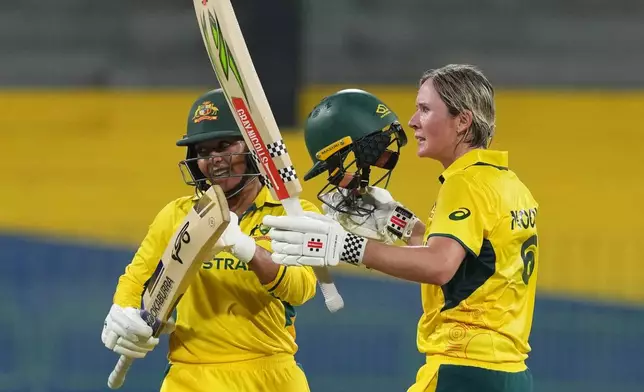
Australia's Beth Mooney, right, celebrates her as Alana King watches during the ICC Women's Cricket World Cup match between Australia and Pakistan at Premadasa Stadium in Colombo, Sri Lanka, Wednesday, Oct, 8, 2025. (AP Photo/Eranga Jayawardena)
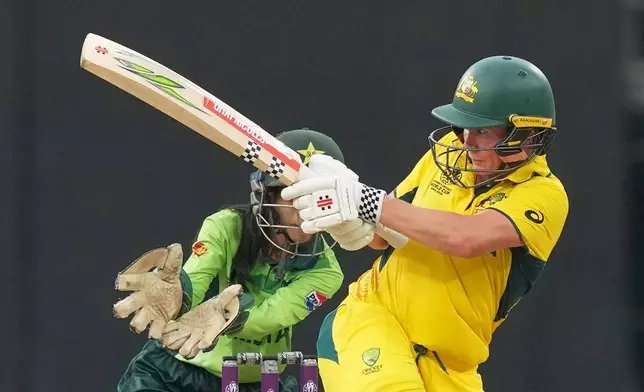
Australia's Beth Mooney plays a shot during the ICC Women's Cricket World Cup match between Australia and Pakistan at Premadasa Stadium in Colombo, Sri Lanka, Wednesday, Oct, 8, 2025. (AP Photo/Eranga Jayawardena)
Tailender Alana King upped the scoring rate late with an unbeaten 51 off 49 balls as she combined with Mooney in a 106-run stand, the highest-ever ninth-wicket partnership in women’s ODIs. Australia eventually finished at a challenging 221-9.
The pace bowling pair of Kim Garth (3-14) and Megan Schutt (2-25) snapped five wickets inside the power play and Pakistan was eventually dismissed for 114 — its third straight loss.
“I was thinking over 200 (team total), we’ve got to win this game,” Mooney said when asked about her approach to the innings. “I’m not here for the hundred, I’m here for the win.”
Australia, which beat New Zealand before its game against Sri Lanka was washed out last Saturday in Colombo, leads the standings with five points.
Pakistan's batting woes continued as its top-order struggled against pace and spin. Sidra Amin, who scored half century against archrival India, top-scored with 35 off 52 balls but Australia kept striking through. Amin was the only top-order Pakistan batter to reach double figures.
The Australian top-order capitulated against three Pakistan spinners, who picked up 6-98 off their combined 30 overs, after skipper Fatima Sana won the toss and elected to field.
Left-armer Iqbal found the turn from the word go once Sana introduced the spinners in the fifth over. Australia captain Alyssa Healy (20) struck three boundaries but flicked Iqbal straight to midwicket in Sana's second over. Sana followed it up by taking a well judged return catch to dismiss Phoebe Litchfield.
Sandhu deceived premier batter Ellyse Perry (5) and had her stumped, and then slipped a delivery between the bat and pad of Annabel Sutherland to hit the stumps as Australia slid to 59-4 in the 15th over.
Off-spinner Shamim, who didn’t concede a boundary in her 10 overs, continued to squeeze Australia when Ashleigh Gardner chipped an easy catch to midwicket. Diana Baig took a smart diving catch of Tahila McGrath to leave Australia in all sorts of trouble at 75-6.
Australia was 115-8 in the 34th over and was in danger of getting bowled out for its lowest ODI total against Pakistan, but Mooney and King stood tall.
Mooney, who hit 11 fours, and King rotated strike frequently and waited patiently to see off the threat of Pakistan spinners before cutting loose against the pace bowlers.
Mooney successfully overturned an lbw decision against her off Iqbal when she was on 85 before completing her well composed century off 110 balls. King completed her half century with two successive sixes against Sana in the last over, which went for 21 runs.
Mooney finally got out of Sana’s final ball of Australia’s innings when she was caught in the covers.
India, which won both its games against Asian rivals Pakistan and Sri Lanka, takes on South Africa at Visakhapatnam on Thursday.
AP cricket: https://apnews.com/hub/cricket
Australia's Beth Mooney, right, celebrates her century with Alana King during the ICC Women's Cricket World Cup match between Australia and Pakistan at Premadasa Stadium in Colombo, Sri Lanka, Wednesday, Oct, 8, 2025. (AP Photo/Eranga Jayawardena)
Australia's Beth Mooney, left, and Alana King run between the wickets to score during the ICC Women's Cricket World Cup match between Australia and Pakistan at Premadasa Stadium in Colombo, Sri Lanka, Wednesday, Oct, 8, 2025. (AP Photo/Eranga Jayawardena)
Australia's Beth Mooney, right, celebrates her as Alana King watches during the ICC Women's Cricket World Cup match between Australia and Pakistan at Premadasa Stadium in Colombo, Sri Lanka, Wednesday, Oct, 8, 2025. (AP Photo/Eranga Jayawardena)
Pakistan's Nashra Sundhu celebrates the wicket of Australia's Tahlia McGrath during the ICC Women's Cricket World Cup match between Australia and Pakistan at Premadasa Stadium in Colombo, Sri Lanka, Wednesday, Oct, 8, 2025. (AP Photo/Eranga Jayawardena)
Australia's Beth Mooney, right, celebrates her as Alana King watches during the ICC Women's Cricket World Cup match between Australia and Pakistan at Premadasa Stadium in Colombo, Sri Lanka, Wednesday, Oct, 8, 2025. (AP Photo/Eranga Jayawardena)
Australia's Beth Mooney plays a shot during the ICC Women's Cricket World Cup match between Australia and Pakistan at Premadasa Stadium in Colombo, Sri Lanka, Wednesday, Oct, 8, 2025. (AP Photo/Eranga Jayawardena)
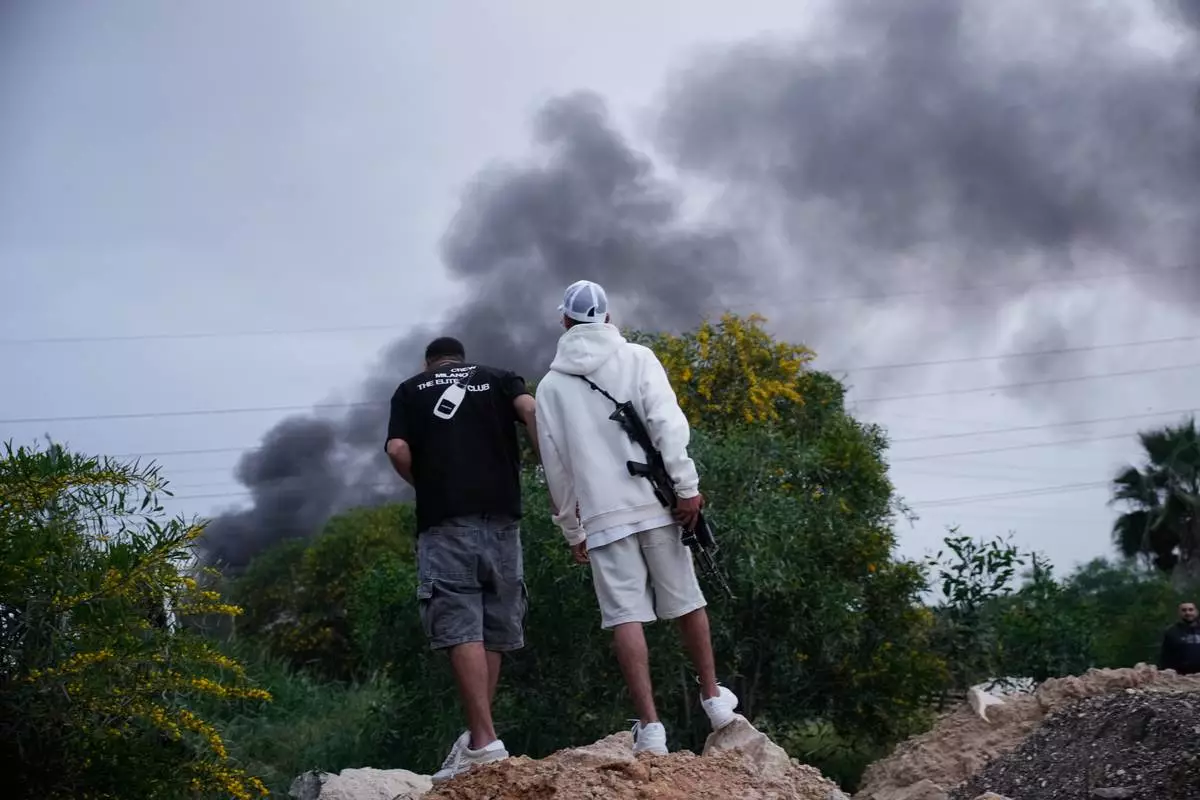
Federal immigration agents deployed to Minneapolis have used aggressive crowd-control tactics that have become a dominant concern in the aftermath of the deadly shooting of a woman in her car last week.
They have pointed rifles at demonstrators and deployed chemical irritants early in confrontations. They have broken vehicle windows and pulled occupants from cars. They have scuffled with protesters and shoved them to the ground.
The government says the actions are necessary to protect officers from violent attacks. The encounters in turn have riled up protesters even more, especially as videos of the incidents are shared widely on social media.
What is unfolding in Minneapolis reflects a broader shift in how the federal government is asserting its authority during protests, relying on immigration agents and investigators to perform crowd-management roles traditionally handled by local police who often have more training in public order tactics and de-escalating large crowds.
Experts warn the approach runs counter to de-escalation standards and risks turning volatile demonstrations into deadly encounters.
The confrontations come amid a major immigration enforcement surge ordered by the Trump administration in early December, which sent more than 2,000 officers from across the Department of Homeland Security into the Minneapolis-St. Paul area. Many of the officers involved are typically tasked with arrests, deportations and criminal investigations, not managing volatile public demonstrations.
Tensions escalated after the fatal shooting of Renee Good, a 37-year-old woman killed by an immigration agent last week, an incident federal officials have defended as self-defense after they say Good weaponized her vehicle.
The killing has intensified protests and scrutiny of the federal response.
On Monday, the American Civil Liberties Union of Minnesota asked a federal judge to intervene, filing a lawsuit on behalf of six residents seeking an emergency injunction to limit how federal agents operate during protests, including restrictions on the use of chemical agents, the pointing of firearms at non-threatening individuals and interference with lawful video recording.
“There’s so much about what’s happening now that is not a traditional approach to immigration apprehensions,” said former Immigration and Customs Enforcement Director Sarah Saldaña.
Saldaña, who left the post at the beginning of 2017 as President Donald Trump's first term began, said she can't speak to how the agency currently trains its officers. When she was director, she said officers received training on how to interact with people who might be observing an apprehension or filming officers, but agents rarely had to deal with crowds or protests.
“This is different. You would hope that the agency would be responsive given the evolution of what’s happening — brought on, mind you, by the aggressive approach that has been taken coming from the top,” she said.
Ian Adams, an assistant professor of criminal justice at the University of South Carolina, said the majority of crowd-management or protest training in policing happens at the local level — usually at larger police departments that have public order units.
“It’s highly unlikely that your typical ICE agent has a great deal of experience with public order tactics or control,” Adams said.
DHS Secretary Tricia McLaughlin said in a written statement that ICE officer candidates receive extensive training over eight weeks in courses that include conflict management and de-escalation. She said many of the candidates are military veterans and about 85% have previous law enforcement experience.
“All ICE candidates are subject to months of rigorous training and selection at the Federal Law Enforcement Training Center, where they are trained in everything from de-escalation tactics to firearms to driving training. Homeland Security Investigations candidates receive more than 100 days of specialized training," she said.
Ed Maguire, a criminology professor at Arizona State University, has written extensively about crowd-management and protest- related law enforcement training. He said while he hasn't seen the current training curriculum for ICE officers, he has reviewed recent training materials for federal officers and called it “horrifying.”
Maguire said what he's seeing in Minneapolis feels like a perfect storm for bad consequences.
“You can't even say this doesn't meet best practices. That's too high a bar. These don't seem to meet generally accepted practices,” he said.
“We’re seeing routinely substandard law enforcement practices that would just never be accepted at the local level,” he added. “Then there seems to be just an absence of standard accountability practices.”
Adams noted that police department practices have "evolved to understand that the sort of 1950s and 1960s instinct to meet every protest with force, has blowback effects that actually make the disorder worse.”
He said police departments now try to open communication with organizers, set boundaries and sometimes even show deference within reason. There's an understanding that inside of a crowd, using unnecessary force can have a domino effect that might cause escalation from protesters and from officers.
Despite training for officers responding to civil unrest dramatically shifting over the last four decades, there is no nationwide standard of best practices. For example, some departments bar officers from spraying pepper spray directly into the face of people exercising Constitutional speech. Others bar the use of tear gas or other chemical agents in residential neighborhoods.
Regardless of the specifics, experts recommend that departments have written policies they review regularly.
“Organizations and agencies aren’t always familiar with what their own policies are,” said Humberto Cardounel, senior director of training and technical assistance at the National Policing Institute.
“They go through it once in basic training then expect (officers) to know how to comport themselves two years later, five years later," he said. "We encourage them to understand and know their training, but also to simulate their training.”
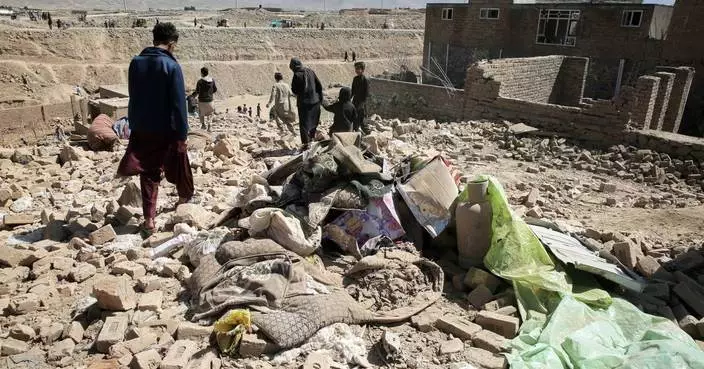
Adams said part of the reason local officers are the best option for performing public order tasks is they have a compact with the community.
“I think at the heart of this is the challenge of calling what ICE is doing even policing,” he said.
"Police agencies have a relationship with their community that extends before and after any incidents. Officers know we will be here no matter what happens, and the community knows regardless of what happens today, these officers will be here tomorrow.”
Saldaña noted that both sides have increased their aggression.
“You cannot put yourself in front of an armed officer, you cannot put your hands on them certainly. That is impeding law enforcement actions,” she said.
“At this point, I’m getting concerned on both sides — the aggression from law enforcement and the increasingly aggressive behavior from protesters.”
Law enforcement officers at the scene of a reported shooting Wednesday, Jan. 14, 2026, in Minneapolis. (AP Photo/Adam Gray)
Federal immigration officers confront protesters outside Bishop Henry Whipple Federal Building, Thursday, Jan. 15, 2026, in Minneapolis. (AP Photo/Adam Gray)
People cover tear gas deployed by federal immigration officers outside Bishop Henry Whipple Federal Building, Thursday, Jan. 15, 2026, in Minneapolis. (AP Photo/Adam Gray)
A man is pushed to the ground as federal immigration officers confront protesters outside Bishop Henry Whipple Federal Building, Thursday, Jan. 15, 2026, in Minneapolis. (AP Photo/John Locher)
A woman covers her face from tear gas as federal immigration officers confront protesters outside Bishop Henry Whipple Federal Building, Thursday, Jan. 15, 2026, in Minneapolis. (AP Photo/Adam Gray)