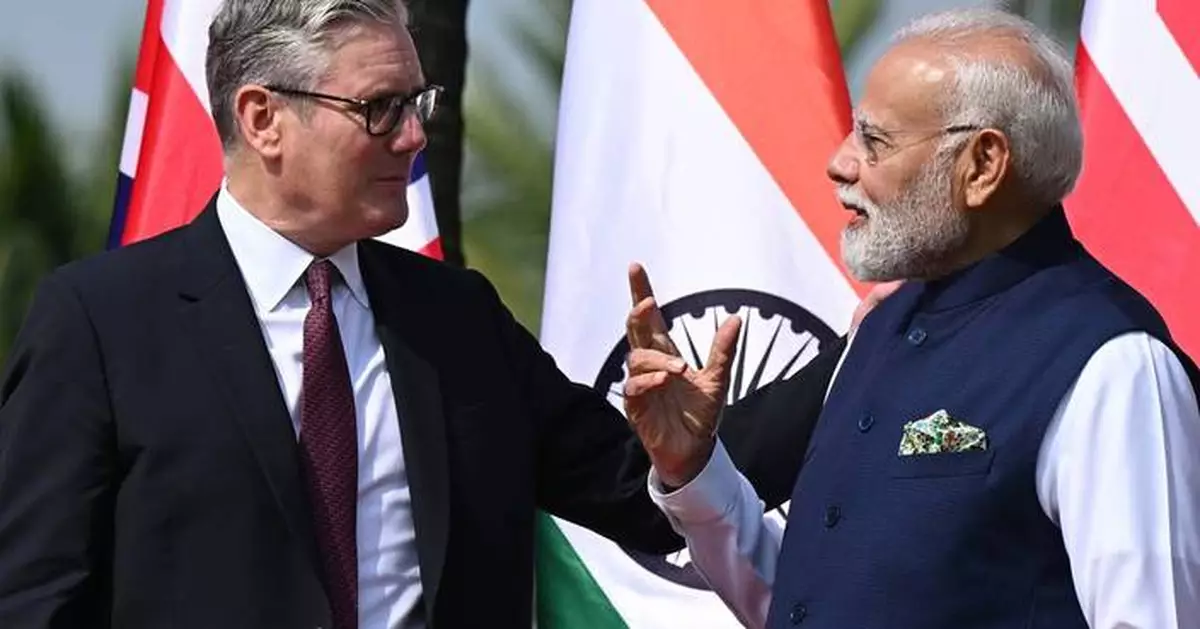
NEW DELHI (AP) — Indian Prime Minister Narendra Modi met his British counterpart Keir Starmer on Thursday in talks meant to deepen cooperation on trade, defense and technology while promoting a trade deal between the countries.
The talks in India's financial capital of Mumbai marked Starmer’s first official trip to India since taking office in July 2024. The two-day visit that began Wednesday comes as the Indian government increases efforts to attract global investment for the nation's rapidly expanding economy.
Click to Gallery
Britain's Prime Minister Keir Starmer, left, and India's Prime Minister Narendra Modi deliver a statement to the press at Raj Bhavan in Mumbai, India Thursday, Oct. 9, 2025. (Stefan Rousseau/Pool Photo via AP)
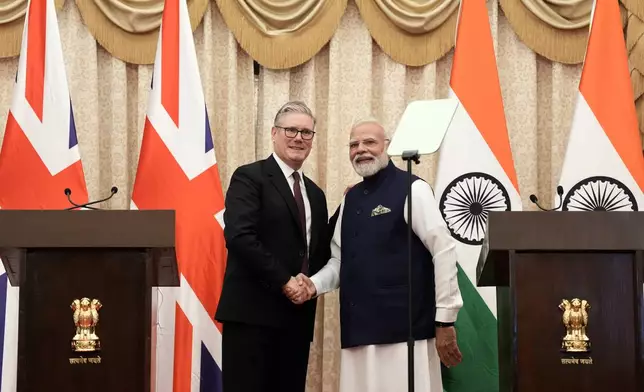
Britain's Prime Minister Keir Starmer, left, and India's Prime Minister Narendra Modi shake hands after delivering a statement to the press at Raj Bhavan in Mumbai, India Thursday, Oct. 9, 2025. (Stefan Rousseau/Pool Photo via AP)
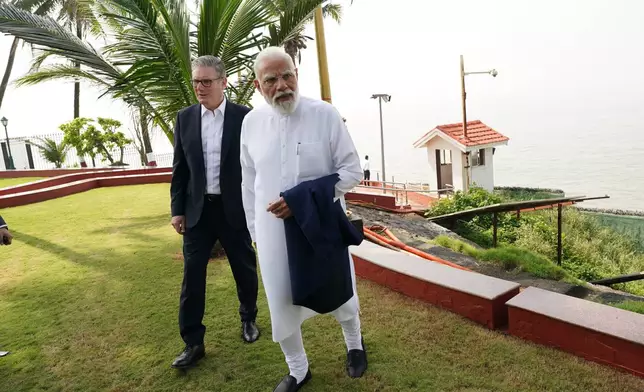
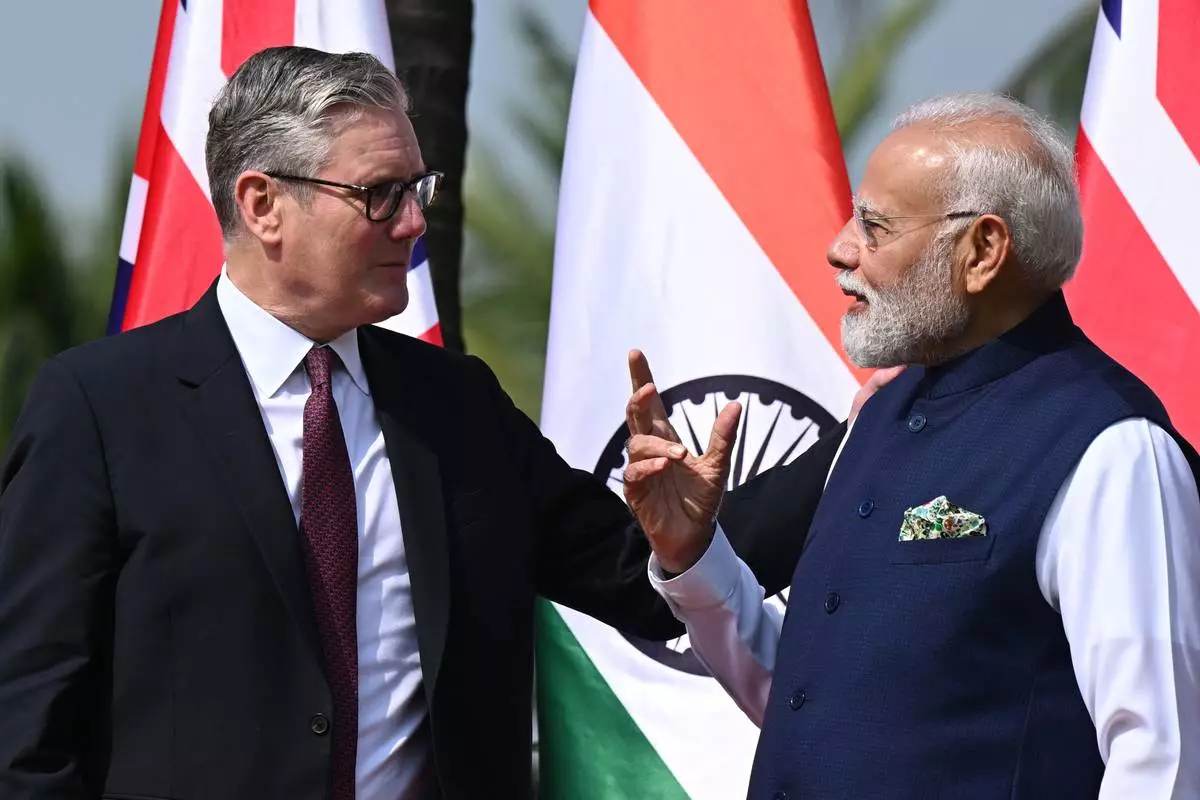
Britain's Prime Minister Keir Starmer, left, and Indian Prime Minister Narendra Modi walk through the gardens at Raj Bhavan in Mumbai, India, ahead of a bilateral meeting Thursday, Oct. 9, 2025. (Stefan Rousseau/Pool Photo via AP)
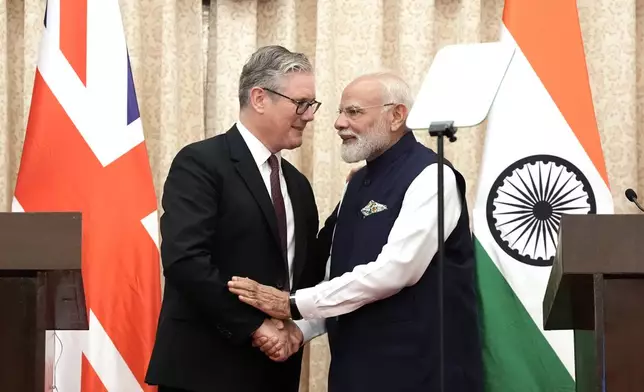
Britain's Prime Minister Keir Starmer, left, and India's Prime Minister Narendra Modi shake hands after delivering a statement to the press at Raj Bhavan in Mumbai, India Thursday, Oct. 9, 2025. (Stefan Rousseau/Pool Photo via AP)
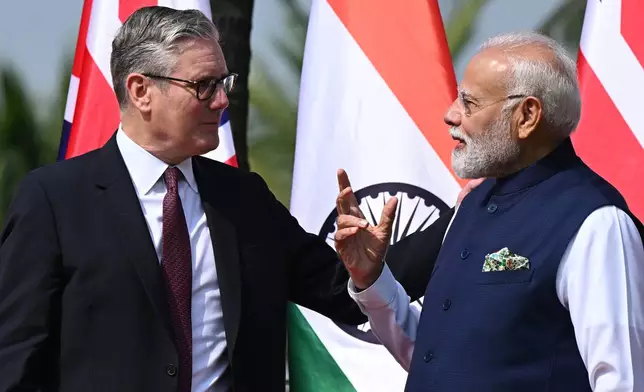
British Prime Minister Keir Starmer, left is greeted by Indian Prime Minister Narendra Modi on his arrival at Raj Bhavan in Mumbai, India, Thursday, Oct. 9, 2025. (Leon Neal/Pool Photo via AP)
The prime ministers said Thursday’s meeting focused on pushing forward a trade agreement signed during Modi's visit to London in July and boosting cooperation in digital infrastructure, technology, defense, critical minerals and education. The two countries also signed a defense deal that will allow Britain to supply missiles, launchers and electric-powered engines for naval ships to India, the British defense ministry said in a statement.
The countries are natural partners and strengthening the partnership “is an example of stability in an uncertain world,” Modi said.
“India-U.K. partnership is becoming crucial foundation for global stability and economic progress,” Modi said, announcing the countries have reached an agreement on military training cooperation, while nine U.K. universities plan to open campuses in India.
Starmer is visiting India with a 125-member delegation that includes business, university and culture sector leaders. He said the trip was about “doubling down on the potential of the trade deal" that will drive growth and jobs in both countries.
“We are creating a new, modern partnership focusing on future,” Starmer said.
The trade agreement, which both nations said they aim to implement within the next year, will slash tariffs on products including Scotch whisky, English gin shipped to India, and Indian food and spices sent to the U.K. The British government said in a statement that the deal would raise bilateral trade by a further $34 billion and increase exports to India by nearly 60%.
Modi and Starmer also shared views on Indo-Pacific stability and discussed the war in Ukraine and developments in Gaza. Starmer hailed the first stage of a peace plan between Israel and Hamas, saying it brings “profound relief,” especially for hostages, families and civilians who have suffered over the past two years.
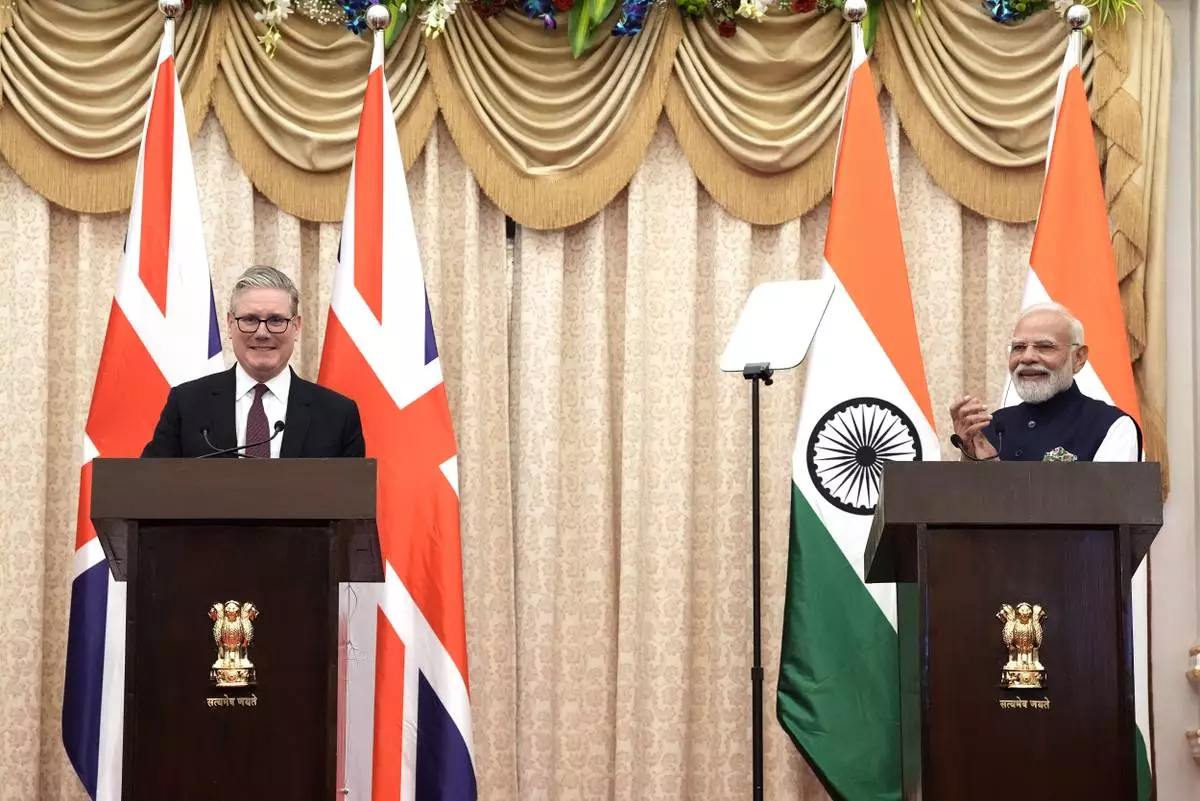
Britain's Prime Minister Keir Starmer, left, and India's Prime Minister Narendra Modi deliver a statement to the press at Raj Bhavan in Mumbai, India Thursday, Oct. 9, 2025. (Stefan Rousseau/Pool Photo via AP)
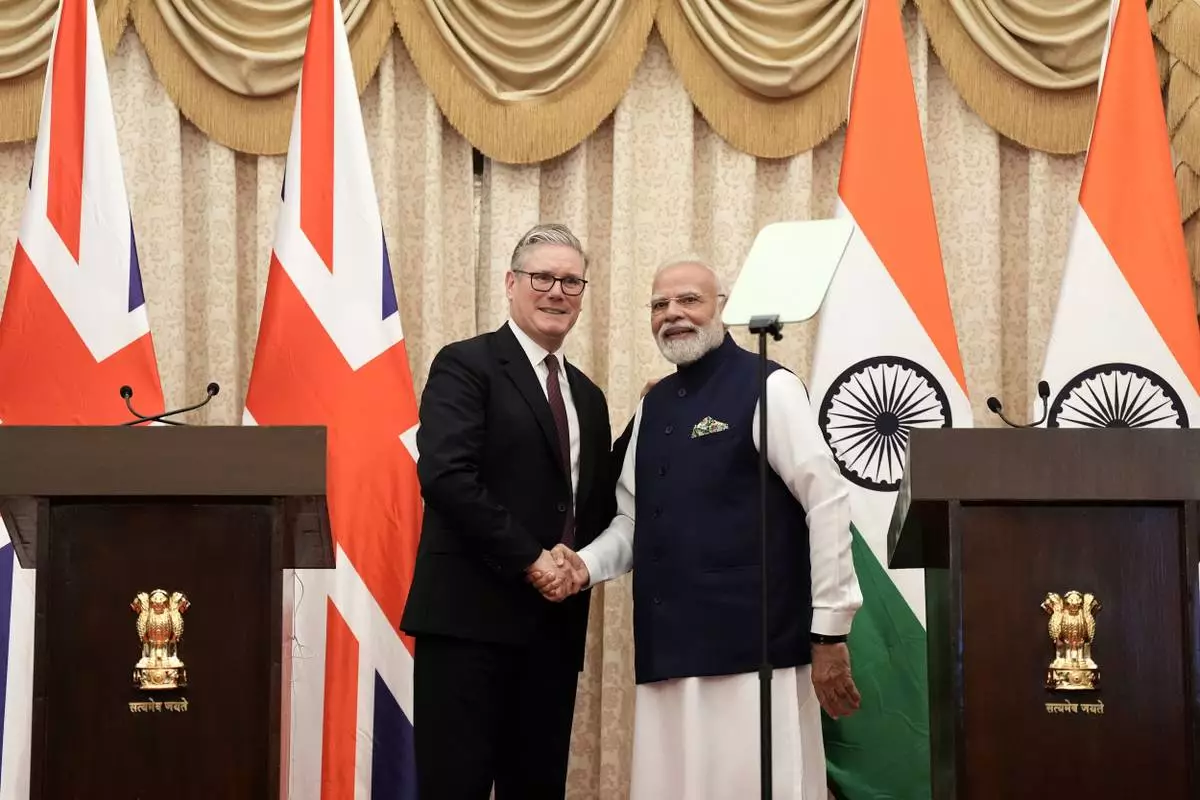
Britain's Prime Minister Keir Starmer, left, and India's Prime Minister Narendra Modi shake hands after delivering a statement to the press at Raj Bhavan in Mumbai, India Thursday, Oct. 9, 2025. (Stefan Rousseau/Pool Photo via AP)
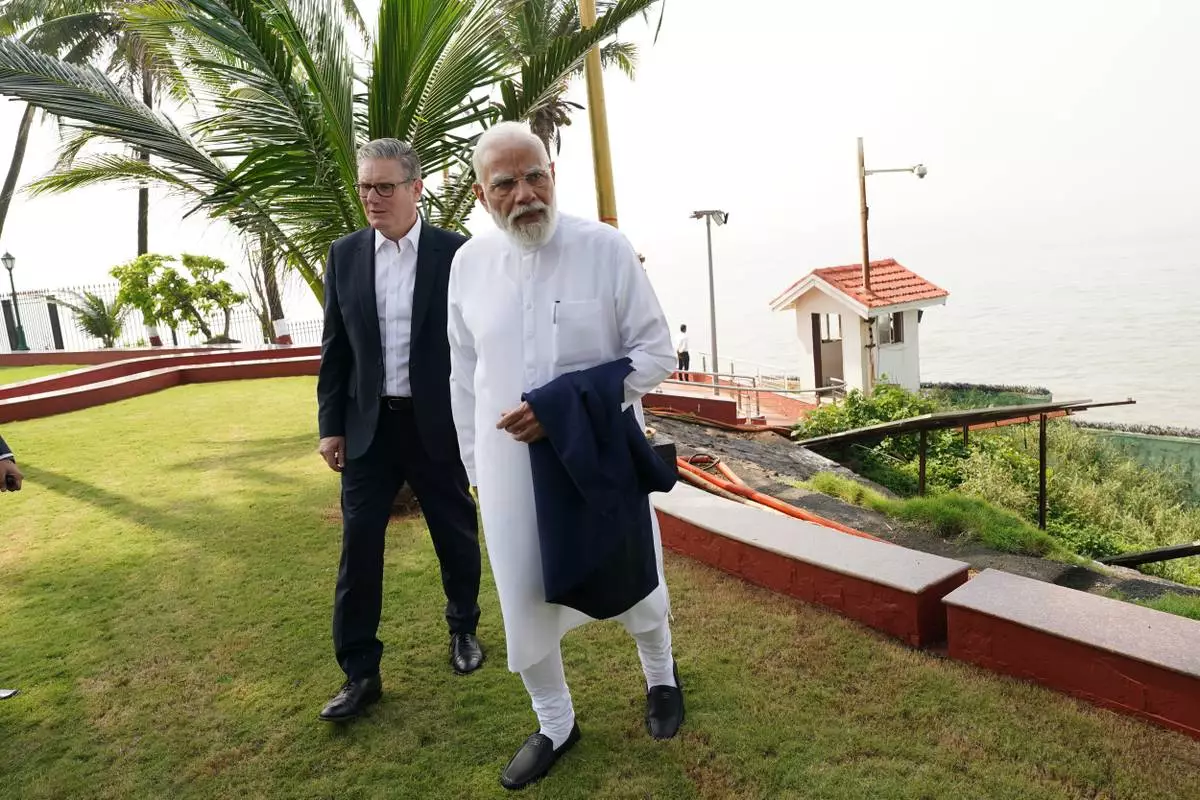
Britain's Prime Minister Keir Starmer, left, and Indian Prime Minister Narendra Modi walk through the gardens at Raj Bhavan in Mumbai, India, ahead of a bilateral meeting Thursday, Oct. 9, 2025. (Stefan Rousseau/Pool Photo via AP)
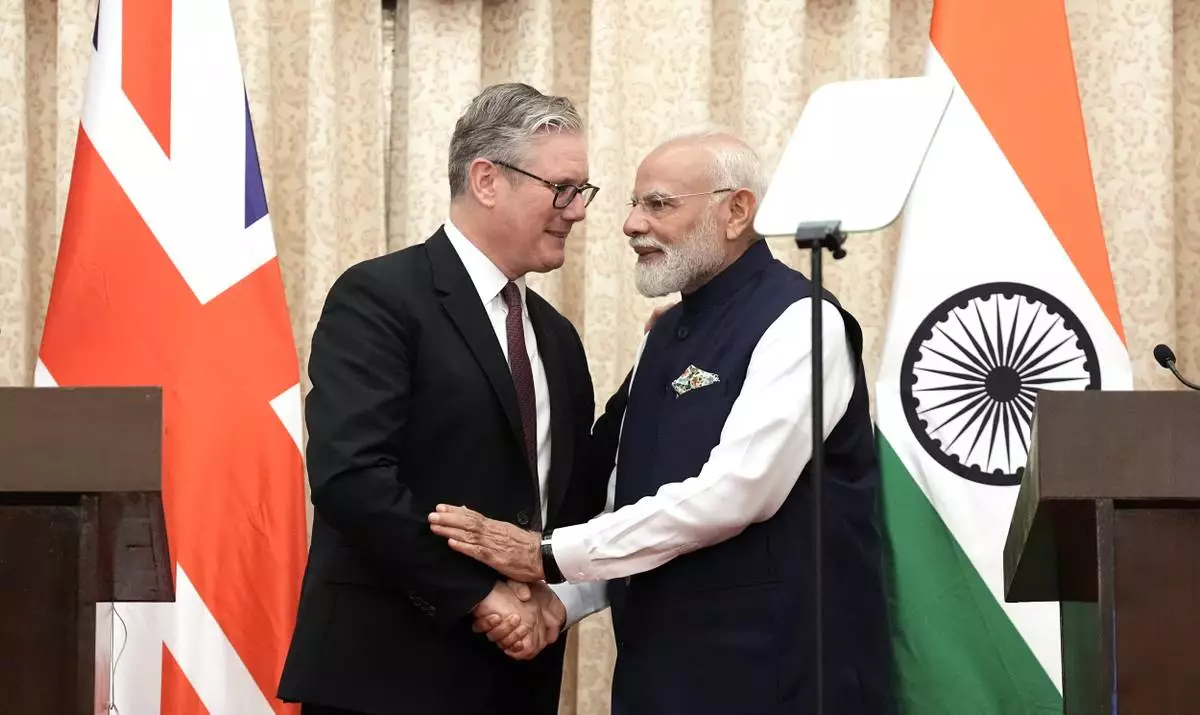
Britain's Prime Minister Keir Starmer, left, and India's Prime Minister Narendra Modi shake hands after delivering a statement to the press at Raj Bhavan in Mumbai, India Thursday, Oct. 9, 2025. (Stefan Rousseau/Pool Photo via AP)
British Prime Minister Keir Starmer, left is greeted by Indian Prime Minister Narendra Modi on his arrival at Raj Bhavan in Mumbai, India, Thursday, Oct. 9, 2025. (Leon Neal/Pool Photo via AP)
NEW YORK (AP) — The average price for a gallon of gasoline jumped 11 cents overnight in the U.S., and some drivers in Europe waited in line to fill their tanks with fuel, as war engulfed the Middle East and shipments of oil and gas were stranded in the Persian Gulf.
A gallon of regular was selling for $3.11 on average in the U.S., according to motor club AAA, surprising some drivers at the pump. Gasoline prices were already rising before the U.S. launched strikes on Iran as refiners switch over to summer blends of fuel. But crude prices rose sharply in recent days because of the war.
Anne Dulske paid $15 more than usual to fill up her tank at a Jackson, Mississippi gas station on Tuesday.
“It’s going to affect everything in our lives,” she said. “It’s very scary, and it does hit closer to home than people think.”
Dulske, who said she had previously noticed gas prices slowly going down, called the increase surprising and said she was caught off guard when she learned the United States and Israel had attacked Iran over the weekend.
“We are knee-deep into the gas price increases," said Patrick DeHaan, head of petroleum analysis at GasBuddy, a technology company that helps people find cheap gasoline. DeHaan estimates gasoline price could rise further, but he doubts the price would reach $4 a gallon in the U.S. “Many Americans seem very panicked that prices could hit multiple dollars higher than that, which at this point, I wouldn’t say anything’s impossible, but certainly it’s quite improbable based on the current developments."
In a suburb of Paris, drivers waited in a queue of 15 cars to fill up at seven pumps, which were charging about 1.846 euros per liter (7 euros per gallon) of diesel Tuesday.
“I’m heading out to the countryside and I’m almost out of fuel," said Laurence Rihouay, a customer at a petrol station. "But there are a lot of people here. There’s never usually this many.”
On Tuesday, oil prices soared to levels not seen in more than a year as Iran launched a series of retaliatory attacks, including a drone strike on the U.S. Embassy in Saudi Arabia.
Iran has also struck energy facilities in Qatar and Saudi Arabia, and disrupted tanker traffic through the Strait of Hormuz, the narrow mouth of the Persian Gulf through which a fifth of all oil traded passes, sending global oil and natural gas prices soaring.
President Donald Trump addressed the rising prices in remarks in the Oval Office Tuesday. “We have a little high oil prices for a little while, but as soon as this ends, those prices are going to drop, I believe, lower than even before,” he said.
Drivers elsewhere were taking precautions.
“With Iran and the Strait of Hormuz effectively blocked, it is causing alarm everywhere and driving up oil prices," said Abdelilah Khalil, who was getting gasoline at a station outside Paris. "It’s panic on board, everyone is worried, and I think that’s why many people are rushing to gas stations to fill up.”
Back in the U.S., Brody Wilkins was filling up gas canisters in Jackson, Mississippi, when he noticed prices had increased to $2.99 a gallon. Wilkins, who works for a landscaping and construction company, said he’s concerned about how the increase will impact the business.
“We use gas nonstop,” Wilkins said. “I don’t know how long this is supposed to last, but I hope not very long.”
Benchmark U.S. crude jumped 8.6% to $77.36 a barrel Tuesday. Brent crude, the international standard, added 6.7% to $81.29 a barrel. Global oil prices jumped to start the week over concerns that the war will clog the global flow of crude.
The price of crude is the single largest factor in how much U.S. drivers pay for fuel. And higher oil prices are usually felt at the pump within a couple of weeks at most.
In Burlington, Massachusetts, prices at one gas station neared $4 on Tuesday.
Erin Kelly called the price tag “hefty” and said she paid more than $5 for premium gas. She was driving her father’s car Tuesday while hers is getting repairs and said she hopes to get her car back soon so she can go back to paying for regular gas.
“We already are paying more in the grocery store,” she said. “We’re paying even more than we were paying before at the gas pump. So, I don’t know, it’s a little concerning.”
__
Associated Press journalists Nicolas Garriga in Paris, Sophie Bates in Jackson, Miss., Rodrique Ngowi in Burlington, Mass. and Seung Min Kim in Washington contributed to this report.
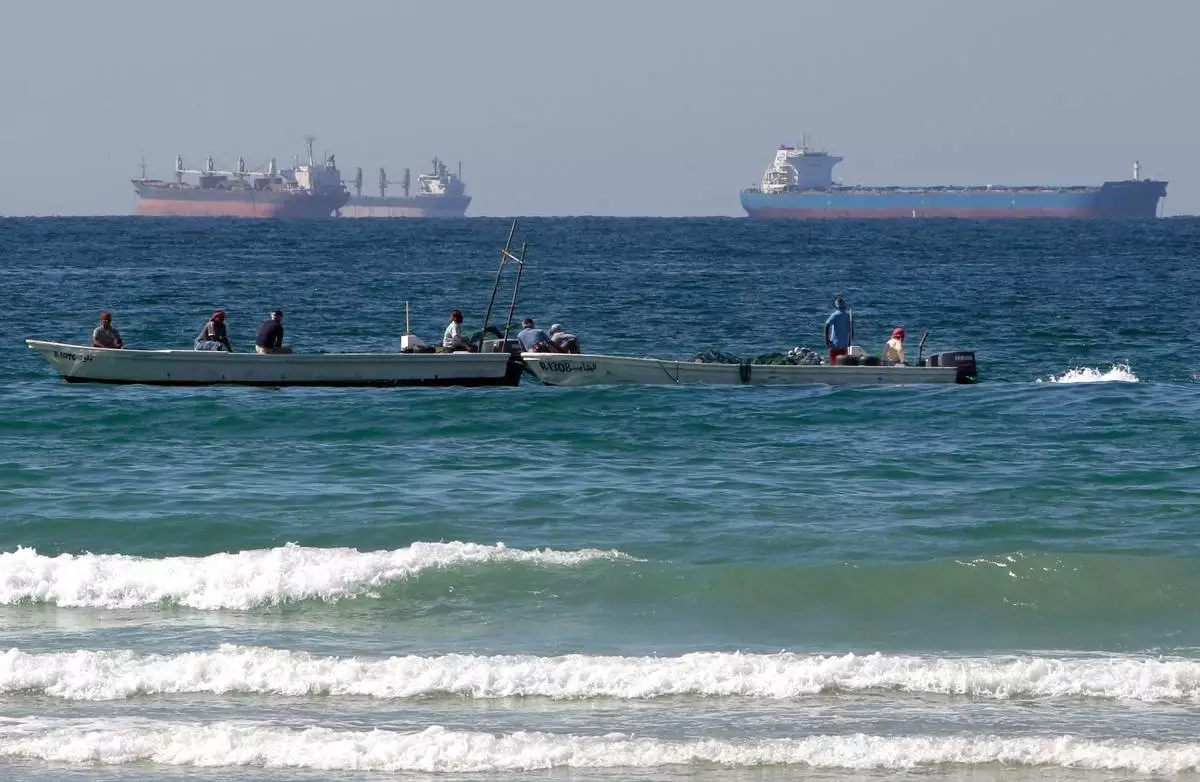
FILE - Fishermen work in front of oil tankers south of the Strait of Hormuz Jan. 19, 2012, offshore the town of Ras Al Khaimah in United Arab Emirates. (AP Photo/Kamran Jebreili, File)
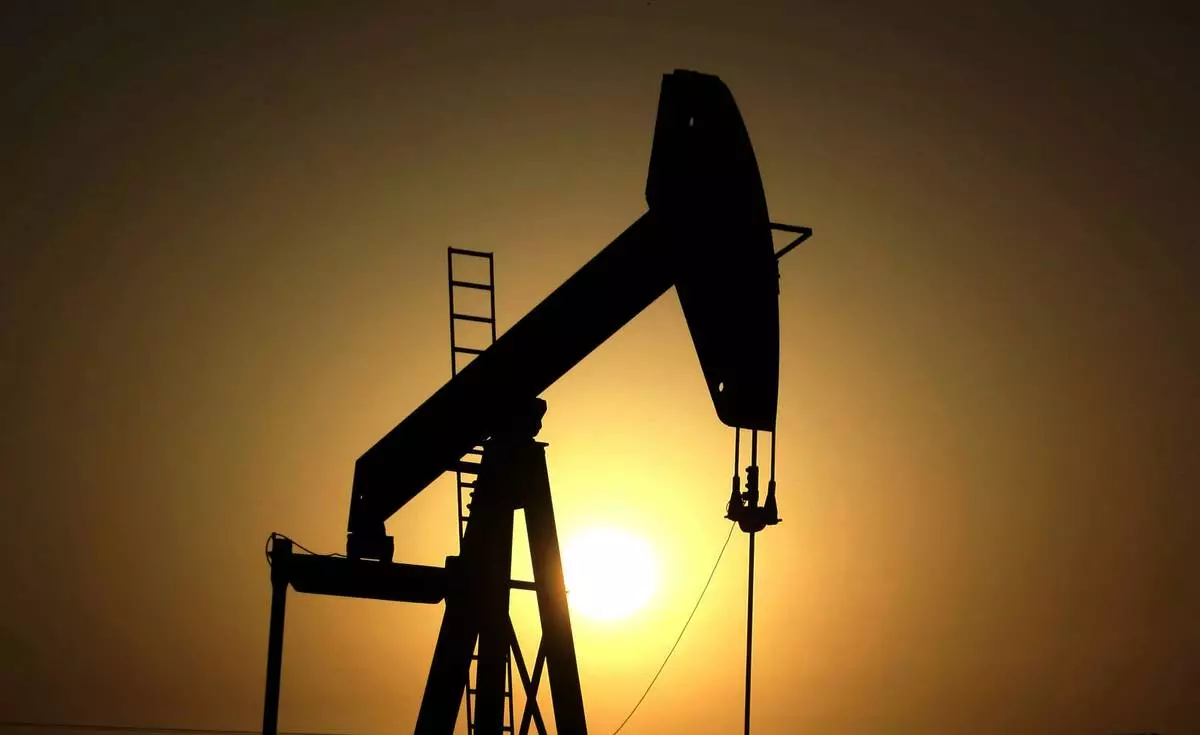
FILE- In this Wednesday, June 8, 2011 file photo, sun sets behind an oil pump in the desert oil fields of Sakhir, Bahrain. (AP Photo/Hasan Jamali, File)