WASHINGTON (AP) — After months of gridlock, President Donald Trump finally landed a long-sought Israel-Hamas ceasefire and hostage deal in Gaza — an agreement that only came together after a weekslong diplomacy blitz and a whole lot of help from some Arab and Muslim allies.
The breakthrough is designed to bring about a pause in the fighting unleashed by Hamas’ Oct. 7, 2023, attack on Israel. The group is expected to release 48 hostages — about 20 of them believed to be alive — in the coming days.
Click to Gallery

Palestinians celebrate following the announcement that Israel and Hamas have agreed to the first phase of a peace plan to pause the fighting, in Khan Younis, southern Gaza Strip, Thursday, Oct. 9, 2025. Celebrations remain limited, as relief is mixed with mourning and concern for what comes next. (AP Photo/Jehad Alshrafi)
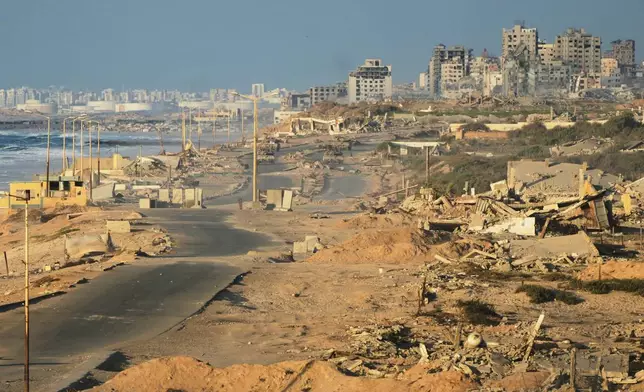
Israeli tanks are positioned on the coastal road leading to Gaza City near Wadi Gaza, in the central Gaza Strip, Thursday, Oct. 9, 2025. (AP Photo/Abdel Kareem Hana)
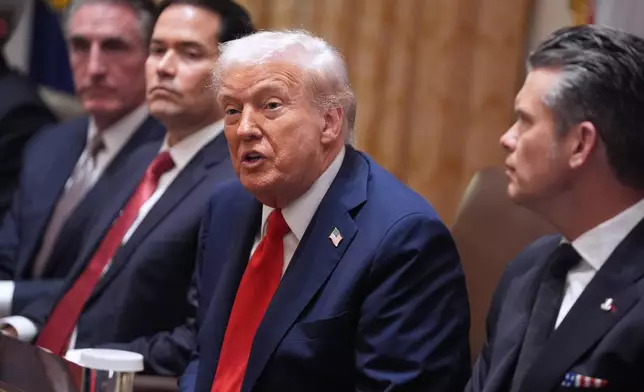
President Donald Trump speaks during a cabinet meeting at the White House, Thursday, Oct. 9, 2025, in Washington. From left are Interior Secretary Doug Burgum, Secretary of State Marco Rubio, Trump and Defense Secretary Pete Hegseth. (AP Photo/Evan Vucci)

Einav Zangauker, center, mother of Matan Zangauker, who is being held hostage by Hamas, reacts as she and others celebrate following the announcement that Israel and Hamas have agreed to the first phase of a peace plan to pause the fighting, at a plaza known as Hostages Square in Tel Aviv, Israel, Thursday, Oct. 9, 2025. (AP Photo/Ohad Zwigenberg)

President Donald Trump speaks upon departing a news conference with Israeli Prime Minister Benjamin Netanyahu, in foreground, in the State Dining Room of the White House, Monday, Sept. 29, 2025, in Washington. (AP Photo/Evan Vucci)
The brutal war finally reached a turning point because a badly battered Hamas recognized the hostages had become more of a liability than an asset, according to two senior U.S. officials who spoke to reporters on condition of anonymity because they were not authorized to publicly discuss internal deliberations.
One of the officials said negotiators, led by special envoy Steve Witkoff and Trump's son-in-law Jared Kushner, believed they finally had an opening when they sensed that “Hamas had enough.”
Still, the way to an agreement had remained complicated, leaving the U.S. administration in the difficult position of negotiating through a thicket of distrust between Israel and its Middle East neighbors that was in danger of further metastasizing.
Major questions remain, including over governance and reconstruction of a territory that largely has been destroyed as well as whether Hamas will disarm — a key Israeli demand that the militants have not yet publicly accepted.
But for now Trump appears to be headed toward a delicate truce and making good on his campaign promise to bring home all remaining hostages.
In early September, long-running ceasefire talks mediated by the U.S., Egypt and Qatar were at a standstill.
Witkoff had walked away weeks earlier, blaming Hamas. The militant group then accepted a proposal that mediators said was almost identical to one approved by Israel, but there was no public response from Israel or the U.S.
Hamas stuck to its position that it would only release the remaining hostages in return for hundreds of Palestinian prisoners, a lasting ceasefire and a full Israeli withdrawal from Gaza. Israeli Prime Minister Benjamin Netanyahu rejected those terms, saying the war would only end with Hamas’ surrender and the return of all the captives, with Israel maintaining open-ended security control over Gaza.
On Sept. 9, explosions rocked Doha. Israel had carried out an airstrike on Hamas leaders and negotiators as they had gathered to consider the latest ceasefire proposal in Qatar, a close U.S. ally and mediator. The strike killed five lower-ranking Hamas members and a Qatari security forces member.
It infuriated Gulf Arab leaders and angered the White House. Trump quickly went into damage control, seeking to reassure Qatar.
The strike alarmed U.S. allies across the region, including countries like Turkey and Egypt that have hosted Hamas political leaders. The war that Trump had pledged to end was at risk of spiraling across the Middle East once again.
But the Qataris remained engaged with Witkoff and Kushner, helping Trump’s chief negotiators tailor what would become the president's 20-point peace plan before he would ultimately present it to other Arab and Muslim countries for support, the U.S. officials said.
Two weeks after the Doha strike, Trump met with the leaders of eight Arab and Muslim nations on the sidelines of an annual gathering of world leaders at the United Nations that highlighted Israel’s growing isolation. The president said it was his “most important meeting.”
The president returned to Washington while Witkoff checked into the luxury Regency New York, staying near Kushner's New York apartment so the two could continue coordinating as they fine-tuned the document.
All the while, along with Secretary of State Marco Rubio, they continued to meet and hold calls with Arab and Muslim country leaders to try to build support.
Less than a week later, Witkoff and Kushner were back in Washington with the finalized plan, as the president was set to meet with Netanyahu for the Israeli leader's fourth visit to the White House this year.
Witkoff and Kushner had come up with the idea of nudging Netanyahu to make a visible gesture toward reconciliation with the Qataris for the strike.
Trump dialed up Qatari Prime Minister Mohammed bin Abdulrahman Al Thani and spoke to him before handing the phone to Netanyahu. The prime minister read from a written apology, expressing his regret for Israel violating Qatari sovereignty with the strike.
The White House later published photos of a grim-faced Trump with the phone awkwardly perched in his lap as Netanyahu delivered the apology.
In a press conference in Washington after the Sept. 29 meeting, Netanyahu said he had accepted Trump's plan.
Rubio said Trump’s negotiators then stepped up their efforts through intermediaries in Qatar and Egypt to get Hamas on board, while Trump held phone calls and meetings with world leaders.
The U.S. plan calls for Hamas to release all the remaining hostages within 72 hours of the ceasefire in return for hundreds of Palestinian prisoners, to give up power in Gaza and to disarm.
Hamas during negotiations made clear its willingness to release all hostages in exchange for Palestinian prisoners and to give up power to other Palestinians. But it said other elements of Trump's plan required more negotiation and offered nothing about disarming, a key Israeli demand.
The response was clearly a “yes, but.”
The U.S. and Israel could have taken it as a “no” and blamed Hamas for the failure to reach a ceasefire on Israel's terms, as they had in the past. Israel could have vowed to press ahead with its invasion of Gaza City or even expand it.
But when the Hamas response landed late Friday, Israel was largely shut down for the Sabbath, and Trump was first to respond, concluding he believed Hamas was ready for peace.
In a brief statement later that night, Netanyahu said Israel was preparing for the implementation of the “first stage” of Trump’s plan — the release of hostages — and was still committed to ending the war according to its own principles.
It made no mention of the fact that Hamas had not accepted some key demands.
Israeli Foreign Minister Gideon Saar said on Fox News on Thursday that he and many other Israeli officials were skeptical about Hamas' heavily qualified acceptance. But he said Trump's decision to frame it as a sign of momentum created opportunity.
In an interview with Fox News host and ally Sean Hannity after announcing the agreement, the president said he hoped it would help repair Israel's international standing.
“I spoke to Bibi Netanyahu just a little while ago,” Trump told Hannity, using the Israeli prime minister's nickname. “I said, ‘Israel cannot fight the world, Bibi.' They can’t fight the world. And he understands that very well.”
Krauss reported from Ottawa, Ontario. AP writers Michelle Price and Will Weissert contributed reporting.

Palestinians celebrate following the announcement that Israel and Hamas have agreed to the first phase of a peace plan to pause the fighting, in Khan Younis, southern Gaza Strip, Thursday, Oct. 9, 2025. Celebrations remain limited, as relief is mixed with mourning and concern for what comes next. (AP Photo/Jehad Alshrafi)
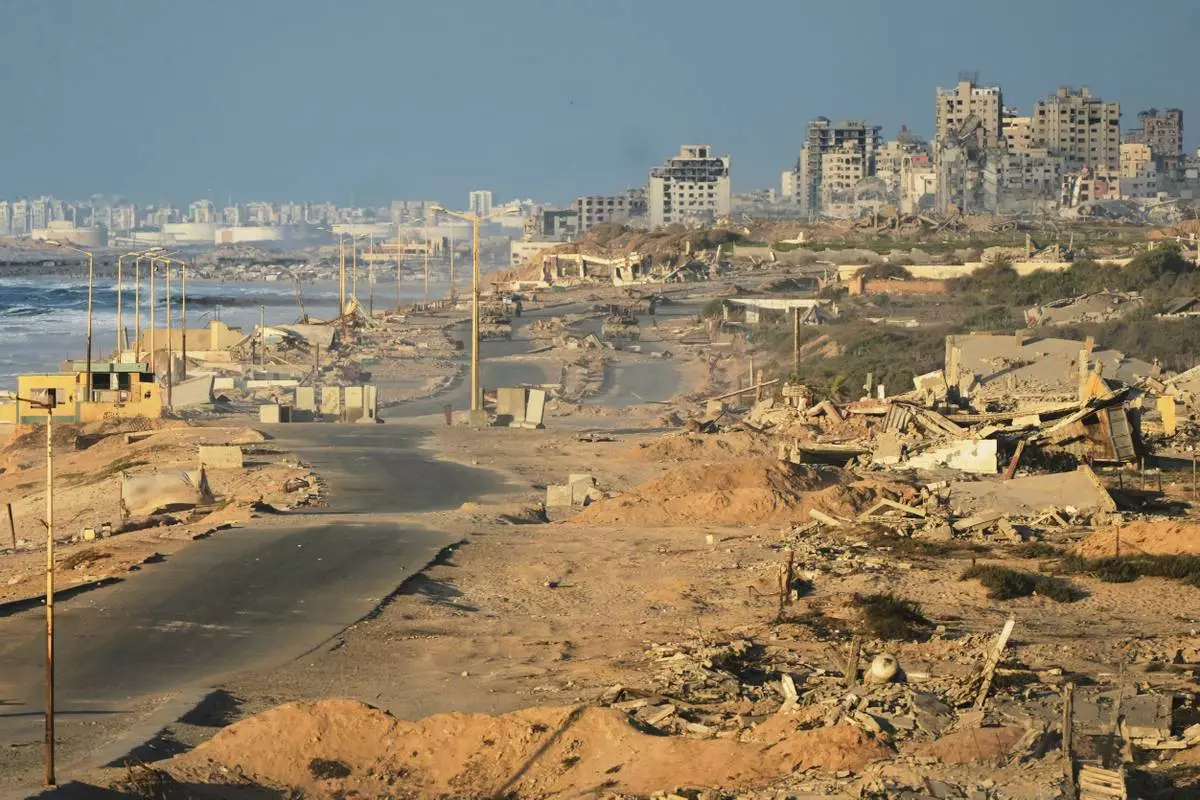
Israeli tanks are positioned on the coastal road leading to Gaza City near Wadi Gaza, in the central Gaza Strip, Thursday, Oct. 9, 2025. (AP Photo/Abdel Kareem Hana)
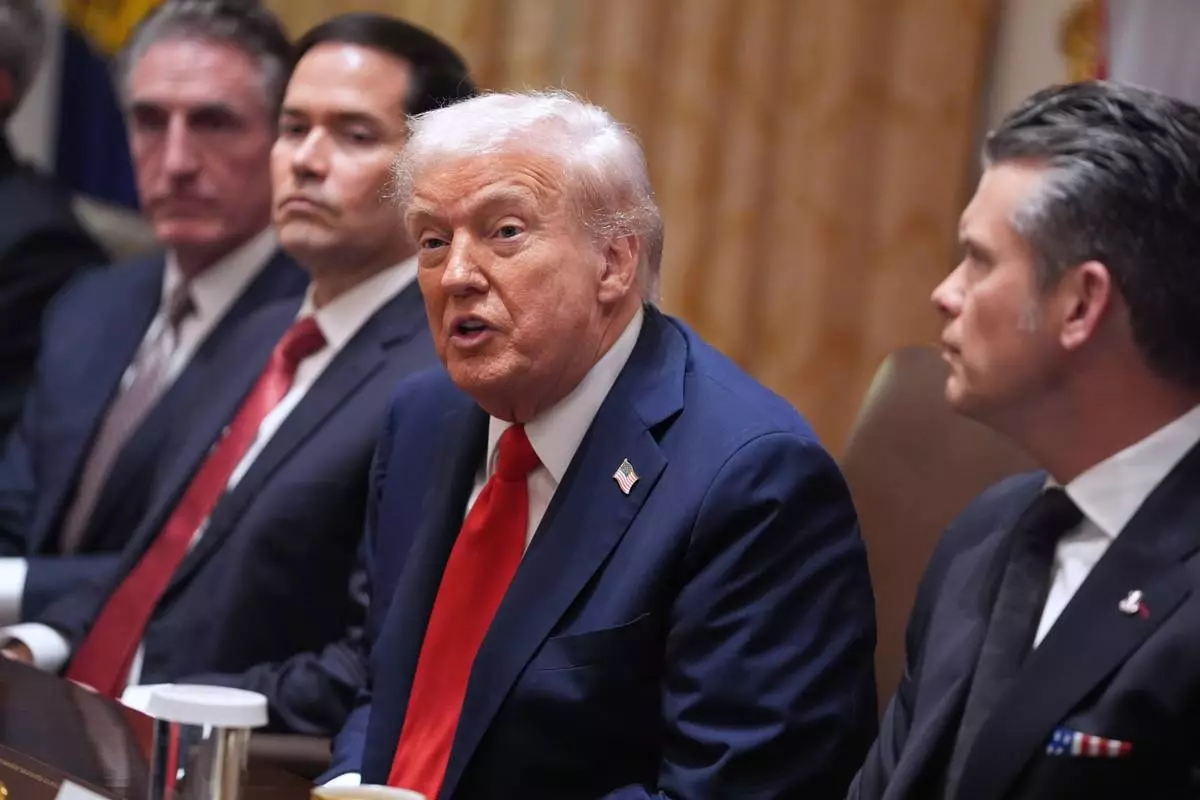
President Donald Trump speaks during a cabinet meeting at the White House, Thursday, Oct. 9, 2025, in Washington. From left are Interior Secretary Doug Burgum, Secretary of State Marco Rubio, Trump and Defense Secretary Pete Hegseth. (AP Photo/Evan Vucci)
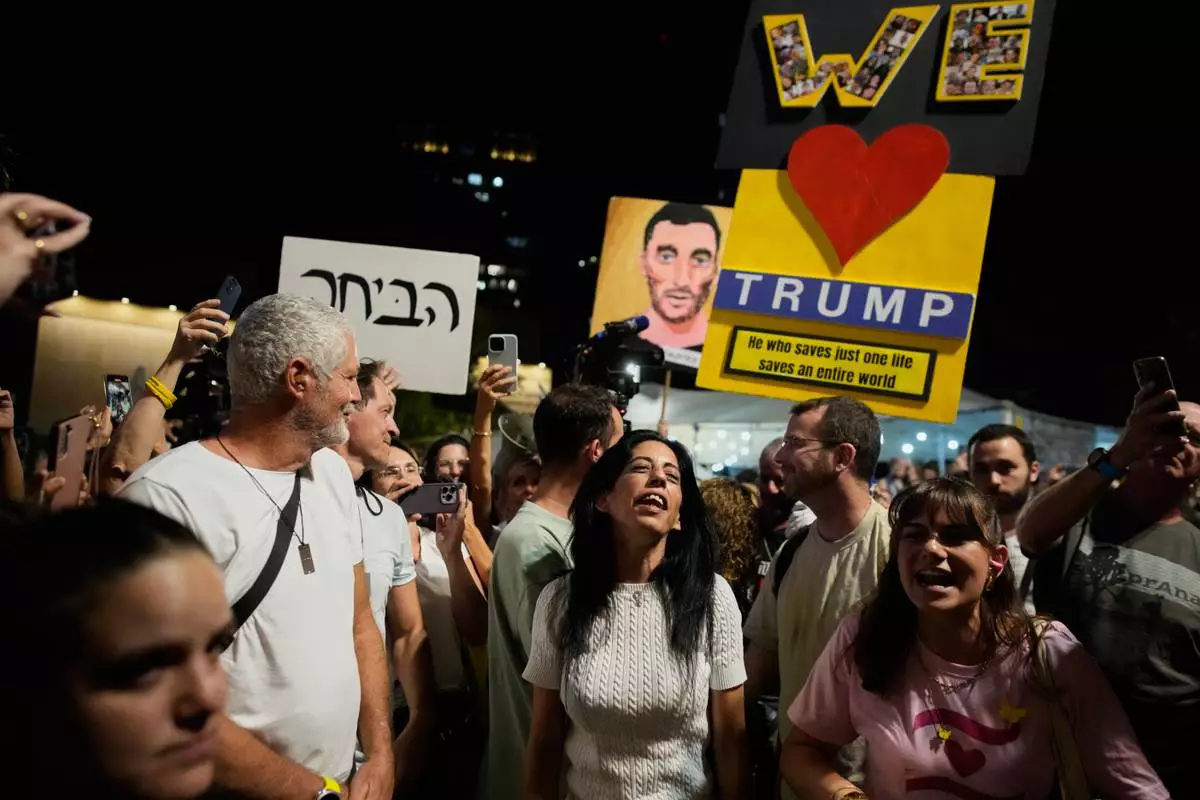
Einav Zangauker, center, mother of Matan Zangauker, who is being held hostage by Hamas, reacts as she and others celebrate following the announcement that Israel and Hamas have agreed to the first phase of a peace plan to pause the fighting, at a plaza known as Hostages Square in Tel Aviv, Israel, Thursday, Oct. 9, 2025. (AP Photo/Ohad Zwigenberg)

President Donald Trump speaks upon departing a news conference with Israeli Prime Minister Benjamin Netanyahu, in foreground, in the State Dining Room of the White House, Monday, Sept. 29, 2025, in Washington. (AP Photo/Evan Vucci)