|
Collaboration to deliver deeply carbon-negative hydrogen using dairy biogas to fuel heavy-duty transportation across California
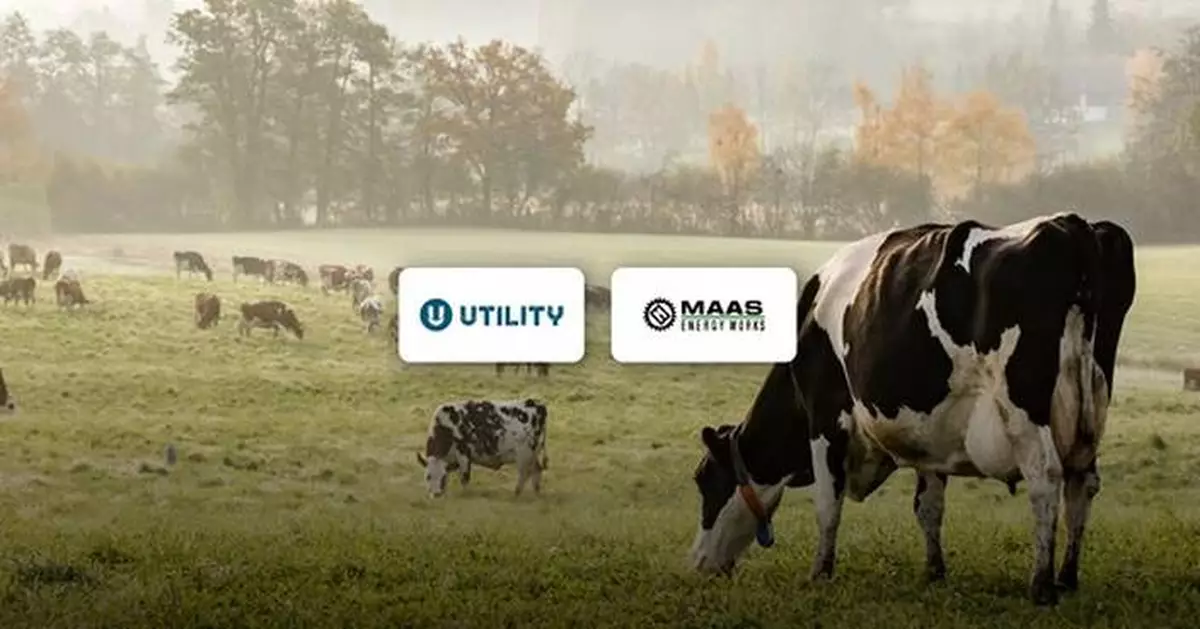
HOUSTON and REDDING, Calif., Oct. 10, 2025 /PRNewswire/ -- Utility Global, Inc. ("Utility"), a U.S.-based leader in economical decarbonization technology, and Maas Energy Works ("MEW"), the nation's leading developer of dairy digester-to-energy projects today announced an agreement to advance the development of the first commercial project in California to use dairy digester biogas for direct hydrogen fuel production. The project will produce deeply carbon-negative hydrogen from water without electricity for the mobility sector, setting a new benchmark for cost-effective decarbonization.
The project will be located at a dairy farm complex in California and will integrate dairy digester biogas systems with Utility's proprietary H2Gen® technology to produce economical clean fuel for heavy-duty transportation. This innovative combination will deliver hydrogen with one of the lowest negative carbon intensity scores in the market and provide a scalable pathway to decarbonize heavy-duty transportation economically. The project has also secured initial offtake at attractive pricing to both partners.
Under the agreement, MEW will develop, build, and operate the anaerobic digesters and associated biogas treatment systems, while Utility will develop and operate the fuel production system. Together, the companies are demonstrating that collaboration across the agriculture and energy sectors can enable economic decarbonization at scale, further supporting the US's energy independence.
"This project is another breakthrough moment for Utility - proving that hydrogen fuel can be produced economically, without electricity, and at deeply negative carbon intensity – greener than 'green hydrogen' from renewable power," said Parker Meeks, CEO of Utility Global. "Partnering with MEW allows us to unite world-class biogas expertise with our H2Gen® technology to deliver extremely clean fuel at scale and accelerate California's transition to zero-emission, heavy-duty transportation."
"Maas Energy Works has always focused on turning dairy manure into biogas and clean energy," said Daryl Maas, CEO of Maas Energy Works. "Partnering with Utility Global takes that innovation further -- producing carbon-negative hydrogen to power the growth of heavy-duty transportation."
Once operational, the project is expected to produce approximately three tons per day of carbon-negative hydrogen fuel, creating a scalable solution to supply the growing network of hydrogen fueling stations across California. This fuel will play a critical role in enabling zero-emission trucks and buses to meet the state's leadership in climate and air quality targets.
The Utility Global–MEW collaboration represents an alternative model for the integration of bio-based clean fuels and industrial decarbonization technology. In addition to dairy farms, other sources of biogas like landfills and wastewater plants are also profitable opportunities for H2Gen to provide a practical and economic pathway to produce and decarbonize transportation fuels near the point of use. The project is currently in front-end engineering development, with final investment decision anticipated following completion of feasibility and design studies and finalization of binding offtake agreements in 2026.
About Utility Global
Utility pioneers clean solutions that power the economic energy transition for hard-to-abate industries such as steel, mobility, upstream oil & gas, refining, and chemicals. Utility's breakthrough H2Gen® technology harnesses energy from industrial off-gases and various biogases to produce high-purity, low-to-negative carbon intensity hydrogen from water, without electricity, using its proprietary electrochemical process. H2Gen systems have been proven to provide the utmost operationally flexible and integrate seamlessly into existing infrastructure, enabling practical, cost-effective decarbonization.
H2Gen also produces a high-concentration CO₂ stream, simplifying and reducing the cost of carbon capture. Designed to be modular, scalable, and with the smallest hydrogen production footprint, H2Gen empowers customers to convert low-value inputs into high-value clean energy, fuels, or feedstocks. This helps heavy industries meet both business and sustainability goals.
Utility is a portfolio company of Ara Partners, a private equity and infrastructure investment firm focused on industrial decarbonization investments. For more information on Utility's solutions and services details, visit www.utilityglobal.com.
About Ara Partners
Ara Partners is a global private equity and infrastructure investment firm focused on industrial decarbonization. Founded in 2017, Ara Partners seeks to build and scale companies with significant decarbonization impact across the industrial and manufacturing, chemicals and materials, energy efficiency and green fuels, and food and agriculture sectors. The company operates from offices in Houston, Boston, Washington D.C., and Dublin. Ara Partners closed its third private equity fund in December 2023 with over $2.8 billion in capital commitments. As of June 30, 2025, Ara Partners had approximately $6.6 billion of assets under management.
For more information about Ara Partners, please visit www.arapartners.com.
About Maas Energy Works
Maas Energy Works is a family-owned renewable energy business with headquarters in Redding, California. We develop, own, and operate renewable energy facilities by partnering with dairy families to create biogas out of cow manure and other organic wastes. We then use that biogas to generate vehicle fuel, electricity, heat, CO2, and soon, hydrogen. Our founders Daryl and Christianna Maas believe this waste-to-energy transformation demonstrates our belief that God created humanity in His image to redeem and create. Our 215 employees operate with excellence the nation's largest fleet of over 80 dairy digesters in 9 states. Learn more at www.maasenergy.com.
Photo - https://mma.prnasia.com/media2/2792762/Utility_and_Maas_Announce_Agreement.jpg?p=medium600
Logo - https://mma.prnasia.com/media2/2590736/Utility_Global_2025_Logo.jpg?p=medium600
Collaboration to deliver deeply carbon-negative hydrogen using dairy biogas to fuel heavy-duty transportation across California
HOUSTON and REDDING, Calif., Oct. 10, 2025 /PRNewswire/ -- Utility Global, Inc. ("Utility"), a U.S.-based leader in economical decarbonization technology, and Maas Energy Works ("MEW"), the nation's leading developer of dairy digester-to-energy projects today announced an agreement to advance the development of the first commercial project in California to use dairy digester biogas for direct hydrogen fuel production. The project will produce deeply carbon-negative hydrogen from water without electricity for the mobility sector, setting a new benchmark for cost-effective decarbonization.
The project will be located at a dairy farm complex in California and will integrate dairy digester biogas systems with Utility's proprietary H2Gen® technology to produce economical clean fuel for heavy-duty transportation. This innovative combination will deliver hydrogen with one of the lowest negative carbon intensity scores in the market and provide a scalable pathway to decarbonize heavy-duty transportation economically. The project has also secured initial offtake at attractive pricing to both partners.
Under the agreement, MEW will develop, build, and operate the anaerobic digesters and associated biogas treatment systems, while Utility will develop and operate the fuel production system. Together, the companies are demonstrating that collaboration across the agriculture and energy sectors can enable economic decarbonization at scale, further supporting the US's energy independence.
"This project is another breakthrough moment for Utility - proving that hydrogen fuel can be produced economically, without electricity, and at deeply negative carbon intensity – greener than 'green hydrogen' from renewable power," said Parker Meeks, CEO of Utility Global. "Partnering with MEW allows us to unite world-class biogas expertise with our H2Gen® technology to deliver extremely clean fuel at scale and accelerate California's transition to zero-emission, heavy-duty transportation."
"Maas Energy Works has always focused on turning dairy manure into biogas and clean energy," said Daryl Maas, CEO of Maas Energy Works. "Partnering with Utility Global takes that innovation further -- producing carbon-negative hydrogen to power the growth of heavy-duty transportation."
Once operational, the project is expected to produce approximately three tons per day of carbon-negative hydrogen fuel, creating a scalable solution to supply the growing network of hydrogen fueling stations across California. This fuel will play a critical role in enabling zero-emission trucks and buses to meet the state's leadership in climate and air quality targets.
The Utility Global–MEW collaboration represents an alternative model for the integration of bio-based clean fuels and industrial decarbonization technology. In addition to dairy farms, other sources of biogas like landfills and wastewater plants are also profitable opportunities for H2Gen to provide a practical and economic pathway to produce and decarbonize transportation fuels near the point of use. The project is currently in front-end engineering development, with final investment decision anticipated following completion of feasibility and design studies and finalization of binding offtake agreements in 2026.
About Utility Global
Utility pioneers clean solutions that power the economic energy transition for hard-to-abate industries such as steel, mobility, upstream oil & gas, refining, and chemicals. Utility's breakthrough H2Gen® technology harnesses energy from industrial off-gases and various biogases to produce high-purity, low-to-negative carbon intensity hydrogen from water, without electricity, using its proprietary electrochemical process. H2Gen systems have been proven to provide the utmost operationally flexible and integrate seamlessly into existing infrastructure, enabling practical, cost-effective decarbonization.
H2Gen also produces a high-concentration CO₂ stream, simplifying and reducing the cost of carbon capture. Designed to be modular, scalable, and with the smallest hydrogen production footprint, H2Gen empowers customers to convert low-value inputs into high-value clean energy, fuels, or feedstocks. This helps heavy industries meet both business and sustainability goals.
Utility is a portfolio company of Ara Partners, a private equity and infrastructure investment firm focused on industrial decarbonization investments. For more information on Utility's solutions and services details, visit www.utilityglobal.com.
About Ara Partners
Ara Partners is a global private equity and infrastructure investment firm focused on industrial decarbonization. Founded in 2017, Ara Partners seeks to build and scale companies with significant decarbonization impact across the industrial and manufacturing, chemicals and materials, energy efficiency and green fuels, and food and agriculture sectors. The company operates from offices in Houston, Boston, Washington D.C., and Dublin. Ara Partners closed its third private equity fund in December 2023 with over $2.8 billion in capital commitments. As of June 30, 2025, Ara Partners had approximately $6.6 billion of assets under management.
For more information about Ara Partners, please visit www.arapartners.com.
About Maas Energy Works
Maas Energy Works is a family-owned renewable energy business with headquarters in Redding, California. We develop, own, and operate renewable energy facilities by partnering with dairy families to create biogas out of cow manure and other organic wastes. We then use that biogas to generate vehicle fuel, electricity, heat, CO2, and soon, hydrogen. Our founders Daryl and Christianna Maas believe this waste-to-energy transformation demonstrates our belief that God created humanity in His image to redeem and create. Our 215 employees operate with excellence the nation's largest fleet of over 80 dairy digesters in 9 states. Learn more at www.maasenergy.com.
Photo - https://mma.prnasia.com/media2/2792762/Utility_and_Maas_Announce_Agreement.jpg?p=medium600
Logo - https://mma.prnasia.com/media2/2590736/Utility_Global_2025_Logo.jpg?p=medium600
** The press release content is from PR Newswire. Bastille Post is not involved in its creation. **
Utility Global and Maas Energy Works Announce Agreement to Develop Dairy Digester-to-Hydrogen Mobility Project in California
- New framework brings together Aon's Risk Capital and Human Capital data with public sentiment analysis from Gallup to create a portfolio view of risk
- Creates further clarity into how risks compound across four megatrends, how resilience is built and activated and where targeted actions can most effectively influence performance
DUBLIN, Jan. 16, 2026 /PRNewswire/ -- Aon plc (NYSE: AON), a leading global professional services firm, announced today that it is releasing insights from a new, data-driven tool to help organizations build sustainable resilience and unlock growth: Aon's Resilience Quotient.
Developed in collaboration with Gallup, Aon's Resilience Quotient responds to a critical insight: in a time of increasing populism and fragmented sources of information, quantitative data alone is not enough to make long-term decisions. Combining public sentiment on global issues with risk and people data and analytics enables greater clarity and confidence to invest and grow amidst uncertainty and volatility.
By integrating Aon's proprietary Risk Capital and Human Capital analytics with the results of Gallup's World Poll covering 140 countries for more than 20 years, the firm's Resilience Quotient captures both objective conditions and subjective sentiment, revealing where sentiment signals hidden risks and potential opportunities to achieve greater resilience. This system-level view enables leaders to spot emerging risks sooner, prioritize resilience investments and move from reactive risk management to proactive decision-making.
"When making decisions around investment, workforce or managing geopolitical risk, a portfolio view is far superior to a siloed perspective," said Greg Case, president and CEO of Aon. "Understanding sentiment can be an opportunity signal or an early warning. Leaders who are limited to only some of the relevant metrics risk missing the signals that matter most. Aon's Resilience Quotient delivers an integrated view to help organizations act decisively, strengthen resilience and unlock sustainable growth."
Four interconnected megatrends – Trade, Technology, Weather and Workforce – are reshaping the global operating environment in ways that traditional models struggle to anticipate. Aon's Resilience Quotient provides a clearer view of the tradeoffs within these interactions: how trade volatility can amplify technology risk, how climate pressures influence workforce mobility and how sentiment can either reinforce resilience or heighten operational risk, even when the fundamentals appear strong.
To illustrate the insights from its Resilience Quotient, the firm published three case studies addressing some of the most relevant and urgent issues facing the 2026 global economy:
- Realizing the Opportunity of AI: Securing Data Center Growth
Data centers are the backbone of the digital economy and with nearly $1.3 trillion projected to be invested globally in data centers by 2030, their rapid expansion brings unprecedented risks. Aon's Resilience Quotient shows that resilience varies sharply at the sub-national level, often more than underlying risk. Within the U.S., Iowa emerges as the most resilient destination for data center development, combining very low overall risk with exceptionally strong trade and weather resilience. "Aon's Resilience Quotient shows that Iowa's resilience–risk balance is roughly twice the national median, demonstrating how governance quality, institutional confidence and preparedness materially shape long-term infrastructure outcomes," said Joe Peiser, CEO of Commercial Risk Solutions at Aon. "This underscores the opportunity for leaders who understand the combined effect of low risk, resilient trade and weather systems and a strong foundation of public trust — factors that ultimately determine where AI infrastructure can grow at scale."
DUBLIN, Jan. 16, 2026 /PRNewswire/ -- Aon plc (NYSE: AON), a leading global professional services firm, announced today that it is releasing insights from a new, data-driven tool to help organizations build sustainable resilience and unlock growth: Aon's Resilience Quotient.
Developed in collaboration with Gallup, Aon's Resilience Quotient responds to a critical insight: in a time of increasing populism and fragmented sources of information, quantitative data alone is not enough to make long-term decisions. Combining public sentiment on global issues with risk and people data and analytics enables greater clarity and confidence to invest and grow amidst uncertainty and volatility.
By integrating Aon's proprietary Risk Capital and Human Capital analytics with the results of Gallup's World Poll covering 140 countries for more than 20 years, the firm's Resilience Quotient captures both objective conditions and subjective sentiment, revealing where sentiment signals hidden risks and potential opportunities to achieve greater resilience. This system-level view enables leaders to spot emerging risks sooner, prioritize resilience investments and move from reactive risk management to proactive decision-making.
"When making decisions around investment, workforce or managing geopolitical risk, a portfolio view is far superior to a siloed perspective," said Greg Case, president and CEO of Aon. "Understanding sentiment can be an opportunity signal or an early warning. Leaders who are limited to only some of the relevant metrics risk missing the signals that matter most. Aon's Resilience Quotient delivers an integrated view to help organizations act decisively, strengthen resilience and unlock sustainable growth."
Four interconnected megatrends – Trade, Technology, Weather and Workforce – are reshaping the global operating environment in ways that traditional models struggle to anticipate. Aon's Resilience Quotient provides a clearer view of the tradeoffs within these interactions: how trade volatility can amplify technology risk, how climate pressures influence workforce mobility and how sentiment can either reinforce resilience or heighten operational risk, even when the fundamentals appear strong.
To illustrate the insights from its Resilience Quotient, the firm published three case studies addressing some of the most relevant and urgent issues facing the 2026 global economy:
"Aon's Resilience Quotient shows that Iowa's resilience–risk balance is roughly twice the national median, demonstrating how governance quality, institutional confidence and preparedness materially shape long-term infrastructure outcomes," said Joe Peiser, CEO of Commercial Risk Solutions at Aon. "This underscores the opportunity for leaders who understand the combined effect of low risk, resilient trade and weather systems and a strong foundation of public trust — factors that ultimately determine where AI infrastructure can grow at scale."
- Workforce Transformation: AI Adoption and the Next Generation Workforce
The acceleration of AI adoption is transforming the workforce, but most organizations face a critical gap between the demand for AI skills and their readiness to adapt. The Resilience Quotient highlights how workforce engagement, trust and institutional preparedness are essential to harnessing AI's potential, making resilience the key differentiator between organizations that thrive through change and those that risk falling behind. "Aon's Resilience Quotient equips leaders to navigate rapid AI change with confidence," said Lisa Stevens, chief administrative officer at Aon. "These insights help create the conditions for early‑career employees to build the skills and confidence they need — so instead of losing a generation of talent, we cultivate one that is more capable and resilient than ever."
"Aon's Resilience Quotient equips leaders to navigate rapid AI change with confidence," said Lisa Stevens, chief administrative officer at Aon. "These insights help create the conditions for early‑career employees to build the skills and confidence they need — so instead of losing a generation of talent, we cultivate one that is more capable and resilient than ever."
- Rethinking Humanitarian Finance: A New Approach to Forced Migration
Over 120 million people are currently displaced by conflict, climate and systemic crises, reshaping societies and economies worldwide. Aon's Resilience Quotient highlights Venezuela and Colombia to illustrate the tradeoffs between investing resources at the source of migration — supporting those facing institutional erosion, food insecurity and economic collapse — or directing investment to more stable countries like Colombia that are absorbing people fleeing unlivable conditions. "Forced displacement results from extreme weather and man-made disasters like conflict and economic failure," said Bridget Gainer, chief public affairs officer at Aon. "If we could leverage the forecasting and financial capability of insurance to better predict and more quickly mitigate the impact of this volatility, we could help create conditions that allow populations to remain and rebuild in their home countries."
"Forced displacement results from extreme weather and man-made disasters like conflict and economic failure," said Bridget Gainer, chief public affairs officer at Aon. "If we could leverage the forecasting and financial capability of insurance to better predict and more quickly mitigate the impact of this volatility, we could help create conditions that allow populations to remain and rebuild in their home countries."
"Resilience is not a single blueprint, it's the way systems mitigate, adapt and transform under pressure. Aon's Resilience Quotient functions as a pressure gauge, surfacing the trade‑offs and early signals that help leaders strengthen resilience where it matters most," said Joe Daly, managing partner at Gallup. "We're proud to collaborate with Aon to combine Gallup's global sentiment analytics with Aon's Risk Capital and Human Capital data, turning confidence into actionable insight."
New insights from Aon's Resilience Quotient suggest that going forward, resilience priorities will shift from static risk management to dynamic, localized strategies. As disruptions become more complex and frequent, organizations will need to tailor resilience investments to specific geographies, sectors and even sub-regional contexts. Aon's Resilience Quotient is supported with a real-time analytics and AI-enabled insights platform, built by Quantum Rise, providing deeper visibility into evolving risk and resilience signals as conditions change.
Aon and Gallup will join global decision-makers at the World Economic Forum Annual Meeting to advance these critical discussions on restoring confidence and unlocking sustainable growth.
Learn more about Aon's Resilience Quotient and explore the case studies here.
About Aon
Aon plc (NYSE: AON) exists to shape decisions for the better — to protect and enrich the lives of people around the world. Through actionable analytic insight, globally integrated Risk Capital and Human Capital expertise, and locally relevant solutions, our colleagues provide clients in over 120 countries with the clarity and confidence to make better risk and people decisions that help protect and grow their businesses.
Follow Aon on LinkedIn, X, Facebook and Instagram. Stay up-to-date by visiting Aon's newsroom and sign up for news alerts here.
Media Contact
mediainquiries@aon.com
Toll-free (U.S., Canada and Puerto Rico): +1 833 751 8114
International: +1 312 381 3024
** The press release content is from PR Newswire. Bastille Post is not involved in its creation. **
Aon's Resilience Quotient Cuts Through Uncertainty and Volatility to Help Businesses Move from Risk to Resilience and Growth