Skip to Content Facebook Feature Image

Many unresolved questions remain as a ceasefire begins in Gaza

News

Many unresolved questions remain as a ceasefire begins in Gaza
News

News

Many unresolved questions remain as a ceasefire begins in Gaza

2025-10-11 03:18 Last Updated At:03:20

CAIRO (AP) — Bombardment stopped and Israeli troops pulled back in Gaza on Friday under a ceasefire between Israel and Hamas. But will the agreement lead, as U.S. President Donald Trump proclaimed, to “a Strong, Durable, and Everlasting Peace”?

It took pressure on Israel and Hamas from the United States, Arab countries and Turkey, each saying it was time to end a two-year war that has devastated the Gaza Strip, killed tens of thousands of Palestinians, sparked other conflicts around the region and increasingly isolated Israel.

That push sealed an agreement on a first phase that is to free the remaining living Israeli hostages within days in exchange for the release of hundreds of Palestinians imprisoned by Israel.

But it left unanswered a long list of questions over what happens next.

The war began when Hamas-led militants stormed into Israel on Oct. 7, 2023, killing some 1,200 people and taking 251 hostage.

Israel wants to ensure that Hamas disarms. Hamas wants to ensure Israel pulls its troops completely out of Gaza and is not allowed to restart the war. At the same time, a postwar government for Gaza must be worked out to replace Hamas’ rule. Without that, reconstruction is unlikely, leaving Gaza’s more than 2 million people in continued misery.

With no trust between the sides, much relies on continued pressure from the U.S., Egypt, Qatar and Turkey. Any hitch in working out those intertwined issues could unravel everything and potentially lead to Israel resuming its campaign to destroy Hamas.

Here is what we know about the deal.

The ceasefire took effect at noon Friday. The Israeli military said it had pulled back its troops to lines inside Gaza agreed on for the first day, withdrawing from much of Gaza City, the southern city of Khan Younis and other areas. Troops remain in most of the southern city of Rafah, towns of Gaza's far north and the wide strip along Gaza's border with Israel.

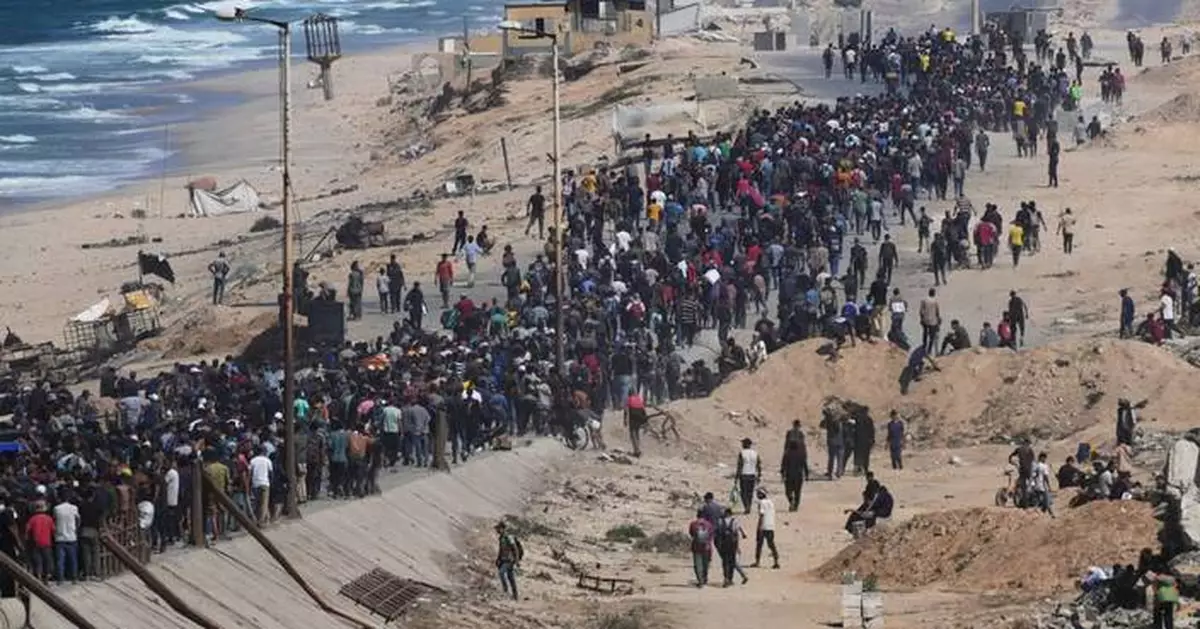
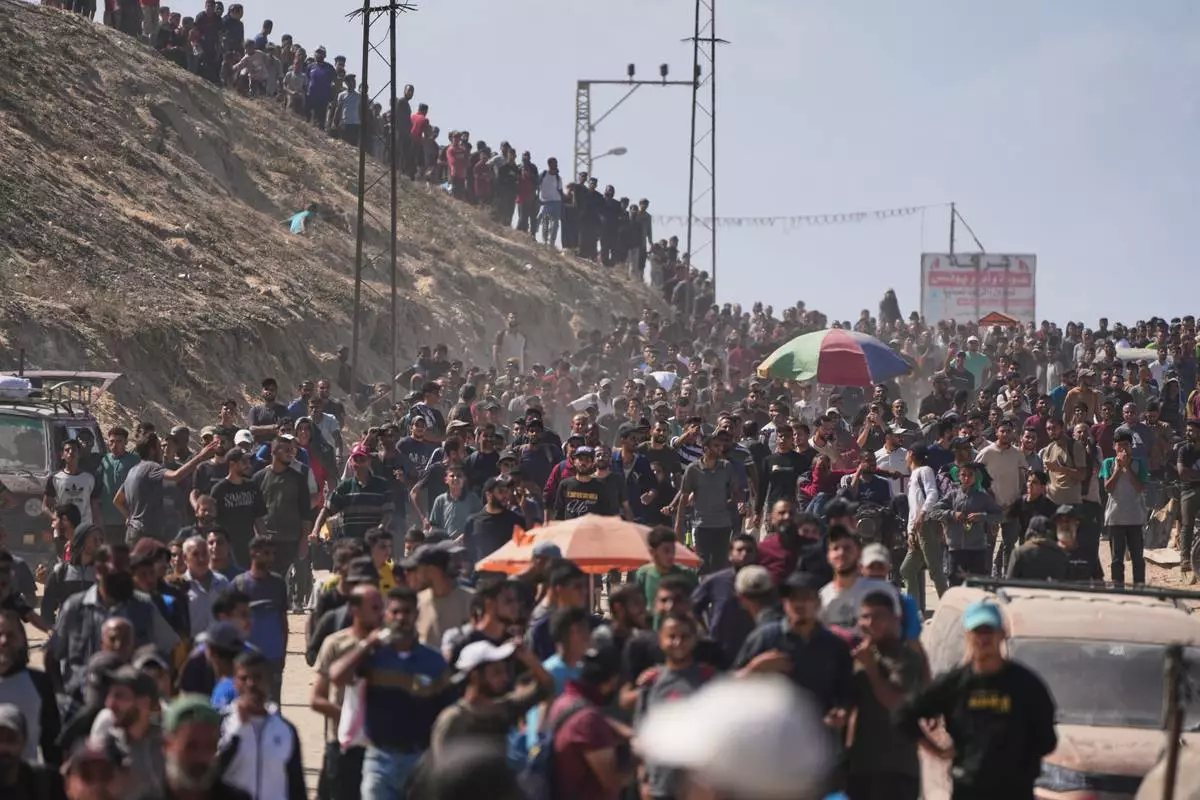
The military said Palestinians displaced to the south would be able to move back to their homes in the north. Thousands were filling roads heading north.

Israel has given the United Nations the green light by Israel to begin delivering scaled-up aid into Gaza starting Sunday, a U.N. official said. The official spoke on the condition of anonymity to discuss details not yet made public.

By Monday, Hamas is to begin releasing the remaining 48 hostages, around 20 of them believed to be alive. Israel will release around 2,000 Palestinians, including several hundred serving prison sentences and others seized from Gaza during the war.

Negotiations for the next phases would then begin.

Hamas had long insisted it would not release its last hostages unless Israeli troops leave Gaza completely. After agreeing to free them first, Hamas says it is relying on guarantees from Trump that the full withdrawal will happen.

How long it will take — weeks, months, years — is unknown.

An initial 20-point plan issued by Trump last week called for Israel to maintain a narrow buffer zone within Gaza along their shared border, and Israel has also spoken of keeping hold of the Philadelphi corridor, a strip of land on Gaza’s border with Egypt.

Israel is unlikely to relinquish those areas unless Hamas disarms and the void left in running Gaza is filled by a body that Israel deems palatable.

Trump's plan also called for an Arab-led international security force to move into Gaza, along with Palestinian police trained by Egypt and Jordan. It said Israeli forces would leave areas as those forces deploy.

It is not known whether that system will be followed or an alternative will be negotiated.

Hamas long refused to give up its weapons, saying it had a right to armed resistance until Israel’s occupation of Palestinian territories ends.

For Israel, disarmament is a key demand. Prime Minister Benjamin Netanyahu has repeatedly said its campaign will not end until Hamas’ military capabilities are dismantled, including the network of tunnels built around the territory.

There are signs, however, that Hamas could agree to a “decommissioning” of its offensive weapons, handing them over to a joint Palestinian-Egyptian committee, according to the Arab officials with direct knowledge of the negotiations who spoke on condition of anonymity.

Israel has said it wants Gaza purged of Hamas influence. But it has also rejected giving any role to the West Bank-based Palestinian Authority or any arrangement that could lead to the creation of a Palestinian state.

Hamas, which has ruled Gaza since 2007, has agreed to step down from governing the territory and hand over governance to a body of Palestinian technocrats.

What takes its place is uncertain.

Under Trump's plan, an international body will govern. The Council of Peace and Board of Peace have both been floated as names for the body.

It would hold most power while overseeing the administration of Palestinian technocrats running day-to-day affairs. It would also hold the commanding role of directing reconstruction in Gaza. Trump’s initial 20-point plan called for former British Prime Minister Tony Blair to lead the body.

Hamas has so far not agreed, saying Gaza’s government should be worked out among Palestinians.

Israelis celebrated the agreement announced overnight after three days of talks in the Egyptian resort city of Sharm el-Sheikh. For much of the Israeli public, freeing the last of the hostages held for two years has been their top priority.

But Palestinians in Gaza were more uncertain. There was relief that the relentless bombardment and ground offensives may stop for a time and aid may flow in. But there was also skepticism and worry over how long any pause in fighting would last, whether hundreds of thousands will be able to return to their homes, and whether Gaza — its cities largely in ruins — will ever be rebuilt.

Many Palestinians fear Israel will take any breakdown in the talks as a chance to resume its assault. For months, Netanyahu and his hard-line allies have insisted they will keep long-term direct security control over Gaza and have spoken of pushing out its Palestinian population, ostensibly on a “voluntary” basis. In Gaza, many believe that remains Israel’s objective.

Pressure from the U.S. and its allies — if it continues after hostages are out — could prevent Israel from relaunching a full-fledged war.

But there is another, murkier scenario.

If Hamas and Israel cannot reach a final deal or negotiations drag on inconclusively, Gaza could slide into an unstable limbo, with Israeli troops still holding parts of it and Hamas still active. In that case, Israel would be unlikely to allow significant reconstruction, leaving Gaza’s population languishing in tent camps or shelters.

Israeli soldiers stand near their tanks along the Israeli-Gaza border, as seen from southern Israel, Friday, Oct. 10, 2025, after Israel and Hamas have agreed to a pause in their war and the release of the remaining hostages. (AP Photo/Emilio Morenatti)
Israeli soldiers stand near their tanks along the Israeli-Gaza border, as seen from southern Israel, Friday, Oct. 10, 2025, after Israel and Hamas have agreed to a pause in their war and the release of the remaining hostages. (AP Photo/Emilio Morenatti)

Displaced Palestinians walk along the coastal road near Wadi Gaza in the central Gaza Strip, moving toward northern Gaza, Friday, Oct. 10, 2025, after Israel and Hamas have agreed to a pause in their war and the release of the remaining hostages. (AP Photo/Abdel Kareem Hana)
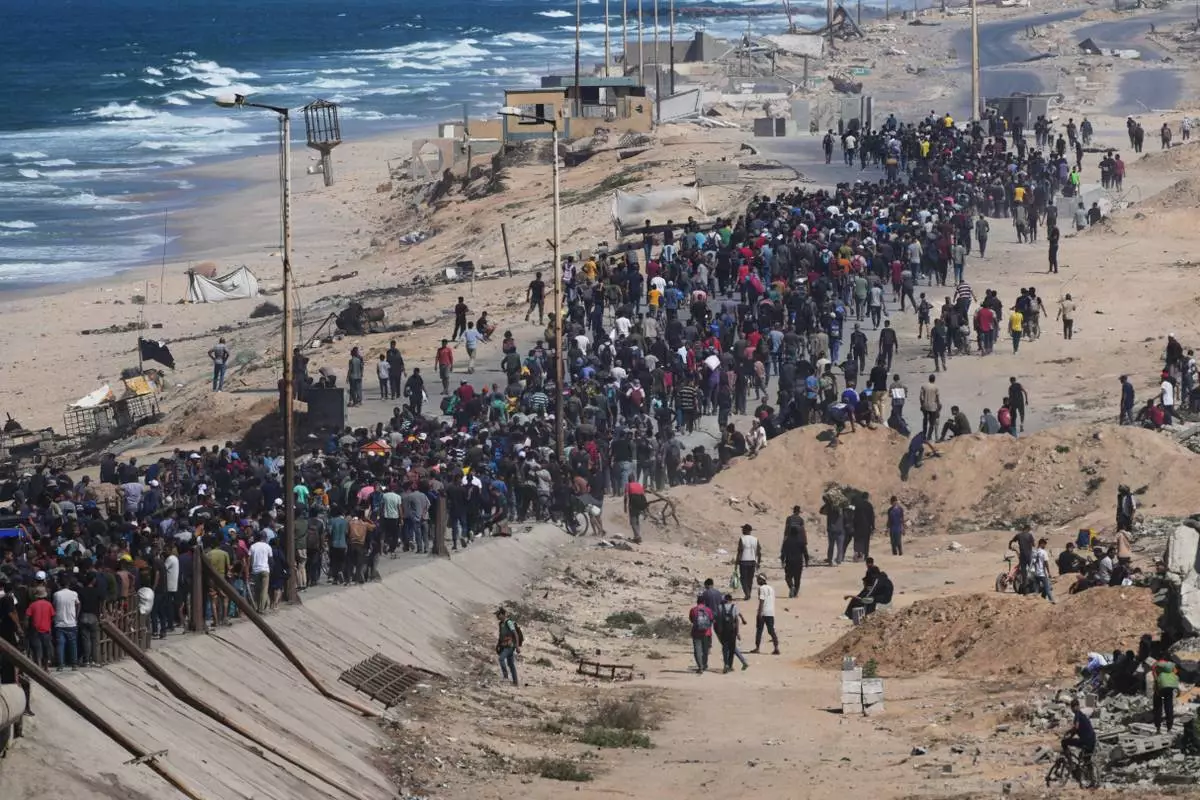
Displaced Palestinians walk along the coastal road near Wadi Gaza in the central Gaza Strip, moving toward northern Gaza, Friday, Oct. 10, 2025, after Israel and Hamas have agreed to a pause in their war and the release of the remaining hostages. (AP Photo/Abdel Kareem Hana)

Displaced Palestinians walk along the coastal road near Wadi Gaza in the central Gaza Strip, moving toward northern Gaza, Friday, Oct. 10, 2025, after Israel and Hamas have agreed to a pause in their war and the release of the remaining hostages. (AP Photo/Abdel Kareem Hana)
Displaced Palestinians walk along the coastal road near Wadi Gaza in the central Gaza Strip, moving toward northern Gaza, Friday, Oct. 10, 2025, after Israel and Hamas have agreed to a pause in their war and the release of the remaining hostages. (AP Photo/Abdel Kareem Hana)
SYDNEY (AP) — As the sounds of bullets rang out and the bodies fell, the young mother threw herself on top of her 5-year-old son and prayed.

“Please don’t let us die,” 33-year-old Rebecca begged God from her hiding place under a table in a park overlooking Bondi, Australia’s most iconic beach. Rebecca spoke on condition that her last name not be used for fear of retaliation. “Please just keep my son safe.”

It was faith that drew Rebecca and hundreds of other members of Sydney’s Jewish community to this picturesque spot to celebrate the start of Hannukah. And it was faith that authorities said made her and others attending the Channukah by the Sea gathering a target of two gunmen who began firing at revelers around 6:40 p.m. on Sunday. Authorities have called it an antisemitic act of terrorism.

In the minutes that followed, the assault would take the lives of at least 15 people, officials said, including a 10-year-old girl, a Holocaust survivor and a beloved rabbi. It would also take away a sense of security in a country that, because of strict gun laws, has largely been insulated from the mass shootings so common in the United States and other Western nations.

This reconstruction is based on interviews with survivors and footage of the assault.

Under the table that held food for the partygoers, Rebecca pulled buckets of drinks on top of her body, to try and hide herself and her son. Suddenly, a man lying on his side just 10 centimeters (3 inches) from her was struck in the chest by a bullet.

“I’m dying,” he told Rebecca. “I can’t breathe.”

Under fire and separated from her husband and 7-year-old daughter, Rebecca could offer him nothing but words. “You’re going to be OK,” she told him desperately. “You’re going to be OK.”

She did not know if that was true.

It started out as a classic Sunday summer evening in Sydney. The sun had not yet set, and the temperature was still a balmy 29 degrees Celsius (84 degrees Fahrenheit). The Tasman Sea was speckled with swimmers and surfers.

In the park overlooking Bondi’s golden arc of sand, children giggled and cuddled animals at a petting zoo set up as part of the Hanukkah celebration. Rebecca’s son scampered up a rock-climbing wall. Music competed with the sound of crashing waves.

And then the bubbles floating through the air were replaced with bullets, the laughter replaced with screams. From their positions on one of the pedestrian bridges connecting the busy main road to the beach, two armed gunmen — a father and son, according to police — had begun firing into the crowd.

Young people began to run, but older people struggled to get up. From her perch on a bench, Rebecca watched in horror as a bullet struck an older woman sitting next to her. Rebecca grabbed her son and dove under the table.

On the beach and the boardwalk, it was bedlam.

Some surfers and swimmers frantically paddled ashore, while others sought safety in the sea. Eleanor, who also spoke on condition that her last name not be used for fear of retaliation, said she been walking down the boardwalk on her way to dinner when she heard the gunshots. Her mind went blank, apart from one command: “Run.” And so she did, fully clothed, into the ocean.

Crowds of people — gathered on a grassy slope overlooking the sea for a sunset viewing of the Christmas romcom, “The Holiday” — abandoned their blankets and beach chairs and fled.

From their hotel room overlooking the streets of Bondi, Joel Sargent, 30, and his partner, Grace, from Melbourne, heard the shots and began to film. Their footage, obtained by The Associated Press, shows the gunfire went on for at least seven minutes, with dozens of blasts. Grace spoke on condition her last name not be used because she didn't want people at work to know she had been involved.

"Baby, I’m scared," Grace can be heard saying as they watched throngs of screaming people stream past their building. She shouted down to them: “Get off the street!”

Phones across the city lit up with panicked calls and messages. Lawrence Stand was at home when his phone rang. It was his 12-year-old daughter, who had been attending a bar mitzvah inside the Bondi Pavilion, overlooking the beach.

Stand told his daughter to stay on the phone as he leaped into his car and raced toward the beach. He found her and pulled her and others into his car, speeding them away from the carnage.

Many did not know where to find sanctuary. Inside a Greek restaurant, 20-year-old American friends Shira Elisha and Lexi Haag first hid in the restaurant’s bathroom, and then ran back to Elisha’s home, where they hid under her bedding. The pair wondered how a situation so common to the U.S. but so alien to Australia was happening here.

Back in the park, the man next to Rebecca was bleeding out. Rebecca’s 65-year-old mother-in-law grabbed a piece of cardboard and pressed it against his wound.

The man did not survive.

The shots kept coming. Sirens wailed. Minutes passed. A bystander can be heard shouting in one video: “Where are the cops?”

That and other widely circulated videos of the attack chronicled what happened next.

Near one of the shooters, a passerby identified by Home Affairs Minister Tony Burke as Ahmed al Ahmed crouched behind a parked car. Ahmed, a fruit shop owner and father of two, then rushed the shooter and wrestled away the gun, before pointing the weapon at the shooter, who fell to the ground. Ahmed was shot in the shoulder by the other gunman, but survived.

The man disarmed by Ahmed got up but, under fire from police, soon fell again. The other shooter traded fire with police for another minute before he, too, fell.

Police later confirmed the older of the two suspected gunmen, a 50-year-old, was fatally shot. His 24-year-old son, who was shot and wounded, is being treated at a hospital.

Back in the park, rescuers frantically pumped the chests of unmoving bodies on the grass, near a picnic table, an abandoned stroller and the petting zoo.

On Monday, Elisha, the American who hid in the restaurant bathroom, wandered down to the beach, where rows of shoes abandoned by fleeing beachgoers lined the sand.

“It just reminded me of the Holocaust — all these shoes lying here. This is like Oct. 7,” she said, referring to Hamas-led militants’ 2023 attack in Israel. “How many times do Jews need to be attacked before the world just wakes up and realizes that we have targets on our backs?”

After a sleepless night, Rebecca and her sister-in-law, draped in the flag of Israel, made their way to the beach to mourn before a memorial of flowers.

Rebecca’s children have asked her many questions since the attack, for which she has no answers, she said.

She has her own questions: for officials she said did little to address a surge in antisemitic crimes in Sydney and Melbourne over the past year. Prime Minister Anthony Albanese has defended his government’s efforts to combat antisemitism and said it planned more.

“The world needs to wake up and see what’s happening,” she said. “They specifically targeted us, the Jewish people. ... No one did anything. They turned a blind eye.”

Police cordon off an area at Bondi Beach after a reported shooting in Sydney, Sunday, Dec. 14, 2025. (AP Photo/Mark Baker)

Police cordon off an area at Bondi Beach after a reported shooting in Sydney, Sunday, Dec. 14, 2025. (AP Photo/Mark Baker)

People offer hugs to each other at a flower memorial placed outside Bondi Pavilion at Sydney's Bondi Beach, Monday, Dec. 15, 2025, a day after a shooting. (AP Photo/Mark Baker)

People offer hugs to each other at a flower memorial placed outside Bondi Pavilion at Sydney's Bondi Beach, Monday, Dec. 15, 2025, a day after a shooting. (AP Photo/Mark Baker)

A woman places an Israeli flag over flowers outside Bondi Pavilion at Sydney's Bondi Beach, Monday, Dec. 15, 2025, a day after a shooting. (AP Photo/Mark Baker)

A woman places an Israeli flag over flowers outside Bondi Pavilion at Sydney's Bondi Beach, Monday, Dec. 15, 2025, a day after a shooting. (AP Photo/Mark Baker)

A couple embrace a day after a shooting at Sydney's Bondi Beach, Monday, Dec. 15, 2025. (AP Photo/Mark Baker)

A couple embrace a day after a shooting at Sydney's Bondi Beach, Monday, Dec. 15, 2025. (AP Photo/Mark Baker)

Shoes sit lined up following a shooting the day prior at Sydney's Bondi Beach, Monday, Dec. 15, 2025. (AP Photo/Mark Baker)

Shoes sit lined up following a shooting the day prior at Sydney's Bondi Beach, Monday, Dec. 15, 2025. (AP Photo/Mark Baker)

Recommended Articles