ADDIS ABABA, Ethiopia (AP) — Among the whimpering of rescued dogs, a soft whistle cuts through. It’s Feven Melese, a young woman hoping to support thousands of abandoned dogs on the streets of the Ethiopian capital, Addis Ababa.
The 29-year-old music degree graduate has put up a rare shelter on the outskirts of the city, where she provides food and a place to stay for 40 dogs, while feeding about 700 others every week on the streets.
Click to Gallery
Stray dogs that were abandoned on the streets rest at a shelter in Addis Ababa, Ethiopia, Sunday, Sept. 7, 2025. (AP Photo/Brian Inganga)
Stray dogs that were abandoned on the streets rest at a shelter in Addis Ababa, Ethiopia, Sunday, Sept. 7, 2025. (AP Photo/Brian Inganga)
Abandoned stray dogs rest at a shelter in Addis Ababa, Ethiopia, Sunday, Sept. 7, 2025. (AP Photo/Brian Inganga)
Stray dogs that were abandoned on the streets rest at a shelter in Addis Ababa, Ethiopia, Sunday, Sept. 7, 2025. (AP Photo/Brian Inganga)
Feven Melesein, 29-years-old, holds a dog that was abandoned on the streets of the capital, Addis Ababa, Ethiopia, Sunday, Sept. 7, 2025. (AP Photo/Brian Inganga)
Melese said she has found new homes for more than 300 dogs in the past two years. Together with fellow young animal rights activists, they are on a mission to change the widespread perception in Ethiopia that dogs are protectors working for humans, not pets to be cared for.
As skyscrapers rise in Addis Ababa, the estimated 200,000 unclaimed dogs roaming the streets have fewer places to hide. Many dog owners have abandoned them as they move into new residential apartments whose landlords enforce a no-pet policy.
Authorities have expressed concern about the spread of diseases like rabies, and in recent months they have faced criticism after poisoning thousands of stray dogs ahead of major events, following an incident in which a resident was bitten.
Melese said many in Ethiopia do not treat dogs with care and abandon them when they become inconvenient.
“In Ethiopia, the society does not understand. They say, are they (dogs) hungry? Do they have feelings? They don’t care if they eat or not. If they are sick, they don’t care,” she said.
Melese’s shelter, though small and makeshift, is also a haven for dogs that survived road accidents. One of them, Konjit — whose name means “beautiful” in Amharic — wears a neck brace to help support healing, and wags her tail as Melese cuddles her.
Melese said that as a child in Addis Ababa, she cared for stray dogs and ended up with five that came to her home and stayed.
“My mother got angry and tried to take them back to the streets, but they kept coming back and I would still take them in,” she said.
Some residents in Addis Ababa say they are worried about the dangers posed by stray dogs and that the animals should be taken to a shelter.
“They (dogs) do not allow people to pass on the road and can be aggressive, even biting. They are very dangerous for the community, as their owners are unknown. No one can safely pass this way at night,” said Yonas Bezabih.
The Addis Ababa city administration official, Melese Anshebo, told The Associated Press that the government was planning to begin a dog registration and vaccination exercise to ensure that dog owners are fully responsible.
“To those who seem to have no owners, we will aim to find them shelters and some of the stray dogs who show symptoms of viruses, we will be forced to eliminate them,” he said.
A veterinarian, Dr. Alazar Ayele, said rabies remains a serious public health concern in Addis Ababa and expressed concern that resources for vaccination, sterilization and sheltering are still very limited.
“What we need are coordinated, humane approaches, more vaccines, trained veterinarians and community education to protect both people and animals,” he said.
Luna Solomon, a friend of Melese's, volunteers several times a week at the shelter to help feed the dogs and check on those that may need a vet.
Solomon said many owners abandon female dogs because they are likely to reproduce.
“People don’t usually pick female dogs because it takes a lot of responsibility to raise a female dog. There’s a lot that comes with it. Also, they don’t want to deal with her having puppies,” she said.
Biruk Dejene met Melese on social media when he was looking for a home for his dog that was being mistreated by his housemates.
He now gets to see his dog, Zuse, when he visits the shelter every week to volunteer.
While many see dogs as their guardians, there is often a lack of reciprocity by the owners, Dejene said.
“There’s no attachment. They just want them for their benefits and so on, so we’re doing a little bit of awareness of that,” he said.
Melese and her friends will continue advocating for dogs both on social media and in the streets of Addis Ababa, she said. They hope the government will consider mass vaccinations, neutering programs, and incentivized adoption to help give stray dogs a second chance at a home.
Associated Press journalist Samuel Getachew contributed.

Stray dogs that were abandoned on the streets rest at a shelter in Addis Ababa, Ethiopia, Sunday, Sept. 7, 2025. (AP Photo/Brian Inganga)

Stray dogs that were abandoned on the streets rest at a shelter in Addis Ababa, Ethiopia, Sunday, Sept. 7, 2025. (AP Photo/Brian Inganga)

Abandoned stray dogs rest at a shelter in Addis Ababa, Ethiopia, Sunday, Sept. 7, 2025. (AP Photo/Brian Inganga)

Stray dogs that were abandoned on the streets rest at a shelter in Addis Ababa, Ethiopia, Sunday, Sept. 7, 2025. (AP Photo/Brian Inganga)

Feven Melesein, 29-years-old, holds a dog that was abandoned on the streets of the capital, Addis Ababa, Ethiopia, Sunday, Sept. 7, 2025. (AP Photo/Brian Inganga)
Even without a host of Galacticos, Real Madrid was far too strong for Manchester City in the latest Champions League clash of these titans.
A 3-0 win at the Bernabeu on Wednesday put Madrid in control of this round-of-16 tie at the halfway mark after a stunning first-half hat trick by Federico Valverde. The Uruguay international took on the responsibility of inspiring the record 15-time champion in the absence of injured stars Kylian Mbappe, Jude Bellingham and Rodrygo.
"We are Real Madrid and you should never consider us dead,” Madrid coach Alvaro Arbeloa told broadcaster Movistar.
The victory could have been even more commanding, but Vinícius Júnior's casually taken second-half penalty was saved by Gianluigi Donnarumma.
Defending champion Paris Saint-Germain beat Chelsea 5-2 and tiny Bodø/Glimt is also in sight of the quarterfinals after a 3-0 win over Sporting Lisbon.
Arsenal drew 1-1 with Bayer Leverkusen.
By fulltime at a rocking Bernabeu, the only comfort City could cling to was the fact that it could have been so much worse.
When Vinícius stood over the ball on the penalty spot shortly before the hour mark, he looked certain add to the lead. But the Brazil forward skipped in his run-up and hit a weak side-footed effort that Donnarumma pushed away.
It will still take a massive turnaround to see City advance after being outclassed by Madrid.
Valverde's hat trick featured three outstanding goals. The pick of the lot was his third when he flicked the ball over the head of City defender Marc Guehi before volleying home.
TV cameras caught Bellingham watching in the stadium with his mouth wide open in awe of the move.
City manager Pep Guardiola will likely be worrying that history is set to repeat itself after his team was eliminated at the hands of Madrid in each of the last two seasons.
“Our game was not as bad as this result,” Guardiola said. “I’m not someone to say we are going to turn it round, but we will try.”
After losing to Chelsea in the final of the Club World Cup last year, PSG got some revenge.
A three-goal advantage after the first leg saw Luis Enrique's team take a big step toward the last eight.
Chelsea had twice leveled the game, but a mistake by goalkeeper Filip Jørgensen, who gave the ball away on the edge of his box in the 74th minute, allowed Vitinha to lift a shot into the open net.
PSG substitute Khvicha Kvaratskhelia scored twice more to leave Chelsea with a mountain to climb back at Stamford Bridge.
“This is our most important moment in the competition,” Luis Enrique said. "We’ll try to play the second leg in the same way as we did today. We’ll try to win the game. That’s the best mentality as if we’re thinking about defending our lead, it could be a big mistake.”
Bodø/Glimt's fairytale run just keeps on going.
Manchester City, Atletico Madrid and Inter Milan have been left in the tiny Norwegian club's wake. Now Sporting Lisbon's Champions League hopes are hanging by a thread.
Bodø/Glimt — located north of the Arctic Circle and farther north than any team in Champions League history — took full advantage of playing the first leg at home and led 2-0 at halftime through Sondre Fet's penalty and Ole Blomberg's goal just before the break.
Kasper Hogh scored in the 71st to put his team on the brink of the next round.
Bodø/Glimt was already the first Norwegian team to the advance to the knockout rounds of the Champions League and could now go even further.
Kai Havertz returned to haunt Bayer Leverkusen and seal a late draw for Arsenal.
The Germany international struck an 89th-minute penalty against the team where he started his career and leveled the round-of-16 first leg tie at BayArena.
“I know the stadium well and have taken many penalties from this spot,” said Havertz, who left Leverkusen for Chelsea in a $95 million deal in 2020.
Premier League leading Arsenal fell behind on Robert Andrich's goal just after halftime. But Malik Tillman fouled Noni Madueke in the box, and Havertz fired low past Janis Blaswich from the spot.
“The time between the penalty whistle and the penalty kick felt like an eternity," Havertz said. “But in the end, you have to be mentally present in those moments.”
After dominating the league phase of this year’s tournament, Premier League teams were brought down to Earth in the round of 16.
Man City, Chelsea and Tottenham all fell to heavy defeats, while Liverpool also lost to Galatasaray.
In all, none of England’s six teams in the knockouts won their first leg, with Arsenal and Newcastle both picking up draws.
Arsenal will be favorite to overcome Leverkusen at home and Liverpool only has to overturn a 1-0 deficit in its second leg at Anfield.
But City, Chelsea and Tottenham face big deficits, while Newcastle travels to Camp Nou to play Barcelona.
James Robson is at https://x.com/jamesalanrobson
AP soccer: https://apnews.com/hub/soccer

Bodo/Glimt's Ole Didrik Blomberg celebrates after scoring their side's second goal of the game during the Champions League soccer match between Bodo/Glimt and Sporting Lisbon, in Bodo, Norway, Wednesday March 11, 2026. (Fredrik Varfjell/NTB Scanpix via AP)

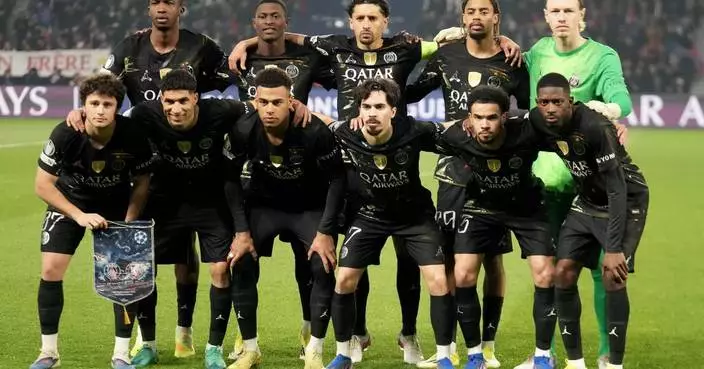
PSG's Ousmane Dembele celebrates after scoring his side's second goal during the first leg of the Champions League round of 16 soccer match between Paris Saint-Germain and Chelsea, in Paris, Wednesday, March 11, 2026. (AP Photo/Michel Euler)

Real Madrid's Federico Valverde, center, celebrates after scoring his third goal during a first leg round of 16 Champions League soccer match between Real Madrid and Manchester City in Madrid, Spain, Wednesday, March 11, 2026. (AP Photo/Jose Breton)
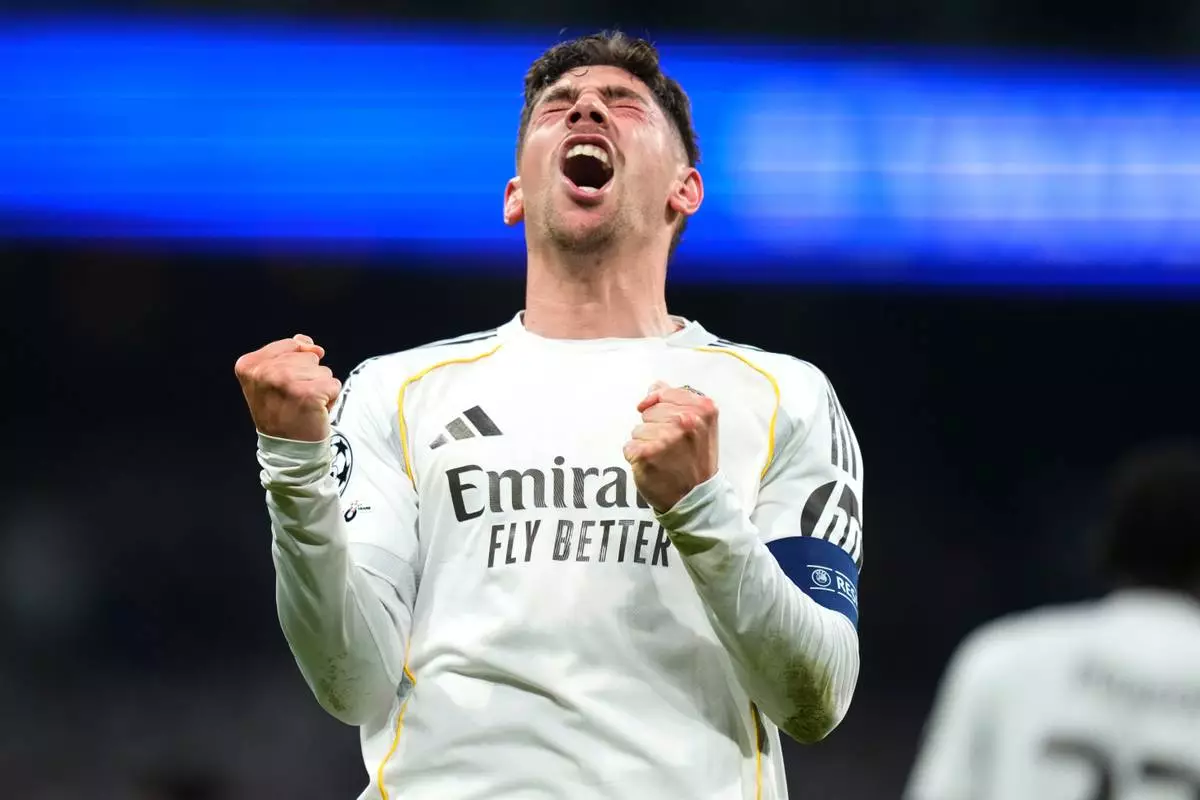
Real Madrid's Federico Valverde celebrates after scoring during a first leg round of 16 Champions League soccer match between Real Madrid and Manchester City in Madrid, Spain, Wednesday, March 11, 2026. (AP Photo/Jose Breton)

Leverkusen's Robert Andrich celebrates after scoring the opening goal of his team during the Champions League round of 16 first leg soccer match between Bayer Leverkusen and Arsenal FC in Leverkusen, Germany, Wednesday, March 11, 2026. (AP Photo/Martin Meissner)

Arsenal's Kai Havertz scores a penalty, his side's first goal, during the Champions League round of 16 first leg soccer match between Bayer Leverkusen and Arsenal FC in Leverkusen, Germany, Wednesday, March 11, 2026. (AP Photo/Martin Meissner)

Arsenal's Gabriel celebrates the first goal of his team during the Champions League round of 16 first leg soccer match between Bayer Leverkusen and Arsenal FC in Leverkusen, Germany, Wednesday, March 11, 2026. (AP Photo/Martin Meissner)

Arsenal's Kai Havertz reacts after scoring a penalty, his side's first goal, during the Champions League round of 16 first leg soccer match between Bayer Leverkusen and Arsenal FC in Leverkusen, Germany, Wednesday, March 11, 2026. (AP Photo/Martin Meissner)

Real Madrid's Vinicius Junior falls during the second leg of the Champions League playoff soccer match between Real Madrid and Benfica in Madrid, Spain, Wednesday, Feb. 25, 2026. (AP Photo/Manu Fernandez)

Manchester City's head coach Pep Guardiola gives instructions during the fifth round FA Cup soccer match between Newcastle and Manchester City in Newcastle, England, Saturday, March 7, 2026. (AP Photo/Ian Hodgson)

Real Madrid's Vinicius Junior, duels for the balls with Celta's Javi Rodriguez during a Spanish La Liga soccer match between Celta Vigo and Real Madrid in Vigo, Spain, Friday, March 6, 2026. (AP Photo/Lalo R. Villar)
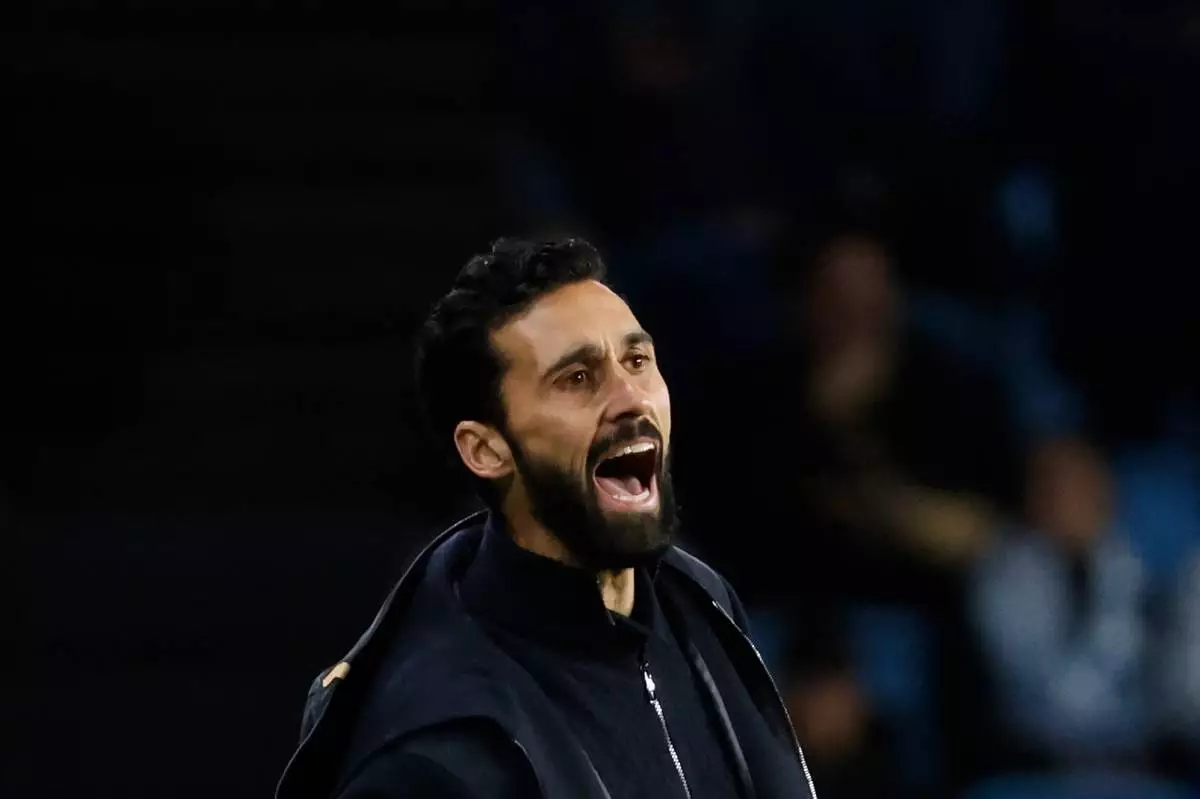
Real Madrid's head coach Alvaro Arbeloa gives instruction inside the box team area during a Spanish La Liga soccer match between Celta Vigo and Real Madrid in Vigo, Spain, Friday, March 6, 2026. (AP Photo/Lalo R. Villar)