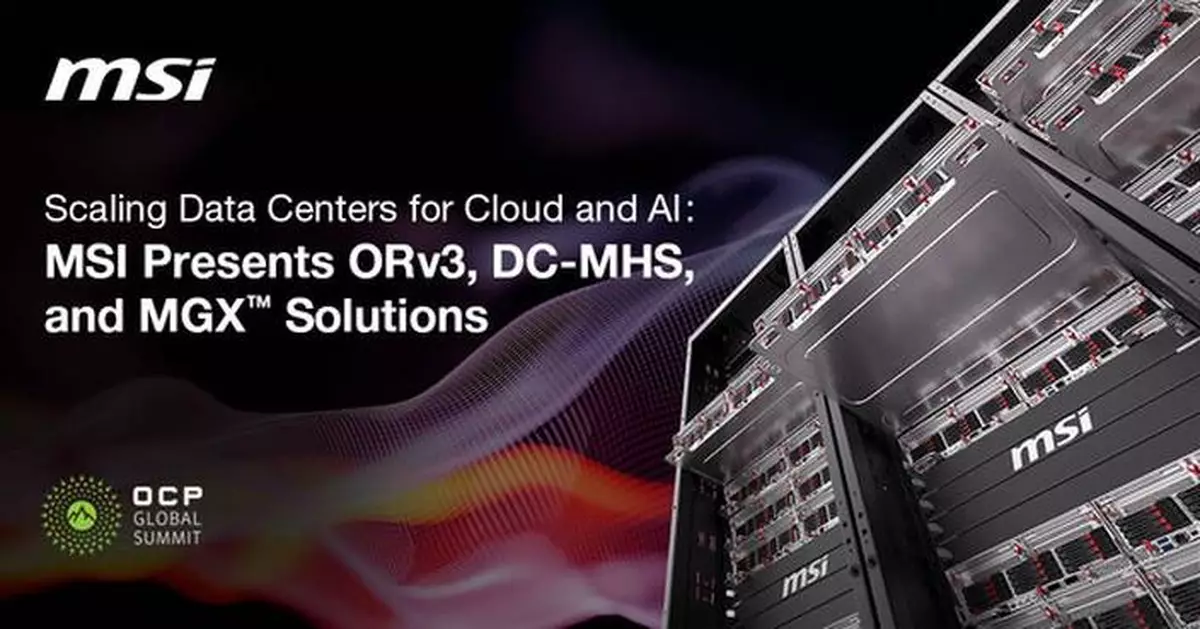
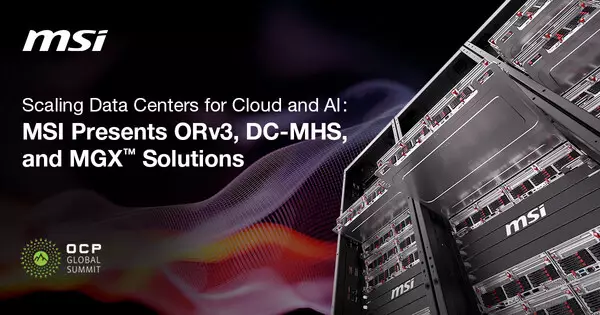
SAN JOSE, Calif., Oct. 15, 2025 /PRNewswire/ -- At 2025 OCP Global Summit (Booth #A55), MSI, a leading global provider of high-performance server solutions, highlights the ORv3 21" 44OU rack, OCP DC-MHS platforms, and GPU servers built on NVIDIA MGX module architecture, accelerated by the latest NVIDIA Hopper GPUs and NVIDIA RTX PRO 6000 Blackwell Server Edition GPUs. These solutions target hyperscale, colocation, and AI deployments, delivering the scalability and efficiency required for next-gen data centers. On Oct 16, MSI Product Marketing Manager Chris Andrada will also present an Expo Hall session titled "Pioneering the Modern Datacenter with DC-MHS Architecture."
"Our focus is on helping datacenter operators bridge the gap between rapidly advancing compute technologies and real-world deployment at scale. By integrating rack-level design with open standards and GPU acceleration, we aim to simplify adoption, reduce complexity, and give the industry a stronger foundation to support the next wave of AI and data-driven applications," said Danny Hsu, General Manager of MSI's Enterprise Platform Solutions.
ORv3 Rack-Scale Integration
MSI's ORv3 21" 44OU Rack comes fully validated with integrated power, thermal, and networking, reducing engineering effort and deployment time for hyperscale environments. With 16 dual-node servers, centralized 48V power shelves, and all front-facing I/O, operators gain more space for CPUs, memory, and storage while keeping airflow clear for efficient cooling.
The CD281-S4051-X2 2OU 2-node DC-MHS server supports a single AMD EPYC™ 9005 CPU up to 500W TDP per node, each node with 12 DDR5 DIMM slots, 12 front E3.S PCIe 5.0 NVMe drives, and 2 PCIe 5.0 x16 slots for balanced compute, storage, and expansion. This combination provides dense performance for cloud and analytics, delivered in a rack system that can be deployed faster and serviced entirely from the cold aisle.
Standardization with OCP DC-MHS Server & Motherboards
MSI's DC-MHS portfolio offers standardized server and HPM designs across Intel® Xeon® 6 and AMD EPYC 9005 processors for CSPs and hyperscale data centers. With standardized DC-SCM modules, these platforms reduce firmware effort and enable cross-vendor interoperability. Available in M-FLW, DNO-2, and DNO-4 form factors, they provide a consistent path to deploy next-gen CPUs without redesigning entire systems.
With support for DDR5 high-bandwidth memory, PCIe 5.0 for accelerators and I/O, and front-service NVMe bays, DC-MHS systems include options such as the CX270-S5062 2U Intel Xeon 6 platform or modular HPMs, which let customers align CPU power, memory density, and drive configurations to workload needs, from cloud clusters to hyperscale data centers. Intel HPMs include the D3071 (DNO-2 single-socket, 12 DIMM slots), D3061 (DNO-2 single-socket, 16 DIMM slots), and D3066 (DNO-4 single-socket, 16 DIMM slots). AMD HPMs include the D4051 (DNO-2 single-socket, 12 DIMM slots) and the D4056 (DNO-4 single-socket, 24 DIMM slots for higher capacity).
GPU Density with NVIDIA MGX
Built on the NVIDIA MGX modular architecture, MSI's GPU servers accelerate AI workloads across training, inference, and simulation with support for the latest NVIDIA Hopper GPUs and NVIDIA RTX PRO 6000 Blackwell Server Edition GPUs.
- The CG481-S6053 (4U) integrates dual AMD EPYC 9005 CPUs, 8 FHFL PCIe 6.0 GPU slots, 24 DDR5 DIMM slots, and 8×400G Ethernet networking via NVIDIA ConnectX-8 SuperNICs, ideal for large-scale AI training clusters requiring maximum GPU density and bandwidth.
- The CG290-S3063 (2U) features a single Intel Xeon 6 CPU, 4 FHFL PCIe 5.0 GPU slots, and 16 DDR5 DIMM slots, providing a compact, efficient system optimized for AI inference and fine-tuning in space-sensitive environments.
Supporting Resources:
** The press release content is from PR Newswire. Bastille Post is not involved in its creation. **
Scaling Cloud and AI: MSI Highlights ORv3, DC-MHS, and MGX Solutions at 2025 OCP Global Summit
|
With Mino, Omni becomes the first AI-native HR and payroll platform built for multi-country teams in Asia.
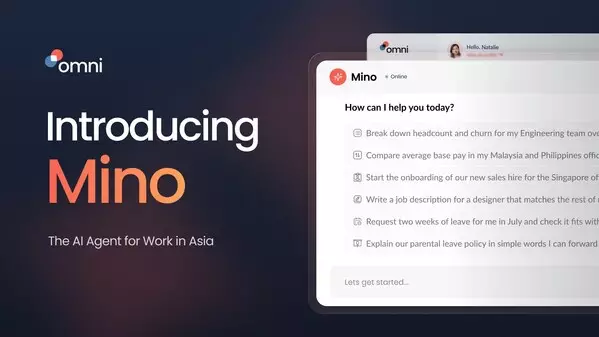
SINGAPORE, June 8, 2026 /PRNewswire/ -- Omni HR today launched Mino, the first AI agent built on unified HR and payroll data for multi-country teams in Asia. Available now in early access to Omni customers, beginning with analytics and recruitment and rolling out across every stage of the employee lifecycle Omni manages.
Omni is the all-in-one HR and multi-country payroll platform for Asia, running hiring, people operations, performance, and payroll in one place. Most HR software in the region was built for a single country, a single function, and a previous generation of technology — leaving teams to stitch together systems and the data fragmented across all of them. Omni's own State of AI in HR report found that fragmented data, not AI capability, is what holds HR teams in Asia back. Because Omni stores employee data in one centralized system, Mino gets the full context of a business that most agents will never have access to.
Mino, Omni's Super Agent for Work
Mino answers questions, analyzes data, and takes action in plain language, always scoped to the access each user already holds. Ask it to surface a candidate shortlist, turn headcount data into a dashboard, or pull an employee's job history — and it returns the answer or takes the action, without switching tools or chasing an admin. It is designed to reason across every module Omni runs, getting more capable as each additional module comes online, spanning people data, compensation, payroll, and performance. It is an intelligence layer across the whole platform, not a chatbot sitting beside it. As the modules connect, Mino coordinates specialized sub-agents that work across HR, payroll, IT, and beyond — giving teams an always-on capability that operates around the clock.
Built on Enterprise-Grade Security
Mino operates entirely within each company's existing role-based permissions. Every user sees only what they are already authorized to access, and every action Mino takes is logged. As new modules and sub-agents become available, the same permission model governs them. Access does not expand because the agent does. Mino is built to meet the security and compliance standards that enterprise teams are already held to.
"Every HR platform will eventually offer AI features and agentic workflows. What makes Mino different is that the data, the compliance logic, and the security model were purpose-built to support it, not adapted from a system designed for something else."
Brian Ip, CEO, Omni HR
Mino is available now in early access for Omni HR customers. To see it, book a demo at omnihr.co.
About Omni HR
Omni HR is the AI-native, all-in-one HR and payroll platform built for Asia. It runs hiring, people operations, performance, and payroll for multi-country teams across the region, with built-in compliance support for the regulatory complexity that comes with operating across borders in Asia. Learn more at omnihr.co.
With Mino, Omni becomes the first AI-native HR and payroll platform built for multi-country teams in Asia.
SINGAPORE, June 8, 2026 /PRNewswire/ -- Omni HR today launched Mino, the first AI agent built on unified HR and payroll data for multi-country teams in Asia. Available now in early access to Omni customers, beginning with analytics and recruitment and rolling out across every stage of the employee lifecycle Omni manages.
Omni is the all-in-one HR and multi-country payroll platform for Asia, running hiring, people operations, performance, and payroll in one place. Most HR software in the region was built for a single country, a single function, and a previous generation of technology — leaving teams to stitch together systems and the data fragmented across all of them. Omni's own State of AI in HR report found that fragmented data, not AI capability, is what holds HR teams in Asia back. Because Omni stores employee data in one centralized system, Mino gets the full context of a business that most agents will never have access to.
Mino, Omni's Super Agent for Work
Mino answers questions, analyzes data, and takes action in plain language, always scoped to the access each user already holds. Ask it to surface a candidate shortlist, turn headcount data into a dashboard, or pull an employee's job history — and it returns the answer or takes the action, without switching tools or chasing an admin. It is designed to reason across every module Omni runs, getting more capable as each additional module comes online, spanning people data, compensation, payroll, and performance. It is an intelligence layer across the whole platform, not a chatbot sitting beside it. As the modules connect, Mino coordinates specialized sub-agents that work across HR, payroll, IT, and beyond — giving teams an always-on capability that operates around the clock.
Built on Enterprise-Grade Security
Mino operates entirely within each company's existing role-based permissions. Every user sees only what they are already authorized to access, and every action Mino takes is logged. As new modules and sub-agents become available, the same permission model governs them. Access does not expand because the agent does. Mino is built to meet the security and compliance standards that enterprise teams are already held to.
"Every HR platform will eventually offer AI features and agentic workflows. What makes Mino different is that the data, the compliance logic, and the security model were purpose-built to support it, not adapted from a system designed for something else."
Brian Ip, CEO, Omni HR
Mino is available now in early access for Omni HR customers. To see it, book a demo at omnihr.co.
About Omni HR
Omni HR is the AI-native, all-in-one HR and payroll platform built for Asia. It runs hiring, people operations, performance, and payroll for multi-country teams across the region, with built-in compliance support for the regulatory complexity that comes with operating across borders in Asia. Learn more at omnihr.co.
** This press release is distributed by PR Newswire through automated distribution system, for which the client assumes full responsibility. **
Omni HR Launches Mino, the First AI Agent Built on Unified APAC HR Data