MELBOURNE, Australia (AP) — Australia’s highest court on Wednesday rejected U.S. conservative commentator Candace Owens ’ bid to overturn an Australian government decision barring her from visiting the country.
Three High Court judges unanimously rejected Owens’ challenge to Home Affairs Minister Tony Burke’s decision in 2024 to refuse her a visa on character grounds.
Owens had planned to begin a speaking tour in Australia last November and also visit neighboring New Zealand.
Burke used his powers under the Migration Act last October to refuse her a visa because she failed the so-called “character test,” court documents said.
Burke found there was a risk Owens would “incite discord in the Australian community” and that refusing her a visa was in the national interest. As a political commentator, author and activist, Owens was “known for her controversial and conspiratorial views.”
She had made “extremist and inflammatory comments toward Muslim, Black, Jewish and LGBTQIA+ communities which generate controversy and hatred,” Burke said in court documents.
Owens’ lawyers had argued the Migrant Act was unconstitutional because it infringed upon Australia's implied freedom of political communications.
Australia doesn't have an equivalent of the U.S. First Amendment that states a right to free speech. But because Australia is a democracy, the High Court has decided that the constitution implies free speech limited to governmental and political matters.
Owens’ lawyers had argued that if the Migration Act was constitutional, then Burke had misconstrued his powers under that law in refusing her a visa.
The judges rejected both arguments and ordered Owens to pay the government’s court costs.
Burke described the ruling as a “win for social cohesion.”
"Inciting discord might be the way some people make money, but it’s not welcome in Australia,” Burke said in statement.
Owens’ spokesman told The Associated Press in an email on Thursday Owens would comment on the court decision on social media later this week.
Burke had told the court that while Owens already had an ability to incite discord through her 18 million followers across social media platforms, her presence in Australia would amplify that potential.
He noted that when Australia’s terrorism threat level was elevated from “possible” to “probable” last year, the national domestic spy agency reported an “increase in extremism.”
Australia has long used a wide discretion under the character test to refuse foreigners temporary visas.
Burke stripped Ye, the U.S. rapper formerly known as Kanye West, of an Australian visa after he released his single “Heil Hitler” in May this year. Ye had been traveling for years to Australia, where his wife of three years, Bianca Censori, was born.
Burke's decision to ban Owens prompted neighboring New Zealand to refuse her a visa in November on the grounds that she had been rejected by Australia. But a New Zealand immigration official overturned that refusal in December, citing "the importance of free speech.”
Owens’ spokesman said on Thursday she would not tour New Zealand.
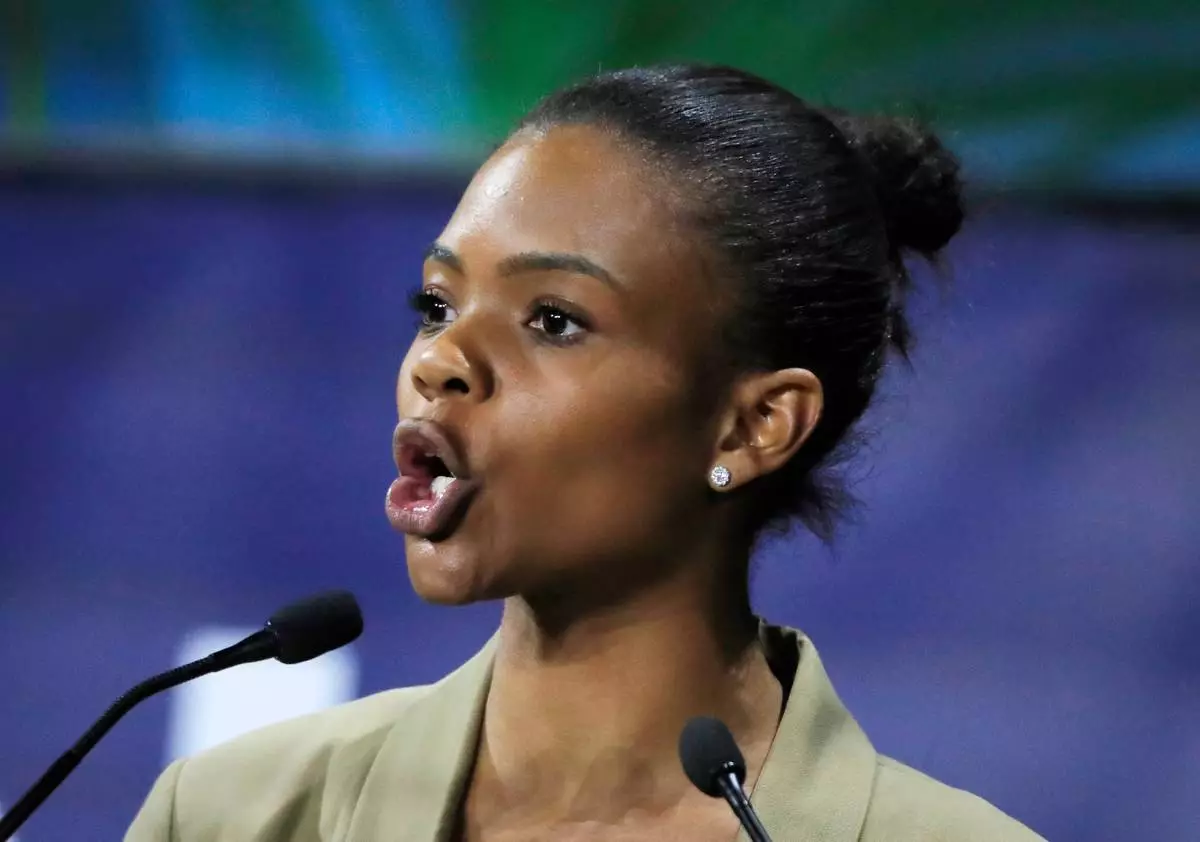
FILE - U.S. conservative commentator Candace Owens speaks at the Convention of the Right, in Paris, on Sept. 28, 2019. (AP Photo/Michel Euler, FILE)

JATUN RUMI, Ecuador (AP) — High in the mountains of the Ecuadorian Andes, a group of young Otavalo Indigenous people is using anime to inspire pride in their ancient culture and language, especially among Otavalo children.
They produced an animated short film titled “We’re Aya” that follows the adventures of Aya, a mythical Otavalo warrior, and other characters who interact under the watchful eye of a condor — an iconic bird for Andean Indigenous cultures that symbolizes power and energy.
Inspired by the work of legendary Japanese animator Hayao Miyazaki, the story takes place in the mountains of Imbabura, a province in the northern Andes that is home to the Otavalo people, known for their handicrafts and textiles.
Tupac Amaru, director and producer of the 9-minute film, said the movie is part of an effort to maintain Otavalo customs and language, which began to erode as globalization created a more interconnected world and influenced their culture.
His people faced two options, “lock ourselves out (from the world) and defend our culture, language, spirituality and clothing or stand tall and fight back,” Amaru said.
The film with 12 Quichua-speaking characters is a first step in trying to get Otavalo children to appreciate their heritage, he said. Indigenous themes have been explored before in short and feature-length films produced in Peru and Ecuador but most of those films have had Spanish-speaking characters.
“Quichua is the vibration that gives meaning to existence and without the language, the meaning of life and our energy comes to an end,” Amaru said.
“Our children no longer know Quichua,” which means they have lost a communication tool and “are losing their sense of belonging, their energy,” he added.
Yarik Sisa, creative manager for the film, said the story is inspired by ancestral practices that have survived the passage of time, including taking musical instruments to energetic points of the land the night before a celebration so that the instruments are endowed with “soul.”
The film also includes characters such as Ayaruku, which represents an indomitable spirit; Ayawa, a representation of the sublime and the feminine; and Ayaku, a child symbolizing tenderness.
These characters play their instruments and stomp their feet as part of a rhythmic dance as they enter a dark cavern, which symbolizes globalization, where the spirits give them the mission of becoming new seeds of their people.
The film then shows an Indigenous grandfather talking to his granddaughter who promises her elder she will become a woman strong as a rock and a defender of their culture. Her grandfather then asks her to never stray from that path.
The team behind “We’re Aya” hopes to release more films and even video games in Quichua in the coming years and even enter the international video game market with games “made by Quichuas in a Quichua environment,” said Malkik Arango, the film's creative director.
Follow AP’s coverage of Latin America and the Caribbean at https://apnews.com/hub/latin-america
Tupac Amaru, the director of "Aya Somos," the first Quichua animated short, blending Otavalo culture with Japanese-style anime, gives an interview in Hatun Rumi, Ecuador, Wednesday, Dec. 3, 2025. (AP Photo/Dolores Ochoa)
Yarik Sisa, an artist with Yay Animación, sketches in his notebook while his colleagues talk about their project "Aya Somos," the first Quichua animated short, blending Otavalo culture with Japanese-style anime, in Hatun Rumi, Ecuador, Wednesday, Dec. 3, 2025. (AP Photo/Dolores Ochoa)
From left, Malkik Anrango, Yarik Sisa and Tupac Amaru walk among landscape they aim to capture in "Aya Somos," the first Quichua animated short, blending Otavalo culture with Japanese-style anime, in Hatun Rumi, Ecuador, Wednesday, Dec. 3, 2025. (AP Photo/Dolores Ochoa)
From left, Malkik Anrango, Tupac Amaru and Yarik Sisa chat about "Aya Somos," the first Quichua animated short, blending Otavalo culture with Japanese-style anime, in the courtyard of the Yay Animación studio in Hatun Rumi, Ecuador, Wednesday, Dec. 3, 2025. (AP Photo/Dolores Ochoa)
Yarik Sisa, an artist with Yay Animación, works on "Aya Somos," the first Quichua animated short, blending Otavalo culture with Japanese-style anime, in Hatun Rumi, Ecuador, Wednesday, Dec. 3, 2025. (AP Photo/Dolores Ochoa)