Three generations of a family in northwest China's Xinjiang Uygur Autonomous Region have witnessed the rapid growth of the Alashankou Station, from a small border stop to an international hub serving the Belt and Road Initiative.
After Gao Baolu's father moved the family to Xinjiang as a railway worker, the members of the family have experienced and served the development of Alashankou in Xinjiang's Bortala Mongolian Autonomous Prefecture amid a harsh natural environment.
Alashankou is located on the border between China and Kazakhstan. Viewed from a satellite map, Alashankou sits in a narrow "funnel-shaped" pass between the Alataw Mountains and the Barlik Mountains, through which cold air from Siberia surges southward and brings strong wind.
Because of this harsh environment, the first establishment in Alashankou was a meteorological station in 1956. In 1962, a dozen soldiers set a border defense post in Alashankou. For nearly 40 years, this remote border town had only these two establishments.
In 1990, the construction of Alashankou Station brought railways to the area. In the same year, the Alashankou Port was also officially established.
Gao Baolu worked at the Alashankou Station from 1991 until his retirement.
"My father brought me to Xinjiang when I was three or four years old. In 1990, I became a railway worker. When my daughter decided to work also as a railway worker, I didn't want her to take the job. But she had her own ideas," said Gao Baolu.
Gao Baolu's daughter, Gao Mengying, majored in Russian language during her university years. After graduating in 2015, she secured a position as a translator at Alashankou Station.
"My father surely didn't want his daughter to take a job that he thought was too hard. I just want to stay with my family. So I chose Russian language as my major in university so that I could work at the Alashankou Station, which is a port of entry that needs translators. Due to the Belt and Road Initiative, Alashankou Station is no longer the small border station it used to be. Now more than 70 trains carrying a total of over 60,000 tons of cargoes enter or leave Alashankou Station every day," said Gao Mengying.
In September 1992, the railway extended westward from Alashankou Station, connecting with Dostyk Station in Kazakhstan, marking the birth of the "New Eurasian Land Bridge," which stretches westward from Lianyungang City of east China's Jiangsu Province, traverses Xinjiang, passes through Kazakhstan and Russia, and reaches Rotterdam in the Netherlands.
In 2011, the first China-Europe freight train departed from China via the Alashankou Port.
Alashankou Port currently operates 125 China-Europe (Central Asia) freight train routes which span 21 countries -- including Germany and Poland -- and carry more than 200 types of goods, ranging from vehicles to machinery components.
"The Alashankou Station has grown from a small station during my grandfather's generation to a national gateway guarded by my father, and then to a port for the Belt and Road Initiative today, and three generations of my family have spent 60 years on doing one thing of serving the rail sector. This is another kind of legend," said Gao Mengying.
As of Sept. 1, Alashankou Port, also known as Alataw Pass, had handled over 5,000 China-Europe (Central Asia) freight train trips this year, according to China Railway Urumqi Group Co., Ltd.
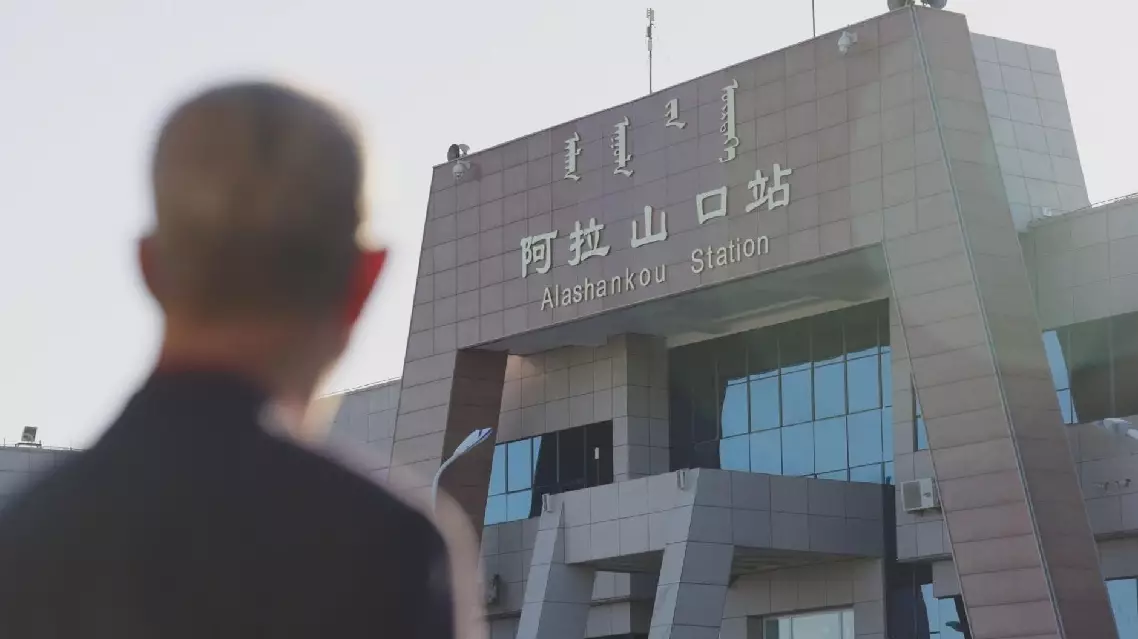
Xinjiang family witnesses significant changes of major rail station