San Francisco's largest tech conference Dreamforce wrapped up Thursday, after several days of events revolving around agentic artificial intelligence (AI).
Around 50,000 participants flocked to the city for the technology extravaganza run by the cloud-based software company Salesforce. Discussions focused on whether users and companies can keep up with the rapidly advancing agentic AI, a system that can accomplish specific goals with limited supervision.
Salesforce's platform, Agentforce, helps companies build autonomous AI agents such as Williams-Sonoma's sous chef Olive, which can tailor recipes to customer preferences and demonstrate how to make them using the appliances people just purchased.
Despite the promise of agentic AI, in a year's time, only about eight percent of Salesforce's customers have so far adopted its Agentforce tech.
"[This is the] moment where this technology innovation is outstripping customer adoption. Our job is to get those customers into adoption mode," said Marc Benioff, Salesforce CEO.
Vernon Keenan, an industry analyst, conducted a study with researchers from the University of California Berkeley that looked into why AI efforts within companies have stalled.
"We find that the vast majority of businesses in America are not ready to adopt AI. It's usually because the CEO hasn't figured out a plan yet. AI is not like buying an IT product anymore. It's like deciding to transform your entire company," Keenan told China Global Television Network (CGTN).
The gap between the speed of innovation and the speed of adoption is one reason why Salesforce has set up the "build your first AI agent" station. Representatives from information technology departments and companies attended Dreamforce for their first crack at the new technology.
"Get ahead of the game, to make sure that we are ahead of either A, our competitors, or B, where the market share is. And we really push people to be more at value, analytically understanding what's actually happening rather than just being a somebody who's doing monotonous data input," said Joseph Gasparini, director of finance and operations of Accordant Company, an enterprise software value-added reseller.
However, Salesforce, like a number of major tech companies, has recently laid off thousands of employees due to AI. Many tech leaders have instead pointed to the promise of AI being used to help people be more productive and create new product streams and businesses.
"The thing that concerns me is the pace of change between job destruction and job creation. So, we've actually imagined a whole new class of entrepreneurs and jobs that are being created through AI. But how many of them compared to how many customer experience, call center workers that are getting laid off? I'm convinced there's a mismatch, and there will be a reckoning," said Keenan.
For now, Salesforce hopes that concerns about AI's impact on the workforce will be outweighed by businesses' desire to lead technological innovation.
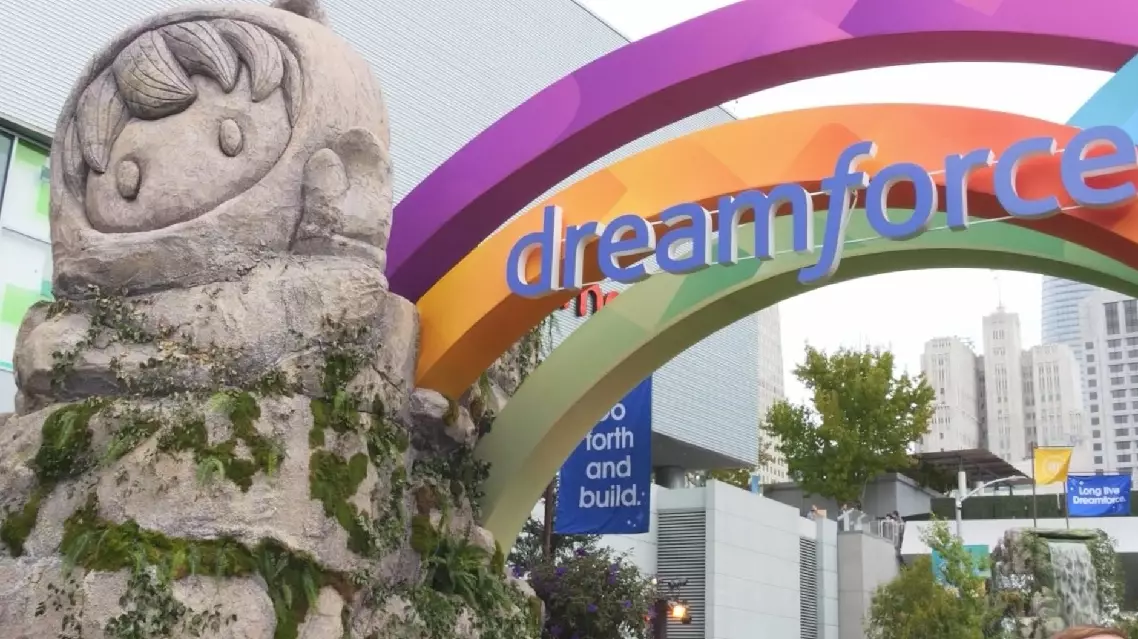
AI innovation outpaces adoption at Dreamforce tech conference in San Francisco