Nurse Rod Salaysay works with all kinds of instruments in the hospital: a thermometer, a stethoscope and sometimes his guitar and ukulele.
In the recovery unit of UC San Diego Health, Salaysay helps patients manage pain after surgery. Along with medications, he offers tunes on request and sometimes sings. His repertoire ranges from folk songs in English and Spanish to Minuet in G Major and movie favorites like “Somewhere Over the Rainbow.”
Patients often smile or nod along. Salaysay even sees changes in their vital signs like lower heart rate and blood pressure, and some may request fewer painkillers.
“There’s often a cycle of worry, pain, anxiety in a hospital,” he said, “but you can help break that cycle with music.”
Salaysay is a one-man band, but he’s not alone. Over the past two decades, live performances and recorded music have flowed into hospitals and doctors’ offices as research grows on how songs can help ease pain.
The healing power of song may sound intuitive given music’s deep roots in human culture. But the science of whether and how music dulls acute and chronic pain — technically called music-induced analgesia — is just catching up.
No one suggests that a catchy song can fully eliminate serious pain. But several recent studies, including in the journals Pain and Scientific Reports, have suggested that listening to music can either reduce the perception of pain or enhance a person’s ability to tolerate it.
What seems to matter most is that patients — or their families — choose the music selections themselves and listen intently, not just as background noise.
“Pain is a really complex experience,” said Adam Hanley, a psychologist at Florida State University. “It’s created by a physical sensation, and by our thoughts about that sensation and emotional reaction to it.”
Two people with the same condition or injury may feel vastly different levels of acute or chronic pain. Or the same person might experience pain differently from one day to the next.
Acute pain is felt when pain receptors in a specific part of the body — like a hand touching a hot stove — send signals to the brain, which processes the short-term pain. Chronic pain usually involves long-term structural or other changes to the brain, which heighten overall sensitivity to pain signals. Researchers are still investigating how this occurs.
“Pain is interpreted and translated by the brain," which may ratchet the signal up or down, said Dr. Gilbert Chandler, a specialist in chronic spinal pain at the Tallahassee Orthopedic Clinic.
Researchers know music can draw attention away from pain, lessening the sensation. But studies also suggest that listening to preferred music helps dull pain more than listening to podcasts.
“Music is a distractor. It draws your focus away from the pain. But it’s doing more than that," said Caroline Palmer, a psychologist at McGill University who studies music and pain.
Scientists are still tracing the various neural pathways at work, said Palmer.
“We know that almost all of the brain becomes active when we engage in music,” said Kate Richards Geller, a registered music therapist in Los Angeles. “That changes the perception and experience of pain — and the isolation and anxiety of pain.”
The idea of using recorded music to lessen pain associated with dental surgery began in the late 19th century before local anesthetics were available. Today researchers are studying what conditions make music most effective.
Researchers at Erasmus University Rotterdam in the Netherlands conducted a study on 548 participants to see how listening to five genres of music — classical, rock, pop, urban and electronic — extended their ability to withstand acute pain, as measured by exposure to very cold temperatures.
All music helped, but there was no single winning genre.
“The more people listened to a favorite genre, the more they could endure pain,” said co-author Dr. Emy van der Valk Bouman. “A lot of people thought that classical music would help them more. Actually, we are finding more evidence that what’s best is just the music you like."
The exact reasons are still unclear, but it may be because familiar songs activate more memories and emotions, she said.
The simple act of choosing is itself powerful, said Claire Howlin, director of the Music and Health Psychology Lab at Trinity College Dublin, who co-authored a study that suggested allowing patients to select songs improved their pain tolerance.
“It’s one thing that people can have control over if they have a chronic condition — it gives them agency,” she said.
Active, focused listening also seems to matter.
Hanley, the Florida State psychologist, co-authored a preliminary study suggesting daily attentive listening might reduce chronic pain.
“Music has a way of lighting up different parts of the brain,” he said, “so you’re giving people this positive emotional bump that takes their mind away from the pain.”
It’s a simple prescription with no side effects, some doctors now say.
Cecily Gardner, a jazz singer in Culver City, California, said she used music to help get through a serious illness and has sung to friends battling pain.
“Music reduces stress, fosters community,” she said, “and just transports you to a better place.”
The Associated Press Health and Science Department receives support from the Howard Hughes Medical Institute’s Department of Science Education and the Robert Wood Johnson Foundation. The AP is solely responsible for all content.
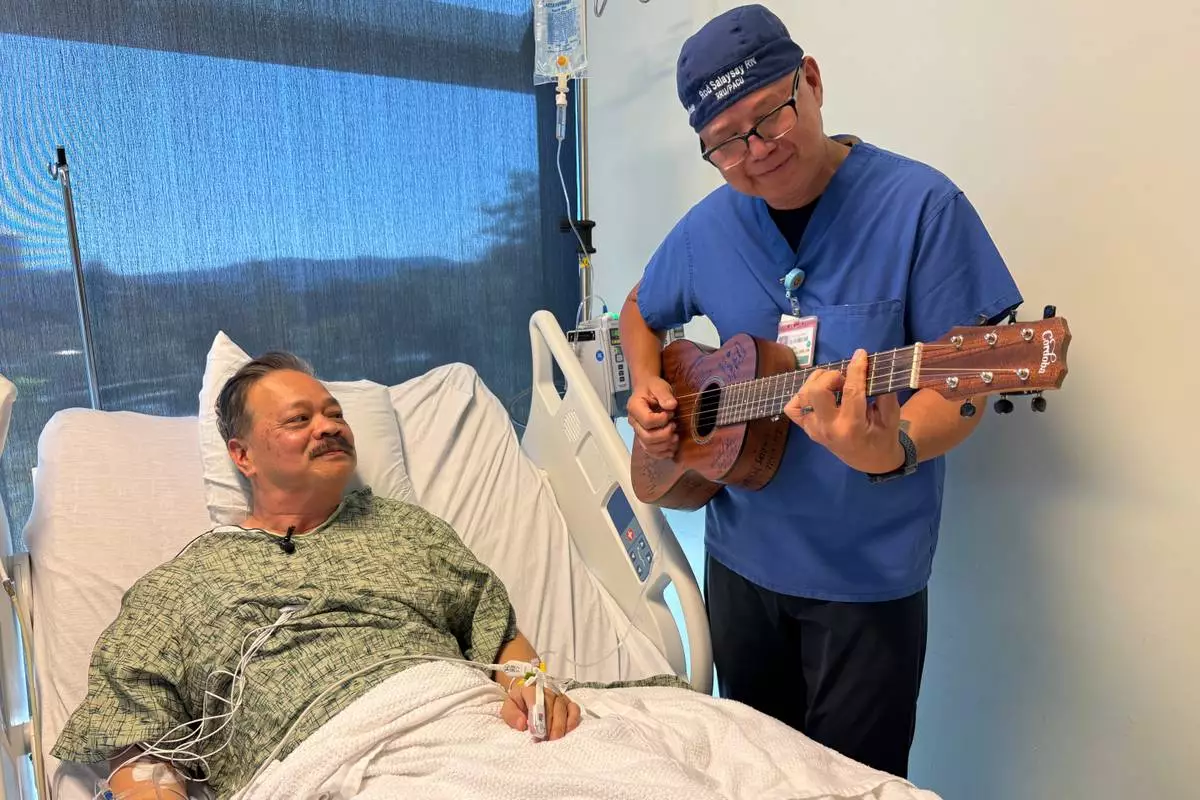
Nurse Rod Salaysay plays guitar for patient Richard Hoang in the recovery unit of UC San Diego Health in San Diego, Calif., on Sept. 30, 2025. (AP Photo/Javier Arciga)
WASHINGTON, D.C.--(BUSINESS WIRE)--Jun 23, 2026--
In celebration of the 250th anniversary of the signing of the Declaration of Independence, Angel, a media and technology company successfully pioneering a first-of-its-kind audience-driven studio model, and Wonder Project, an independent studio, distribution platform and trusted brand, today announced a strategic partnership with the U.S. Department of State to screen the upcoming film Young Washington at U.S. embassies around the world, as part of a new global screening initiative.
This press release features multimedia. View the full release here: https://www.businesswire.com/news/home/20260623725809/en/
Directed by Jon Erwin and starring William Franklyn-Miller, Golden Globe winners Kelsey Grammer and Mary-Louise Parker, and Academy Award winner Ben Kingsley, Young Washington tells the story of a young man whose courage, conviction, and character helped shape the course of a nation. Rooted in American history, it is a story about integrity, resilience, and service – values that resonate across cultures and generations. Young Washington is slated for a nationwide theatrical release on July 3, 2026, to coincide with America’s 250th anniversary.
The U.S. Department of State regularly collaborates with the entertainment industry to share American stories, traditions, and the values that define the nation. Through curated international screenings of classic and contemporary films, the Department showcases the creative excellence of the American film industry and the technical artistry that contributes to the global influence of American cinema.
“As America prepares to celebrate its 250th anniversary, Young Washington takes us back when the leaders we now admire were still discovering who they would become,” said Neal Harmon, Co-Founder and CEO of Angel. “It’s a deeply human story about growth, sacrifice, humility, and leadership earned through adversity and preserved by divine providence. We believe audiences around the world will connect with those themes, and we are honored to partner with the U.S. Department of State.”
Cate Dillon, Assistant Secretary of State for the Bureau of Educational and Cultural Affairs said, “The Department of State is proud to partner with Angel and Wonder Project in support of the global release of Young Washington— a uniquely American story that reminds the world that the ideals behind this nation were forged by real people of courage, character, and conviction. American storytelling remains a vital element of diplomacy, and this film reflects a long tradition of creative works that engage global audiences and highlight the nation’s history and values.”
“At Wonder Project, we believe great stories have the power to shape how people see themselves and the world around them,” said Kelly Merryman Hoogstraten, CEO of Wonder Project. “What drew us to Young Washington was the opportunity to explore a chapter of American history through the eyes of a young man whose future was far from certain. Rather than asking audiences to admire a historical figure from a distance, the film invites them to walk alongside him. That's the kind of story we hope stays with audiences long after the credits roll.”
“One of the privileges of playing Thomas Fairfax was portraying a mentor who recognized potential in a young George Washington long before the world knew his name,” said Kelsey Grammer, who plays Lord Fairfax in Young Washington. “In this film, we see what Fairfax saw – a young man wrestling with responsibility, ambition, failure, and purpose. That humanity is what makes his eventual greatness so inspiring. As this film travels to embassies around the world on the eve of America’s 250th anniversary, I hope audiences are reminded that freedom is not just an inheritance, but a responsibility to be carried forward by every generation.”
The U.S. embassy screening series engages audiences, including students, emerging filmmakers, government counterparts, cultural leaders, and the broader public.
U.S. embassies anticipated to participate in the Young Washington Freedom 250 screening include: Argentina, Armenia, Austria, Bahrain, Belize, Bolivia, Bosnia & Herzegovina, Brazil, Cambodia, Cameroon, Canada, China, Colombia, Costa Rica, Czech Republic, Denmark, Dominican Republic, Egypt, El Salvador, Finland, Germany, Ghana, Greece, Honduras, Hungary, India, Indonesia, Israel, Italy, Japan, Jordan, Kazakhstan, Kenya, Kyrgyz Republic, Latvia, Malaysia, Maldives, Malta, Mexico, Micronesia, Morocco, Nepal, The Netherlands, New Zealand, Nigeria, North Macedonia, Pakistan, Panama, Papua New Guinea, Philippines, Qatar, Romania, Rwanda, Saudi Arabia, Serbia, South Africa, South Korea, Spain, Sri Lanka, Suriname, Sweden, Tanzania, Thailand, Türkiye, Turkmenistan, Uganda, United Arab Emirates (UAE), Uzbekistan, Vietnam, and Zambia
About Angel
Angel (NYSE: ANGX) is a media and technology company successfully pioneering a first-of-its-kind audience-driven studio model. Founded by brothers who struggled to find films they could watch with their children, Angel was built on the belief that there was a global audience hungry for values-driven storytelling that amplifies light, celebrates hope, and inspires the moral imagination of viewers. That audience became the Angel Guild, a rapidly growing community of nearly 2.5 million paying members who watch, screen, and vote on which films and television series get produced and distributed in theaters and on the Angel app. Angel has achieved the highest audience satisfaction scores in the industry 1 and the highest average domestic box office per title among all independent studios since 2023. It has done so while evolving a new economic model that shares profits more fully with filmmakers. For more information, visit www.angel.com.
About Wonder Project
Wonder Project is an entertainment company dedicated to telling courageous stories that inspire hope and restore faith in things worth believing in. Operating as an independent studio, distribution platform and trusted brand, Wonder produces and curates premium content for the faith and values audience. Wonder Project's subscription service on Prime Video offers original programming alongside an extensive curated library of licensed titles. Learn more at www.thewonderproject.com.
1www.rottentomatoes.com Popcornmeter (Data sourced April 22, 2026)

Courtesy of Angel.