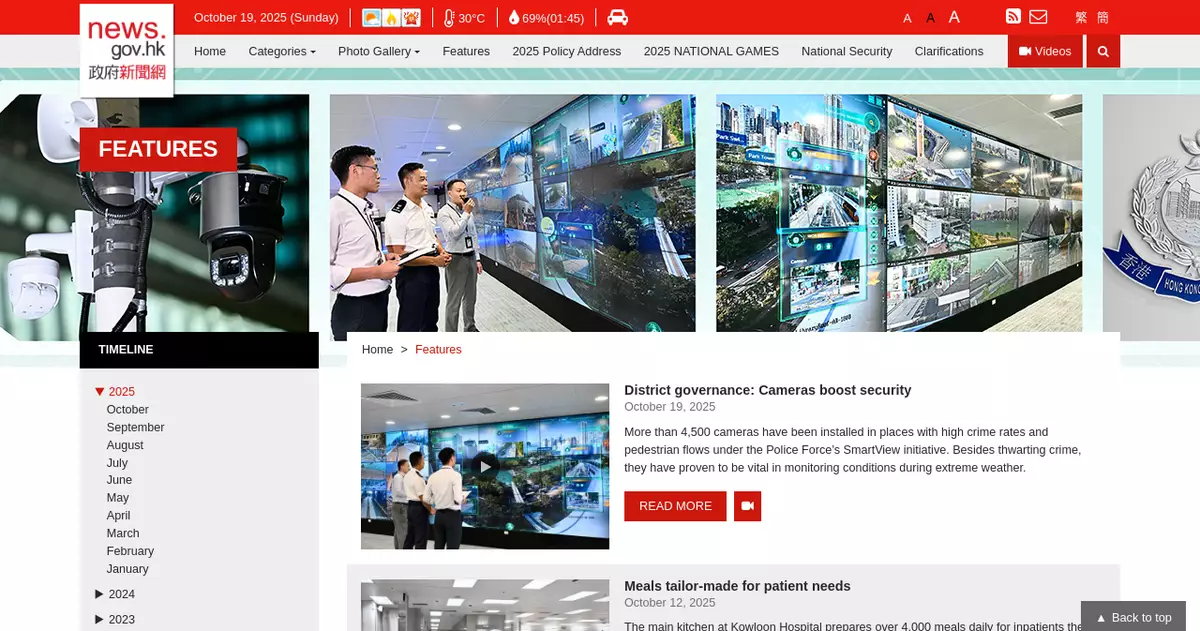
District governance: Cameras boost security
More than 4 500 cameras have been installed in public places with high crime rates and pedestrian flows under the Hong Kong Police Force's SmartView initiative, assisting the force in detecting more than 480 criminal cases. Besides thwarting crime, the cameras have proven to be vital for monitoring high-risk locations such as low-lying areas and public transport interchanges during extreme weather. The Police have also shared the video feeds with the Drainage Services Department to help with monitoring flooding conditions.
News.gov.hk spoke to the force's representative to learn more about SmartView and its future development.
The story is available at www.news.gov.hk/eng/feature from today (October 19) in text and video format.
Source: AI-found images
HKSAR Government expresses dissatisfaction with and opposition to unfounded comments by individual so-called human rights experts on Lai Chee-ying case
The Hong Kong Special Administrative Region (HKSAR) Government today (December 24) expressed dissatisfaction with and opposition to the unfounded comments by individual so-called human rights experts after the court of the HKSAR convicted Lai Chee-ying of offences of endangering national security in strict accordance with the law and evidence.
A spokesperson for the HKSAR Government pointed out, "The HKSAR Government noted that individual so-called human rights experts have entirely no respect for the HKSAR court's independent judgment of the case, which had been made on the basis of facts and evidence. They also refused to acknowledge the evidence set out in the reasons for verdict, and refused to understand the court's considerations and the reasons for verdict. Instead, they wantonly launched attacks, slandered and attacked the HKSAR Government, with despicable political manipulations to demand the immediate release of Lai Chee-ying, overriding the rule of law with politics and confounding right and wrong. Their despicable intent to interfere with the court's sentencing has been seen through by all. The HKSAR Government has to refute resolutely to set the record straight."
Court's conviction verdict was entirely free from any political considerations
"The court's reasons for verdict in this case are 855 pages long, which are fully open for public inspection, and include the court's analysis of the relevant legal principles and evidence, as well as the reasons for convicting Lai Chee-ying and the three defendant companies in full detail. The court clearly pointed out in the reasons for verdict that Lai Chee-ying was not on trial for his political views or beliefs. The court's conviction verdict is well-founded and reasoned, fully demonstrating that the court has made its decision on the case strictly in accordance with the law and evidence, free from any interference, and absolutely free of any political considerations."
The spokesperson stressed, "Hong Kong is a society underpinned by the rule of law and has always adhered to the principle that laws must be obeyed and lawbreakers be held accountable. Article 5 of the Hong Kong National Security Law (HKNSL) and section 2 of the Safeguarding National Security Ordinance (SNSO) clearly stipulate that the principle of the rule of law shall be adhered to in preventing, suppressing and imposing punishment for offences endangering national security. Any suggestion that certain individuals or organisations should be immune from legal consequences for their illegal acts is no different from advocating a special privilege to break the law, and this totally runs contrary to the spirit of the rule of law."
The Lai Chee-ying case has nothing to do with freedom of speech and of the press at all
The spokesman pointed out, "These so-called human rights experts have conflated the criminal acts in this case with freedom of speech and of the press, with the purpose of misleading the public and defaming the HKSAR. In fact, the Lai Chee-ying case has nothing to do with freedom of speech and of the press at all. Over the years, the defendants were using journalism as a guise to commit acts that brought harm to our country and Hong Kong.
"The public trial of this case revealed Lai Chee-ying's close management and hands-on control of the editorial direction of Apple Daily. Lai Chee-ying had repeatedly and personally colluded with foreign forces, begging for sanctions and hostile actions against the Central Authorities and the HKSAR Government. The court clearly pointed out that Lai Chee-ying's only intent, whether pre or post HKNSL, was to seek the downfall of the Communist Party of China, even though the ultimate cost was the sacrifice of the interests of the people of the People's Republic of China and the HKSAR.
"Anyone who vilify the rule of law and human rights situation in the HKSAR using this case is fact-twisting and has no integrity at all. We have to emphasise that the HKNSL and the SNSO clearly stipulate that human rights shall be respected and protected in safeguarding national security. The rights and freedoms, including the freedoms of the press, of speech and of publication, enjoyed by Hong Kong people under the Basic Law and the provisions of the International Covenant on Civil and Political Rights (ICCPR) and the International Covenant on Economic, Social and Cultural Rights as applied to the HKSAR, are protected in accordance with the law. However, like all other places in the world, journalists, like everyone else, have an obligation to abide by all the laws. According to the principles established by Article 19 of the ICCPR, the European Convention on Human Rights and relevant jurisprudence, when the media and journalists publish opinions, information and articles, they must observe and discharge 'special duties and responsibilities', including the protection of national security and public order; journalists must, in accordance with the tenets of 'responsible journalism', act in good faith on an accurate factual basis and provide reliable and precise information, so as to be entitled to the protection of freedom of speech and press freedom."
The spokesman reiterated, "The HKSAR Government will continue to resolutely, fully and faithfully implement the HKNSL, the SNSO and other relevant laws safeguarding national security in the HKSAR, to effectively prevent, suppress and impose punishment for acts and activities endangering national security in accordance with the law, whilst upholding the rights and freedoms of Hong Kong residents in accordance with the law, so as to ensure the steadfast and successful implementation of the principle of 'one country, two systems'. The HKSAR Government urges the relevant so-called human rights experts to understand the facts clearly and stop making any unfounded criticisms."

Source: AI-found images