Netflix missed the earnings target set by stock market analysts during the video streamer’s latest quarter, a letdown that the company blamed on a tax dispute in Brazil.
The results announced Tuesday broke Netflix's six-quarter streak of posting a profit that eclipsed analysts' projections.
The Los Gatos, California, cited an unexpected $619 million expense tied to the Brazilian tax dispute for the earnings shortfall while hailing its lineup of distinctive TV series and films for keeping its audience engaged and delivering a mix of subscriber fees and increased ad sales that helped it deliver revenue that matched analyst forecasts.
Investors, though, weren't placated by the explanation as Netflix's shares still fell by about 6% in extended trading after the numbers came out.
Analysts varied in their interpretation of the third-quarter report.
Investing.com analyst Thomas Monteiro worries Netflix is using the Brazilian tax hit as a way to mask signs of a slowdown in subscriber growth and advertising amid economy uncertainty. “The truth is that the company failed to deliver the kind of growth we’ve grown used to over the past couple of years,” he said.
But Zacks analyst Jeremy Mullin said he sees little reason for concern, asserting Netflix's “underlying story remains solid.”
Netflix earned $2.5 billion, or $5.87 per share, in its July-September quarter, an 8% increase from the same time last year. Revenue climbed 17% from last year to $11.5 billion. Analysts surveyed by FactSet Research had predicted the Los Gatos, California, company to earn $6.96 per share on revenue of $11.5 billion.
Delivering solid financial growth has become more important than ever for Netflix as management has steered investors from fixating on how many subscribers its service gains from one quarter to the next. As part of that process, Netflix stopped disclosing its subscribers at the end of last year.
The shift has paid off so far, with Netflix’s stock price rising about 40% so far this year, although the downturn in extended trading signaled some of those gains are about to evaporate.
Although Netflix no longer reveals the specific, this year’s revenue growth signals that its worldwide subscriber count has increased from the roughly 302 million it had at the end of last year – by far the most among video streamers, even as rivals with deeper pockets such as Amazon and Apple expand their programming selections.
In the company's quarterly conference call, Netflix co-CEO Ted Sarandos said the streaming service's total worldwide audience — including multiple people living in the same subscriber household — is approaching 1 billion.
“We have a better understanding of the streaming business than any of our competitors,” Greg Peters, Netflix's other co-CEO, boasted during the call.
Netflix has maintained its lead by adding more live sports and video games to supplement its wide array of scripted programming – a diversification effort that will expand into video podcasts from Spotify next year.
And now Netflix may have another opportunity to add even more compelling programming with Warner Bros. Discovery announcing it may sell all or part of its holdings, which include HBO, DC Studios and CNN. Analysts are already speculating that Netflix may join the bidders looking to grab a piece of Warner Bros. Discovery.
In response to a question about Netflix's acquisition strategy, Sarandos noted that the company traditionally has been “more builders than buyers” without ruling out a potential bid for some of Warner Bros. Discovery's properties other than cable TV networks like CNN and TBS. “We can be and will be choosey,” Sarandos said.
The company has also mining a new vein of revenue by selling commercials as part of a low-priced option of its service it introduced three years ago.
Although the advertising business still isn’t large enough to require the company to disclose its sales, management expects its revenue to more than double from last year. A recent analyst by S & P forecast $1.1 billion in ad sales for Netflix this year — a figure that would represent about 2% of its projected total revenue.
It’s getting to the point that Netflix may be in danger of trying to juggle too many ball at once, said Forrester Research analyst Mike Proulx. “If the company goes too broad to become all things entertainment, it risks diluting its core.”

FILE - This Aug. 13, 2020 photo shows a logo for Netflix on a remote control in Portland, Ore. (AP Photo/Jenny Kane, File)
Launch preparations have begun for the Artemis II mission, NASA’s planned lunar fly-around by four astronauts that will be the first moon trip in 53 years.
Tensions were high as hydrogen fuel started flowing into the rocket hours ahead of the planned launch. Dangerous hydrogen leaks erupted during a countdown test earlier this year, forcing a lengthy flight delay.
The launch team needs to load more than 700,000 gallons of fuel (2.6 million liters) into the 32-story Space Launch System rocket on the pad before the Artemis II crew can board.
The 32-story Space Launch System rocket is poised to blast off Wednesday evening with a two-hour launch window beginning at 6:24 p.m. EDT at Kennedy Space Center in Florida.
Artemis astronauts Reid Wiseman, Victor Glover, Christina Koch and Jeremy Hansen will be on board. They’ll hurtle several thousand miles beyond the moon, hang a U-turn and then come straight back. No circling around the moon, no stopping for a moonwalk — just a quick out-and-back lasting less than 10 days. NASA promises more boot prints in the gray lunar dust, but not before a couple practice missions.
Unlike the Apollo missions that sent astronauts to the moonfrom 1968 through 1972, Artemis’ debut crew includes a woman, a person of color and a Canadian citizen.
Artemis II is the opening shot of NASA’s grand plans for a permanent moon base. The space program is aiming for a moon landing near the lunar south pole in 2028.
The Latest:
The wind is picking up at Cape Canaveral, more clouds are appearing and rain is expected in about two hours. But there is no lightning threat, NASA says, and there’s still an 80% chance the weather will be good enough to launch.
L-minus tracks the overall time to liftoff, counting down the days, hours and minutes away before the planned blastoff. It doesn’t include built-in holds, or pauses — that’s T-minus time.
The T-minus countdown in the final 10 minutes is where nerves tense up and hearts start pounding. Automated software kicks off a series of highly choreographed milestones. During this period, the clock can be stopped if a problem is spotted and restarted if it’s fixed in time.
T-0 is the moment of liftoff — zero — when the boosters ignite and the rocket begins its journey.
NASA has a narrow time frame each month to fly to the moon.
The Earth and moon must be aligned just so to achieve the proper trajectory for the mission. In any given month, there’s only about a week when Artemis II astronauts can lift off.
The Orion capsule needs to get a check of its life-support and other systems in near-Earth orbit. If that goes well, Orion will fire its main engine to hurtle toward the moon, taking advantage of the moon and Earth’s gravity to get there and back in a slingshot maneuver that requires little if any fuel.
Orion also needs sunlight for power and can’t be in darkness for more than 90 minutes at a time. Plus NASA wants to minimize heating during reentry at flight’s end.
The latest launch window runs through April 6. The next opportunity opens on April 30.
The hydrogen tank of the rocket’s core stage is 100% filled. NASA said no significant leaks have been observed so far in fueling. It was hydrogen leaks that prevented the rocket from flying in February.
The alarm clocks just went off in Kennedy Space Center’s crew quarters.
That means it’s rise and shine for the three Americans and one Canadian who are about to become the first lunar visitors in more than 53 years.
They have a long day ahead of them, whether they launch or not.
After breakfast, they’ll start suiting up. NASA’s launch window opens at 6:24 p.m. and lasts a full two hours.
Launch director Charlie Blackwell-Thompson is wearing green as are many of the controllers alongside her in the firing room.
Green represents “go” for NASA, a color symbolizing good luck.
The team is monitoring the fueling of the 322-foot moon rocket, set to blast off Wednesday evening.
A plush toy named Rise will ride with the Artemis II astronauts around the moon, carrying the names of more than 5.6 million people.
Rise is what’s known as a zero gravity indicator, which gives the astronauts a visual cue of when they reach space.
The design was inspired by the iconic “Earthrise” photo during Apollo 8, showing the planet as a shadowed blue marble from space in 1968.
Rise was selected from more than 2,600 contest submissions. It was designed by Lucas Ye of California.
Commander Reid Wiseman and his crew tucked a small memory card into Rise before the toy was loaded into the Orion capsule. The card bears the names of all those who signed up with NASA to vicariously tag along on the nearly 10-day journey.
“Zipping that little pocket on the bottom of Rise was kind of the moment that put it all together for me,” Wiseman said. “We are going for all and by all. It’s time to fly.”
NASA is fueling the new rocket that will send four astronauts to the moon.
Launch teams have begun pumping more than 700,000 gallons (2.6 million liters) of liquid hydrogen and liquid oxygen into the Space Launch System rocket at Kennedy Space Center in Florida.
It’s the latest milestone in the two-day countdown that kicked off on Monday when launch controllers reported to duty.
It will take at least four hours to fully load the rocket before astronauts climb aboard for humanity’s first flight to the moon since Apollo 17 in 1972.
The two-hour launch window opens at 6:24 p.m. EDT.
▶ Read more about Apollo vs. Artemis
The Americans who blazed the trail to the moon more than half a century ago were white men chosen for their military test pilot experience.
The Artemis II crew includes a woman, a person of color and a Canadian, products of a more diversified astronaut corps.
▶ Read more about Christina Koch, Victor Glover, Jeremy Hansen and Reid Wiseman
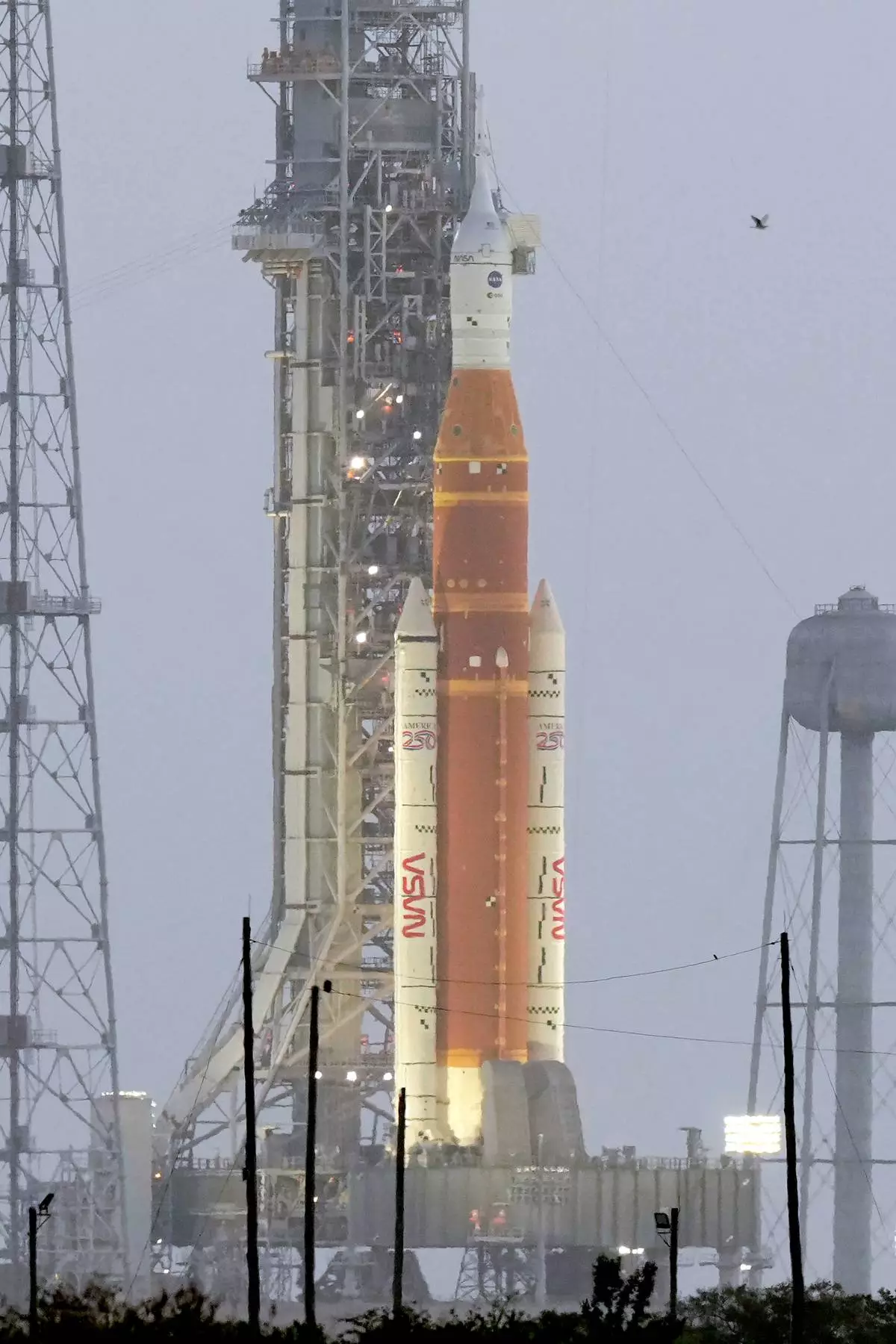
NASA's Artermis II moon rocket sits on Launch Pad 39-B at the Kennedy Space Center hours ahead of planned liftoff Wednesday, April 1, 2026, in Cape Canaveral, Fla. (AP Photo/Chris O'Meara)
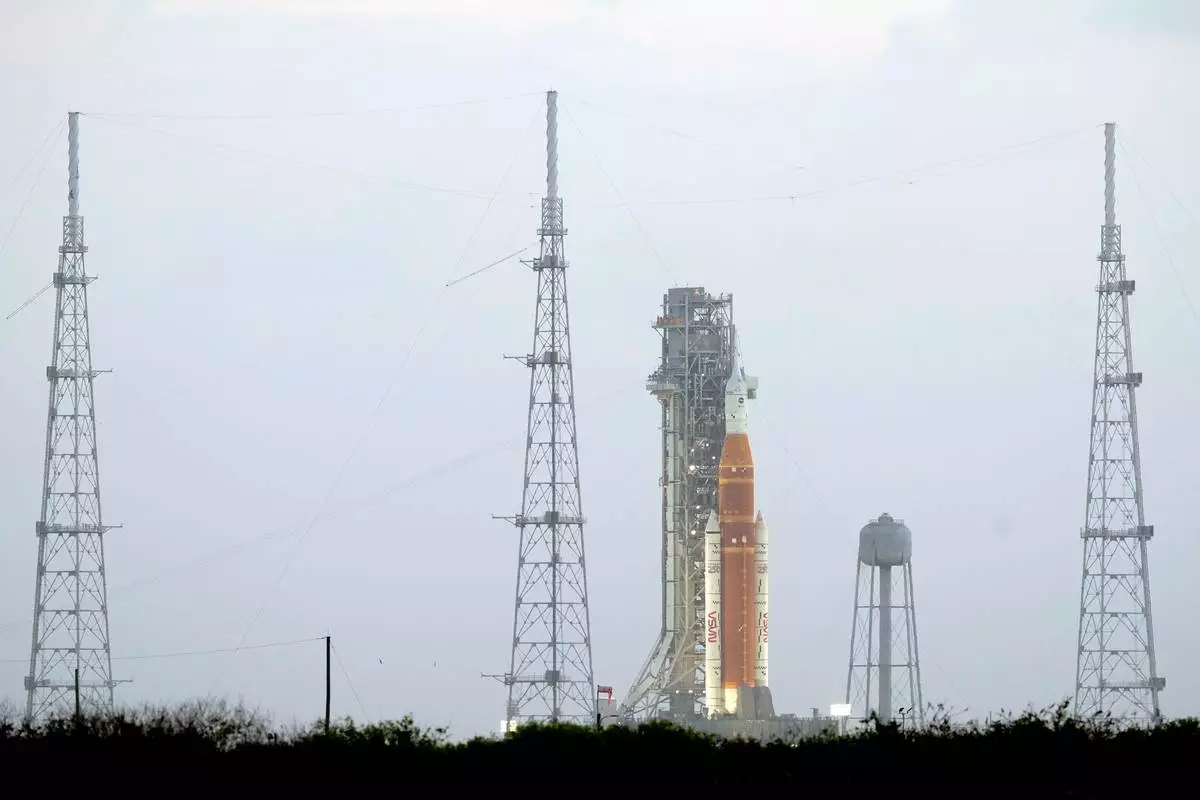
NASA's Artermis II moon rocket sits on Launch Pad 39-B at the Kennedy Space Center hours ahead of a planned launch attempt Wednesday, April 1, 2026, in Cape Canaveral, Fla. (AP Photo/Chris O'Meara)
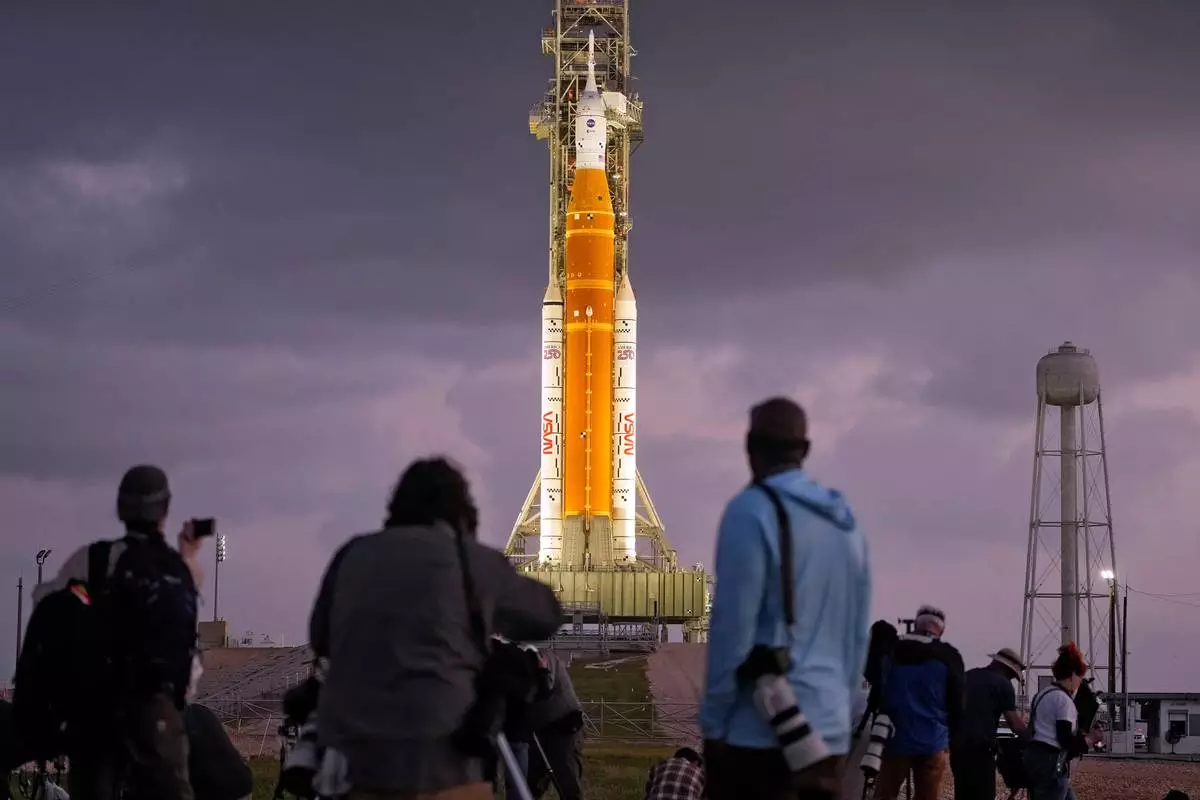
Photographers set up remote cameras near NASA's Artermis II moon rocket on Launch Pad 39-B just before sunrise at the Kennedy Space Center Tuesday, March 31, 2026, in Cape Canaveral, Fla. (AP Photo/Chris O'Meara)