Skip to Content Facebook Feature Image

American e-waste is causing a 'hidden tsunami' in Southeast Asia, report says

News

American e-waste is causing a 'hidden tsunami' in Southeast Asia, report says
News

News

American e-waste is causing a 'hidden tsunami' in Southeast Asia, report says

2025-10-23 14:29 Last Updated At:14:30

HANOI, Vietnam (AP) — Millions of tons of discarded electronics from the United States are being shipped overseas, much of it to developing countries in Southeast Asia unprepared to safely handle hazardous waste, according to a new report released Wednesday by an environmental watchdog.

The Seattle-based Basel Action Network, or BAN, said a two-year investigation found at least 10 U.S. companies exporting used electronics to Asia and the Middle East, in what it says is a “hidden tsunami” of electronic waste.

“This new, almost invisible tsunami of e-waste, is taking place ... padding already lucrative profit margins of the electronics recycling sector while allowing a major portion of the American public’s and corporate IT equipment to be surreptitiously exported to and processed under harmful conditions in Southeast Asia,” the report said.

Electronic waste, or e-waste, includes discarded devices like phones and computers containing both valuable materials and toxic metals like lead, cadmium and mercury. As gadgets are replaced faster, global e-waste is growing five times quicker than it’s formally recycled.

The world produced a record 62 million metric tons in 2022. That's expected to climb to 82 million by 2030, according to the United Nations’ International Telecommunication Union and its research arm, UNITAR.

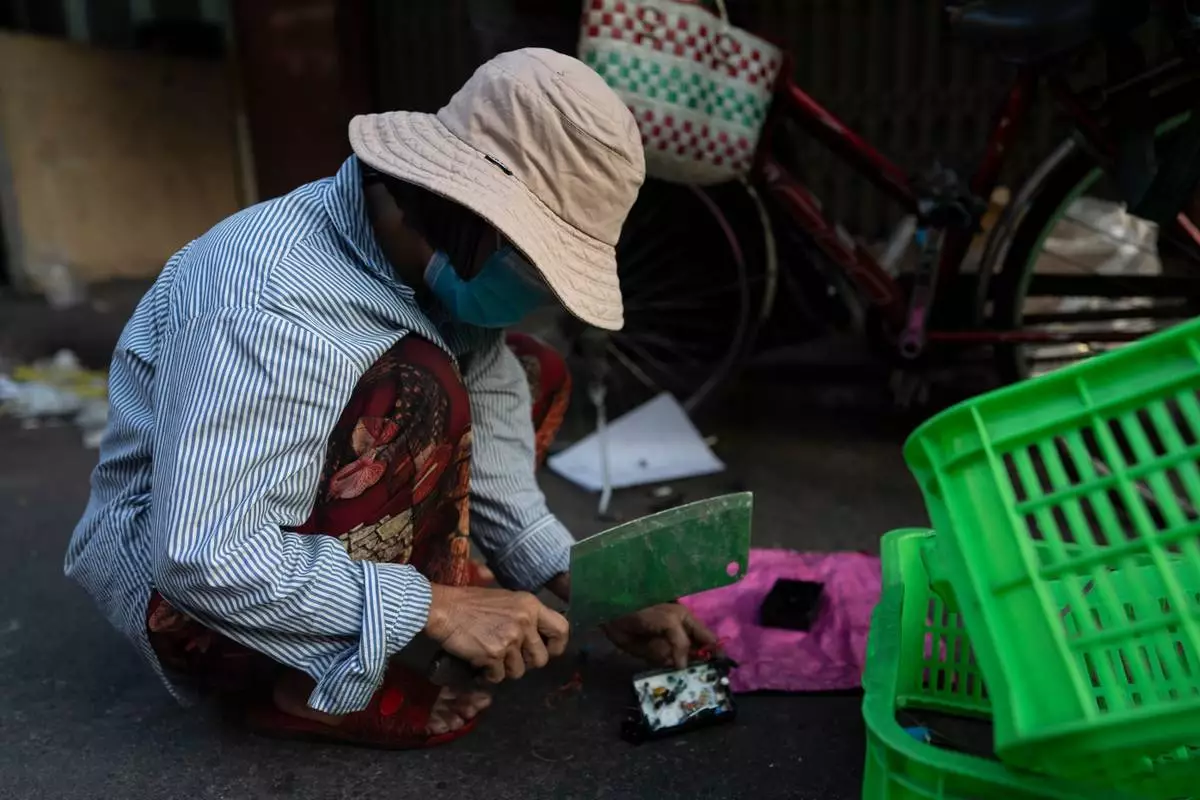
That American e-waste adds to the burden for Asia, which already produces nearly half the world’s total. Much of it is dumped in landfills, leaching toxic chemicals into the environment. Some ends up in informal scrapyards, where workers burn or dismantle devices by hand, often without protection, releasing toxic fumes and scrap.

About 2,000 containers — roughly 33,000 metric tons (36,376 U.S. tons) — of used electronics leave U.S. ports every month, according to the report. It said the companies behind the shipments, described as “e-waste brokers,” typically don’t recycle the waste themselves but send it to companies in developing countries.

The companies identified in the report include Attan Recycling, Corporate eWaste Solutions or CEWS, Creative Metals Group, EDM, First America Metal Corp., GEM Iron and Metal Inc., Greenland Resource, IQA Metals, PPM Recycling and Semsotai.

Six of the companies didn't immediately respond to emailed requests for comment.

Semsotai told The Associated Press that it doesn't export scrap, only working components for reuse. It accused BAN of bias.

PPM Recycling told The Associated Press that its warehouses in California and Texas ship only aluminum and other non-iron metals to Malaysia. It said BAN had exaggerated shipment volumes, adding that it used accurate trade codes and followed U.S. and international rules.

Greenland Resource told The Associated Press it took the allegations seriously and was reviewing the matter internally and couldn’t comment further without seeing the report.

CEWS said it follows strict environmental standards, but some aspects of where and how recycled materials are handled are industrial secrets.

The report estimated that between January 2023 and February 2025, the 10 companies exported more than 10,000 containers of potential e-waste valued at over $1 billion, the report said. Industrywide, such trade could top $200 million a month.

Eight of the 10 identified companies hold R2V3 certifications — an industry standard meant to ensure electronics are recycled safely and responsibly, raising questions about the value of such a certification, the report said.

Several companies operate out of California, despite the state’s strict e-waste laws requiring full reporting and proper downstream handling of electronic and universal waste.

Many e-waste containers go to countries that have banned such imports under the Basel Convention, which is an international treaty that bars hazardous waste trade from non-signatories like the U.S., the only industrialized nation yet to ratify it.

The nonprofit said its review of government and private trade records from ships and customs officials showed shipments were often declared under trade codes that did not match those for electronic waste, such as “commodity materials” like raw metals or other recyclable goods to evade detection. Such classifications were “highly unlikely” given how the companies publicly describe their operations, the report said.

Tony R. Walker, who studies global waste trade at the Dalhousie University’s School for Resource and Environmental Studies in Halifax in Canada, said he wasn’t surprised that e-waste continues to evade regulation. While some devices can be legally traded if functional, most such exports to developing nations are broken or obsolete and mislabeled, bound for landfills that pollute the environment and have little market value, he said.

He pointed to Malaysia — a Basel Convention signatory identified in the report as the primary destination for U.S. e-waste — saying the country would be overwhelmed by that volume, in addition to waste from other wealthy nations.

“It simply means the country is being overwhelmed with what is essentially pollution transfer from other nations,” he said.

The report estimates that U.S. e-waste shipments may have made up about 6% of all U.S. exports to the country from 2023 to 2025. After China banned imports of foreign waste in 2017, many Chinese businesses shifted their operations to Southeast Asia, using family and business ties to secure permits.

“Malaysia suddenly became this mecca of junk,” said Jim Puckett of the Basel Action Network.

Containers were also sent to Indonesia, Thailand, the Philippines and the UAE, despite bans under the Basel Convention and national laws, the report added.

In countries receiving this U.S. e-waste, "undocumented workers desperate for jobs" toil in makeshift facilities, inhaling toxic fumes as they strip wires, melt plastics and dismantle devices without protection, the report said.

Authorities in Thailand and Malaysia have stepped up efforts to curb illegal imports of U.S. e-waste.

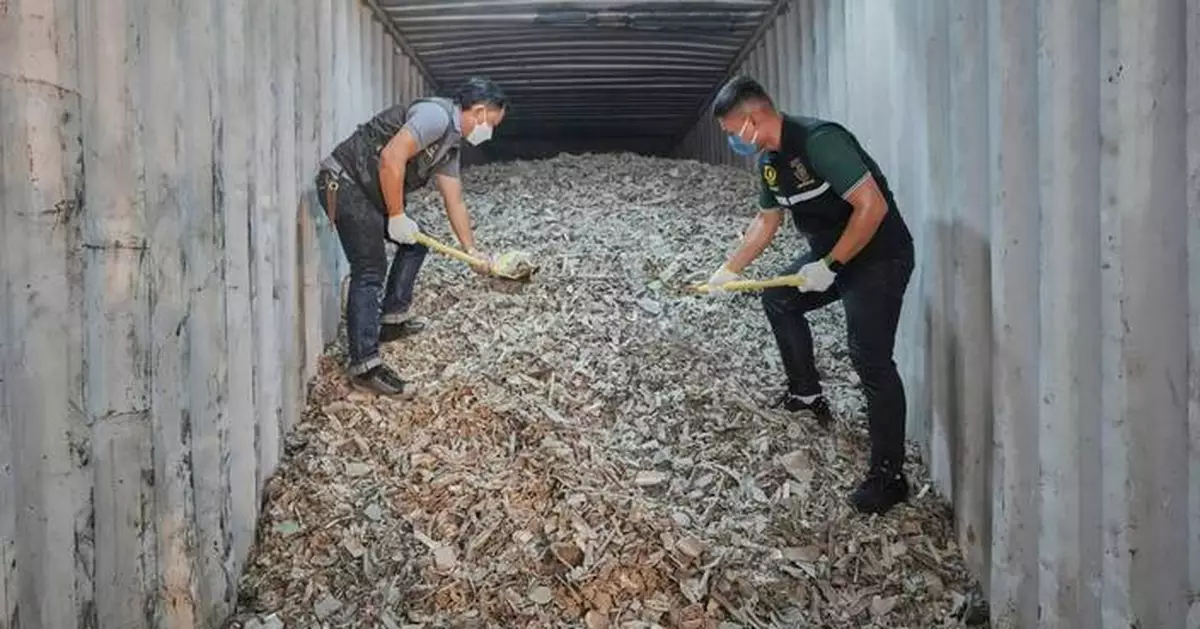
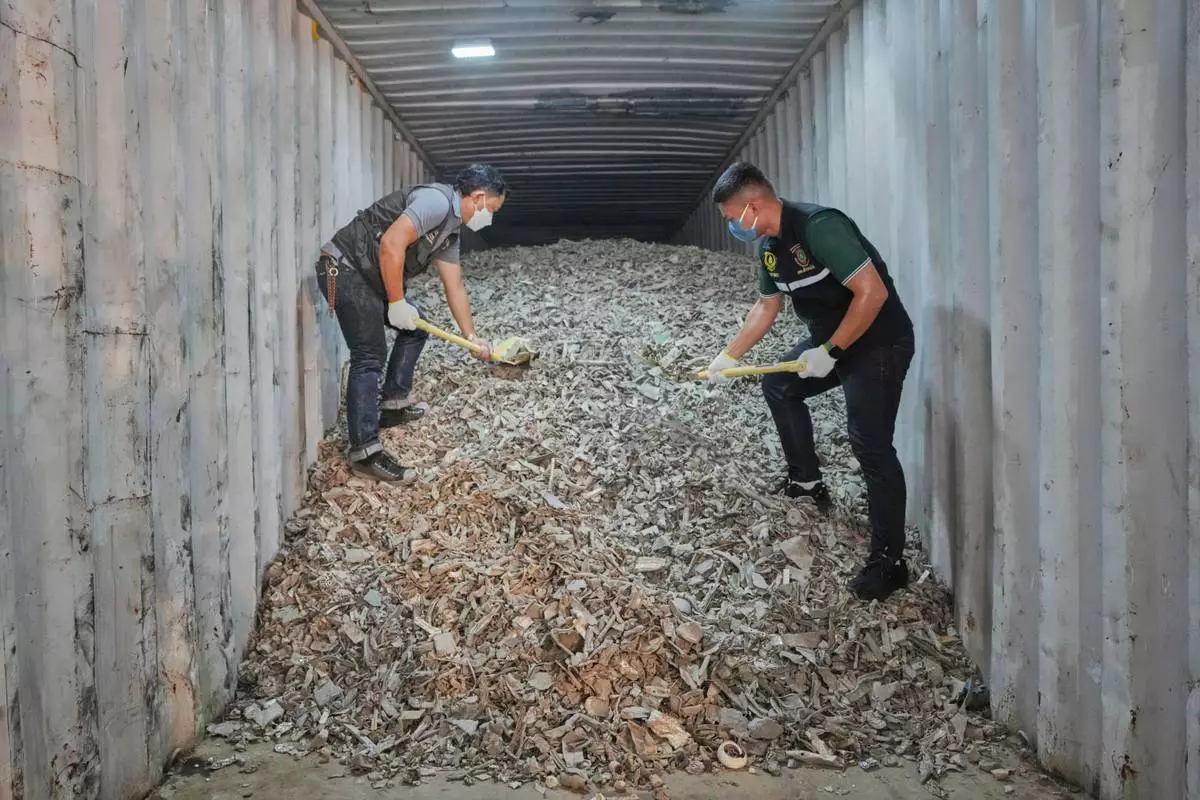
In May, Thai authorities seized 238 tons of U.S. e-waste at Bangkok’s port seized 238 tons of U.S. scrap at Bangkok’s port while Malaysian authorities confiscated e-waste worth $118 million in nationwide raids in June.

Most of the facilities in Malaysia were illegal and lacked environmental safeguards, said SiPeng Wong, of Malaysia’s Center to Combat Corruption & Cronyism.

Exporting e-waste from rich nations to developing nations strains local facilities, overwhelms efforts to manage domestic waste and is a form of “waste colonialism,” she said.

This story has been corrected to show that one of the companies identified in the report is called First America Metal Corp., not First American Metals.
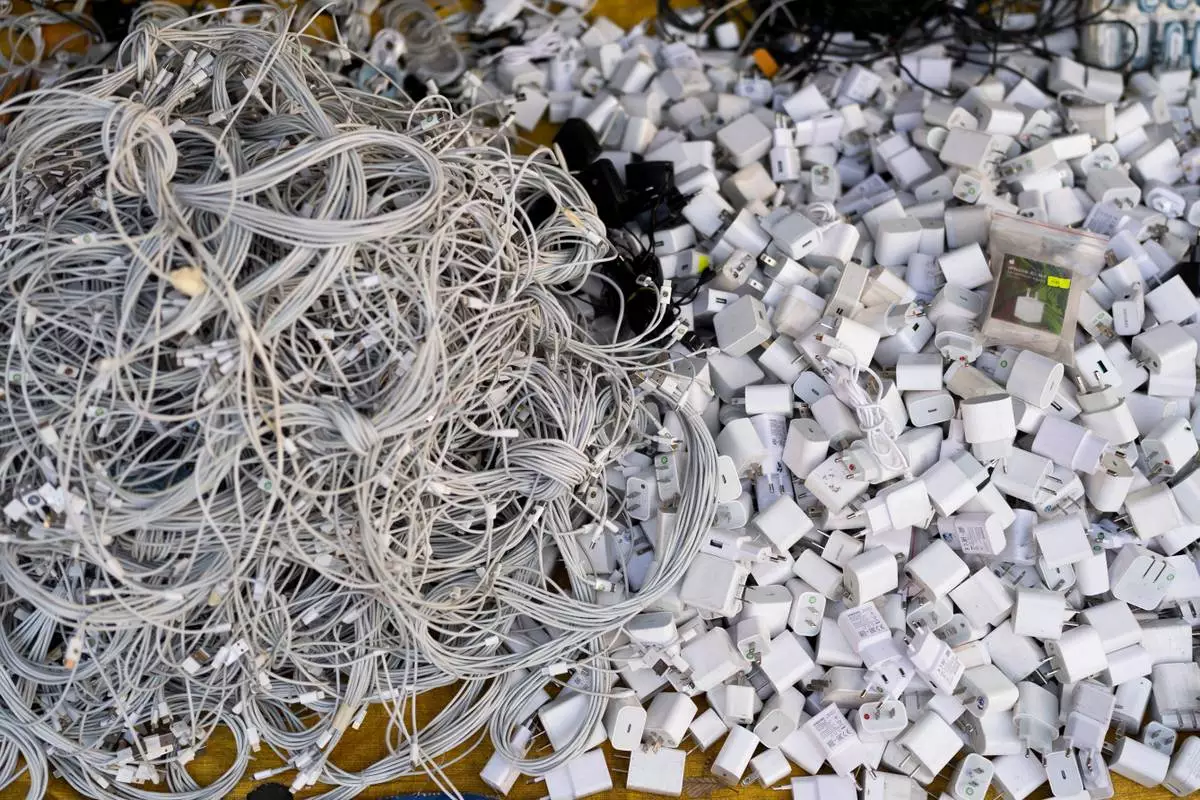
FILE -Used charging cables and power adapters are piled up at a shop in Nhat Tao market, the largest informal recycling market in Ho Chi Minh City, Vietnam, Jan. 28, 2024. (AP Photo/Jae C. Hong, File)
FILE -Used charging cables and power adapters are piled up at a shop in Nhat Tao market, the largest informal recycling market in Ho Chi Minh City, Vietnam, Jan. 28, 2024. (AP Photo/Jae C. Hong, File)

FILE - An e -waste collector uses a cleaver to remove copper wire from a device in Nhat Tao market, the largest informal recycling market in Ho Chi Minh City, Vietnam, Jan. 31, 2024. (AP Photo/Jae C. Hong, File)
FILE - An e -waste collector uses a cleaver to remove copper wire from a device in Nhat Tao market, the largest informal recycling market in Ho Chi Minh City, Vietnam, Jan. 31, 2024. (AP Photo/Jae C. Hong, File)

FILE - Thai officials show samples of illegally imported electronic waste from the United States which they said they seized at Bangkok Port during a press conference in Bangkok, Thailand, May 14, 2025. (AP Photo/Sakchai Lalit), File)

FILE - Thai officials show samples of illegally imported electronic waste from the United States which they said they seized at Bangkok Port during a press conference in Bangkok, Thailand, May 14, 2025. (AP Photo/Sakchai Lalit), File)

MILAN (AP) — Milan’s storied Teatro alla Scala celebrates its gala season premiere Sunday with a Russian opera for the second time since Moscow’s 2022 invasion of Ukraine. But this year, instead of drawing protests for showcasing the invader’s culture, a flash mob will demonstrate for peace.

La Scala’s music director Riccardo Chailly will conduct Dmitry Shostakovich’s “Lady Macbeth of Mtsensk” for the gala season opener that draws luminaries from culture, business and politics for one of the most anticipated events of the European cultural calendar.

Shostakovich's 1934 opera highlights the condition of women in Stalin’s Soviet Union, and was blacklisted just days after the communist leader saw a performance in 1936, the threshold year of his campaign of political repression known as the Great Purge.

The Italian liberal party +Europa announced a demonstration outside the theater as dignitaries arrive “to draw attention to the defense of liberty and European democracy, threatened today by Putin’s Russia, and to support the Ukrainian people.’’

The party underlined that Shostakovich's opera exposes the abuse of power and the role of personal resistance.

Due to security concerns, authorities moved the protest from the square facing La Scala, to another behind City Hall.

Chailly began working with Russian stage director Vasily Barkhatov on the title about two years ago, following the 2022 gala season premiere of the Russian opera “Boris Godunov,” which was attended by Italian Premier Giorgia Meloni and European Commission President Ursula von der Leyen, both of whom separated Russia’s politicians from its culture.

But outside the Godunov premiere, Ukrainians protested against highlighting Russian culture during a war rooted in the denial of a unique Ukrainian culture. The Ukrainian community did not announce any separate protests this year.

Chailly called the staging of Shostakovich’s “Lady Macbeth" at La Scala for just the fourth time “a must.’’

“It is an opera that has long suffered, and needs to make up for lost time,’’ Chailly told a news conference last month.

La Scala’s new general manager, Fortunato Ortombina, defended the choices made by his predecessor to stage both Shostakovich’s “Lady Macbeth” and Modest Mussorgsky’s “Boris Godunov " at the theater best known for its Italian repertoire, but which has in recent years showcased other traditions.

‘‘Music is fundamentally superior to any ideological conflict,’’ Ortombina said on the sidelines of the press conference. “Shostakovich, and Russian music more broadly, have an authority over the Russian people that exceeds Putin's own.’’

American soprano Sara Jakubiak is making her La Scala debut in the title role of Katerina, whose struggle against existential repression leads her to commit murder, landing her in a Siberian prison where she dies. It’s the second time Jakubiak has sung the role, after performances in Barcelona last year, and she said Shostakovich's Katerina is full of challenges.

“That I’m a murderess, that I’m singing 47 high B flats in one night, you know, all these things,’’ Jakubiak said while sitting in the makeup chair ahead of the Dec. 4 preview performance to an audience of young people. “You go, ‘Oh my gosh, how will I do this?’ But you manage, with the right kind of work, the right team of people. Yes, we’re just going to go for the ride.”

Speaking to journalists recently, Chailly joked that he was “squeezing” Jakubiak like an orange. Jakubiak said she found common ground with the conductor known for his studious approach to the original score and composer’s intent.

“Whenever I prepare a role, it’s always the text and the music and the text and the rhythms,'' she said. “First, I do this process with, you know, a cup of coffee at my piano and then we add the other layers and then the notes. So I guess we’re actually somewhat similar in that regard.''

Jakubiak, best known for Strauss and Wagner, has a major debut coming in July when she sings her first Isolde in concert with Anthony Pappano and the London Symphony.

Barkhatov, who has a flourishing international career, called the choice of “Lady Macbeth,” “very brave and exciting.”

Barkhatov's stage direction sets the opera in a cosmopolitan Russian city in the 1950s, the end of Stalin’s regime, rather than a 19th-century rural village as written for the 1930s premier.

For Barkhatov, Stalin’s regime defines the background of the story and the mentality of the characters for a story he sees as a personal tragedy and not a political tale. Most of the action unfolds inside a restaurant appointed in period Art Deco detail, with a rotating balustrade creating a kitchen, a basement and an office where interrogations take place.

Despite the tragic arc, Barkhatov described the story as “a weird … breakthrough to happiness and freedom.’’

“Sadly, the statistics show that a lot of people die on their way to happiness and freedom,’’ he added.

Stage director Vasily Barkhatov sits during an interview with The Associated Press prior to the dressed rehearsal of Dmitri Shostakovich's Lady Macbeth of the Mtsensk District at La Scala Opera House in Milan, Italy, Thursday, Dec. 4, 2025. (AP Photo/Antonio Calanni)

Stage director Vasily Barkhatov sits during an interview with The Associated Press prior to the dressed rehearsal of Dmitri Shostakovich's Lady Macbeth of the Mtsensk District at La Scala Opera House in Milan, Italy, Thursday, Dec. 4, 2025. (AP Photo/Antonio Calanni)

A wig receives final touches ahead of the dress rehearsal of Dmitri Shostakovich's Lady Macbeth of the Mtsensk District at La Scala Opera House in Milan, Italy, Thursday, Dec. 4, 2025. (AP Photo/Antonio Calanni)

A wig receives final touches ahead of the dress rehearsal of Dmitri Shostakovich's Lady Macbeth of the Mtsensk District at La Scala Opera House in Milan, Italy, Thursday, Dec. 4, 2025. (AP Photo/Antonio Calanni)

A wig receives final touches ahead of the dress rehearsal of Dmitri Shostakovich's Lady Macbeth of the Mtsensk District at La Scala Opera House in Milan, Italy, Thursday, Dec. 4, 2025. (AP Photo/Antonio Calanni)

A wig receives final touches ahead of the dress rehearsal of Dmitri Shostakovich's Lady Macbeth of the Mtsensk District at La Scala Opera House in Milan, Italy, Thursday, Dec. 4, 2025. (AP Photo/Antonio Calanni)

External view of Teatro all Scala ahead of the dress rehearsal of Dmitri Shostakovich's Lady Macbeth of the Mtsensk District in Milan, Italy, Thursday, Dec. 4, 2025. (AP Photo/Antonio Calanni)

External view of Teatro all Scala ahead of the dress rehearsal of Dmitri Shostakovich's Lady Macbeth of the Mtsensk District in Milan, Italy, Thursday, Dec. 4, 2025. (AP Photo/Antonio Calanni)

Soprano Sara Jakubiak has her makeup done ahead of the dress rehearsal of Dmitri Shostakovich's Lady Macbeth of the Mtsensk District at La Scala Opera House in Milan, Italy, Thursday, Dec. 4, 2025. (AP Photo/Antonio Calanni)

Soprano Sara Jakubiak has her makeup done ahead of the dress rehearsal of Dmitri Shostakovich's Lady Macbeth of the Mtsensk District at La Scala Opera House in Milan, Italy, Thursday, Dec. 4, 2025. (AP Photo/Antonio Calanni)

The stage is prepared ahead of the dressed rehearsal of the Lady Macbeth of Mtsensk District, by Dmitri Shostakovich, at La Scala Opera House in Milan, Italy, Thursday, Dec. 4, 2025. (AP Photo/Antonio Calanni)

The stage is prepared ahead of the dressed rehearsal of the Lady Macbeth of Mtsensk District, by Dmitri Shostakovich, at La Scala Opera House in Milan, Italy, Thursday, Dec. 4, 2025. (AP Photo/Antonio Calanni)

Recommended Articles