
Skip to Content Facebook Feature Image

Infineon Launches Two New Secured Prepaid Tag Solutions for Gift Cards to Protect Issuers, Merchants and Consumers From Rising Fraud Rates

News

Infineon Launches Two New Secured Prepaid Tag Solutions for Gift Cards to Protect Issuers, Merchants and Consumers From Rising Fraud Rates
News

News

Infineon Launches Two New Secured Prepaid Tag Solutions for Gift Cards to Protect Issuers, Merchants and Consumers From Rising Fraud Rates

2025-10-23 22:01 Last Updated At:22:10

SAN JOSE, Calif.--(BUSINESS WIRE)--Oct 23, 2025--

As the use of prepaid gift cards continues to grow at a 9% CAGR 1, consumers in the US are experiencing losses of $1 billion USD related to tampered gift cards, according to the US Federal Trade Commission (FTC). To help card issuers increase the security of gift cards, improve confidence in brands and limit consumer risks, Infineon Technologies AG (FSE: IFX / OTCQX: IFNNY) today introduced two new secured prepaid tag solutions. Infineon’s secured EMV prepaid tag solution focuses on open loop gift cards, while secured prepaid tag solution is offered for closed loop gift cards.

This press release features multimedia. View the full release here: https://www.businesswire.com/news/home/20251023313408/en/

Announced prior to Money 20/20, the new additions to the Infineon security solutions address the challenges associated with traditional gift cards by replacing the need for visible codes, barcodes, or magnetic stripes with a secured chip using cryptographic mechanisms. This chip can be accessed using NFC (near-field communication) devices by using a consumer's phone authenticated with the necessary data, allowing both retailers and consumers to simply "tap" the gift card for activation, check the balance, and redeem assets.

According to information compiled by the FTC, roughly 25% of all fraud reports are related to gift card fraud and 34% of US adults said that they or someone they know have already been targeted by gift card scams. This is bad for consumers but even worse for merchants as the operational overhead to identify, manage and resolve gift card fraud ultimately generates merchant costs of four dollars on every dollar lost to gift card fraud (according to Chargebacks911, July 2025).

Infineon’s secured EMV prepaid tag solutions aim to mitigate these fraud issues for open loop gift cards by enabling a simple tap-and-pay approach at any POS merchant device or at any retail outlet processed via payment networks. Secured prepaid tag solutions are intended to be used for closed loop gift cards, which are processed in retailer-specific or closed-loop environments.

“Gift card scams include sales of expired cards previously tampered with by bad actors, theft by fraudsters who trick consumers into revealing gift card ID information and sophisticated social engineering techniques used to trick consumers into ‘buying’ cards and revealing the data needed to use them,” said Tolgahan Yildiz, Head of the Trusted Mobile Connectivity and Transactions Product Line, Infineon Technologies AG. “Our secured prepaid tag solutions make this kind of theft and asset drainage ineffective by securing all usable information on a well-protected chip, accessible only to issuers, retailers and the valid holders of the gift cards.”

Infineon’s first ecosystem partner in the gift card industry is Karta Gift Card Ltd., a provider of secured access and processing capabilities of prepaid gift cards issued by retailers. For both Infineon’s secured prepaid tag solutions, Karta provides support of AES encryption protocols and processing capabilities. Karta’s technology offers cryptographic validation with every tap for seamless adoption by gift card retailers. With the combination of Infineon and Karta technologies, every gift card transaction will be enhanced with secured dynamic NFC tags and state-of-the-art cryptographic intelligence to avoid gift card cloning, skimming and replay attacks. “By combining Karta’s real-time cryptographic validation technology with Infineon‘s advanced secure NFC chip solutions, we’re setting a new benchmark for prepaid gift card security. Leveraging AES-based encryption and dynamic authentication with every tap, this collaboration delivers end-to-end protection against gift card draining and scams,” said David Anderson, Co-founder and Co-CEO of Karta Gift Cards.

Infineon’s secured prepaid tag solution for closed loop gift cards is fully compatible with existing manufacturing infrastructures for smart cards and paper tickets. The secured EMV prepaid tag solution is fully EMV compatible and supports the latest approved Visa and Mastercard applets.

Availability

Both secured prepaid tag families are available today. More information is available at https://www.infineon.com/product-information/infineon-gift-card-products.

About Infineon

Infineon Technologies AG is a global semiconductor leader in power systems and IoT. Infineon drives decarbonization and digitalization with its products and solutions. The Company had around 58,060 employees worldwide (end of September 2024) and generated revenue of about €15 billion in the 2024 fiscal year (ending 30 September). Infineon is listed on the Frankfurt Stock Exchange (ticker symbol: IFX) and in the USA on the OTCQX International over-the-counter market (ticker symbol: IFNNY).

Further information is available at www.infineon.com.
This press release is available online at www.infineon.com/press.
Follow us: Facebook - LinkedIn

 

Infineon launches two new secured prepaid tag solutions for gift cards to protect issuers, merchants and consumers from rising fraud rates


Infineon launches two new secured prepaid tag solutions for gift cards to protect issuers, merchants and consumers from rising fraud rates
ANCHORAGE, Alaska (AP) — A state appeals court is being asked to dismiss felony voter misconduct charges against an Alaska resident born in American Samoa, one of numerous cases that have drawn attention to the complex citizenship status of people born in the U.S. territory.

In arguments Thursday, attorneys for Tupe Smith plan to ask the Alaska Court of Appeals in Anchorage to reverse a lower court's decision that let stand the indictment brought against her. Her supporters say she made an innocent mistake that does not merit charges, but the state contends Smith falsely and deliberately claimed citizenship.

Prosecutors also have brought charges against 10 other people from American Samoa in the small Alaska community of Whittier, including Smith’s husband and her mother-in-law. American Samoa is the only U.S. territory where residents are not automatically granted citizenship by being born on American soil and instead are considered U.S. nationals. Paths to citizenship exist, such as naturalization, though that process can be expensive and cumbersome.

American Samoans can serve in the military, obtain U.S. passports and vote in elections in American Samoa, but they cannot hold public office in the U.S. or participate in most U.S. elections.

About 25 people gathered on a snowy street outside the courthouse before Thursday's hearing to support Smith. One woman, Fran Seager of Palmer, held a sign that said, “Support our Samoans. They are US nationals.”

Smith's husband, Michael Pese, thanked the American Samoa community in the Anchorage area. “If it wasn’t for you guys, I wouldn’t be strong enough to face this head on,” he said.

State Sen. Forrest Dunbar, a Democrat who attended the rally, said the Alaska Department of Law has limited resources.

“We should be going after people who are genuine criminals, who are violent criminals, or at least have the intent to deceive,” he said. “I do not think it is a good use of our limited state resources to go after these hardworking, taxpaying Alaskans who are not criminals.”

Smith was arrested after winning election to a regional school board in 2023. She said she relied on erroneous information from local election officials when she identified herself as a U.S. citizen on voter registration forms.

In a court filing in 2024, one of her previous attorneys said that when Smith answered questions from the Alaska state trooper who arrested her, she said she was aware that she could not vote in presidential elections but was “unaware of any other restrictions on her ability to vote.”

Smith said she marks herself as a U.S. national on paperwork. But when there was no such option on voter registration forms, she was told by city representatives that it was appropriate to mark U.S. citizen, according to the filing.

Smith “exercised what she believed was her right to vote in a local election. She did so without any intent to mislead or deceive anyone,” her current attorneys said in a filing in September. “Her belief that U.S. nationals may vote in local elections, which was supported by advice from City of Whittier election officials, was simply mistaken.”

The state has said Smith falsely and deliberately claimed citizenship. Prosecutors pointed to the language on the voter application forms she filled out in 2020 and 2022, which explicitly said that if the applicant was not at least 18 years old and a U.S. citizen, “do not complete this form, as you are not eligible to vote.”

The counts Smith was indicted on “did not have anything to do with her belief in her ability to vote in certain elections; rather they concerned the straightforward question of whether or not Smith intentionally and falsely swore she was a United States citizen,” Kayla Doyle, an assistant attorney general, said in court filings last year.

One of Smith's attorneys, Neil Weare, co-founder of the Washington-based Right to Democracy Project, said by email last week that if the appeals court lets stand the indictment, Alaska will be “the only state to our knowledge with such a low bar for felony voter fraud.”

Bohrer reported from Juneau, Alaska.

Michael Pese and his wife, Tupe Smith, stand outside the Boney Courthouse in Anchorage, Alaska, Thursday, Jan. 15, 2026, ahead of the Alaska Court of Appeals hearing a challenge to the voter fraud case brought against her by the state. (AP Photo/Mark Thiessen)

Michael Pese and his wife, Tupe Smith, stand outside the Boney Courthouse in Anchorage, Alaska, Thursday, Jan. 15, 2026, ahead of the Alaska Court of Appeals hearing a challenge to the voter fraud case brought against her by the state. (AP Photo/Mark Thiessen)

Michael Pese, left, his wife, Tupe Smith, and their son Maximus pose for a photo outside the Boney Courthouse in Anchorage, Alaska, Thursday, Jan. 15, 2026, ahead of the Alaska Court of Appeals hearing a challenge to the voter fraud case brought against her by the state. (AP Photo/Mark Thiessen)

Michael Pese, left, his wife, Tupe Smith, and their son Maximus pose for a photo outside the Boney Courthouse in Anchorage, Alaska, Thursday, Jan. 15, 2026, ahead of the Alaska Court of Appeals hearing a challenge to the voter fraud case brought against her by the state. (AP Photo/Mark Thiessen)

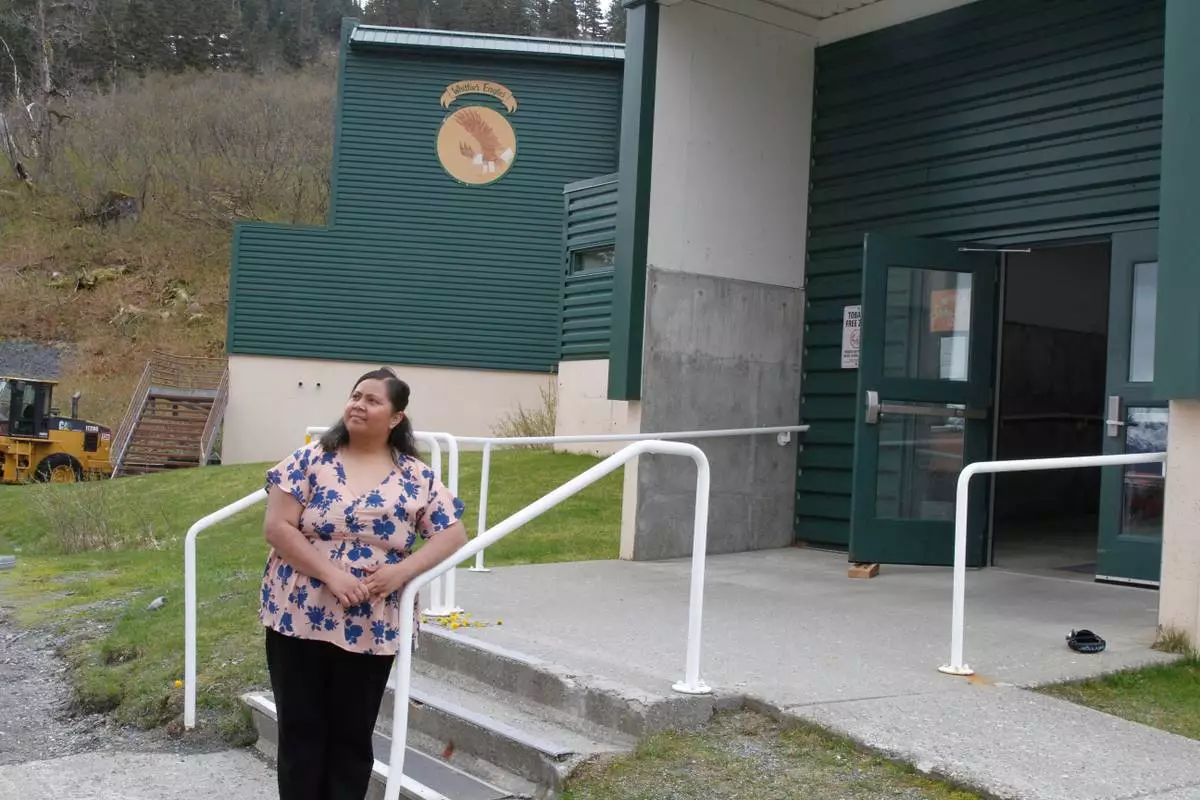
FILE - Tupe Smith poses for a photo outside the school in Whittier, Alaska, May 13, 2025. (AP Photo/Mark Thiessen, File)

FILE - Tupe Smith poses for a photo outside the school in Whittier, Alaska, May 13, 2025. (AP Photo/Mark Thiessen, File)

Recommended Articles