INGLEWOOD, Calif. (AP) — Four days after a humbling loss, the Los Angeles Chargers bounced back in a big way.
Justin Herbert threw for 227 yards and three touchdowns in a 37-10 win over the Minnesota Vikings on Thursday night, ending a skid of three losses in four games that knocked them from atop the AFC West.
Click to Gallery

Los Angeles Chargers wide receiver Tre Harris (9) catches a touchdown pass ahead of Minnesota Vikings safety Josh Metellus (44) during the second half of an NFL football game Thursday, Oct. 23, 2025, in Inglewood, Calif. (AP Photo/Gregory Bull)

Los Angeles Chargers tight end Oronde Gadsden II (86) catches a touchdown pass ahead of Minnesota Vikings safety Josh Metellus (44) during the first half of an NFL football game Thursday, Oct. 23, 2025, in Inglewood, Calif. (AP Photo/Gregory Bull)
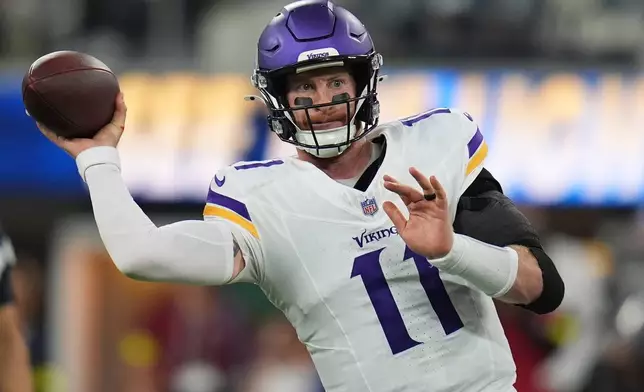
Minnesota Vikings quarterback Carson Wentz (11) passes during the first half of an NFL football game against the Los Angeles Chargers Thursday, Oct. 23, 2025, in Inglewood, Calif. (AP Photo/Gregory Bull)
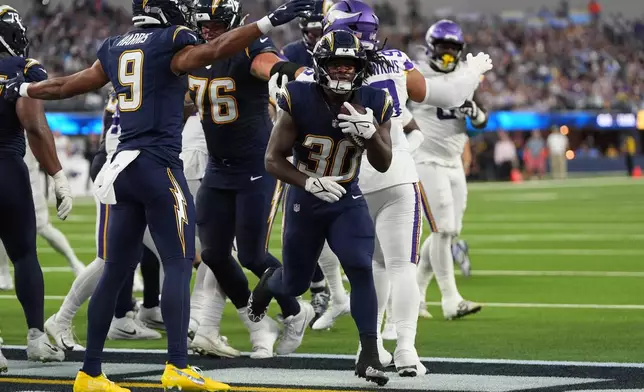
Los Angeles Chargers running back Kimani Vidal (30) scores a touchdown during the first half of an NFL football game against the Minnesota Vikings Thursday, Oct. 23, 2025, in Inglewood, Calif. (AP Photo/Gregory Bull)

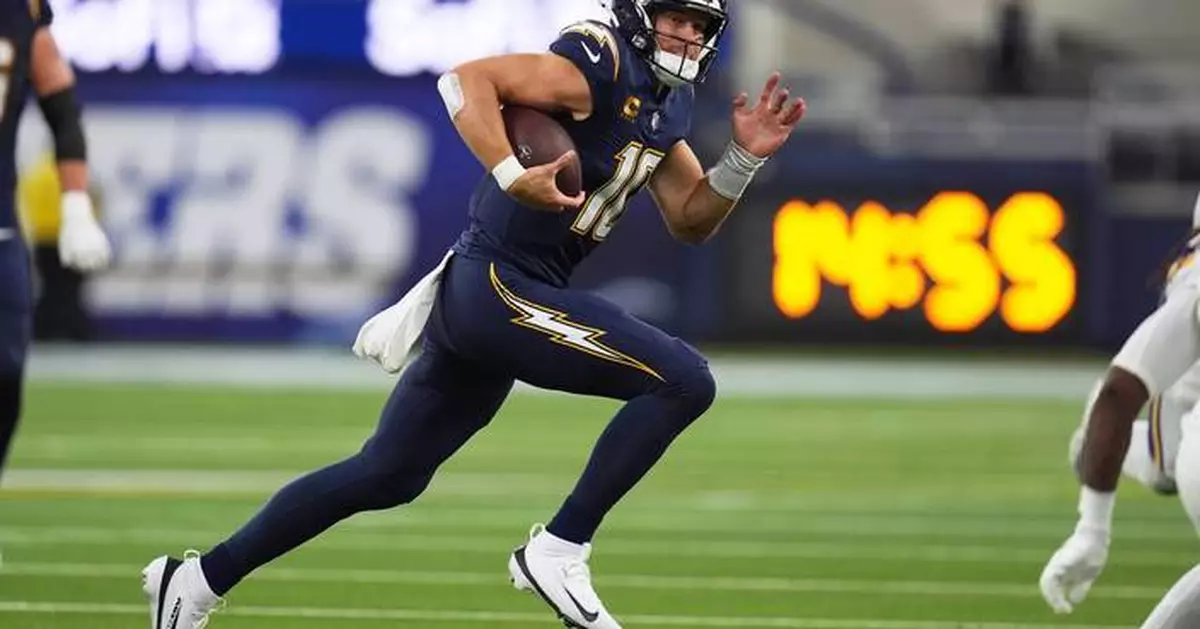
Los Angeles Chargers quarterback Justin Herbert (10) runs with the football during the first half of an NFL football game against the Minnesota Vikings Thursday, Oct. 23, 2025, in Inglewood, Calif. (AP Photo/Gregory Bull)
“It was a big win for us, a big opportunity for us to go correct some more mistakes,” said Herbert, who also rushed for 62 yards.
The Chargers (5-3) won for the first time since Week 6 at Miami, after coming off a resounding 38-24 defeat to the AFC South-leading Indianapolis Colts at SoFi Stadium.
“The team really responded,” Chargers coach Jim Harbaugh said. “They went back to work after Sunday and they set their minds to it that they weren’t going to be denied.”
The Chargers scored 30 points or more for the first time and didn’t punt.
“If we don’t beat ourselves, I feel like we’re a hard football team to beat,” said Ladd McConkey, who caught a 27-yard TD pass from Herbert that made it 21-3 late in the first half.
Keenan Allen had four catches for 44 yards and joined Hall of Famer Antonio Gates as the only players in Chargers history with 11,000 receiving yards.
The Vikings (3-4) lost consecutive games for the first time this season, with both coming in a five-day span. They managed just 12 first downs to 29 for the Chargers, were 3 of 11 on third down and had the ball for just 21 minutes.
“This is not a bury-the-tape kind of time for our organization,” Vikings coach Kevin O'Connell said. “This is a watch it, view it, own it — every coach and every player, and it starts with me. I did not have our team prepared to play.”
Carson Wentz started on short rest in place of quarterback J.J. McCarthy, who missed his fifth straight game with an ankle injury. Wentz was 15 of 27 for 144 yards with one touchdown and an interception while getting sacked five times. He played through a left shoulder injury that he aggravated multiple times.
“Hats off to their defense on a short week,” Wentz said. “Scheme-wise, they have some good players. We were banged up up front. I thought guys competed their tails off. I could always get the ball out quicker and make some plays and make decisions faster, but the defense made it tough.”
The Chargers had chances to score on all four of their possessions in the first half, and they led 21-3 at the break. They missed only on Cameron Dicker's 49-yard field-goal attempt that went wide left after holder JK Scott had to go up and get a bad snap. Dicker had made 46 of 47 attempts at home.
Oronde Gadsden II caught an 8-yard TD pass and Kimani Vidal scored on a 3-yard run to go with McConkey's score. Vidal finished with 117 yards rushing.
Scott salvaged another bad snap on Dicker's 49-yard field goal early in the third that extended the lead to 24-3.
After the Vikings were forced to punt, Herbert was intercepted at the Chargers 26. That led to the Vikings' lone touchdown, helped by two Chargers penalties.
Will Reichard’s 32-yard field goal was nullified when the Chargers were penalized for having too many men on the field. The Vikings went for it on fourth-and-9 and Wentz nearly got sacked, but Chargers cornerback Benjamin St-Juste was penalized for illegal contact. That kept the drive alive and Wentz hit Jordan Addison for a 4-yard score to make it 24-10.
The Chargers answered early in the fourth on Herbert's 6-yard pass over the middle to Tre' Harris. The Vikings were penalized for too may players on the field and the Chargers overcame a false-start penalty by Foster Sarell.
Rookie RJ Mickens had his first career interception, picking off Wentz to end Minnesota's first possession in the fourth.
The Chargers caught a couple of breaks on their way to taking a 7-0 lead.
Isaiah Rodgers’ apparent pick-6 of Herbert was reversed and ruled an incomplete pass.
Herbert scrambled up the middle, dodging two defenders in the backfield and two at the line of scrimmage, to get the Chargers to third-and-goal. On the next play, Gadsden scored before the rookie was penalized for unsportsmanlike conduct.
Vikings running back Aaron Jones returned from a hamstring injury that kept him out the last four games. He rushed for 15 yards on five carries and had two catches for 15 yards.
Vikings: CB Jeff Okudah (concussion) left in the third quarter. ... LT Christian Darrisaw (knee) and TE Josh Oliver (foot) got hurt.
Chargers: S Derwin James Jr. (ankle) and RG Mekhi Becton (ankle) got hurt in the first quarter.
The Vikings visit Detroit and the Chargers visit Tennessee on Sunday, Nov. 2.
AP NFL: https://apnews.com/hub/nfl
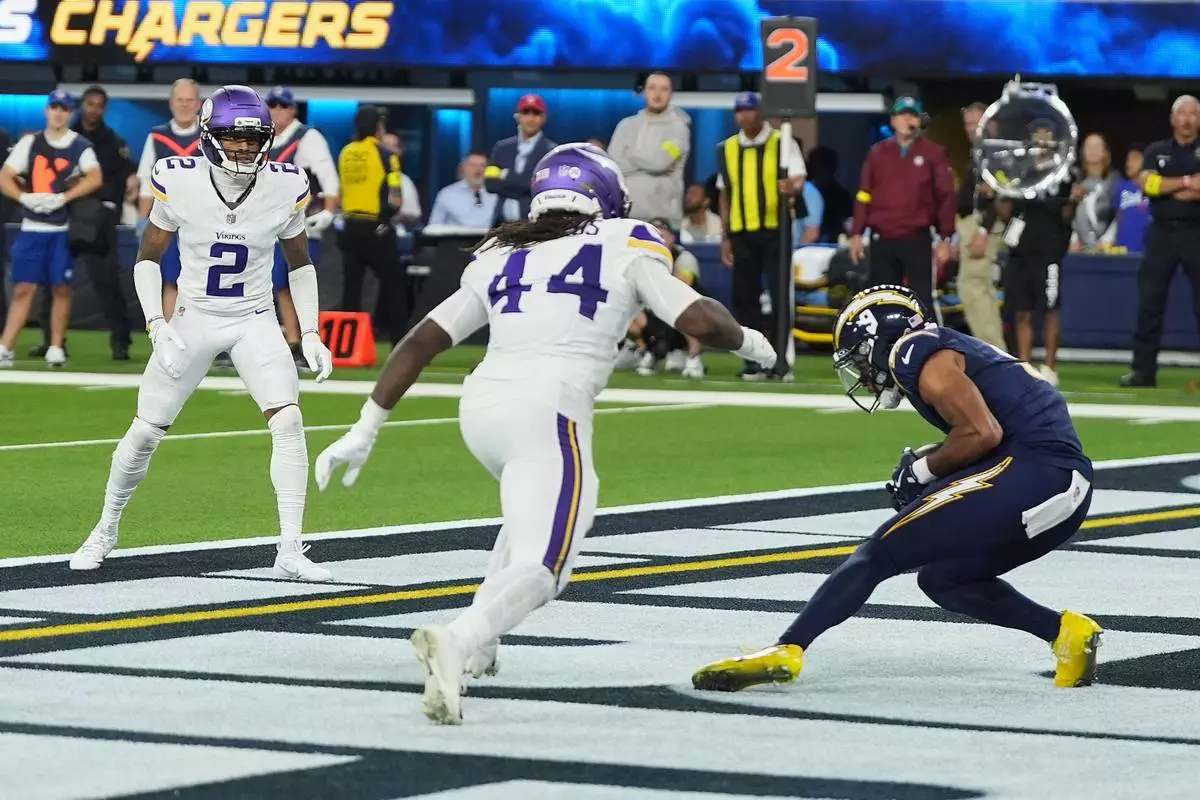
Los Angeles Chargers wide receiver Tre Harris (9) catches a touchdown pass ahead of Minnesota Vikings safety Josh Metellus (44) during the second half of an NFL football game Thursday, Oct. 23, 2025, in Inglewood, Calif. (AP Photo/Gregory Bull)
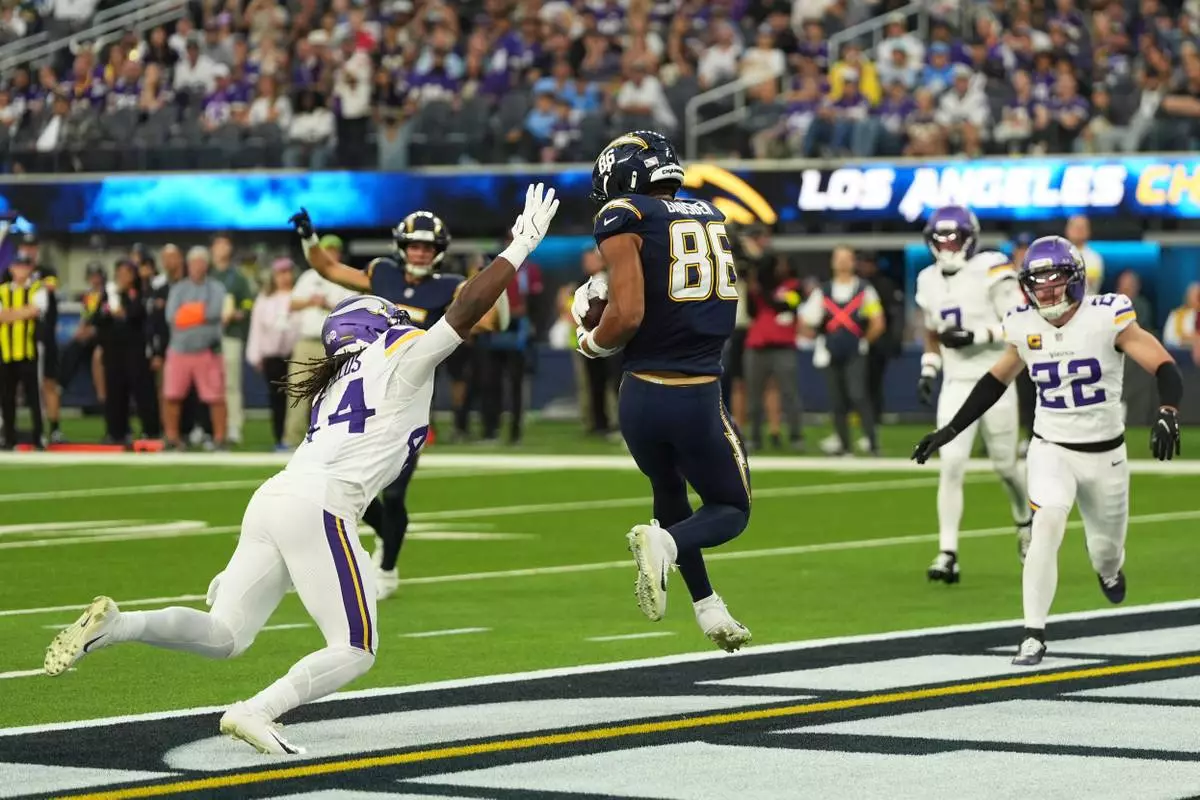
Los Angeles Chargers tight end Oronde Gadsden II (86) catches a touchdown pass ahead of Minnesota Vikings safety Josh Metellus (44) during the first half of an NFL football game Thursday, Oct. 23, 2025, in Inglewood, Calif. (AP Photo/Gregory Bull)
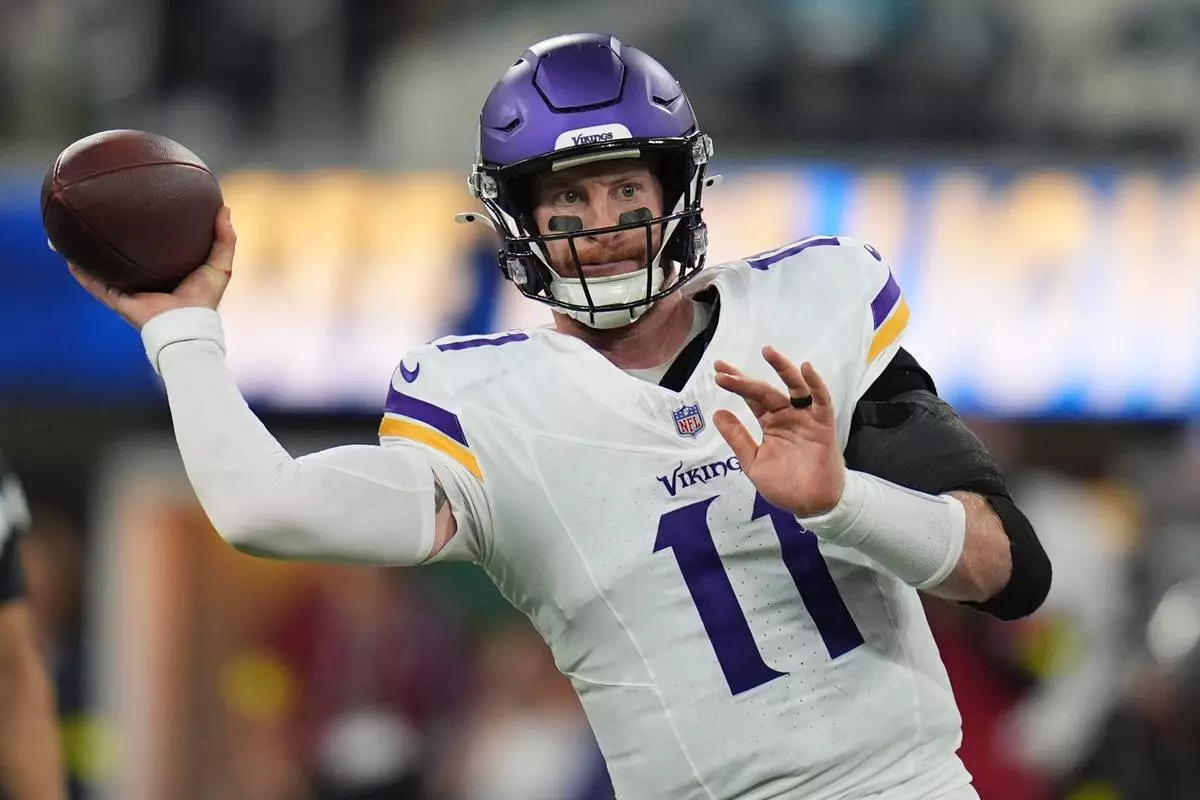
Minnesota Vikings quarterback Carson Wentz (11) passes during the first half of an NFL football game against the Los Angeles Chargers Thursday, Oct. 23, 2025, in Inglewood, Calif. (AP Photo/Gregory Bull)
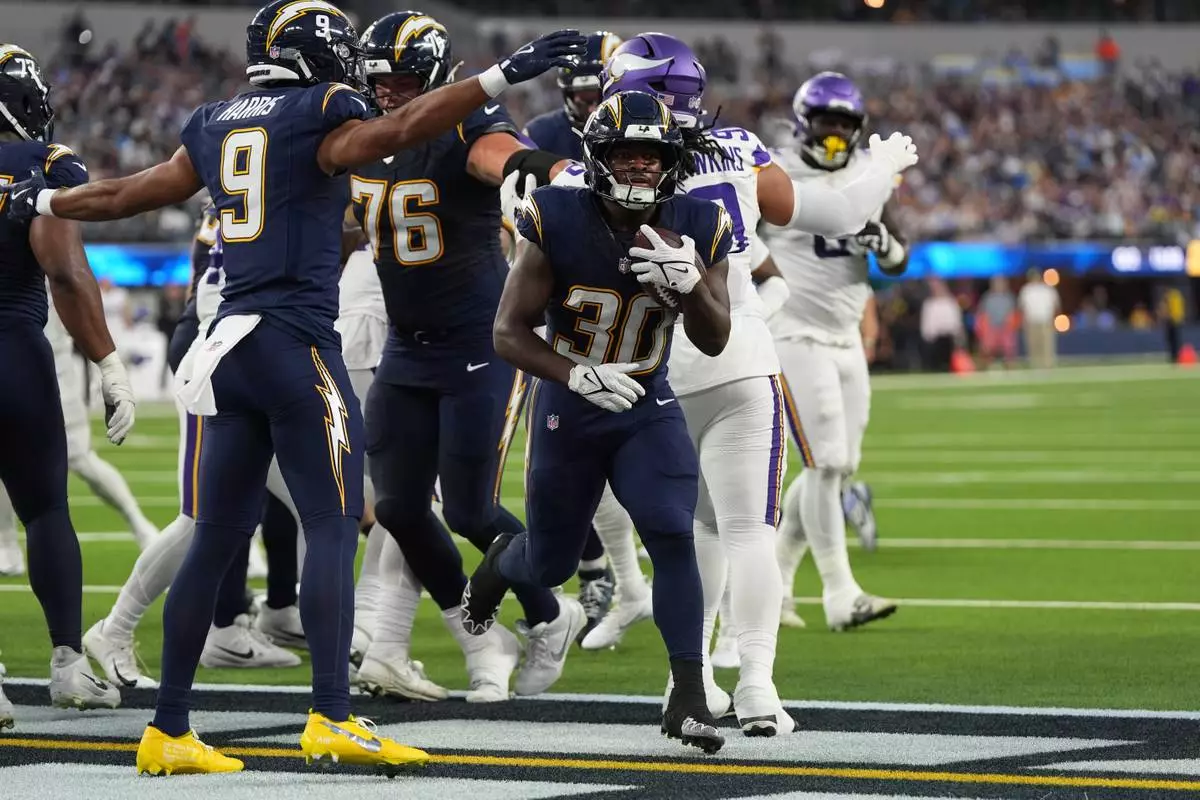
Los Angeles Chargers running back Kimani Vidal (30) scores a touchdown during the first half of an NFL football game against the Minnesota Vikings Thursday, Oct. 23, 2025, in Inglewood, Calif. (AP Photo/Gregory Bull)
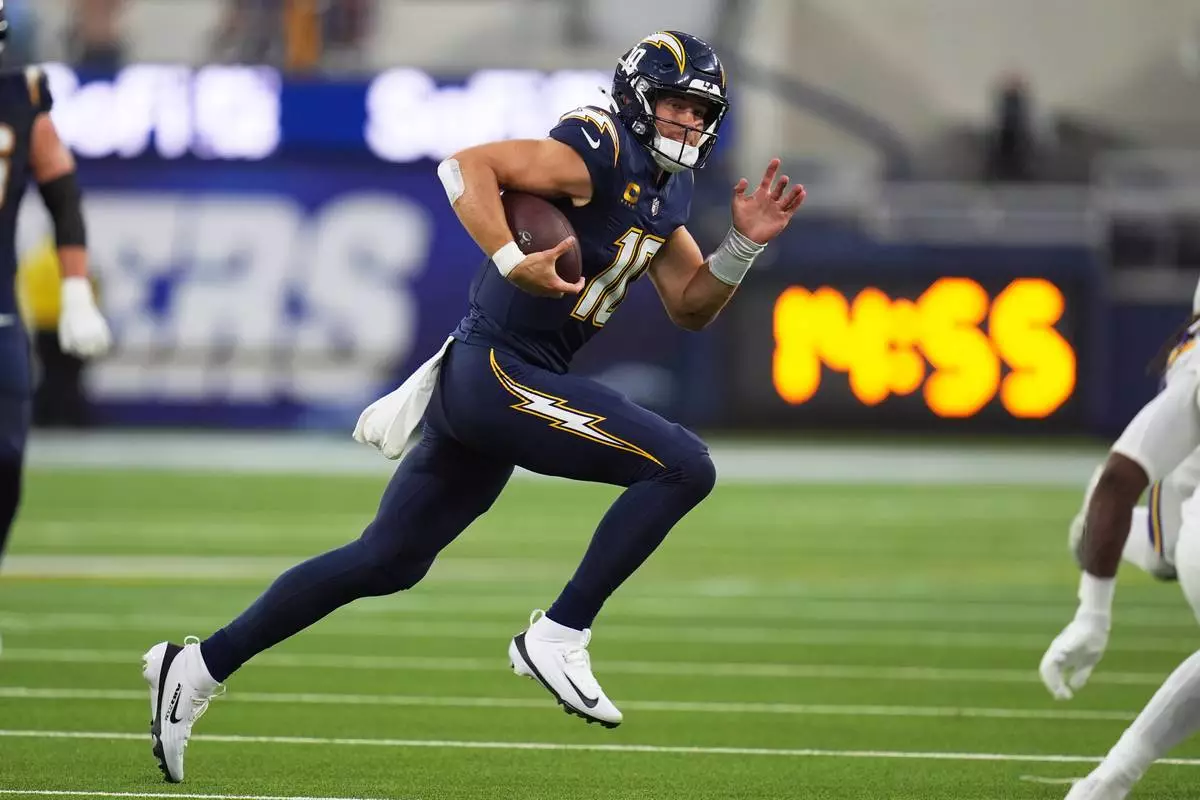
Los Angeles Chargers quarterback Justin Herbert (10) runs with the football during the first half of an NFL football game against the Minnesota Vikings Thursday, Oct. 23, 2025, in Inglewood, Calif. (AP Photo/Gregory Bull)