Skip to Content Facebook Feature Image

Interpol-led crackdown on environmental crime leads to 225 arrests in Latin America

News

Interpol-led crackdown on environmental crime leads to 225 arrests in Latin America
News

News

Interpol-led crackdown on environmental crime leads to 225 arrests in Latin America

2025-10-24 23:13 Last Updated At:23:20

BOGOTA, Colombia (AP) — A two-month multinational police operation spanning nine Latin American countries resulted in 225 arrests for environmental crime and hundreds of new investigations into illegal logging, wildlife trafficking and gold mining, Interpol said Friday.

The announcement marked the first public comments about the crackdown dubbed Operation Madre Tierra VII, coordinated by Interpol’s bureau for Central America.

The May-June operation was assisted by Interpol's environmental security unit, the Paris-based international police organization said.

Interpol, which helps countries share intelligence and coordinate cross-border investigations, said the effort uncovered more than 400 cases of environmental crimes, including illegal logging, wildlife trafficking, fishing violations, illegal mining and pollution offenses.

Among the most frequent violations were 203 forestry-related crimes and 138 linked to the illegal wildlife trade, it said.

The operation also exposed transnational routes that reached as far away as Europe and Asia, revealing how organized crime networks are increasingly driving deforestation, illegal mining and the exploitation of protected species across the region.

A wide range of contraband was seized: live birds, reptiles, turtles, primates and big cats, along with 2.4 tons of shark and ray fins. Some 875 kilograms (almost 1,930 pounds) of totoaba — a critically endangered fish — and 7 kilograms (15 pounds) of dried sea cucumber.

Interpol said the seizures highlight the ongoing exploitation of protected species for lucrative international markets.

The results underscore how organized criminal networks are turning protected species and forests into trans-continental commodity chains, with profound consequences for ecosystems and climate resilience.

Interpol and partner agencies have carried out similar cross-border crackdowns in recent years, including one along the Paraguay-Brazil-Argentina border that led to 26 arrests for illegal timber trafficking.

Large quantities of illegally harvested timber, including pine, oak, and high-value cedarwood and rosewood, were also confiscated. Rosewood can fetch up to $6,000 per cubic meter on the black market, according to Interpol, underscoring the profits driving forest destruction.

Investigators identified deforestation hotspots spanning more than 50,000 hectares (193 square miles), many linked to organized criminal groups operating across continents.

In Panama, one major case uncovered large-scale illegal gold mining involving child labor, human trafficking, and mercury contamination of rivers and soil.

The operation also resulted in the seizure of weapons, vehicles, boats, and communication equipment. Authorities said additional investigations are ongoing, and a final analytical report will be presented in late November.

Oscar Soria, chief executive of The Common Initiative, an environmental think tank, told The Associated Press that the operation shows how environmental crime in Latin America “has become deeply integrated with traditional organized crime networks,” as drug-trafficking groups expand into illegal mining, logging and wildlife smuggling.

“These low-risk, high-profit crimes now provide financing for armed groups and thrive on corruption at multiple levels,” Soria said. “What’s urgently needed is a structural response — not just arrests, but stronger governance, better regional coordination and efforts to reclaim territories where criminal networks fill the void left by the state.”

The operation was part of Project GAIA, a program backed by Germany’s Environment Ministry and police from countries including Colombia, Mexico, and Costa Rica took part in the coordinated effort, Interpol said.

The Associated Press’ climate and environmental coverage receives financial support from multiple private foundations. AP is solely responsible for all content. Find AP’s standards for working with philanthropies, a list of supporters and funded coverage areas at AP.org.
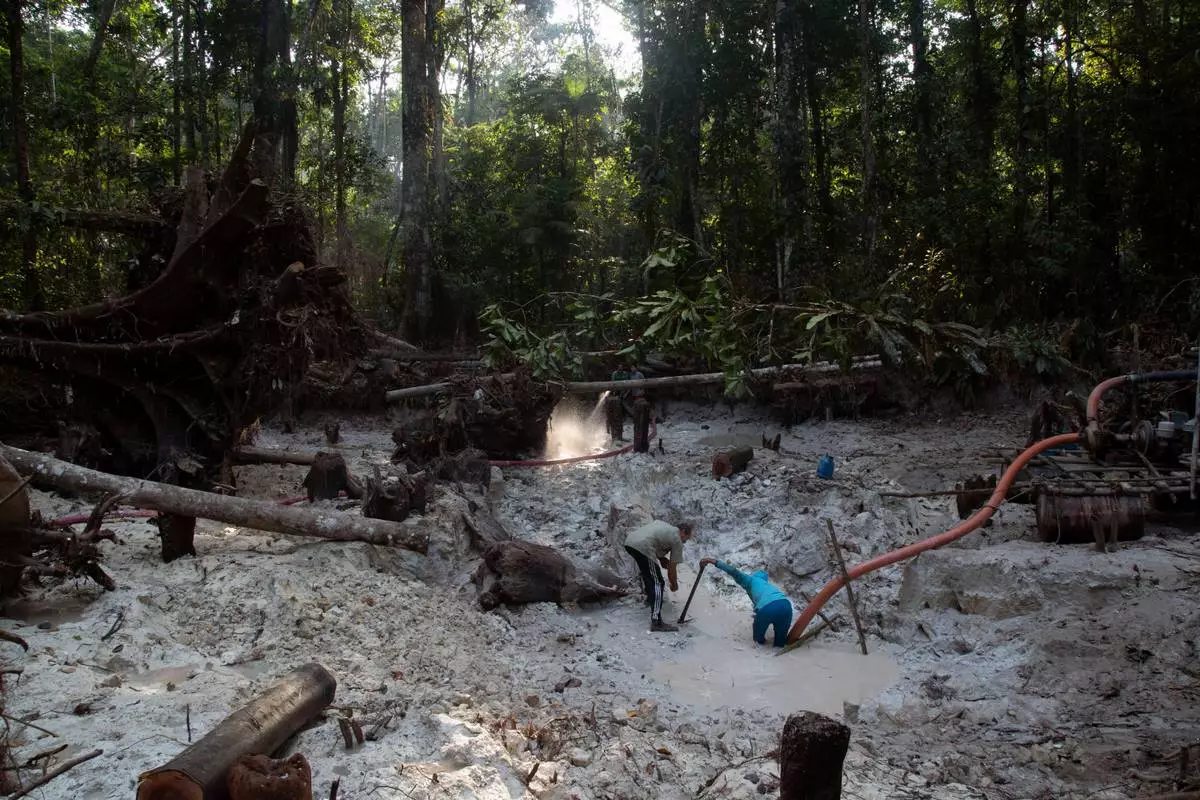
FILE - Men search for gold at an illegal gold mine in the Amazon jungle in the Itaituba area of Para state, Brazil, Friday, Aug. 21, 2020. (AP Photo/Lucas Dumphreys, File)


FILE - Men search for gold at an illegal gold mine in the Amazon jungle in the Itaituba area of Para state, Brazil, Friday, Aug. 21, 2020. (AP Photo/Lucas Dumphreys, File)

WASHINGTON (AP) — U.S. forces in the Caribbean Sea have seized another sanctioned oil tanker that the Trump administration says has ties to Venezuela, part of a broader U.S. effort to take control of the South American country’s oil.

Homeland Security Secretary Kristi Noem wrote on social media that the U.S. Coast Guard had boarded the Motor Tanker Veronica early Thursday. She said the ship had previously passed through Venezuelan waters and was operating in defiance of President Donald Trump’s "established quarantine of sanctioned vessels in the Caribbean.”

U.S. Southern Command said Marines and sailors launched from the aircraft carrier USS Gerald R. Ford to take part in the operation alongside a Coast Guard tactical team, which Noem said conducted the boarding as in previous raids. The military said the ship was seized “without incident.”

Noem posted a brief video that appeared to show part of the ship’s capture. The black-and-white footage showed helicopters hovering over the deck of a merchant vessel while armed troops dropped down on the deck by rope.

The Veronica is the sixth sanctioned tanker seized by U.S. forces as part of the effort by Trump’s administration to control the production, refining and global distribution of Venezuela’s oil products and the fourth since the U.S. ouster of Venezuela President Nicolás Maduro in a surprise nighttime raid almost two weeks ago.

The Veronica last transmitted its location on Jan. 3 as being at anchor off the coast of Aruba, just north of Venezuela’s main oil terminal. According to the data it transmitted at the time, it was partially filled with crude.

The ship is currently listed as flying the flag of Guyana and is considered part of the shadow fleet that moves cargoes of oil in violation of U.S. sanctions.

According to its registration data, the ship also has been known as the Galileo, owned and managed by a company in Russia. In addition, a tanker with the same registration number previously sailed under the name Pegas and was sanctioned by the U.S. Treasury Department for moving cargoes of illicit Russian oil.

As with prior posts about such raids, Noem and the military framed the seizure as part of an effort to enforce the law. Noem argued that the multiple captures show that “there is no outrunning or escaping American justice.”

However, other officials in Trump's Republican administration have made clear that they see the actions as a way to generate cash as they seek to rebuild Venezuela’s battered oil industry and restore its economy.

Trump met with executives from oil companies last week to discuss his goal of investing $100 billion in Venezuela to repair and upgrade its oil production and distribution. His administration has said it expects to sell at least 30 million to 50 million barrels of sanctioned Venezuelan oil.

This story has been corrected to show the Veronica is the fourth, not the third, tanker seized by U.S. forces since Maduro's capture.

Homeland Security Secretary Kristi Noem speaks with reporters at the White House, Thursday, Jan. 15, 2026, in Washington. (AP Photo/Alex Brandon)

Homeland Security Secretary Kristi Noem speaks with reporters at the White House, Thursday, Jan. 15, 2026, in Washington. (AP Photo/Alex Brandon)

Homeland Security Secretary Kristi Noem speaks with reporters at the White House, Thursday, Jan. 15, 2026, in Washington. (AP Photo/Evan Vucci)

Homeland Security Secretary Kristi Noem speaks with reporters at the White House, Thursday, Jan. 15, 2026, in Washington. (AP Photo/Evan Vucci)

Homeland Security Secretary Kristi Noem speaks with reporters at the White House, Thursday, Jan. 15, 2026, in Washington. (AP Photo/Evan Vucci)

Homeland Security Secretary Kristi Noem speaks with reporters at the White House, Thursday, Jan. 15, 2026, in Washington. (AP Photo/Evan Vucci)

Homeland Security Secretary Kristi Noem speaks with reporters at the White House, Thursday, Jan. 15, 2026, in Washington. (AP Photo/Evan Vucci)

Homeland Security Secretary Kristi Noem speaks with reporters at the White House, Thursday, Jan. 15, 2026, in Washington. (AP Photo/Evan Vucci)

Homeland Security Secretary Kristi Noem speaks with reporters at the White House, Thursday, Jan. 15, 2026, in Washington. (AP Photo/Evan Vucci)

Homeland Security Secretary Kristi Noem speaks with reporters at the White House, Thursday, Jan. 15, 2026, in Washington. (AP Photo/Evan Vucci)

U.S. Homeland Security Secretary Kristi Noem speaks during a press conference, Thursday, Jan. 8, 2026, in New York. (AP Photo/Yuki Iwamura)

U.S. Homeland Security Secretary Kristi Noem speaks during a press conference, Thursday, Jan. 8, 2026, in New York. (AP Photo/Yuki Iwamura)

U.S. Homeland Security Secretary Kristi Noem speaks at a news conference at Harry Reid International Airport, Nov. 22, 2025, in Las Vegas. (AP Photo/Ronda Churchill, File)

U.S. Homeland Security Secretary Kristi Noem speaks at a news conference at Harry Reid International Airport, Nov. 22, 2025, in Las Vegas. (AP Photo/Ronda Churchill, File)

Recommended Articles