WALTHAM, Mass.--(BUSINESS WIRE)--Oct 24, 2025--
Pegasystems Inc. (NASDAQ: PEGA), The Enterprise Transformation Company TM, today announced that Gartner has named Pega a Leader in the Gartner Magic Quadrant for Business Orchestration and Automation Technology (1) and was recognized in the accompanying Critical Capabilities report (2). Pega was named a Leader in the Magic Quadrant for its Completeness of Vision and Ability to Execute and received the highest scores for two Critical Capabilities use cases: Case Management, and Enterprise Task and Process Automation.
This press release features multimedia. View the full release here: https://www.businesswire.com/news/home/20251024416903/en/
Gartner first introduced Business Orchestration and Automation Technology (BOAT) in May 2024, responding to an urgent enterprise need that has since driven rapid market growth. According to Gartner, “By 2030, 70% of enterprises will pivot to a consolidated automation platform that orchestrates business processes, AI agents, bots, APIs and human actions, up from 5% today.”
The Magic Quadrant report explains, “Gartner defines business orchestration and automation technologies (BOAT) as a consolidated software platform that delivers enterprise process automation by enabling capabilities including orchestration of business processes, enterprise connectivity, low code development and agentic automation. A BOAT platform includes a cross section of certain capabilities from different markets such as business process automation (BPA), low-code application platforms (LCAP), integration platform as a service (iPaaS), intelligent document processing (IDP), robotic process automation (RPA), collaborative workflow management and document management.”
The Magic Quadrant evaluated 20 vendors for Completeness of Vision and Ability to Execute across multiple criteria, including product or service, overall viability, sales execution/pricing, market responsiveness and track record, meeting execution, customer experience, and operations. The Critical Capabilities report evaluated the same vendors for use cases, including case management, enterprise task and process automation, agentic workflows, and governance.
The Magic Quadrant and Critical Capabilities reports evaluated Pega Infinity TM, the agentic enterprise transformation platform that helps organizations modernize legacy systems, automate work with AI agents, and boost productivity. They also assessed Pega Blueprint TM, an AI design agent that instantly turns client goals into agent-driven workflows; Pega Predictable AI TM, which helps ensure reliable agentic execution; and Pega Agentic Process Fabric TM, which orchestrates AI agents across platforms and applications to automate work across the enterprise.
Pega’s robotics tools were also included in the reports, including Pega Robot Studio, an AI-powered bot builder, and Pega Robot Runtime, which runs and manages those bots on desktops. Together, these AI and automation capabilities represent a fundamentally different enterprise transformation approach, combining AI’s creative potential and dependable execution for enterprise-grade reliability.
These reports are among Pega's many recent analyst recognitions for its platform capabilities. Recently, Pega was recognized as a Leader in The Forrester Wave™: Customer Relationship Management Software, Q1 2025 (3), the Gartner® Magic Quadrant for CRM Customer Engagement Center (CEC) 2024 (4), and The Forrester Wave: Real-Time Interaction Management, Q1 2024 (5), and the Gartner Magic Quadrant for Process Mining Platforms 2025 (6). For more background on these and additional analyst reports, visit www.pega.com/analyst-reports.
Quotes & Commentary:
“The new Gartner BOAT category signals a major shift in enterprise transformation, representing a growing need for unified, end-to-end agent orchestration and AI-powered automation that delivers real results,” said Kerim Akgonul, chief product officer at Pega. “We believe this recognition further validates Pega’s advancements in intelligent orchestration and distinct vision for AI: blending design-time creativity with run time-control and predictability. By providing our clients with comprehensive transformation solutions that leverage the latest automation and AI technology, we’re helping enterprises achieve more meaningful, dependable outcomes.”
Supporting Resources:
GARTNER is a registered trademark and service mark of Gartner, Inc. and/or its affiliates in the U.S. and internationally, MAGIC QUADRANT is a registered trademark of Gartner, Inc. and/or its affiliates and is used herein with permission. All rights reserved.
Gartner does not endorse any vendor, product or service depicted in its research publications and does not advise technology users to select only those vendors with the highest ratings or other designation. Gartner research publications consist of the opinions of Gartner’s Research & Advisory organization and should not be construed as statements of fact. Gartner disclaims all warranties, expressed or implied, with respect to this research, including any warranties of merchantability or fitness for a particular purpose.
About Pegasystems
Pega provides the leading AI-powered platform for enterprise transformation. The world’s most influential organizations trust our technology to reimagine how work gets done by automating workflows, personalizing customer experiences, and modernizing legacy systems. Since 1983, our scalable, flexible architecture has fueled continuous innovation, helping clients accelerate their path to the autonomous enterprise. Ready to Build for Change®? Visit www.pega.com.
All trademarks are the property of their respective owners.

Gartner Magic Quadrant for Business Orchestration and Automation Technologies
MONTGOMERY, Ala. (AP) — Thousands of people rallied Saturday in the cradle of the modern Civil Rights Movement to mobilize a new voting rights era as conservative states dismantle congressional districts that helped secure Black political representation.
U.S. Sen. Cory Booker of New Jersey called Montgomery “sacred soil” in the fight for civil rights.
“If we in our generation do not now do our duty, we will lose the gains and the rights and the liberties that our ancestors afforded us,” Booker said.
The crowd was led in chants of “we won’t go back” and “we fight.”
“We are not going down without a fight. We are not going down to Jim Crow maps,” Shalela Dowdy, a plaintiff in the Alabama redistricting case said.
A crowd of thousands gathered in front of the city’s historic Alabama Capitol, the place where the Confederacy was formed in 1861 and where the Rev. Martin Luther King, Jr. spoke in 1965 at the end of the Selma-to-Montgomery Voting Rights March. The stage, set in front of the Capitol, was flanked from behind by statues of Confederate President Jefferson Davis and civil rights icon Rosa Parks — dueling tributes erected nearly 90 years apart.
Speakers said the spot was once the temple of the confederacy and became holy ground of the civil rights movement.
Some in the crowd said the effort to redraw lines has echoes of the past.
“We lived through the “60s. It takes you back. When you think that Alabama’s moving forward, it takes two steps back,” said Camellia A Hooks, 70, of Montgomery, Alabama.
The rally began in Selma, where a violent clash between law enforcement and voting rights activists in 1965 galvanized support for passage of the Voting Rights Act. It then moved to the state Capitol, where the Rev. Martin Luther King Jr. gave his “How Long, Not Long” speech that same year.
A recent U.S. Supreme Court ruling involving Louisiana hollowed out voting rights law that was already weakened by a separate decision in 2013 and then narrowed further over the years. That helped clear the way for stricter voter ID laws, registration restrictions, and limits on early voting and polling place changes, including in states that once needed federal preclearance before they could change voting laws because of their historical discrimination against Black voters.
Veterans of the Civil Rights Movement are alarmed by the speed of the rollbacks, noting that protections won through generations of sacrifice have been weakened in little more than a decade.
Kirk Carrington, 75, was a teen in 1965 when law enforcement officers attacked marchers in Selma on what became known as “Bloody Sunday.” A white man on a horse wielding a stick chased Carrington through the streets.
“It’s really just appalling to me and all the young people that marched during the ’60s, fought hard to get voting rights, equal rights and civil rights,” Carrington said. “It’s sad that it’s continuing after 60-plus-odd years that we are still fighting for the same thing we fought for back then.”
Montgomery is home to one of the congressional districts that is being altered in the wake of the Supreme Court ruling.
A federal court in 2023 redrew Alabama's 2nd Congressional District after ruling that the state intentionally diluted the voting power of Black residents, who make up about 27% of its population. The court said there should be a district where Black people are a majority or near-majority and have an opportunity to elect their candidate of choice.
But the Supreme Court cleared the way for a different map that could let the GOP reclaim the seat. While the matter remains under litigation, the state plans special primaries Aug. 11 under the new map.
Democratic Rep. Shomari Figures, who won election in the district in 2024, said the dispute is not about him but rather people's opportunity to have representation.
“When Republicans are literally turning back the clock on what representation, what the faces of representation, look like, what the opportunities, legitimate opportunities for representation look like across this country, then I think it starts to resonate with people in a little bit of a different way,” Figures said.
Alabama House Speaker Nathaniel Ledbetter, a Republican, said the Louisiana ruling provided an opportunity to revisit a map that was forced on the state by the federal court.
“People tend to forget what happened. When this thing went to court, the Republican Party had that seat, congressional seat two,” Ledbetter said last week. “There’s been a push through the courts to try to overtake some of these red state seats, and that’s certainly what happened in that one.”
Evan Milligan, the lead plaintiff in the Alabama redistricting case, said there is grief over the implosion of the Voting Rights Act but it is crucial that people recommit to the fight.
“We have to accept that this is the new reality, whether we like it or not,” Milligan said. “We don’t have to accept that this will be the reality for the next 10 years or two years or forever.”

A man sings a spirtual song during a voting rally, Saturday, May 16, 2026, in Montgomery, Ala. (AP Photo/Mike Stewart)

The State capitol is seen during a voting rally, Saturday, May 16, 2026, in Montgomery, Ala. (AP Photo/Mike Stewart)
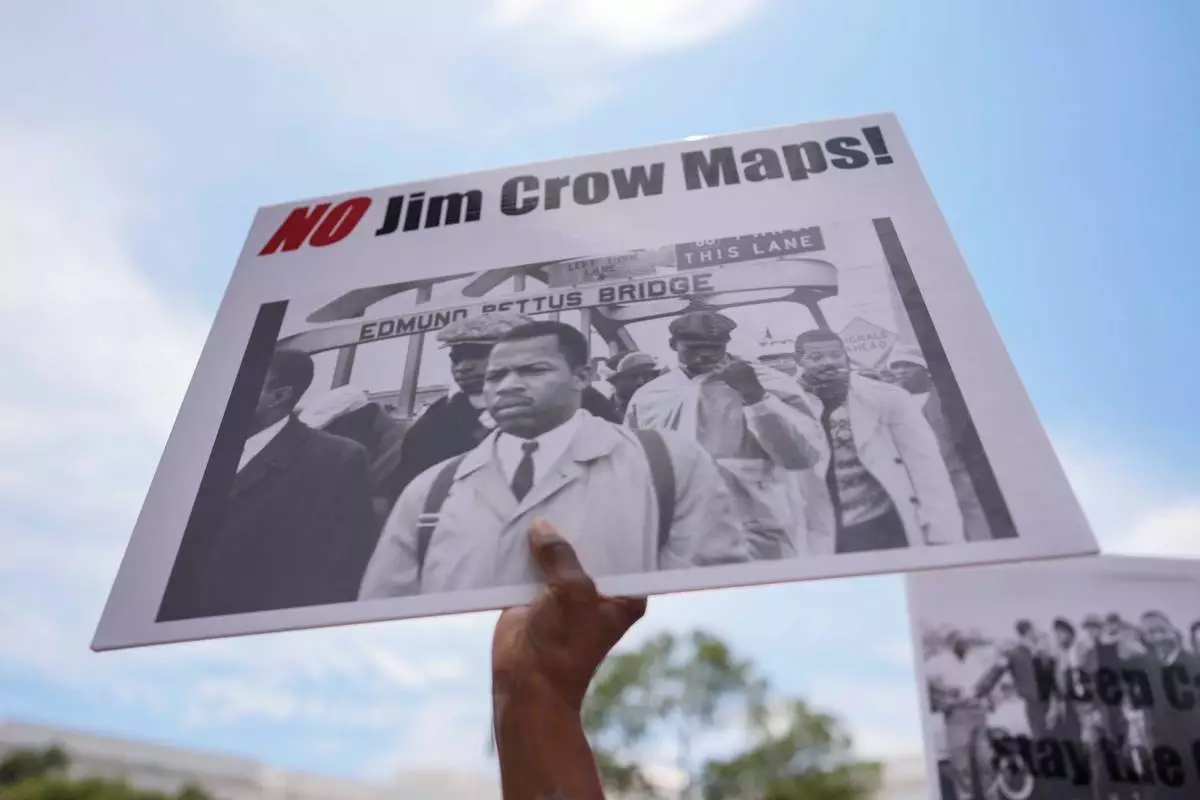
A protestor holds a sign of the late Georgia Congressman John Lewis during a voting rally, Saturday, May 16, 2026, in Montgomery, Ala. (AP Photo/Mike Stewart)

A man sings a spirtual song during a voting rally, Saturday, May 16, 2026, in Montgomery, Ala. (AP Photo/Mike Stewart)
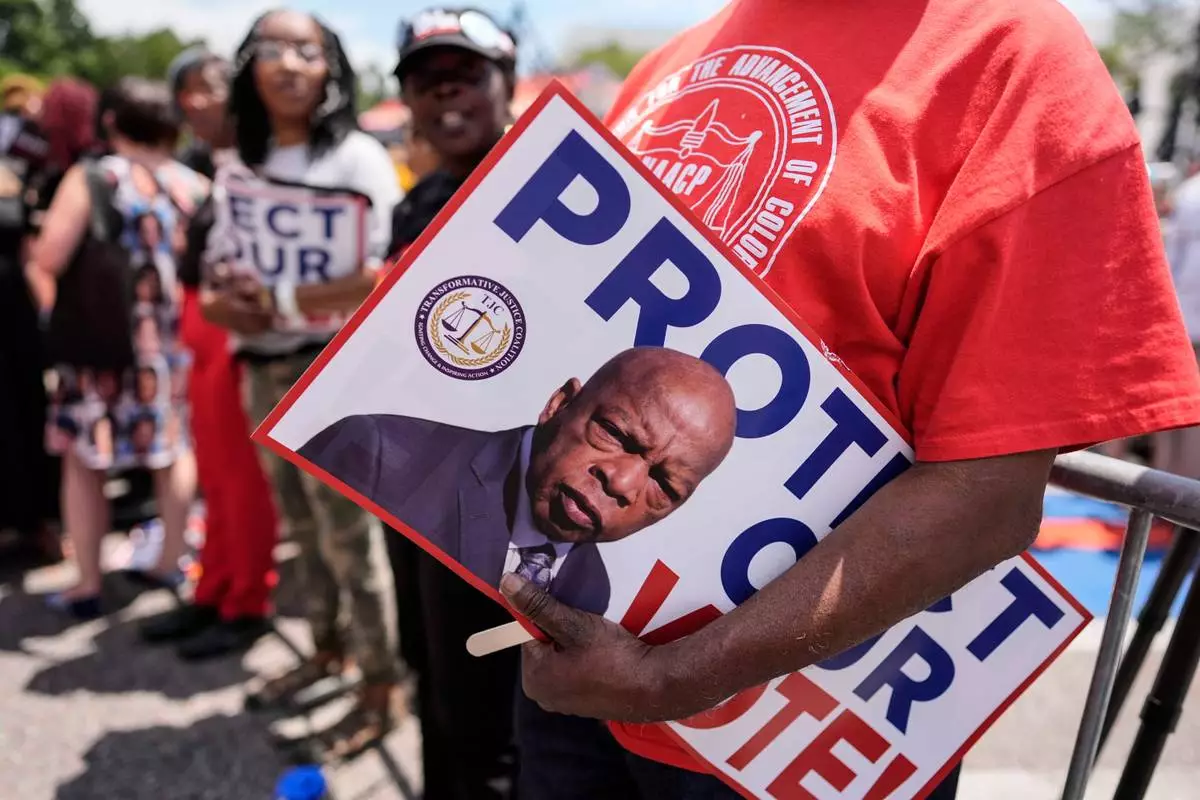
A protestor holds a sign of the late Georgia Congressman John Lewis during a voting rally, Saturday, May 16, 2026, in Montgomery, Ala. (AP Photo/Mike Stewart)

U.S. Sen Corey Booker, D-NY., has his photo taken during a voting rally, Saturday, May 16, 2026, in Montgomery, Ala. (AP Photo/Mike Stewart)

People gather during a voting rally, Saturday, May 16, 2026, in Montgomery, Ala. (AP Photo/Mike Stewart)
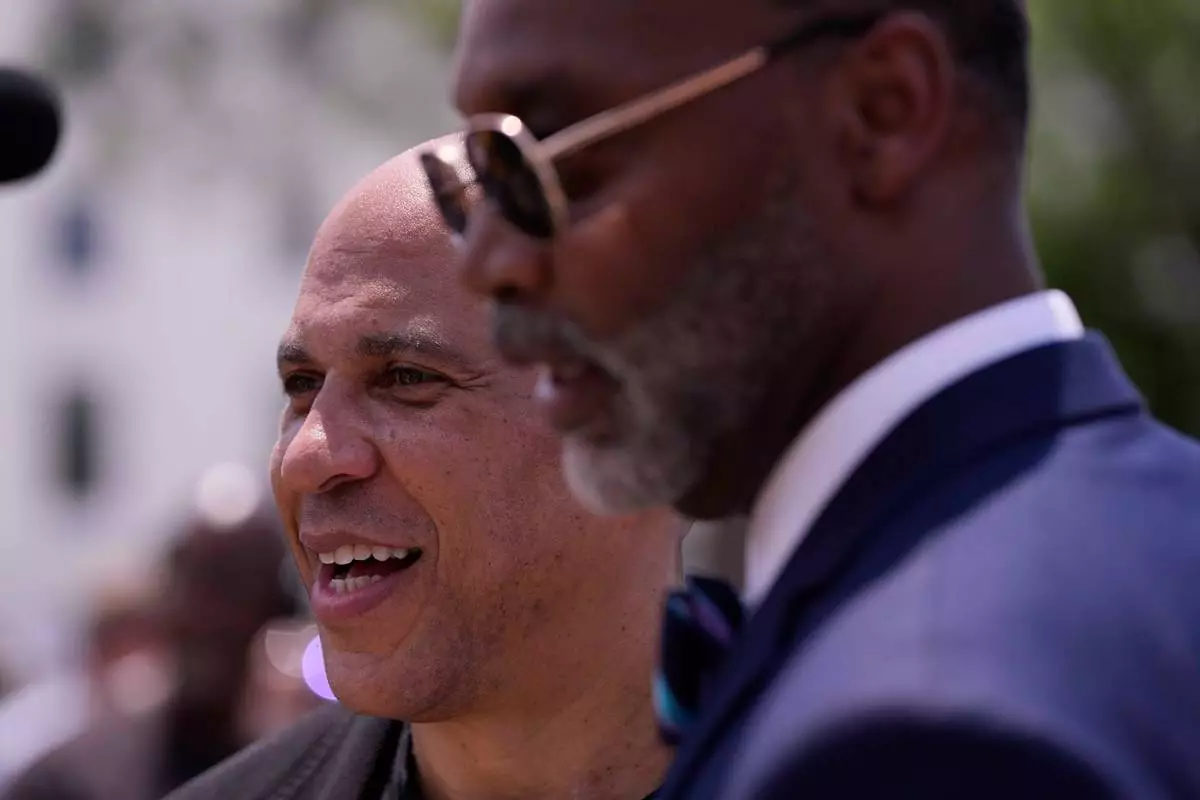
U.S. Sen Corey Booker, D-NY., has his photo taken during a voting rally, Saturday, May 16, 2026, in Montgomery, Ala. (AP Photo/Mike Stewart)
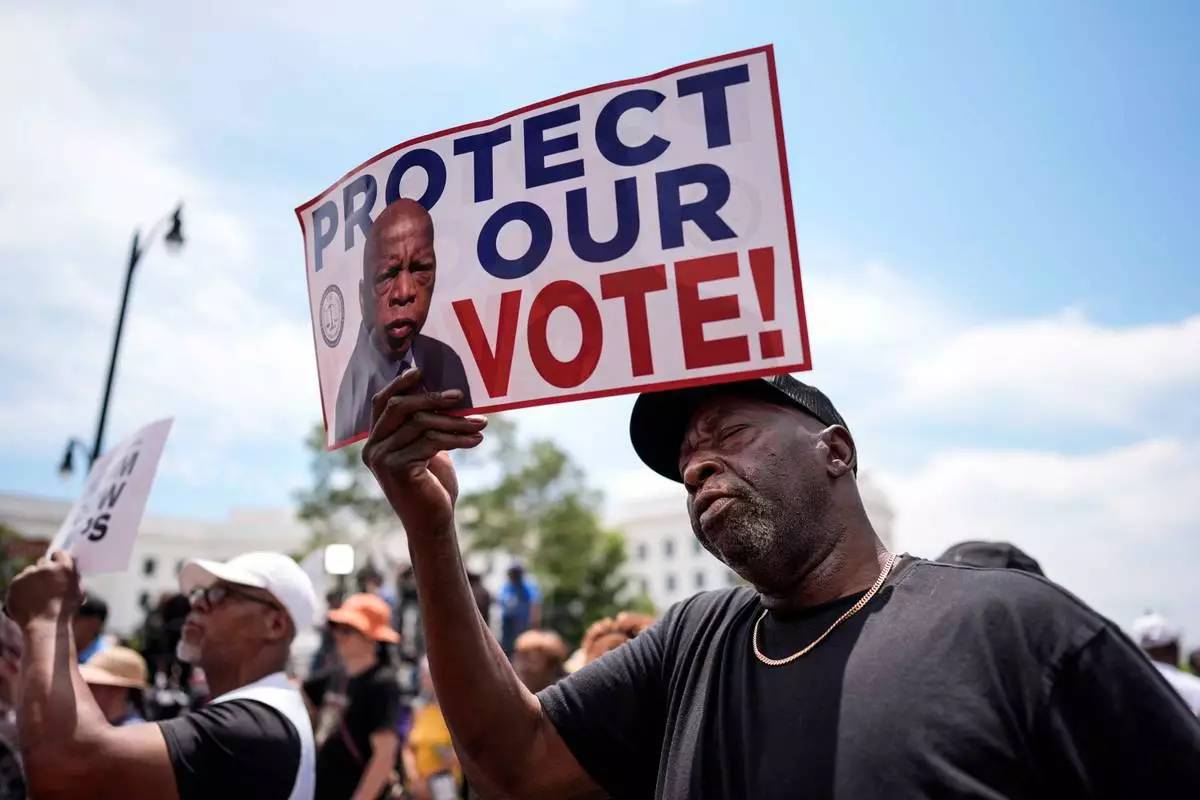
Aaron McGuire sings a spirtual song during a voting rally, Saturday, May 16, 2026, in Montgomery, Ala. (AP Photo/Mike Stewart)