As the 15th Five-Year Plan period begins next year, the world can expect China to continue its path of high-quality development, benefiting not only itself, but also the world, according to a China Media Group (CMG) commentary published on Friday.
An edited English-language version of the commentary is as follows:
China's latest five-year plan has drawn international attention, with observers calling each national plan "a beat marking the rhythm of the country's progress" and noting that the new roadmap will not only guide China's domestic development, but also provide direction for international cooperation. As some analysts have put it, "the strategic thinking and top-level planning of the Chinese ruling party is rarely seen elsewhere."
From October 20 to 23, the Fourth Plenary Session of the 20th Central Committee of the CPC was held in Beijing. The meeting deliberated and adopted the Recommendations of the CPC Central Committee for Formulating the 15th Five-Year Plan for National Economic and Social Development, setting out the guiding principles and main goals for China's development from 2026 to 2030 - a crucial period in China's long-term modernization strategy.
In China, the scientific formulation and consistent implementation of five-year plans stand as an important piece of experience in the Communist Party of China's (CPC) approach to governing the country. It also represents the political advantage of socialism with Chinese characteristics. Since 1953, China has implemented 14 five-year plans, fostering rapid economic development and long-term social stability.
The outgoing 14th Five-Year Plan is nearing completion, with China's GDP expected to reach around 140 trillion yuan (about 19.7 trillion U.S. dollars) in 2025. Its economic increment is projected to exceed 35 trillion yuan over the period.
Throughout the 2021-2025 period, China contributed approximately 30 percent annually to global economic growth, making it a key driver of world economic development and fully demonstrating the resilience and vitality of a major economy.
The fourth plenary session underscored that the 15th Five-Year Plan period will serve as a key time to lay a solid foundation for basically achieving socialist modernization by 2035. China is working through three successive five-year plans – the 14th, 15th, and 16th – to realize this long-term goal. As such, the 15th plan serves as a vital "bridge" from current progress to longer-term ambitions, enabling China to gain greater strategic initiative and ensure steady improvement of Chinese modernization.
The meeting has conveyed China's confidence and determination in realizing socialist modernization through continued efforts, reinforcing the world's expectations of China as a pillar of growth and an anchor of stability.
While five-year plans are not unique to China, the country remains the only one in the world to consistently formulate and implement them over the long term.
The most critical factor in deciphering the success of China's governance is the CPC's leadership and its people-centered development philosophy. The document highlights six guiding principles for the 15th Five-Year Plan period, with the first two being "upholding the Party's overall leadership" and "putting people first." As Brazil's Forum magazine observed, China's success hinges on historical patience and policy continuity.
Development remains the master key to solving all problems -- another factor in deciphering the success of China's governance. The 15th Five-Year Plan sets "achieving significant progress in high-quality development" as its top goal. The outside world has noted that "building a modern industrial system and consolidating and strengthening the foundation of the real economy" ranks first among the plan's strategic tasks.
Initial estimates indicate that upgrades to traditional industries could add about 10 trillion yuan in market space over the next five years. Emerging and future-oriented industries are expected to expand on a scale equivalent to recreating the current high-tech sector. Key growth areas include quantum technology, biomanufacturing, hydrogen energy, nuclear fusion, brain-computer interfaces, embodied intelligence, and 6G communications, all of which could inject new momentum into the global economy
Openness and cooperation are other factors in understanding the success of China's governance. The document includes a dedicated section on high-standard opening-up, emphasizing efforts to actively expand institutional opening-up, promote innovative development in trade, broaden two-way investment cooperation, and advance high-quality Belt and Road cooperation.
If in the past China's opening up was about "following the lead," now it aims to "lead the way," bringing more development prospects to the world. Many executives of multinational companies have said that investing in China is not an option, but a necessit
Achieving socialist modernization is a step-by-step historical process. Despite global uncertainty, China remains committed to a consistent blueprint and steady, sustained efforts. As the 15th Five-Year Plan period begins, the world can expect China to continue its path of high-quality development, benefiting not only itself but also the world at large.
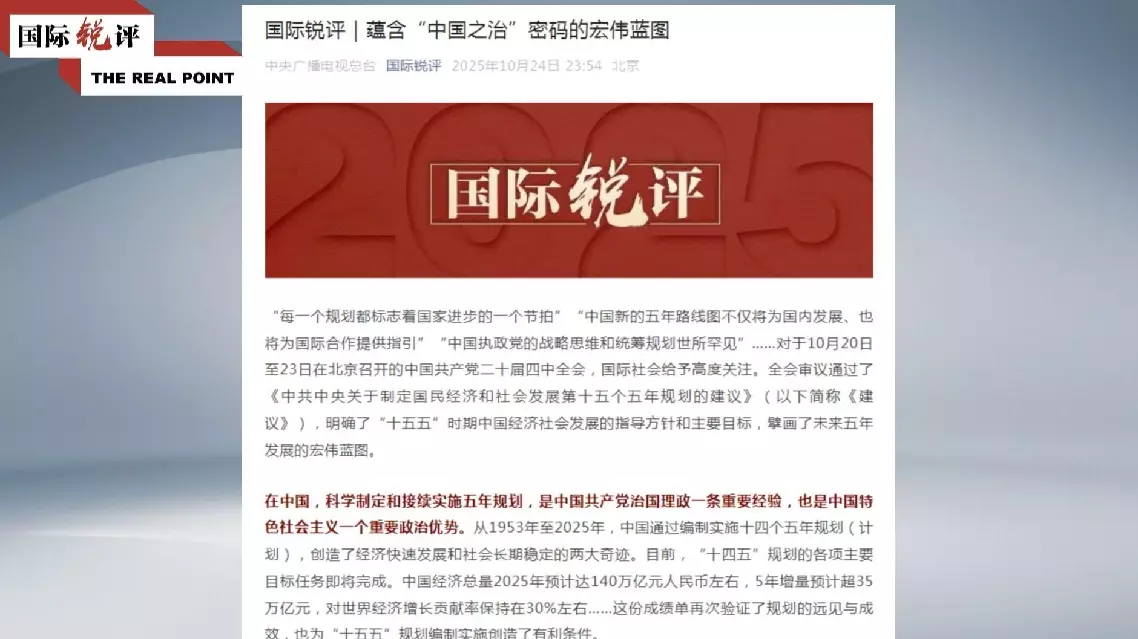
New blueprint charts China's development goals: commentary
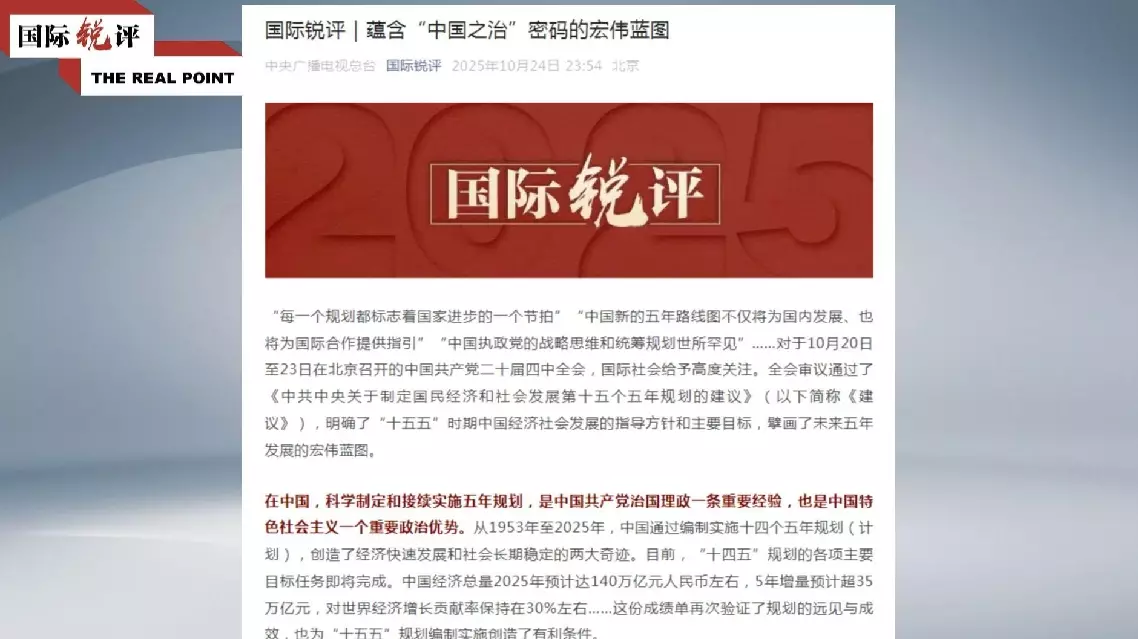
New blueprint charts China's development goals: commentary