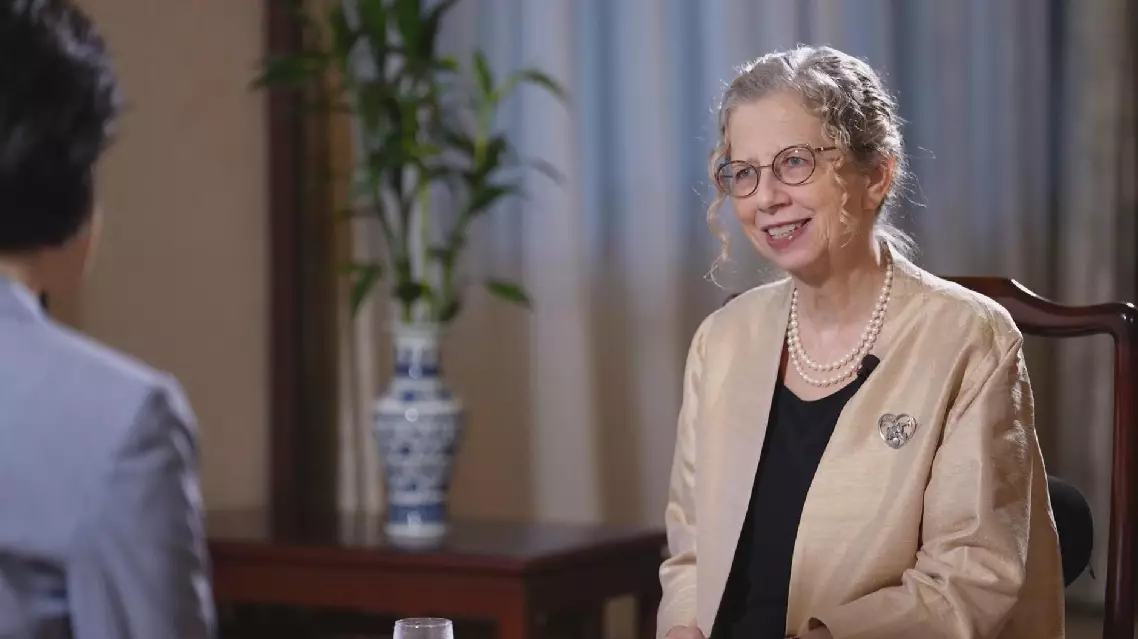
The concept of "lucid waters and lush mountains are invaluable assets" has not only brought economic and social benefits to China but also is enlightening countries around the world as they try to learn and implement it, said Inger Andersen, executive director of the United Nations Environment Program (UNEP) in Beijing.
The concept was first put forward by President Xi Jinping, then secretary of the Communist Party of China (CPC) Zhejiang Provincial Committee, during his visit to Yucun Village in Anji County in east China on Aug 15, 2005.
Since then, it has opened a new chapter in China's ecological conservation and green development.
China is now among the fastest countries in the world at reducing energy intensity. It has become the largest exporter and investor in clean energy, signing project agreements with 42 countries to tackle climate change globally.
In an exclusive interview with China Central Television (CCTV) aired on Friday, Andersen said she has witnessed how this concept benefits the environment, economy, and people's livelihoods across China.
"We are now seeing that the two mountains theory and the two mountains framework is implemented across this country precisely so that people in communities can see the benefits that they are gaining from a healthier agriculture, more productive agriculture from cleaner streams, cleaner air and of course from smarter, more sophisticated can I say industrial production that is cleaner, smarter, more mechanized, etc. It's a journey that all countries have gone through and are going through and still have to go through depending on where we are in the development spectrum," she said.
"ut the Chinese methods are reaching into the future, painting a picture quite evocatively that then describes for our people - this is where we are heading. It's quite powerful and I think that is what we are seeing. And in this country, we are seeing cleaner air and we are seeing more lucid water and we are seeing more green mountains. And all of that is meaningful, and it is, as I said, a gift to the current population, but also to the generations to come," said Andersen.
She said the concept is also positively affecting the rest of the world.
"Maybe the world beyond China would relate to this sustainable development goals, in a sense, right? Many countries have sort of absorbed this learning and are really looking at what it would look like to tackle some of these polluting sectors or indeed to think about conservation as a way to get wealth, as a way to get more vibrant agriculture or as a way for eco-tourism. So, I think that at the global level, yes, also there is a solid understanding of this theory. They may use different language and different words, and not necessarily the poetry of China and our President Xi Jinping, but nevertheless, I think that the concepts are well understood," said Andersen.
UN environment official lauds China's environmental conservation concept