The Republican governor of Indiana said Monday he’s scheduling a special session to redraw congressional boundaries after weeks of pressure to back President Donald Trump’s bid to add more winnable seats with midcycle redistricting.
Trump has pressed Republicans to draw new maps that give the party an easier path to maintain control of the House in the midterms. But Democrats have pushed back in some states, including Virginia, where a special session Monday marked a first step toward redistricting.
While Republicans in Texas, Missouri and North Carolina already have enacted new congressional districts, Indiana lawmakers have been hesitant. Indiana Gov. Mike Braun called for the General Assembly to convene Nov. 3 for the special session. It’s unclear whether enough of the GOP-majority Senate will back new maps.
Democrats only need to gain three seats to flip control of the U.S. House. Trump hopes redistricting can help avert historical trends, in which the president's party typically loses seats in midterm elections.
Vice President JD Vance and Trump have met separately with Indiana Republicans, including Senate President Pro Tem Rodric Bray, in recent months. Braun is a staunch Trump ally in a state the president won by 19 percentage points in 2024, but said previously he did not want to call a special session until he was certain lawmakers would back a new map.
Indiana Republicans hold a supermajority in both chambers.
“I am calling a special legislative session to protect Hoosiers from efforts in other states that seek to diminish their voice in Washington and ensure their representation in Congress is fair,” Braun said in a statement Monday.
Typically, states redraw boundaries of congressional districts every 10 years after the census has concluded. Opponents are expected to challenge any new maps in court.
When Indiana Republicans adopted the existing boundaries four years ago, Bray said they would “serve Hoosiers well for the next decade.”
A Bray spokesperson said last week that the Indiana Senate lacked the votes to pass a new congressional map, and on Monday said votes are still lacking, casting doubt on whether a special session can achieve Braun's goals.
With just 10 Democrats in the 50-member Senate, that means more than a dozen of the 40 Republicans oppose the idea. Some Republican state lawmakers have warned that midcycle redistricting can be costly and could backfire politically.
Republicans who vote against redistricting could be forced out of office if their colleagues back primary opponents as punishment.
Republicans outnumber Democrats in Indiana’s congressional delegation 7-2, limiting possibilities of squeezing out another seat. However, many in the GOP see redistricting as a chance for the party to represent all nine seats.
The GOP would likely target Indiana’s 1st Congressional District, a longtime Democratic stronghold encompassing Gary and other cities near Chicago in the state’s northwest corner.
“I believe that representation should be earned through ideas and service, not political manipulation,” third-term Democratic U.S. Rep. Frank Mrvan, who holds the seat, said in a statement Monday.
Republicans could also zero in on Indiana’s 7th Congressional District, comprised of Marion County and the Democratic stronghold of Indianapolis. But that option would be more controversial, potentially slicing up the state’s largest city and diluting Black voters’ influence.
Changing Virginia's congressional districts requires more steps than in Indiana. The state is currently represented by six Democrats and five Republicans who ran in districts established by a court in 2021 after a bipartisan commission failed to agree on a map.
Because Virginia’s redistricting commission was created by a voter-approved constitutional amendment, voters must sign off on any changes to the redistricting process. A proposed constitutional amendment would have to pass the General Assembly in two separate sessions and then be placed on the statewide ballot. Democrats are scrambling to hold that first legislative vote this year, so that they can take a second vote after a new legislative session begins Jan. 14.
On Monday, the House amended its agenda to allow a redistricting amendment to be put forward, with details to come later.
Democratic state Sen. Schuyler VanValkenburg said he still supports the concept of a bipartisan redistricting commission, "but I’m also not going to let Donald Trump go around to states that have the majorities that he likes and try to make it so that he can’t lose.”
Democrats also are hoping for gains in California. Voters there are deciding Nov. 4 whether to scrap districts drawn by an independent citizens commission in favor of ones drafted by the Democratic-led Legislature that could help Democrats win up to five additional seats in next year's election. Democrats already hold 43 of the 52 seats.
U.S. House Minority Leader Hakeem Jeffries was in Illinois Monday to meet with Democratic state lawmakers about the possibility of redrawing the state's congressional districts to favor Democrats even more heavily. Democrats already hold 14 of the 17 seats.
The Democratic-led Illinois General Assembly was scheduled to be in session this week.
In Kansas, meanwhile, Republicans moved a step closer to calling themselves into a special session on redistricting through a legislative petition. Senate President Ty Masterson said Monday he has the necessary two-thirds in the Senate, but House Republicans have at least a few holdouts. The petition drive is necessary because Democratic Gov. Laura Kelly isn’t likely to call a session to redraw the current map that has sent three Republicans and one Democrat to the House.
__
Volmert reported from Lansing, Michigan. Associated Press writers Joe Cappelletti in Washington; Olivia Diaz in Richmond, Virginia; John Hanna in Topeka, Kansas; David A. Lieb in Jefferson City, Missouri; and John O'Connor in Springfield, Illinois, contributed to this report.

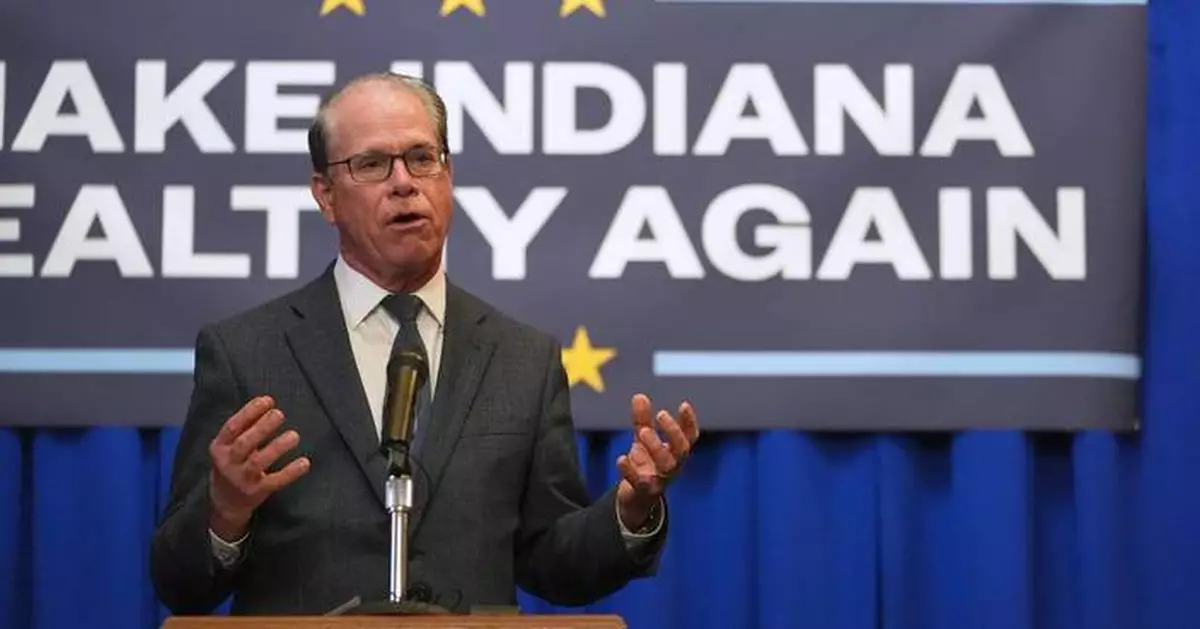
FILE - Indiana Gov. Mike Braun speaks during a Make Indiana Healthy Again initiative event in Indianapolis, April 15, 2025. (AP Photo/Michael Conroy, file)