Ghana is expecting to strengthen AI-assisted healthcare collaboration with China to enhance the wellbeing of its people as the two countries keep promoting exchange and cooperation in the medical field.
The AI-assisted healthcare cooperation was built on the two countries' years of healthcare exchanges and communication, during which batches of Chinese medical workers had been sent to the African country to help enhance its independent medical capability.
"Our main goal is to help Ghanaian medical workers make progress through years of cooperation with us by introducing new ideas, providing technical guidance, and offering regular training. Our mission is to build a medical team that continues to serve even after we leave," said Yang Yongguang, leader of the 14th Chinese Medical Team to Ghana.
Yang's team successfully carried out surgeries to save two Ghanaian orphans from umbilical hernia at the China-Ghana Friendship Hospital, popularly known as Lekma Hospital, in Accra.
The milestone achievement stood as an exceptional example of the increasing medical cooperation between the two countries, which a top Ghanaian health official said will be further enhanced by focusing on high-tech fields such as AI.
"We've identified that using technology, you can bridge some of these gaps. And one of the areas of identify (identification) has to do with introducing AI into our health service system for screening, for diagnostics, for treatment, among many other things. And we are looking forward to collaborating with China, with the companies, with the AI companies to see how best together we would advance," said Samuel Kaba Akoriyea, director-general of the Ghana Health Service.
AI has emerged as one of the most important fields of medical cooperation between China and Ghana. In Aug 20, the second edition of the China-West Africa Medical and Health Industry Expo opened in Accra, the Ghanaian capital, to promote the use of AI in medical diagnosis and deepen project cooperation between China and West African countries.
The three-day event, co-organized by the Health Community of West Africa (HCOWA), a Ghana-based Chinese firm, and the Ghana Health Service, brought together government officials, health professionals, regulators, and more than 100 exhibitors from China and West African countries.

Ghana expects to strengthen AI-assisted healthcare collaboration with China
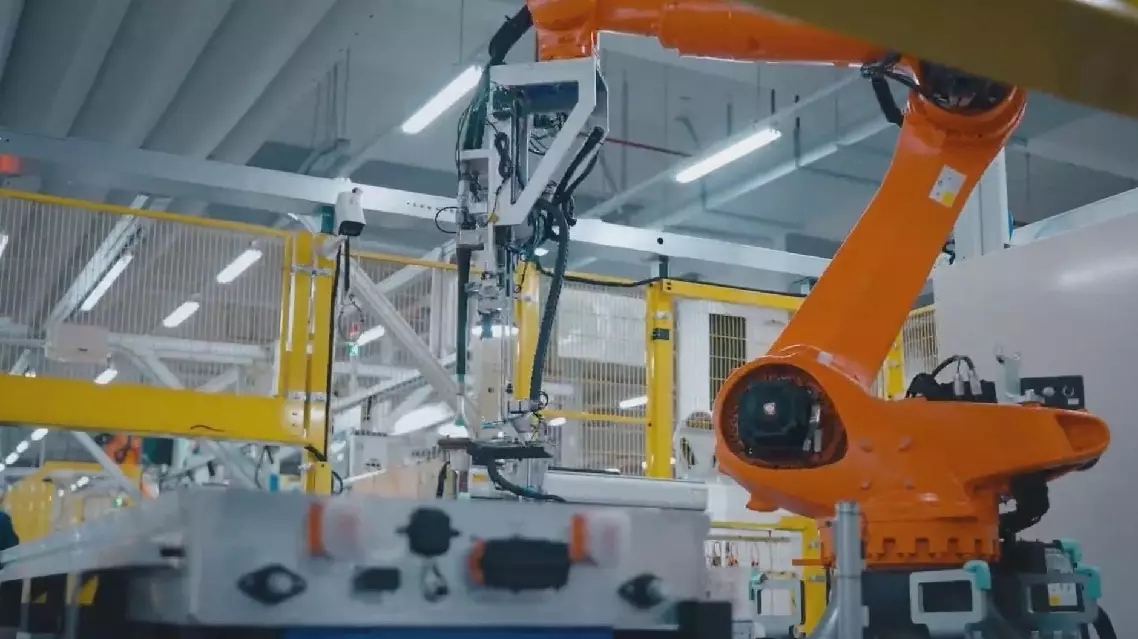
Adopting artificial intelligence (AI) and lightweight technologies are critical for the auto industry to pursue smart and green development, Li Shufu, chairman of China's leading automaker, Geely Holding Group, told China Global Television Network (CGTN), in a recent interview in Hangzhou, the capital of east China's Zhejiang Province.
Li said AI is set to bring a wave of changes across the auto industry and enterprises should embrace the new tech.
"Artificial intelligence marks the start of a new era and the arrival of the new era will have a far-reaching, revolutionary impact on all industries. Its impact on the auto industry is equally revolutionary and will bring fundamental changes. Going forward, automobiles will be manufactured by AI, and the entire upstream and downstream industrial chain will be managed by AI. AI will be applied to automotive research and development, production, supply chain management, marketing channels, talent training, and overall corporate operations. This poses enormous challenges, yet we must embrace it, face up to it, and take part in the AI wave. Technology and AI should be fully integrated with the auto industry," said Li.
He also stressed that AI should not completely replace humans and efforts should be made to achieve a win-win situation.
"I believe there are essential distinctions between humans and machines. AI is ultimately meant to serve humanity, which I think should be pointed out unambiguously. Therefore, we need to constantly review the situations we meet as AI technology evolves and is applied in real-world scenarios, to figure out how to achieve win-win coordination between humans and AI," said Li.
Regarding green transformation, Li said making lightweight vehicles is critical for auto industry to reduce carbon emissions and energy consumption.
"Geely has been making relevant efforts for more than two decades, with a large team dedicated to research. We have no intention of fully committing to large-scale production of lithium-battery electric vehicles, because such vehicles are excessively heavy. Lightweight technology is critical to the development of the auto industry. The heavier a vehicle is, the more energy it consumes. Therefore, energy conservation and emission reduction are directly related to the weight of vehicle," said Li.
Li also said enhancing inefficient production capacity is essential for major companies like Geely.
"Every enterprise has its own unique situation. As for Geely, which has already reached a considerable scale, it can no longer blindly pursue expansion. Therefore, our current focus is basically on resource integration and optimal allocation. We are committed to revitalizing inefficient production capacity through integration and coordination to unleash new vitality and momentum. We are also exploring ways for strengthening cooperation and coordination to pursue common development. This is exactly what we are doing now, and the results have been good. This is precisely what China's 15th Five-Year Plan anticipates and demands. We will push ahead with solid implementation to translate the plan into tangible results," said Li.
Head of China's leading automaker says AI, lightweight tech key to industry development