NEW YORK (AP) — It’s a tough time for the job market.
Amid wider economic uncertainty, some analysts have said that businesses are at a “no-hire, no fire” standstill. That's caused many to limit new work to only a few specific roles, if not pause openings entirely. At the same time, some sizeable layoffs have continued to pile up — raising worker anxieties across sectors.
Some companies have pointed to rising operational costs spanning from President Donald Trump's barrage of new tariffs and shifts in consumer spending. Others cite corporate restructuring more broadly — or, as seen with big names like Amazon, are redirecting money to artificial intelligence.
Federal employees have encountered additional doses of uncertainty, impacting worker sentiment around the job market overall. Shortly after Trump returned to office at the start of the year, federal jobs were cut by the thousands. And many workers are now going without pay as the U.S. government shutdown nears its fourth week.
“A lot of people are looking around, scanning the job environment, scanning the opportunities that are available to them — whether it’s in the public or private sector," said Jason Schloetzer, professor business administration at Georgetown University’s McDonough School. “And I think there’s a question mark around the long-term stability everywhere.”
Government hiring data is on hold during the shutdown, but earlier this month a survey by payroll company ADP showed that the private sector lost 32,000 jobs in September.
Here are some companies that have moved to cut jobs recently.
General Motors moved to lay off about 1,700 workers across manufacturing sites in Michigan and Ohio on Wednesday, as the auto giant adjusts to slowing demand for electric vehicles.
Hundreds of additional employees are reportedly slated for “temporary layoffs." And GM has recently moved to downsize other parts of its workforce, too — including 200 layoffs mostly impacting engineers in Detroit, and other 300 job cuts at a Georgia IT Innovation Center, which it is also shuttering.
In long-awaited cuts just months after completing its $8 billion merger with Skydance, Paramount is going to lay off about 2,000 employees — about 10% of its workforce.
Paramount initiated roughly 1,000 of those layoffs on Wednesday, according to a source familiar with the matter, who spoke on the condition of anonymity. The rest of the cuts will be made at a later date.
Amazon said Tuesday that it will cut about 14,000 corporate jobs, close to 4% of its workforce, as the online retail giant ramps up spending on AI while trimming costs elsewhere. A letter to employees said most workers would be given 90 days to look for a new position internally.
CEO Andy Jassy previously said he anticipated generative AI would reduce Amazon’s corporate workforce in the coming years. And he has worked to aggressively cut costs overall since 2021.
United Parcel Service has disclosed about 48,000 job cuts this year as part of turnaround efforts, which arrive amid wider shifts in the company's shipping outputs.
In a Tuesday regulatory filing, UPS said it's cut about 34,000 operational positions — and the company announced another 14,000 role reductions, mostly within management. Combined, that's much higher than the roughly 20,000 cuts UPS forecast earlier this year.
Last week, Target that it would eliminate about 1,800 corporate positions, or about 8% of its corporate workforce globally.
Target said the cuts were part of wider streamlining efforts — with Chief Operating Officer Michael Fiddelke noting that “too many layers and overlapping work have slowed decisions.” The retailer is also looking to rebuild its customer base. Target reported flat or declining comparable sales in nine of the past eleven quarters.
In mid-October, Nestlé said it would be cutting 16,000 jobs globally — as part of wider cost cutting aimed at reviving its financial performance.
The Swiss food giant said the layoffs would take place over the next two years. The cuts arrive as Nestlé and others face headwinds like rising commodity costs and U.S. imposed tariffs. The company announced price hikes over the summer to offset higher coffee and cocoa costs.
In September, Lufthansa Group said it would shed 4,000 jobs by 2030 — pointing to the adoption of artificial intelligence, digitalization and consolidating work among member airlines.
Most of the lost jobs would be in Germany, and the focus would be on administrative rather than operational roles, the company said. The layoff plans arrived even as the company reported strong demand for air travel and predicted stronger profits in years ahead.
Also in September, Danish pharmaceutical company Novo Nordisk said it would cut 9,000 jobs, about 11% of its workforce.
Novo Nordisk — which makes drugs like Ozempic and Wegovy — said the layoffs were part of wider restructuring as the company works to sell more obesity and diabetes medications amid rising competition.
Oil giant ConocoPhillips has said it plans to lay off up to a quarter of its workforce, as part of broader efforts from the company to cut costs.
A spokesperson for ConocoPhillips confirmed the layoffs on Sept. 3, noting that 20% to 25% of the company’s employees and contractors would be impacted worldwide. At the time, ConocoPhillips had a total headcount of about 13,000 — or between 2,600 and 3,250 workers. Most reductions were expected to take place before the end of 2025.
Intel has moved to shed thousands of jobs — with the struggling chipmaker working to revive its business as it lags behind rivals like Nvidia and Advanced Micro Devices.
In a July memo to employees, CEO Lip-Bu Tan said Intel expected to end the year with 75,000 “core” workers, excluding subsidiaries, through layoffs and attrition. That’s down from 99,500 core employees reported the end of last year. The company previously announced a 15% workforce reduction.
In May, Microsoft began began laying off about 6,000 workers across its workforce. And just months later, the tech giant said it would be cutting 9,000 positions — marking its biggest round of layoffs seen in more than two years.
The latest job cuts hit Microsoft’s Xbox video game business and other divisions. The company has cited “organizational changes,” with many executives characterizing the layoffs as part of a push to trim management layers. But the labor reductions also arrive as the company spends heavily on AI.
In June, Procter & Gamble said it would cut up to 7,000 jobs over the next two years, 6% of the company’s global workforce.
The maker of Tide detergent and Pampers diapers said the cuts were part of a wider restructuring — also arriving amid tariff pressures. In July, P&G said it would hike prices on about a quarter of its products due to the newly-imposed import taxes, although it's since said it expects to take less of a hit than previously anticipated for the 2026 fiscal year.

This undated combination of photos shows clockwise from top left the company logos for Amazon, Target, Lufthansa Group, UPS, ConocoPhillips, Intel, Microsoft, Procter & Gamble and Nestle. (AP Photo, file)
NUUK, Greenland (AP) — Troops from several European countries continued to arrive in Greenland on Thursday in a show of support for Denmark as talks between representatives of Denmark, Greenland and the U.S. highlighted “fundamental disagreement” over the future of the Arctic island.
Denmark announced it would increase its military presence in Greenland on Wednesday as foreign ministers from Denmark and Greenland were preparing to meet with White House representatives in Washington. Several European partners — including France, Germany, the U.K., Norway and Sweden — started sending symbolic numbers of troops already on Wednesday or promised to do so in the following days.
The troop movements were intended to portray unity among Europeans and send a signal to President Donald Trump that an American takeover of Greenland is not necessary as NATO together can safeguard the security of the Arctic region amid rising Russian and Chinese interest.
“The first French military elements are already en route” and “others will follow,” French President Emmanuel Macron announced Wednesday, as French authorities said about 15 soldiers from the mountain infantry unit were already in Nuuk for a military exercise.
Germany will deploy a reconnaissance team of 13 personnel to Greenland on Thursday, the Defense Ministry said.
On Thursday, Danish Defense Minister Troels Lund Poulsen said the intention was “to establish a more permanent military presence with a larger Danish contribution,” according to Danish broadcaster DR. He said soldiers from several NATO countries will be in Greenland on a rotation system.
Danish Foreign Minister Lars Løkke Rasmussen, flanked by his Greenlandic counterpart Vivian Motzfeldt, said Wednesday that a “fundamental disagreement” over Greenland remains with Trump after they held highly anticipated talks at the White House with Vice President JD Vance and Secretary of State Marco Rubio.
Rasmussen added that it remains “clear that the president has this wish of conquering over Greenland” but that dialogue with the U.S. would continue at a high level over the following weeks.
Inhabitants of Greenland and Denmark reacted with anxiety but also some relief that negotiations with the U.S. would go on and European support was becoming visible.
Greenland's Prime Minister Jens-Frederik Nielsen welcomed the continuation of “dialogue and diplomacy.”
“Greenland is not for sale,” he said Thursday. “Greenland does not want to be owned by the United States. Greenland does not want to be governed from the United States. Greenland does not want to be part of the United States.”
In Greenland’s capital, Nuuk, local residents told The Associated Press they were glad the first meeting between Greenlandic, Danish and American officials had taken place but suggested it left more questions than answers.
Several people said they viewed Denmark’s decision to send more troops, and promises of support from other NATO allies, as protection against possible U.S. military action. But European military officials have not suggested the goal is to deter a U.S. move against the island.
Maya Martinsen, 21, said it was “comforting to know that the Nordic countries are sending reinforcements” because Greenland is a part of Denmark and NATO.
The dispute, she said, is not about “national security” but rather about “the oils and minerals that we have that are untouched.”
On Wednesday, Poulsen announced a stepped-up military presence in the Arctic “in close cooperation with our allies,” calling it a necessity in a security environment in which “no one can predict what will happen tomorrow.”
“This means that from today and in the coming time there will be an increased military presence in and around Greenland of aircraft, ships and soldiers, including from other NATO allies,” Poulsen said.
Asked whether the European troop movements were coordinated with NATO or what role the U.S.-led military alliance might play in the exercises, NATO referred all questions to the Danish authorities. However, NATO is currently studying ways to bolster security in the Arctic.
The Russian embassy in Brussels on Thursday lambasted what it called the West's “bellicose plans” in response to “phantom threats that they generate themselves”. It said the planned military actions were part of an “anti-Russian and anti-Chinese agenda” by NATO.
“Russia has consistently maintained that the Arctic should remain a territory of peace, dialogue and equal cooperation," the embassy said.
Rasmussen announced the creation of a working group with the Americans to discuss ways to work through differences.
“The group, in our view, should focus on how to address the American security concerns, while at the same time respecting the red lines of the Kingdom of Denmark,” he said.
Commenting on the outcome of the Washington meeting on Thursday, Poulsen said the working group was “better than no working group” and “a step in the right direction.” He added nevertheless that the dialogue with the U.S. did not mean “the danger has passed.”
“We are really happy that action is being taken to make sure that this discussion is not just ended with that meeting alone,” Greenlandic MP Aki-Matilda Høegh-Dam said on Thursday during a news conference in Copenhagen.
She said Greenlandic people understood they were a “pivotal point” in a broader transformation of the international rules-based order and that they felt responsible not just for themselves but also for the whole world to get it right.
Høegh-Dam said the military operations should not happen “right next to our schools and right next to our kindergartens.”
Line McGee, 38, from Copenhagen, told AP that she was glad to see some diplomatic progress. “I don’t think the threat has gone away,” she said. “But I feel slightly better than I did yesterday.”
Trump, in his Oval Office meeting with reporters, said: “We’ll see how it all works out. I think something will work out.”
Niemann reported from Copenhagen, Denmark, and Ciobanu from Warsaw, Poland.
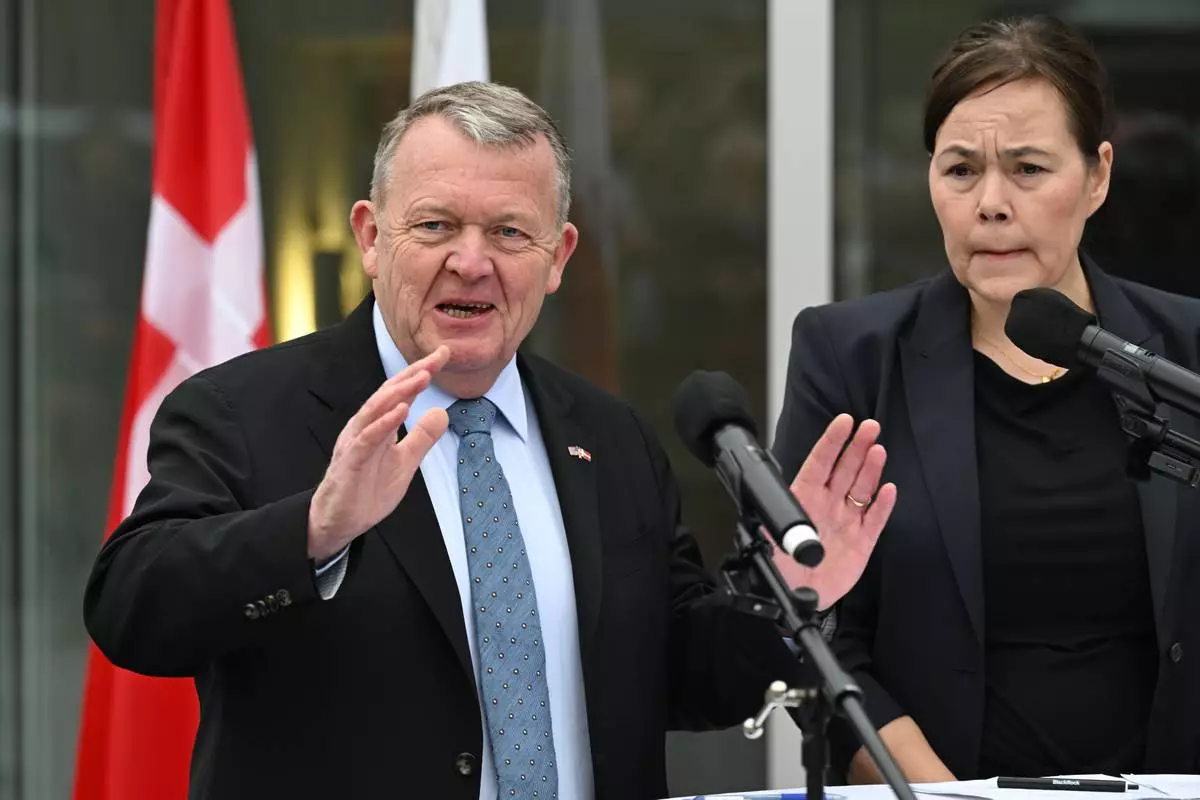
Denmark's Foreign Minister Lars Løkke Rasmussen and Greenland's Foreign Minister Vivian Motzfeldt speak at a news conference at the Embassy of Denmark, Wednesday, Jan. 14, 2026, in Washington. (AP Photo/John McDonnell)
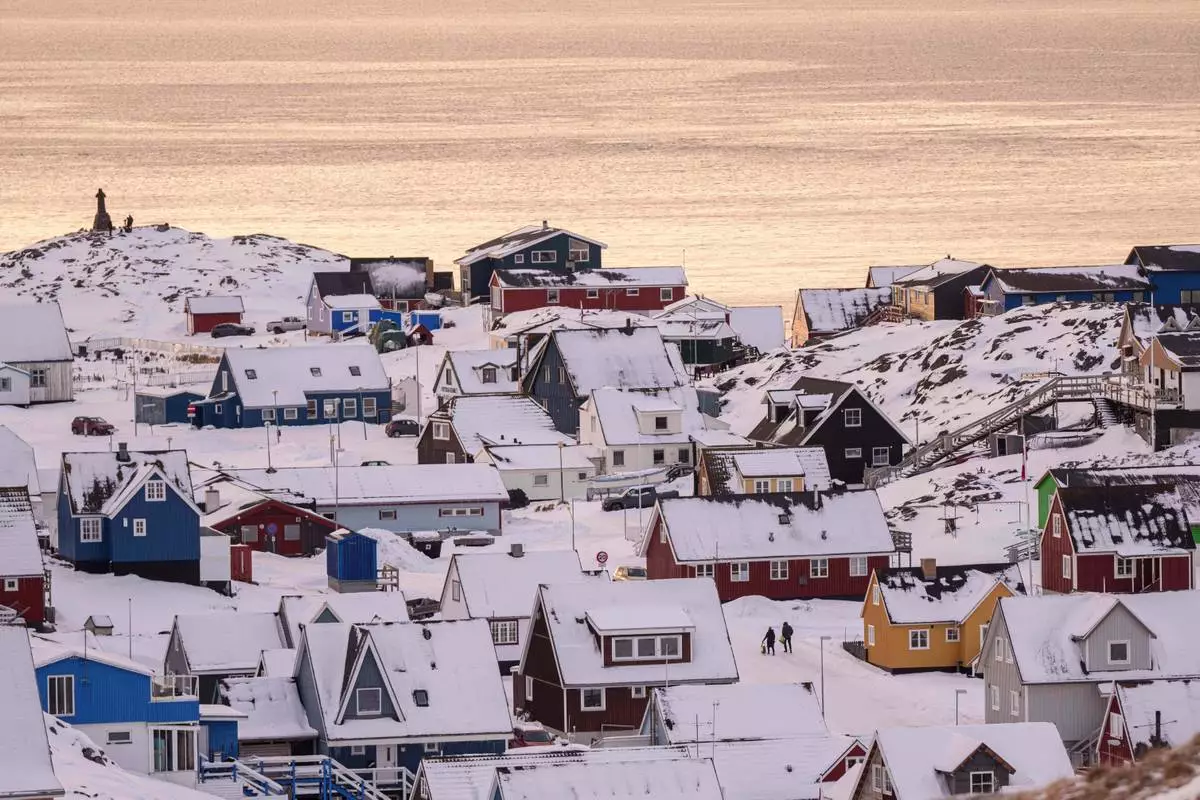
People walk on a street in Nuuk, Greenland, Wednesday, Jan. 14, 2026. (AP Photo/Evgeniy Maloletka)

From center to right, Greenland Foreign Minister Vivian Motzfeldt, Denmark's Ambassador Jesper Møller Sørensen, rear, and Danish Foreign Minister Lars Løkke Rasmussen, right, arrive on Capitol Hill to meet with senators from the Arctic Caucus, in Washington, Wednesday, Jan. 14, 2026. (AP Photo/J. Scott Applewhite)

An Airbus A400M transport aircraft of the German Air Force taxis over the grounds at Wunstorf Air Base in the Hanover region, Germany, Thursday, Jan. 15, 2026 as troops from NATO countries, including France and Germany, are arriving in Greenland to boost security. (Moritz Frankenberg/dpa via AP)
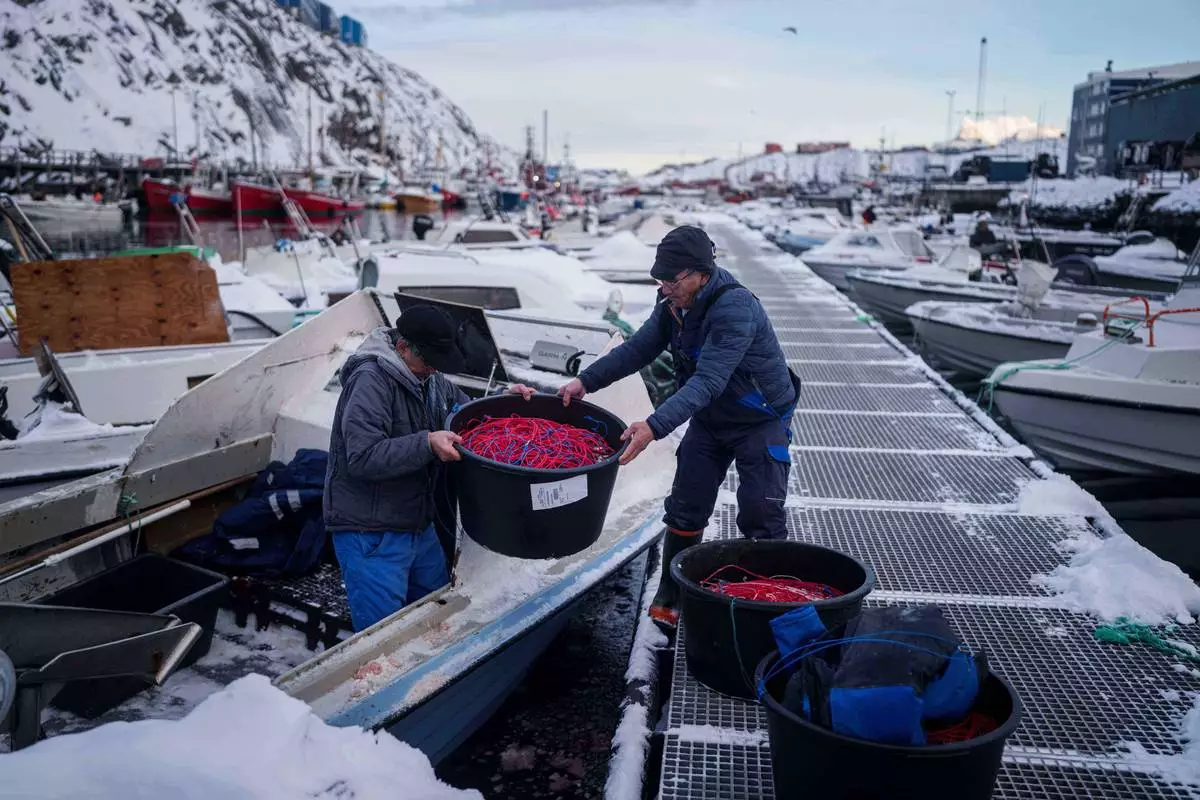
Fishermen load fishing lines into a boat in the harbor of Nuuk, Greenland, Wednesday, Jan. 14, 2026. (AP Photo/Evgeniy Maloletka)

Greenland Foreign Minister Vivian Motzfeldt, left, and Danish Foreign Minister Lars Løkke Rasmussen, arrive on Capitol Hill to meet with members of the Senate Arctic Caucus, in Washington, Wednesday, Jan. 14, 2026. (AP Photo/J. Scott Applewhite)