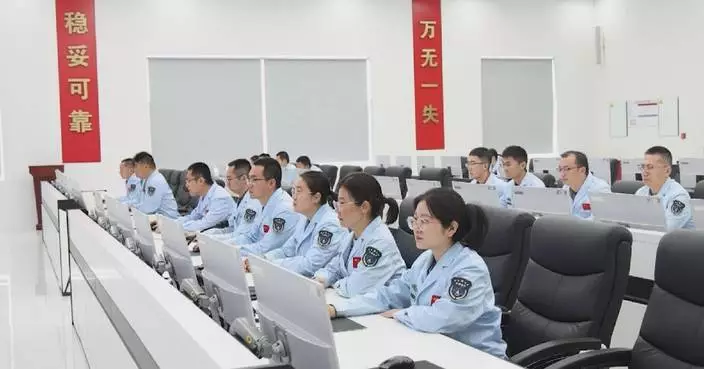
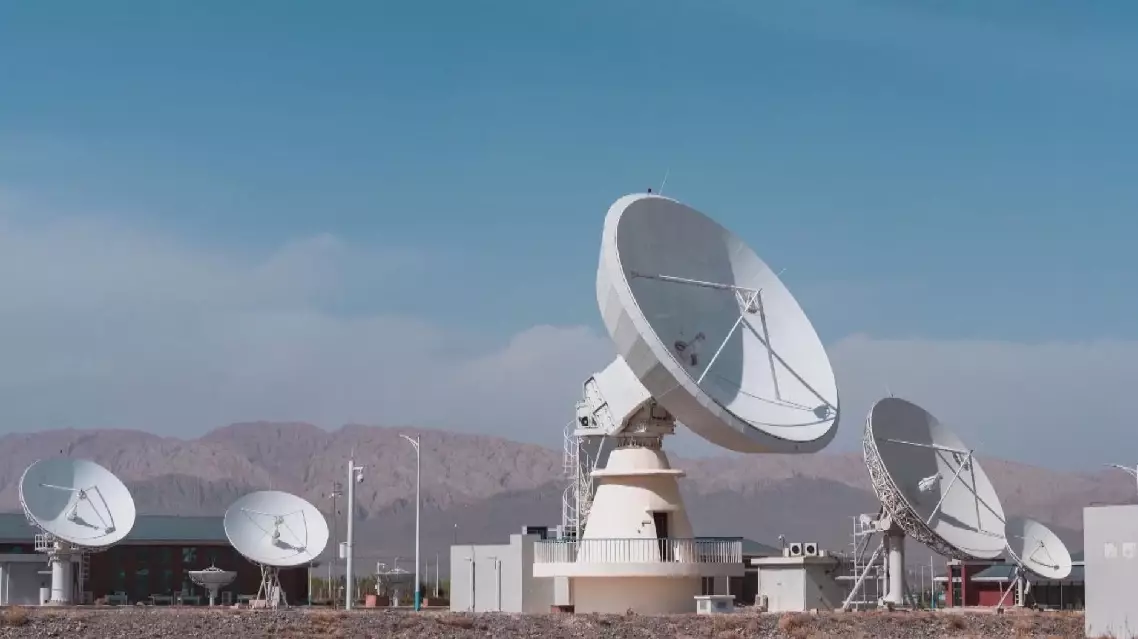
China's land-based tracking telemetry and comm (TT and C and) network is fully prepared for the upcoming Shenzhou-21 crewed mission, set to ensure a smooth liftoff of the manned spaceship and safe trip of astronauts to the space station. As one of the seven major subsystems of China's crewed space program, the TT and C system serves as the only communication link between spacecraft and ground control after the aircraft's liftoff. The TT and C network that is composed of TT and C stations plays a vital role during the rocket's ascent phase thanks to its high reliability, precision, real-time performance, and data rate.
"After the launch, we mainly rely on TT and C stations along the rocket's flight path, including Dongfeng, Weinan, and Qingdao, to provide TT and C support. It's like a relay race, with each station passing the baton to ensure smooth liftoff and orbital insertion. Once the spacecraft enters orbit, TT and C support is primarily provided through the Tianlian relay satellites. Land-based tracking equipment and relay satellites complement each other, forming an integrated space-ground network that ensures the astronauts' safety throughout their journey," said Yan Yuan, an engineer with the Xi'an Satellite Control Center.
Located on the shores of the Yellow Sea, the Qingdao TT and C station will soon support the launch of Shenzhou-21. During the mission, engineers of the station will be responsible for sending remote control commands during the rocket-spacecraft separation phase, receiving telemetry data, and preparing key safety instructions. It will be the final baton in the land-based TT and C relay during the launch process.
"The combination of rocket and aircraft flies almost directly over us. We have to rotate antenna by nearly 180 degrees within just a few seconds as the target passes overhead. Then, in the following dozen seconds, we must quickly reacquire the target and issue critical commands," said Zhao Guohua, an engineer at the Qingdao TT and C station of Xi'an Satellite Control Center.
To this end, engineers have developed and rehearsed over a dozen operational plans. Through repeated drills, they have perfectly resolved the potential issues and risks during launch, ensuring that each crew can reach the space station safely.
"The Qingdao TT and C station was established for China's space program. As we shoulder bigger responsibilities, as our teams expand and the number of equipment grows, we'll continue to refine our TT and C models and innovate new methods to provide solid support for every Shenzhou crewed mission," said Zhao.
Land-based tracking telemetry, command network ready to support Shenzhou-21 mission

Chinese officials attending a recent study session at the National Academy of Governance in Beijing have pledged to make solid efforts for the country's development over the next five years.
Speaking at the opening meeting for the session, Chinese President Xi Jinping called the session attendees, principal officials at the provincial and ministerial levels, to secure a good start for the country's 15th Five-Year (2026-2030) Plan.
Xi said it is necessary to develop a comprehensive, profound and accurate understanding of the strategic arrangements for economic and social development during the 15th Five-Year Plan period, which were made at the fourth plenary session of the 20th Central Committee of the Communist Party of China (CPC).
He stressed that China is currently at a stage where strategic opportunities and risks coexist, with increasing uncertainty and unpredictable factors. He added that building a modern industrial system and achieving an overall industrial structure upgrade are key strategic tasks for the 15th Five-Year Plan period.
"The year 2026 marks the beginning of the 15th Five-Year Plan period. For the first time in a Five-Year Plan, the CPC Central Committee has proposed making China strong in the energy sector, clearly defining the strategic direction and priorities for the country's energy development. Building a country strong in the energy sector means to make the country independent in energy supply so as to provide reliable energy assurance for the country's modernization," said Dai Houliang, chairman of China National Petroleum Corporation.
Yin Hejun, minister of science and technology, said the next five years is a critical phase for building a solid foundation and exerting comprehensive efforts to basically achieve socialist modernization.
"We must focus on the goal of building a strong country in science and technology, take a holistic approach to formulating the 15th Five-Year Plan for science and technology innovation, strengthen strategic, forward-looking, and systematic planning for basic research, promote the deep integration of sci-tech innovation and industrial innovation, and provide solid support for comprehensively advancing Chinese modernization through high-level sci-tech self-reliance and self-improvement," Yin said.
Chen Zhongyue, chairman of China Mobile Communications Group, said it is essential to study and comprehend the spirit of the fourth plenary session of the 20th CPC Central Committee.
"Currently, digital-intelligence technologies are deeply integrated into all sectors of the economy and society, presenting broad opportunities for the information and communications industry. We will deepen scientific and technological innovation, develop new quality productive forces, and contribute more to Chinese modernization with new achievements in building a strong cyber power and a Digital China," he said.
Speaking at the study session, Xi said that improving livelihoods should be prioritized to promote social development. And while advancing economic growth, steady efforts should be made to raise quality of life for the people.
"We will strive to make healthcare security services more accessible to the public, support the development of the medical and health sector, and foster the growth of the pharmaceutical industry. Healthcare security is not only a traditional undertaking in the health domain but also a concrete manifestation of new quality productive forces in health. We are continuously exploring ways to drive emerging industries with new technologies so as to benefit all people," said Zhang Ke, head of the National Healthcare Security Administration.
Chinese officials pledge to make solid efforts to implement 15th Five-Year Plan