Skip to Content Facebook Feature Image

Russian mobsters sentenced to 25 years for foiled plot to assassinate Iranian dissident journalist

News

Russian mobsters sentenced to 25 years for foiled plot to assassinate Iranian dissident journalist
News

News

Russian mobsters sentenced to 25 years for foiled plot to assassinate Iranian dissident journalist

2025-10-30 04:25 Last Updated At:04:30

NEW YORK (AP) — Two purported Russian mobsters were each sentenced to 25 years behind bars Wednesday for hiring a hitman to kill Iranian American journalist Masih Alinejad at her Brooklyn home three years ago on behalf of the Iranian government.

“I crossed an ocean to come to America and have a normal life and I don’t have a normal life,” Alinejad said just before Judge Colleen McMahon announced the sentences in Manhattan federal court for Rafat Amirov, 46, and Polad Omarov, 41.

“I’m a brave woman. I’m a strong woman. They couldn’t break me. But they brought fear to my life. These criminals turned my life upside down,” Alinejad said as she spoke at a lectern near the men, who sat in prison uniforms with their hands folded before them. She urged the judge to send a message “to the regime and the women of Iran.”

McMahon said the men had committed a “terrible, terrible crime” and that she hoped her sentence would alert foreign gangs and foreign powers “that this kind of conduct will not be tolerated by the United States.”

Outside the courthouse afterward, Alinejad appeared at a bank of microphones with Barry Rosen, one of more than 50 Americans who were seized in Iran in 1979 and held hostage for more than a 14 months.

“Justice is beautiful,” Alinejad said as she held a yellow sunflower someone had given her. She said Rosen, who had a gun held to his head when he was a hostage, “is here to stand by my side to see justice.”

Rosen called Alinejad “one of the most important people in the world” for her efforts to give voice to the voiceless in Iran and elsewhere around the globe.

At the sentencing proceeding, Assistant U.S. Attorney Michael D. Lockard had urged McMahon to send the convicted men away for 55 years. He said Iranian leaders had hoped to silence a woman who has a bigger social media following than the supreme leader of Iran.

Lockard said the intended target of the assassination plot was not just Alinejad, “but those millions of people who look to Masih Alinejad to be their voice, to promote their cause and to shine a light on the corrupt and deadly tactics of the government of Iran.”

Prosecutors said Amirov, of Iran, and Omarov, of Georgia, were crime bosses in the Russian mob, motivated by $500,000 offered for the death of Alinejad.

Before he was sentenced, Amirov urged the judge not to “take into account only my associations” and to understand that the descriptions of violence associated with the mob “is not who we are.” His lawyers requested he serve no more than 13 years in prison.

Omarov declined to speak. His lawyer, Elena Fast, said her client should not be imprisoned for more than 10 years.

The men were convicted in a two-week March trial that featured dramatic testimony from a hired gunman and Alinejad, an author, activist and contributor to Voice of America.

Prosecutors said the men were high-ranking members of the Gulici, a faction of the Russian Mob that carried out murders, assaults, extortions, kidnappings, robberies and arsons in the United States and abroad.

Alinejad, 49, has led online campaigns encouraging women in Iran to record videos of themselves exposing their hair to protest edicts that demand head coverings in public.

Prosecutors said Iranian intelligence officials first plotted in 2020 and 2021 to kidnap Alinejad in the U.S. and move her to Iran to silence her criticism.

Iran offered a half million dollars in July 2022 to kill Alinejad after efforts to harass, smear and intimidate her failed, prosecutors said.

In court papers, prosecutors said the plot “came chillingly near success,” interrupted only by the luck that Alinejad was out of town while a hired gunman tried persistently to locate her and because of the “diligence and tenacity of American law enforcement, which detected and disrupted the plot in time.”

Omarov was extradited to the U.S. in February 2024, a year after he was detained in the Czech Republic.

Alinejad testified at the March trial that she came to the United States in 2009 after she was banned from covering Iran’s disputed presidential election and the newspaper where she worked was shut down.

Establishing herself in New York City, she built an online audience of millions and launched her “My Stealthy Freedom” campaign to encourage Iranian women to expose their hair when the morality police were not around.

Prosecutors have kept the investigation open. In October 2024, they announced charges against a senior Iranian military official and three others, none of whom are in custody.

Alinejad said outside the courthouse that she wore a red coat for symbolic reasons, “because the killers wanted to see me covered with blood; they wanted to see me dead on my porch in Brooklyn.”

Now, she said, she'll continue her quest to inspire and help the women she left behind in Iran, where she said the American hostages were released by a regime that then took all of its citizens hostage.

Alinejad described how she had to leave her Brooklyn home and the neighbors who rallied around her after the assassination attempt was revealed and said she has since moved 21 times.

The moves, she said, have left her with guilt and trauma because she worries that she has ruined her husband's life.

The continuous threat to her life has left her unable to experience some simple joys, like carefree bicycle rides with the wind in her hair.

“Now I cannot do that because of these criminals,” she said. “I have to look over my shoulder.”

——

An earlier version of this story was updated to correct that prosecutors wrote that Amirov and Omarov were offered a bounty, not Alinejad, Amirov and Omarov.

Iranian American journalist Masih Alinejad walks out of Manhattan federal court, Wednesday, Oct. 29, 2025, in New York, after two Russian mobsters were sentenced to 25 years in prison for agreeing to attempt to assassinate her. (AP Photo/Larry Neumeister)
Iranian American journalist Masih Alinejad walks out of Manhattan federal court, Wednesday, Oct. 29, 2025, in New York, after two Russian mobsters were sentenced to 25 years in prison for agreeing to attempt to assassinate her. (AP Photo/Larry Neumeister)

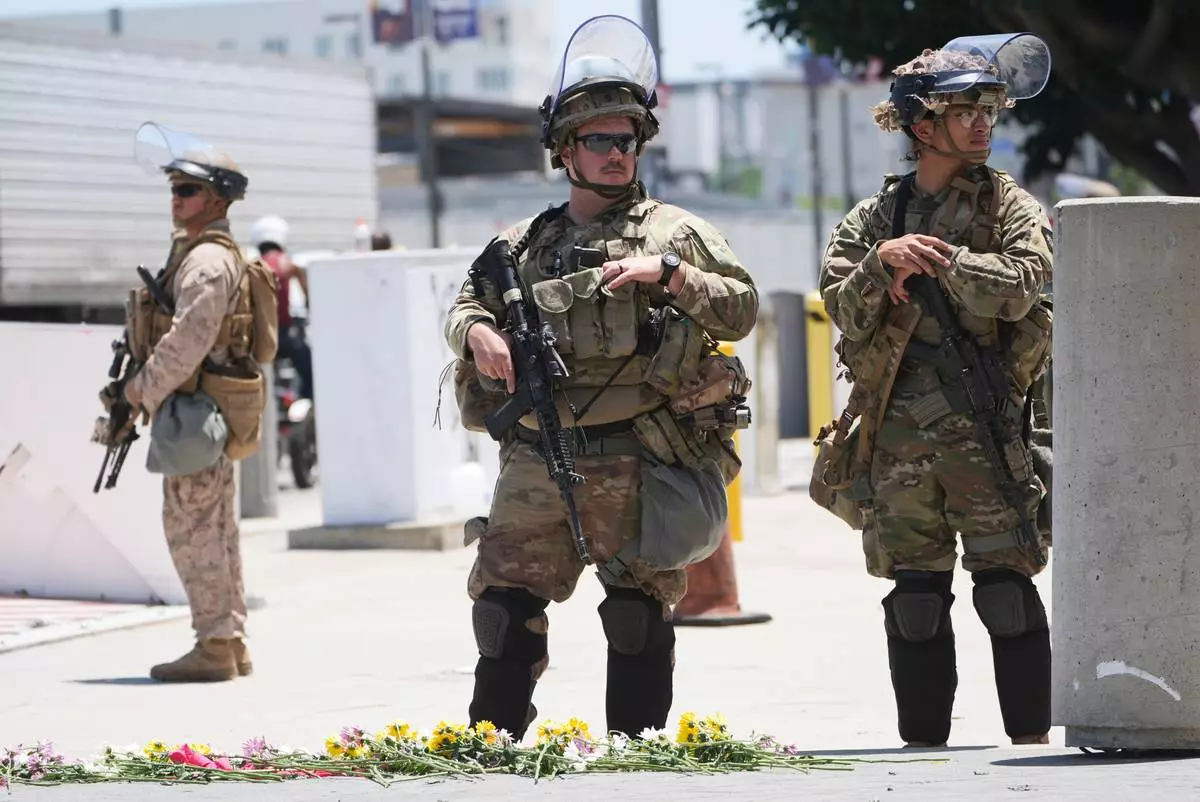
The Trump administration must stop deploying the California National Guard in Los Angeles and return control of the troops to the state, a federal judge ordered Wednesday in an emphatic ruling.

U.S. District Judge Charles Breyer in San Francisco granted a preliminary injunction sought by California officials, but also put the decision on hold until Monday, presumably to give the administration a chance to appeal.

In an extraordinary move, President Donald Trump called up more than 4,000 California National Guard troops in June without Gov. Gavin Newsom’s approval to further the Trump administration's immigration enforcement efforts. The number had dropped to several hundred by late October, but California remained steadfast in its opposition to Trump's command of the troops.

White House spokeswoman Abigail Jackson suggested in a statement that the administration would appeal Breyer's ruling, saying it looked forward to "ultimate victory on the issue.”

“President Trump exercised his lawful authority to deploy National Guard troops to support federal officers and assets following violent riots that local leaders like Newscum refused to stop,” she said, using a pejorative moniker Trump has used to refer to the Democratic governor.

California Attorney General Rob Bonta said the ruling was a victory for democracy and the rule of law, and he accused the administration of playing “political games” with the troops.

“But the President is not king,” he said in a statement. “And he cannot federalize the National Guard whenever, wherever, and for however long he wants, without justification.”

Breyer rejected the administration's arguments that he could not review extensions of a Guard deployment and that it still needed Guard troops in Los Angeles to protect federal personnel and property, saying the first claim was “shocking” and the second one bordered on “misrepresentation.”

“The Founders designed our government to be a system of checks and balances,” added Breyer, a nominee of President Bill Clinton, a Democrat. “Defendants, however, make clear that the only check they want is a blank one.”

The 100 or so California troops that remain in Los Angeles are guarding federal buildings or staying at a nearby base and are not on the streets with immigration enforcement officers, according to U.S. Northern Command.

California argued that conditions in Los Angeles had changed since Trump first deployed the troops following clashes between federal immigration officers and people protesting his stepped-up enforcement of immigration laws. During one demonstration, protesters threw rocks at Border Patrol vehicles. One man later pleaded guilty to throwing a Molotov cocktail.

The Republican administration has extended the deployment until February while also trying to use California Guard members in Portland, Oregon as part of its effort to send the military into Democratic-run cities over the objections of mayors and governors. It also sent some California National Guard troops to Illinois.

In his ruling, Breyer accused the Trump administration of “effectively creating a national police force made up of state troops.”

The idea that risks from demonstrations in the Los Angeles area could not be managed today without the National Guard defied “common sense,” the judge wrote.

“After all, local law enforcement like the LAPD, the LASD, and the California Highway Patrol (“CHP”) have not only been willing to manage the protests, but have capably done so since June,” he wrote.

The June call-up was the first time in decades that a state’s national guard was activated without a request from its governor and marked a significant escalation in the administration’s efforts to carry out its mass deportation policy. The troops were stationed outside a federal detention center in downtown Los Angeles where protesters gathered and later sent on the streets to protect immigration officers as they made arrests.

California sued, arguing that the president was using Guard members as his personal police force in violation of a law limiting the use of the military in domestic affairs. The administration said courts could not second-guess the president’s decision that violence during the protests made it impossible for him to execute U.S. laws with regular forces and reflected a rebellion, or danger of rebellion.

Breyer said in Wednesday's decision the suggestion there was danger of rebellion was even more “farfetched” when the administration extended the deployment than it was in June.

Breyer initally issued a temporary restraining order that required the administration to return control of the Guard members to California, but an appeals court panel put that decision on hold.

After a trial, Breyer ruled in September that the deployment violated the law.

Other judges have blocked the administration from deploying National Guard troops to Portland, Oregon, and Chicago.

FILE - Members of the California National Guard and U.S. Marines guard a federal building on Tuesday, June 17, 2025, in Los Angeles. (AP Photo/Damian Dovarganes, File)

FILE - Members of the California National Guard and U.S. Marines guard a federal building on Tuesday, June 17, 2025, in Los Angeles. (AP Photo/Damian Dovarganes, File)

Recommended Articles