Skip to Content Facebook Feature Image

Baltimore Symphony Orchestra hopes to foster closer connection between Chinese, US people

China

China

China

Baltimore Symphony Orchestra hopes to foster closer connection between Chinese, US people

2025-10-30 21:23 Last Updated At:21:37

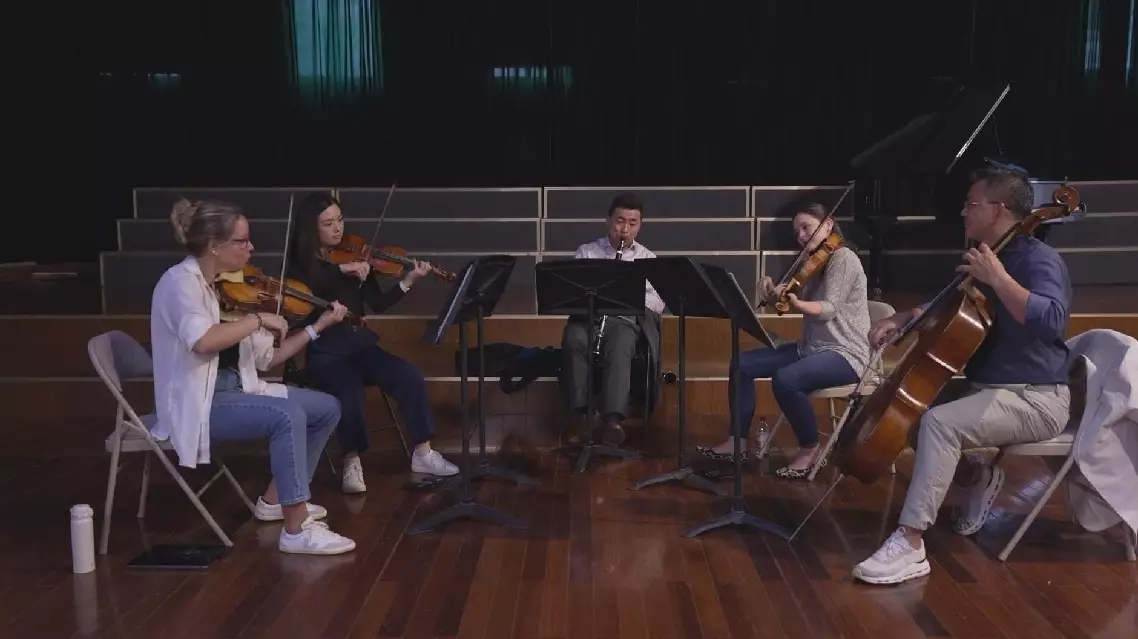
The Baltimore Symphony Orchestra (BSO), one of the leading orchestras in the United States, made its historic tour to China during the 7th China-U.S. Sister Cities Conference, hoping to use melodies as a bridge to foster understanding and emotional connection between the Chinese and American peoples.

In an exclusive interview with China Global Television Network (CGTN), BSO's president and CEO Mark Hanson shared the motivation behind this landmark trip to China.

"This trip for the Baltimore Symphony is about building new friendships, exploring new partnerships, and showcasing the talents of our incredible musicians. On behalf of our great city of Baltimore and our great state of Maryland, we hope to build awareness of those two vibrant places in the United States. And we're just thrilled to be here," said Hanson.

He stressed the crucial role that music, often regarded as a universal language, plays in bridging cultural gaps.

"It is often said that everyone loves music. There's really no better way to bring people and communities together. I'm also struck by how musicians are perfectionists. They strive to be the very, very best versions of themselves, and at the same time, they have this craving to collaborate, to partner with others. And I think that's a beautiful lesson for us all to try to be the best versions of ourselves and to constantly look for ways to partner and to collaborate with each other. That perhaps even applies to countries," he said.

For many in the BSO, this trip holds personal significance. China-born cellist Li Bo expects more exchange events between China and the U.S. to better bridge the two cultures and connect the two peoples.

"This is a very special trip for us. I have been to China many times, performing and teaching, but this is the first time Baltimore Symphony, as an organization, visiting China. This time, we brought five musicians with us, and also our CEO, so, as an organization, it's very special for us. And then, I know there are many other American orchestras visited China before, like Philadelphia Orchestra and New York Philharmonic, but for BSO, it is the first time. And we hope there will be many tours in the future for us," said Li.

The orchestra had presented several wonderful performances in Hangzhou City, east China's Zhejiang Province from Oct. 24 to 27, where the 17th China-U.S. Sister Cities Conference was held, then they traveled to Xiamen City, east China's Fujian Province from Oct. 28 to 29 for exchanges with local orchestra and celebration event for the 40th anniversary of Xiamen-Baltimore Sister Cities. The orchestra will also make tour performances in Xi'an City, northwest China's Shaanxi Province and Shanghai before they finish the China trip on Nov. 2.
Baltimore Symphony Orchestra hopes to foster closer connection between Chinese, US people


Baltimore Symphony Orchestra hopes to foster closer connection between Chinese, US people
Geoeconomic confrontation is the leading short-term global threat in 2026, the World Economic Forum (WEF) warned in its Global Risks Report 2026 released on Wednesday ahead of its annual meeting in Davos, Switzerland.

The report ranks geoeconomic confrontation as the top risk for 2026, followed by interstate conflict, extreme weather, societal polarization, and misinformation and disinformation. It also identifies geoeconomic confrontation as the most severe risk over the next two years.

"I think if there is to be one key takeaway from the report, it's that we are entering an age of competition and this new competitive order is then shaping current global risks, but it is also shaping and to some extent hindering our ability to actually cope with them. That's really the key takeaway. If we take a look at, the number one risk both for 2026 and two years out, it's dual economic confrontation. But then if we look at the risks 10 years out. It's really the climate and environment related risks. All of these things require global cooperation and that's where we're seeing a big backsliding in this new age of competition," said Saadia Zahidi, managing director of the WEF.

Economic risks showed the largest increase in the two-year outlook, with concerns over economic downturns, inflation, rising debt and potential asset bubbles intensifying amid geoeconomic tensions, the report said.

Environmental risks remain the most severe overall, led by extreme weather, biodiversity loss and critical changes to Earth systems. The report noted that three-quarters of respondents expect a turbulent environmental outlook.

Risks related to adverse outcomes of artificial intelligence rose sharply, climbing from 30th in the two-year horizon to fifth in the 10-year outlook, reflecting concerns over impacts on labor markets, society and security.

The 21st edition of the report draws on views from more than 1,300 experts, policymakers and industry leaders.

The WEF's annual meeting will be held in Davos from Jan 19 to 23 and draw nearly 3,000 guests from more than 130 countries and regions to participate.

"So overall, we are starting to see this shift away from what have traditionally been the ways in which people have been able to cooperate. Now, that is not to say that any of this is a foregone conclusion. And I think that's a really important message around the risks report. None of this is set in stone. All of this is in the hands of leaders. Whether they choose to cooperate and invest in resilience or whether they do not. So that's really what we'll be focused on next week in Davos bringing leaders together under this overall theme of 'a spirit of dialogue' and trying to reestablish relationships, cooperation and trust. That's the fundamental," said Zahidi.

WEF warns of rising geoeconomic risks in 2026

WEF warns of rising geoeconomic risks in 2026

Recommended Articles