Skip to Content Facebook Feature Image

'America First' Trump loved hanging out with the global elite during his Asia trip

News

'America First' Trump loved hanging out with the global elite during his Asia trip
News

News

'America First' Trump loved hanging out with the global elite during his Asia trip

2025-10-31 07:06 Last Updated At:07:10

TOKYO (AP) — For an “America First” president, Donald Trump seemed to love his whirlwind five days skipping across Asia — a reflection of a White House that is increasingly focused on the rest of the world.

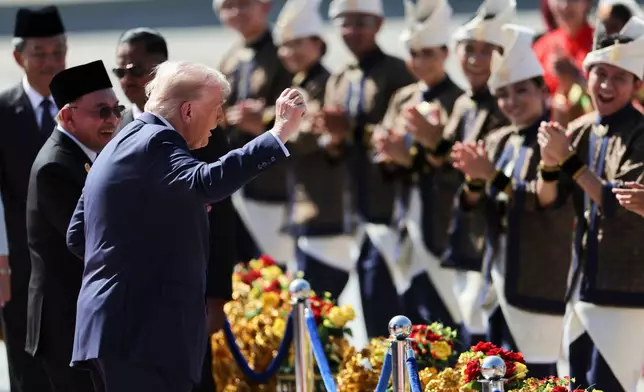
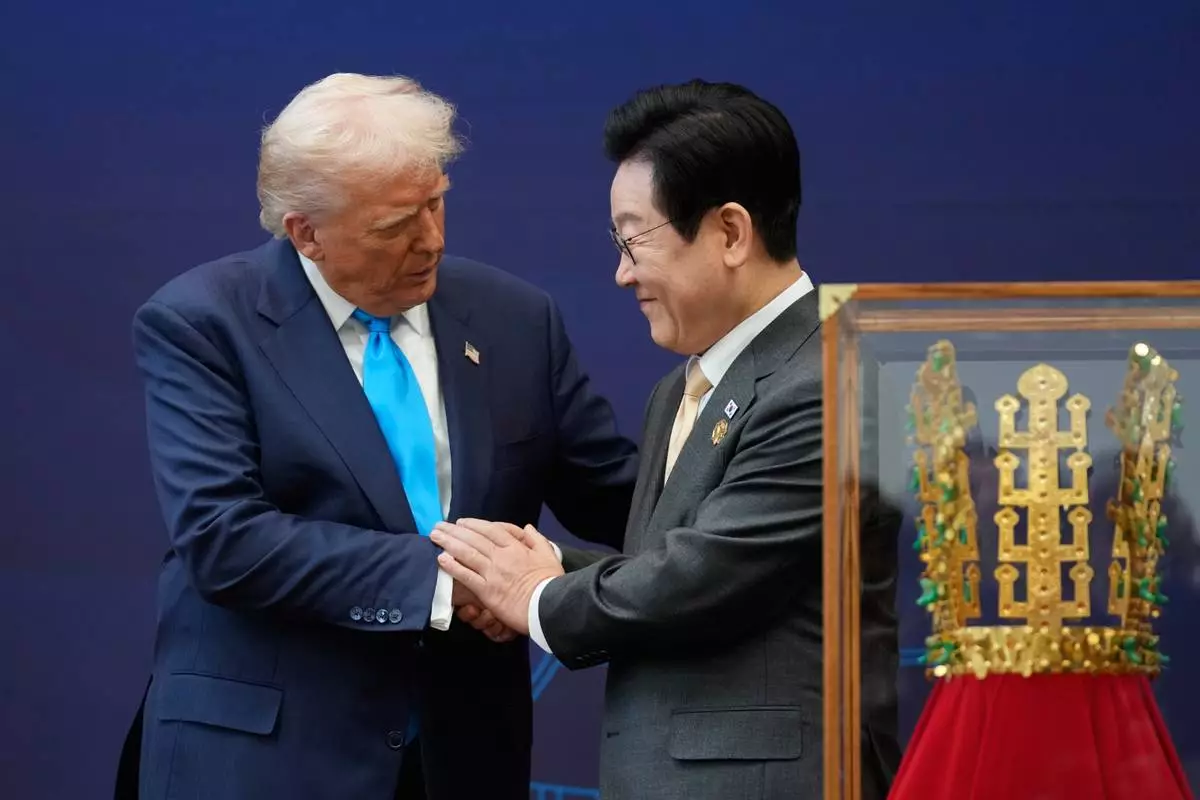
When Trump stepped off Air Force One on Sunday for his first stop in Malaysia, he danced with local performers who had greeted him on the red carpet. In Japan, he helicoptered to a mammoth aircraft carrier for a speech with the country's prime minister. And South Korea gave him a gold medal and crown as gifts.

More Images
President Donald Trump shakes hands with South Korean President Lee Jae Myung as they attend a high honor ceremony at the Gyeongju National Museum in Gyoeongju, South Korea, Wednesday, Oct. 29, 2025. (AP Photo/Mark Schiefelbein)
President Donald Trump shakes hands with South Korean President Lee Jae Myung as they attend a high honor ceremony at the Gyeongju National Museum in Gyoeongju, South Korea, Wednesday, Oct. 29, 2025. (AP Photo/Mark Schiefelbein)

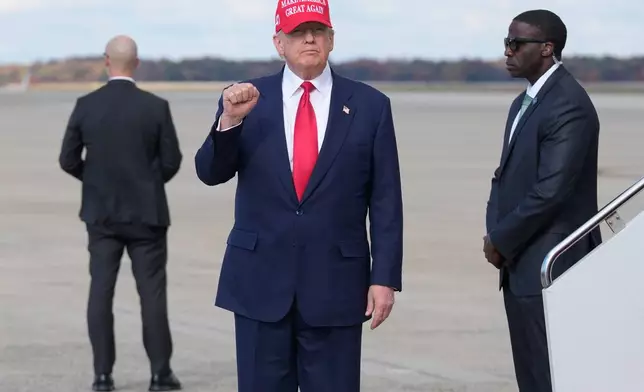
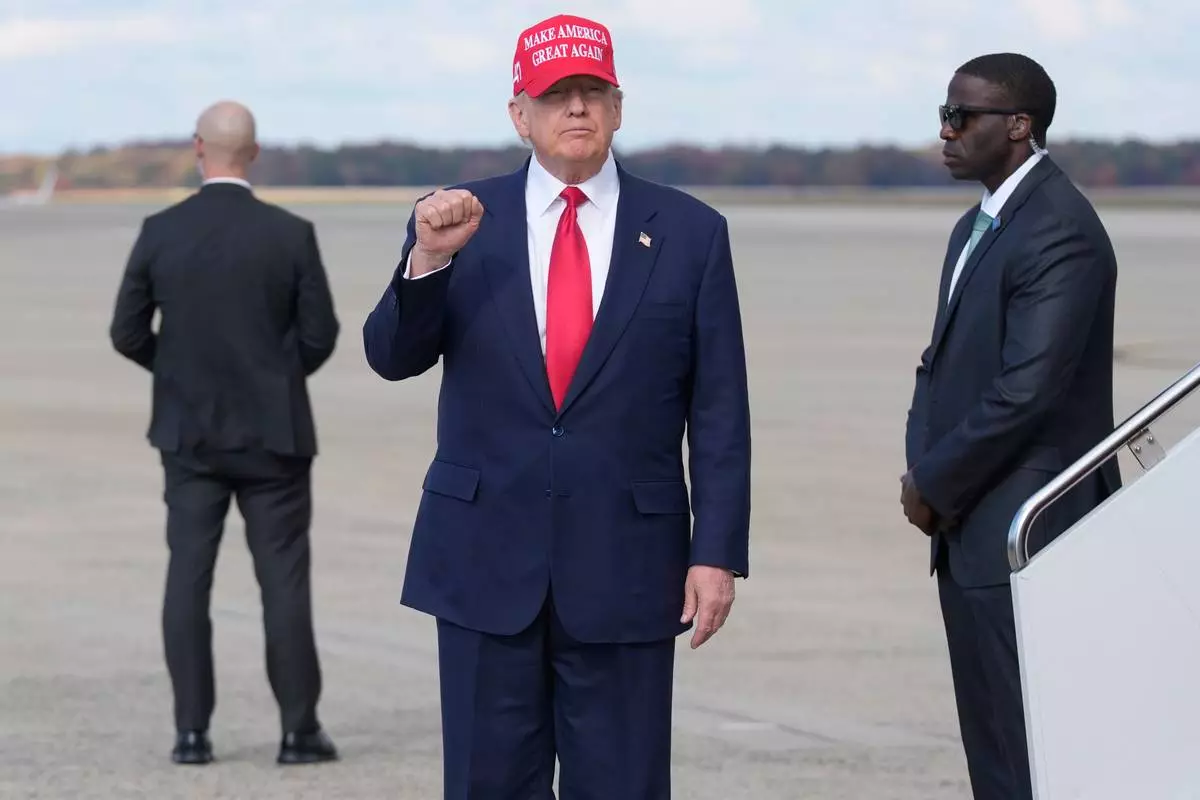
President Donald Trump gestures as he arrives on Air Force One, Thursday, Oct. 30, 2025, at Joint Base Andrews, Md., after returning from a trip to Asia. (AP Photo/Mark Schiefelbein)
President Donald Trump gestures as he arrives on Air Force One, Thursday, Oct. 30, 2025, at Joint Base Andrews, Md., after returning from a trip to Asia. (AP Photo/Mark Schiefelbein)

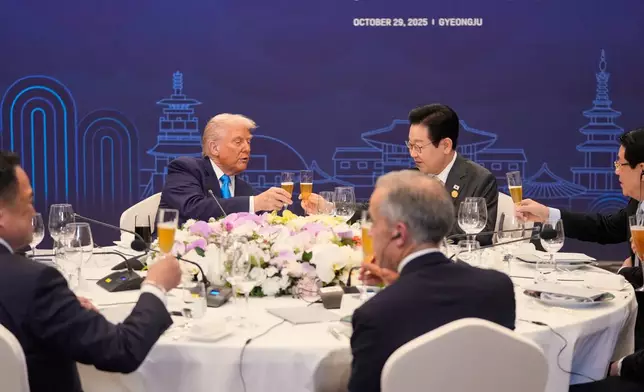
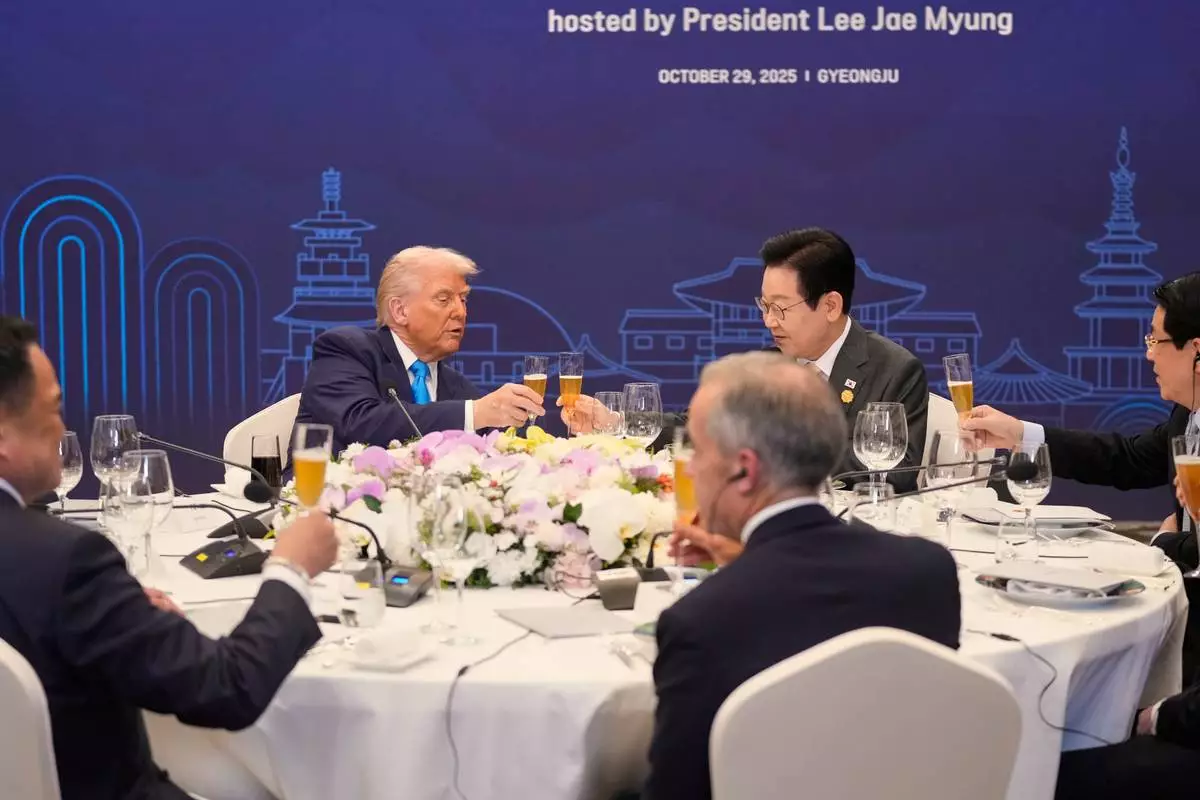
President Donald Trump toasts with state leaders including South Korean President Lee Jae Myung, center right, during a dinner event in Gyeongju, South Korea, Wednesday, Oct. 29, 2025. (AP Photo/Mark Schiefelbein)

President Donald Trump toasts with state leaders including South Korean President Lee Jae Myung, center right, during a dinner event in Gyeongju, South Korea, Wednesday, Oct. 29, 2025. (AP Photo/Mark Schiefelbein)

President Donald Trump left, and Chinese President Xi Jinping, shake hands before their U.S.-China summit talk at Gimhae International Airport in Busan, South Korea, Thursday, Oct. 30, 2025. (AP Photo/Mark Schiefelbein)
President Donald Trump left, and Chinese President Xi Jinping, shake hands before their U.S.-China summit talk at Gimhae International Airport in Busan, South Korea, Thursday, Oct. 30, 2025. (AP Photo/Mark Schiefelbein)

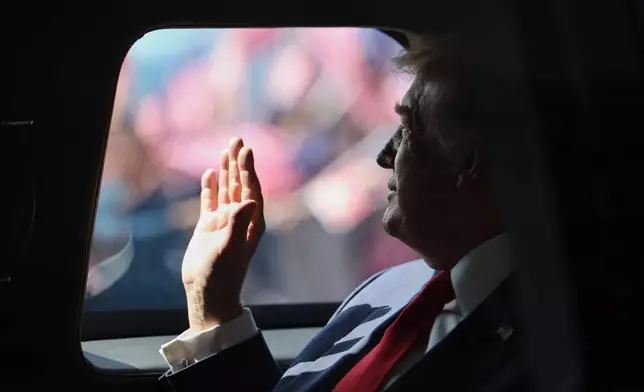
U.S. President Donald Trump waves from his official vehicle as he heads to attend the 47th Association of Southeast Asian Nations (ASEAN) summit after arriving at Kuala Lumpur International Airport in Kuala Lumpur, Malaysia, Sunday, Oct. 26, 2025. (Hasnoor Hussain/Pool Photo via AP)
U.S. President Donald Trump waves from his official vehicle as he heads to attend the 47th Association of Southeast Asian Nations (ASEAN) summit after arriving at Kuala Lumpur International Airport in Kuala Lumpur, Malaysia, Sunday, Oct. 26, 2025. (Hasnoor Hussain/Pool Photo via AP)

U.S. President Donald Trump reacts to dancing performers during a welcoming ceremony after arriving at Kuala Lumpur International Airport, to attend the 47th Association of Southeast Asian Nations (ASEAN) summit in Kuala Lumpur, Malaysia, Sunday, Oct. 26, 2025. (Hasnoor Hussain/Pool Photo via AP)

U.S. President Donald Trump reacts to dancing performers during a welcoming ceremony after arriving at Kuala Lumpur International Airport, to attend the 47th Association of Southeast Asian Nations (ASEAN) summit in Kuala Lumpur, Malaysia, Sunday, Oct. 26, 2025. (Hasnoor Hussain/Pool Photo via AP)

Back home in Washington, the federal government was shut down as Trump’s poll numbers remain low, and it's unclear how much Trump's trip will resonate with voters consumed by other concerns at home.

Yet on the last night of his trip, Trump was overheard at a state dinner talking about how much he enjoyed meetings with his foreign counterparts.

“That was a great meeting,” Trump said. “They’re all great meetings. This was a great meeting. We had a fantastic meeting.”

Had a president who once used the term “globalist” as a slur suddenly found the fun in being a little bit globalist? He definitely likes the international deal making, the parties in his honor, the praise from other leaders and the possibility of leaving his mark on the wider world.

The president sees diplomacy as a way to fulfill his domestic agenda of returning manufacturing to America and creating factory jobs, said Carla Sands, who was the U.S. ambassador to Denmark during Trump's first term and is now chair of the foreign policy initiative at the America First Policy Institute, a pro-Trump think tank.

“President Trump is working as fast as possible to reindustrialize America, bring jobs back home, and secure better trade deals for the American people and businesses,” Sands said.

The ebullience abroad also reflects the mood of a president who has struck economic deals and helped smooth relations between warring nations.

He helped to affirm a ceasefire between Cambodia and Thailand. There’s a detailed list of nearly $500 billion in investment commitments from Japan. And South Korea pledged $150 billion to help revive American shipbuilding, including a project to acquire a nuclear-powered submarine — on top of $200 billion in investments over a decade to the U.S.

“It's not globalism to go to other countries and stand up for America,” said Hogan Gidley, a former White House aide who traveled to Asia and other foreign destinations with Trump in his first term. When Trump travels, he makes sure “the globe is fully aware that this president is going to stand up for the American people first,” Gidley said, making it “the exact opposite of globalism.”

As for the dancing?

“Look, when you're scoring touchdowns, it's OK to dance in the end zone,” Gidley said. “And this president is scoring touchdowns and running up the score.”

Many Trump voters believed they were electing a president who would focus on them instead of distant countries. But Trump in his second term is increasingly finding it easier to sell the idea of America with jaunts to Asia and the Middle East.

The shift in tone reflects foreign governments’ strenuous efforts to keep Trump happy, like stationing American-made vehicles near him in Tokyo and featuring U.S.-raised beef on the menu.

Trump is increasingly showing confidence that he can play on the global stage, instead of grinding metaphorical axes as he did during his first term by attacking NATO and finding ways to intimidate and frustrate allies such as Angela Merkel, then the chancellor of Germany.

“He appears to believe in his skills as a one-on-one negotiator with world leaders,” said Jasen Castillo, a professor with a focus on national security at Texas A&M University. “All of this suggests that his foreign policy ventures are genuine.”

Still, it’s not always clear what Trump is trying to achieve, other than a chance to declare victory. Some of his trade talks have led to foreign countries promising investments, but not necessarily the careful negotiations on which durable coalitions are built.

“What can confuse observers is that he lacks a consistent, coherent world view,” Castillo added.

The U.S. president in Asia was hardly the grimacing presence he’s been at times in the Oval Office, where he’s objected to the support Ukrainian President Volodymyr Zelenskyy has sought in the war against Russia and chastised post-apartheid South Africans on their treatment of white Afrikaners.

In Asia, it was a love fest. Trump said Southeast Asian nations had “spectacular leaders,” the new Japanese prime minister was “a winner,” and the South Korean president could “go down as the greatest of them all.”

Rather than complaining about foreign countries ripping off America, he told business leaders that “the best deals are deals that work for everybody.”

Trump was similarly effusive after sitting down on Thursday with Chinese leader Xi Jinping shortly before returning to Washington.

“I guess on the scale from 0 to 10, with 10 being the best, I would say the meeting was a 12,” Trump told reporters aboard Air Force One.

Trump seems to enjoy doing foreign policy on his own terms. He prizes bold shows of force, like attacking nuclear sites in Iran and boats allegedly carrying drugs in the Caribbean. He minimizes participation in lengthy multilateral meetings that can require more listening than talking.

Arriving at the summit for the Association of Southeast Asian Nations, Trump offered a spot in the armored presidential limousine to Malaysian Prime Minister Anwar Ibrahim, who was thrilled to join him in the vehicle nicknamed “The Beast.”

“When the president arrives, he asked me to join him in the car,” Anwar later recalled in a speech. “I said, ‘That’s against the security and protocol rules,’ and he was delighted to break the rules.”

The White House said that Japanese Prime Minister Sanae Takaichi planned to nominate him for the Nobel Peace Prize, with Takaichi telling him she was “so impressed and inspired” by Trump’s commitment to world peace and stability.

South Korean President Lee Jae Myung said Trump “will be recognized forever in the history of humanity” if he could bring his peacemaker skills to ending the military standoff with North Korea, before complimenting him for U.S. stock indexes hitting a record high.

Even the far more reserved Xi seemed to suggest that Trump’s policies behind elevating America were also good for China.

“I always believe that China’s development goes hand in hand with your vision to ‘Make America Great Again,’” Xi said through a translator.

While the White House is trumpeting the results of Trump's trip back home, it's unclear how much his foreign policy actions mattered to a country worried about inflation staying high.

Going into the 2025 elections Tuesday with a mayoral race in New York City and governors' elections in Virginia and New Jersey, many Americans are harboring deep anxieties about Trump’s leadership. The monthlong government shutdown is starting to cause pain with missed paychecks and government food aid no longer being available to millions of families.

About 6 in 10 U.S. adults disapprove of Trump’s performance as president, according to an October poll by The Associated Press-NORC Center for Public Affairs Research.

Trump told his audiences in Kuala Lumpur, Tokyo and South Korea that America has never been better.

“We’re literally sort of an inspiration to a lot of other countries,” Trump said.

Megerian reported from Busan, South Korea, and Kim reported from Washington.
President Donald Trump shakes hands with South Korean President Lee Jae Myung as they attend a high honor ceremony at the Gyeongju National Museum in Gyoeongju, South Korea, Wednesday, Oct. 29, 2025. (AP Photo/Mark Schiefelbein)
President Donald Trump shakes hands with South Korean President Lee Jae Myung as they attend a high honor ceremony at the Gyeongju National Museum in Gyoeongju, South Korea, Wednesday, Oct. 29, 2025. (AP Photo/Mark Schiefelbein)

President Donald Trump gestures as he arrives on Air Force One, Thursday, Oct. 30, 2025, at Joint Base Andrews, Md., after returning from a trip to Asia. (AP Photo/Mark Schiefelbein)
President Donald Trump gestures as he arrives on Air Force One, Thursday, Oct. 30, 2025, at Joint Base Andrews, Md., after returning from a trip to Asia. (AP Photo/Mark Schiefelbein)

President Donald Trump toasts with state leaders including South Korean President Lee Jae Myung, center right, during a dinner event in Gyeongju, South Korea, Wednesday, Oct. 29, 2025. (AP Photo/Mark Schiefelbein)

President Donald Trump toasts with state leaders including South Korean President Lee Jae Myung, center right, during a dinner event in Gyeongju, South Korea, Wednesday, Oct. 29, 2025. (AP Photo/Mark Schiefelbein)

President Donald Trump left, and Chinese President Xi Jinping, shake hands before their U.S.-China summit talk at Gimhae International Airport in Busan, South Korea, Thursday, Oct. 30, 2025. (AP Photo/Mark Schiefelbein)
President Donald Trump left, and Chinese President Xi Jinping, shake hands before their U.S.-China summit talk at Gimhae International Airport in Busan, South Korea, Thursday, Oct. 30, 2025. (AP Photo/Mark Schiefelbein)

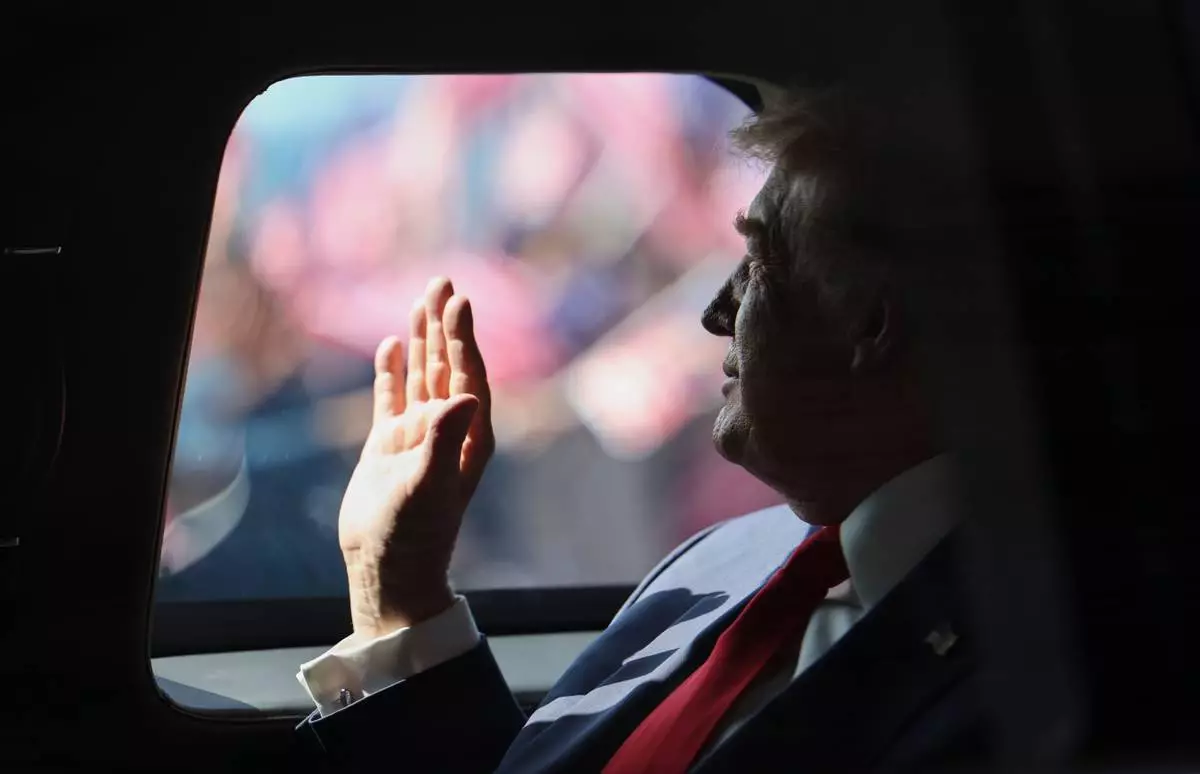
U.S. President Donald Trump waves from his official vehicle as he heads to attend the 47th Association of Southeast Asian Nations (ASEAN) summit after arriving at Kuala Lumpur International Airport in Kuala Lumpur, Malaysia, Sunday, Oct. 26, 2025. (Hasnoor Hussain/Pool Photo via AP)
U.S. President Donald Trump waves from his official vehicle as he heads to attend the 47th Association of Southeast Asian Nations (ASEAN) summit after arriving at Kuala Lumpur International Airport in Kuala Lumpur, Malaysia, Sunday, Oct. 26, 2025. (Hasnoor Hussain/Pool Photo via AP)

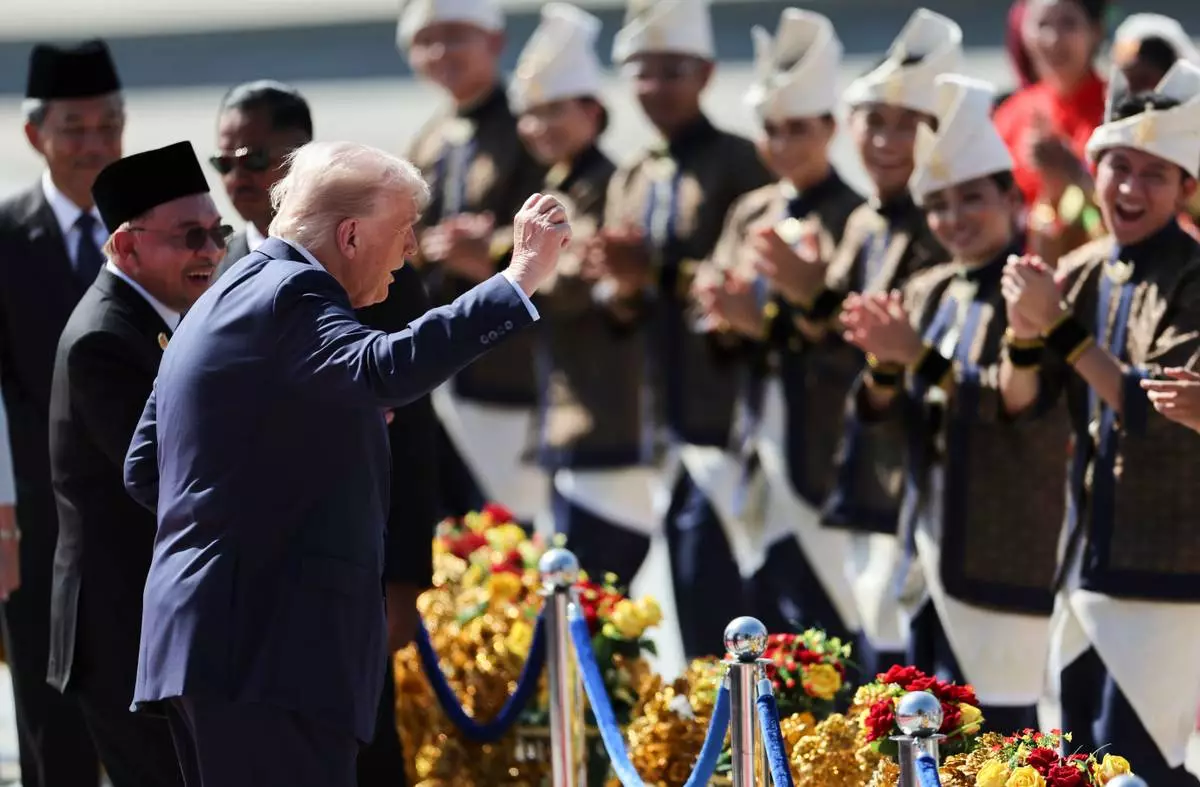
U.S. President Donald Trump reacts to dancing performers during a welcoming ceremony after arriving at Kuala Lumpur International Airport, to attend the 47th Association of Southeast Asian Nations (ASEAN) summit in Kuala Lumpur, Malaysia, Sunday, Oct. 26, 2025. (Hasnoor Hussain/Pool Photo via AP)


U.S. President Donald Trump reacts to dancing performers during a welcoming ceremony after arriving at Kuala Lumpur International Airport, to attend the 47th Association of Southeast Asian Nations (ASEAN) summit in Kuala Lumpur, Malaysia, Sunday, Oct. 26, 2025. (Hasnoor Hussain/Pool Photo via AP)

DUBAI, United Arab Emirates (AP) — Israel said it launched airstrikes against Iranian missile launchers and a nuclear research site Tuesday, and Iran struck back against Israel and across the Gulf region, targeting U.S. embassies and disrupting energy supplies and travel.

Four days into a war that President Donald Trump suggested would last several weeks but perhaps longer, nearly 800 people have been killed in Iran, including some Trump said he had considered as possible future leaders of the country.

Explosions rang out Tuesday in Tehran and in Lebanon — where Israel said it retaliated against Hezbollah militants — and the American embassy in Saudi Arabia came under drone attack. Iran has fired dozens of ballistic missiles at Israel, though most of the incoming fire has been intercepted. Eleven people in Israel have been killed since the conflict began.

The spiraling nature of the war raised questions about when and how it would end. Trump seemed to leave open the possibility for more extensive U.S. military involvement, telling the New York Post on Monday that he was not ruling out the possibility of boots on the ground.

The administration has given various objectives. While the initial U.S.-Israeli strikes killed Iranian Supreme Leader Ayatollah Ali Khamenei and Trump urged Iranians to overthrow their government, senior administration officials have since said regime change was not the goal.

Trump said Monday the military campaign’s four objectives were to destroy Iran’s missile capabilities, wipe out its navy, prevent it from obtaining a nuclear weapon and ensure that it cannot continue to support allied armed groups.

Trump said Tuesday that “someone from within” the Iranian regime might be the best choice to take power once the U.S.-Israel campaign is finished.

Speaking from the Oval Office Tuesday, Trump said Reza Pahlavi, the exiled son of Iran’s toppled Shah, is not someone that his administration has considered in depth to take over.

As far as possible leaders inside Iran, “the people we had in mind are dead,” Trump said.

“I guess the worst case would be do this, and then somebody takes over who’s as bad as the previous person, right? That could happen," Trump said. "We don’t want that to happen.”

Iran’s leaders are scrambling to replace Khamenei, who ruled the country for 37 years. It’s only the second time since the 1979 Islamic Revolution that a new supreme leader is being chosen. Potential candidates range from hard-liners committed to confrontation with the West to reformists who seek diplomatic engagement.

Information coming out of Iran has been limited because of poor communications, round-the-clock airstrikes and tight restrictions on journalists. But across Iran’s capital, aircraft were heard overhead and explosions rang out.

The Israeli military said it conducted a wave of airstrikes on sites that produce and store ballistic missiles, in Tehran and Isfahan. It also said it destroyed what it called Iran’s secret, underground nuclear headquarters. Without providing evidence, it said the site was used for scientific research “to develop a key component for nuclear weapons.”

“The regime attempted to rebuild its efforts and conceal them, thinking we wouldn’t notice. They were mistaken,” said Israeli military spokesman Brig. Gen. Effie Defrin.

Iran has said it has not enriched uranium since June, though it has maintained its right to and says its nuclear program is peaceful.

The United Nations’ nuclear watchdog said Iran’s Natanz nuclear enrichment site had sustained “some recent damage,” though there was “no radiological consequence expected.” The U.S. hit Natanz during the 12-day war in June, when Israeli and American strikes greatly weakened Iran's nuclear program.

New rounds of U.S. and Israeli airstrikes rattled Tehran and several other Iranian cities.

“Since midnight, I and my wife are hearing sound of explosions,” said Ali Amoli, an engineer living in north Tehran. “Sometimes from the west side of the city and sometimes from other directions.” Streets and gas stations appeared quieter than in recent days.

Local media published images of a damaged commercial plane at Bushehr airport that broke apart following an airstrike on Tuesday.

A north Tehran resident who spoke on condition of anonymity for fear of retaliation described growing fears in the capital as it comes under heavy bombardment. The resident said most stores in the normally bustling area of Tajrish were closed, though bakeries and supermarkets remained open.

An attack from two drones on the U.S. Embassy in Riyadh caused a “limited fire,” according to Saudi Arabia’s Defense Ministry, and the embassy urged Americans to avoid the compound. It followed an attack on the U.S. Embassy in Kuwait. U.S. Embassies in Saudi Arabia, Kuwait and Lebanon said they were closed to the public.

The U.S. State Department ordered the evacuation of non-emergency personnel and family in Kuwait, Bahrain, Iraq, Qatar, Jordan and the United Arab Emirates. The U.S. also urged citizens to leave more than a dozen Middle Eastern countries, though with much of the airspace closed many were stranded.

The State Department said Tuesday it’s preparing military and charter flights for Americans who want to leave the Middle East. Several other countries also arranged evacuation flights for their citizens.

The U.S.-Israeli strikes have killed at least 787 people in Iran, according to the Red Crescent Society. In Lebanon, where Israel launched retaliatory strikes on the Iranian-supported militant group Hezbollah, 40 people were killed, including seven children, in Lebanon, the health ministry said. The ministry had previously said 52 people were killed.

The U.S. military has confirmed six deaths of American service members. In addition, three people were killed in the United Arab Emirates, and one each in Kuwait and Bahrain.

Turkish Foreign Minister Hakan Fidan on Tuesday criticized Iran's attacks against Gulf neighbors that had worked to prevent war as an “incredibly flawed strategy” that threatened to widen the war if these states decide to retaliate.

This story has been updated to correct that communications in Iran are poor, but that the internet isn't shut down. It also clarifies that more than one drone hit the U.S. Embassy in Saudi Arabia. Some instances referred to just one drone.

Becatoros reported from Athens, Greece, and Magdy from Cairo. Seung Min Kim, Michelle Price and Konstantin Toropin in Washington, David Rising in Bangkok, Melanie Lidman in Tel Aviv, Israel, Hallie Golden in Seattle, Giovanna Dell'Orto in Miami, and Suzan Fraser in Ankara, Turkey, contributed to this report.

A firefighter extinguishes fire at a building that was hit by an Israeli airstrike in Dahiyeh, a southern suburb of Beirut, Lebanon, Tuesday, March 3, 2026. (AP Photo/Hussein Malla)

A firefighter extinguishes fire at a building that was hit by an Israeli airstrike in Dahiyeh, a southern suburb of Beirut, Lebanon, Tuesday, March 3, 2026. (AP Photo/Hussein Malla)

A woman crosses almost deserted square with a billboard at rear showing a portrait of the late Iranian Supreme Leader Ayatollah Ali Khamenei, who was killed in the U.S.–Israeli military campaign, in Tehran, Iran, Tuesday, March 3, 2026. (AP Photo/Vahid Salemi)

A woman crosses almost deserted square with a billboard at rear showing a portrait of the late Iranian Supreme Leader Ayatollah Ali Khamenei, who was killed in the U.S.–Israeli military campaign, in Tehran, Iran, Tuesday, March 3, 2026. (AP Photo/Vahid Salemi)

Smoke rises from a destroyed building that was hit by an Israeli airstrike in Dahiyeh, a southern suburb of Beirut, Lebanon, Tuesday, March 3, 2026. (AP Photo/Hussein Malla)

Smoke rises from a destroyed building that was hit by an Israeli airstrike in Dahiyeh, a southern suburb of Beirut, Lebanon, Tuesday, March 3, 2026. (AP Photo/Hussein Malla)

An Iranian flag is placed among the ruins of a police station struck Monday during the U.S.–Israeli military campaign in Tehran, Iran, Tuesday, March 3, 2026. (AP Photo/Vahid Salemi)

An Iranian flag is placed among the ruins of a police station struck Monday during the U.S.–Israeli military campaign in Tehran, Iran, Tuesday, March 3, 2026. (AP Photo/Vahid Salemi)

Smoke rises from Israeli airstrikes in Dahiyeh, a southern suburb of Beirut, Lebanon, Tuesday, March 3, 2026. (AP Photo/Hussein Malla)

Smoke rises from Israeli airstrikes in Dahiyeh, a southern suburb of Beirut, Lebanon, Tuesday, March 3, 2026. (AP Photo/Hussein Malla)

Jewish men covered in prayer shawls pray in an underground parking garage as a precaution against possible Iranian missile attacks, in Tel Aviv, Israel, Tuesday, March 3, 2026. (AP Photo/Oded Balilty)

Jewish men covered in prayer shawls pray in an underground parking garage as a precaution against possible Iranian missile attacks, in Tel Aviv, Israel, Tuesday, March 3, 2026. (AP Photo/Oded Balilty)

A group of men inspects the ruins of a police station struck Monday amid the U.S.–Israeli military campaign in Tehran, Iran, Tuesday, March 3, 2026. (AP Photo/Vahid Salemi)

A group of men inspects the ruins of a police station struck Monday amid the U.S.–Israeli military campaign in Tehran, Iran, Tuesday, March 3, 2026. (AP Photo/Vahid Salemi)

Smoke rises from Israeli airstrikes in Dahiyeh, a southern suburb of Beirut, Lebanon, Tuesday, March 3, 2026. (AP Photo/Hussein Malla)

Smoke rises from Israeli airstrikes in Dahiyeh, a southern suburb of Beirut, Lebanon, Tuesday, March 3, 2026. (AP Photo/Hussein Malla)

Smoke rises from Israeli airstrikes in Dahiyeh, a southern suburb of Beirut, Lebanon, early Tuesday, March 3, 2026. (AP Photo/Bilal Hussein)

Smoke rises from Israeli airstrikes in Dahiyeh, a southern suburb of Beirut, Lebanon, early Tuesday, March 3, 2026. (AP Photo/Bilal Hussein)

This image provided by U.S. Central Command shows a F-35C Lightning II preparing for launch on the flight deck of the USS Abraham Lincoln (CVN 72) in support of Operation Epic Fury on Monday, March 2, 2026. (U.S. Navy via AP)

This image provided by U.S. Central Command shows a F-35C Lightning II preparing for launch on the flight deck of the USS Abraham Lincoln (CVN 72) in support of Operation Epic Fury on Monday, March 2, 2026. (U.S. Navy via AP)

Mourners take cover while air-raid sirens warn of incoming missiles launched by Iran toward Israel during the funeral of Sarah Elimelech and her daughter Ronit who were killed in an Iranian missile attack, in Beit Shemesh, Israel, Monday, March 2, 2026. (AP Photo/Ohad Zwigenberg)

Mourners take cover while air-raid sirens warn of incoming missiles launched by Iran toward Israel during the funeral of Sarah Elimelech and her daughter Ronit who were killed in an Iranian missile attack, in Beit Shemesh, Israel, Monday, March 2, 2026. (AP Photo/Ohad Zwigenberg)

A worker instals a billboard on an overpass containing a portrait of the late Iranian Supreme Leader Ayatollah Ali Khamenei, who was killed during the ongoing joint U.S.-Israeli military campaign, in Tehran, Iran, Monday, March 2, 2026. (AP Photo/Vahid Salemi)

A worker instals a billboard on an overpass containing a portrait of the late Iranian Supreme Leader Ayatollah Ali Khamenei, who was killed during the ongoing joint U.S.-Israeli military campaign, in Tehran, Iran, Monday, March 2, 2026. (AP Photo/Vahid Salemi)

Smoke engulfs a street after a strike in Tehran, Iran, Monday, March 2, 2026. (AP Photo/Mohsen Ganji)

Smoke engulfs a street after a strike in Tehran, Iran, Monday, March 2, 2026. (AP Photo/Mohsen Ganji)

Recommended Articles