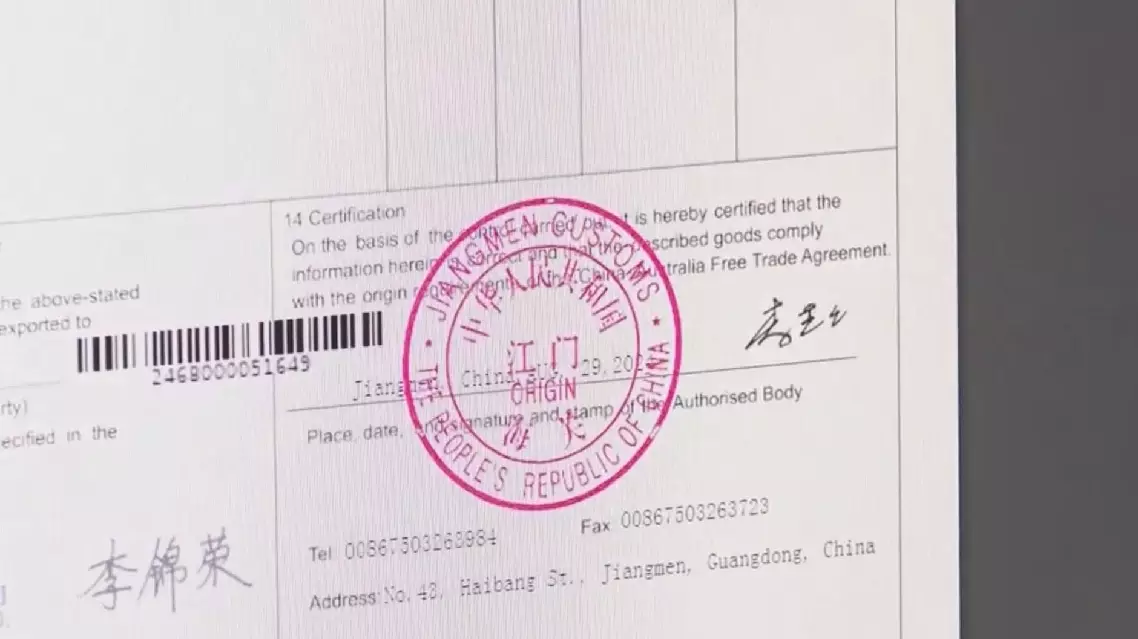
Trade promotion authorities nationwide issued over 6.15 million certificates that boost foreign trade in the first nine months of 2025, up 17.64 percent year on year, according to the latest data from the China Council for the Promotion of International Trade (CCPIT) on Friday.
The trade documents issued include certificates of origin, or CO, that certifies goods in a particular export shipment are wholly obtained, produced, manufactured or processed in a particular country or region; ATA Carnets which, known as the passport for goods, is an international customs document that allows temporary entry and exit of goods on a duty-free and tax-free basis; and other assortment.
Among them, more than 3.33 million non-preferential certificates of origin and nearly 2.29 million preferential certificates of origin were issued, up 5.10 percent and 47.25 percent year on year, respectively. Meanwhile, 242,500 RCEP certificates of origin were issued, an increase of 25.57 percent year on year, according to the CCPIT.
The Regional Comprehensive Economic Partnership (RCEP) is the world's largest free trade agreement in terms of combined gross domestic product and market size, accounting for almost one-third of the world's population.
The hike in the number of the certificates issued underscores the strong resilience of China's foreign trade in the first three quarters, which achieved steady growth in both volume and quality, said Yang Fan, a spokeswoman for the CCPIT, at a press conference held in Beijing.
"This fully demonstrates that China's vast array of foreign trade enterprises are actively adapting, innovating and expanding their "circle of friends" amid a complex external environment, while accumulating new momentum and advantages steadily, providing strong support for the stable development of China's foreign trade in the next stage," said Yang.
China sees 17.64 pct increase in issuance of trade promotion certificates in first three quarters: CCPIT
A clean energy program aiming to explore the abundant solar resources in an arid town in northwest China via smart technology has transformed the town into a vibrant green power hub.
Thanks to advanced smart grid systems, energy storage and initiating regional new energy training sessions introduced by the program, Minning Town in Yinchuan City of Ningxia Hui Autonomous Region has achieved a 24-hour supply of 100 percent green electricity since 2024, pioneering a new model for rural revitalization.
Designated as the first "Green Electricity Town" in the region, Minning Town boasts the largest and most fully equipped new energy training school in northwest China, where students are engaged in lessons around a disassembled wind-driven generator.
The Ningxia Lineng New Energy Vocational Skills Training School also offers trainees access to energy storage and power transformation equipment of different generations and technical characteristics.
Leveraging its abundant solar and wind power facilities, a training base has been established for the trainees in the town.
"Trainees can learn theories in the morning at school, and then go to stations nearby for some practices in the afternoon," said Xing Bowen, manager of the school.
With the annual sunshine duration reaching 3,000 hours, residents in the town have utilized local solar resources to increase their income.
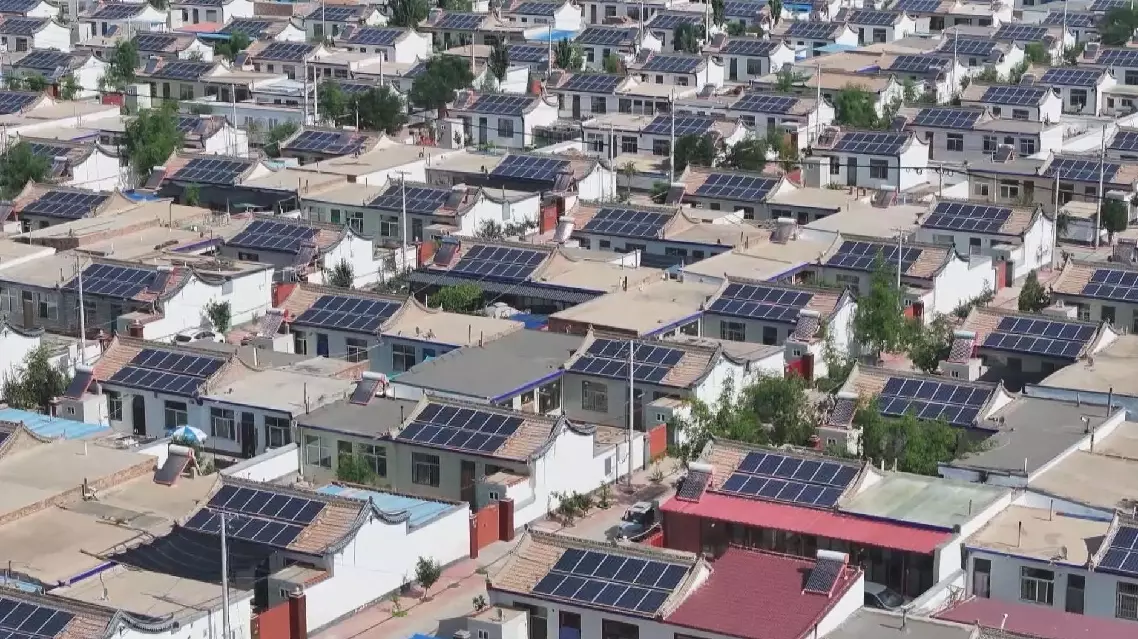
In Yuanlong Village, the roofs of 1,922 households installed with photovoltaic panels have become a unique sight.
"Since our roof photovoltaic industry started grid-connected operation in 2016, residents in Yuanlong Village have leased their roofs out to enterprises. As a result, each household earns a rent of 480 yuan every year, and it also brings a collective income of nearly 1 million yuan to our village," said Ma Keyu, secretary of the Party branch in Yuanlong.
Besides roofs, many villages there have made full use of their idle land, while raising livestock animals under solar panels.
Wind turbines have been also put up on the desertified land around the town to synergize with solar panels to generate electricity.
To ensure a stable power supply at night or when wind stops, the town is equipped with 40 battery compartments that consist of around 200,000 battery cells. The facilities can reserve 180,000 kilowatt-hours of electricity and release 180,000 kilowatt-hours at one time, meeting the daily needs of 24,000 households.
A homegrown smart power dispatching system has been applied for the first time in the town.
"The system works as a smart brain for our power grid. It can predict when the wind is the heaviest and when the sunshine is the strongest, as well as power consumption of residents. It can ensure green power supply by automatically arranging the operations of wind and solar power facilities and reserve stations and dispatching power in real time," said Wang Erqing, deputy director of the Power Dispatching and Control Center of State Grid Yinchuan Power Supply Company.
Since 2024, the town has achieved an annual supply of 566 million kilowatt-hours of green electricity, saving 69,500 tons of coal, and reducing carbon dioxide emissions by 192,700 tons, with the utilization efficiency of new energy exceeding 95 percent.
Clean energy program turns arid town in northwest China into green power hub