The transaction volume of green electricity in the operating area of China's State Grid exceeded 200 billion kilowatt-hours in the first 10 months of this year, setting a new record for the period.
The latest official data shows that from January to October this year, the State Grid organized 202.6 billion kilowatt-hours of green electricity transactions in its operating area, an increase of 62 percent year on year.
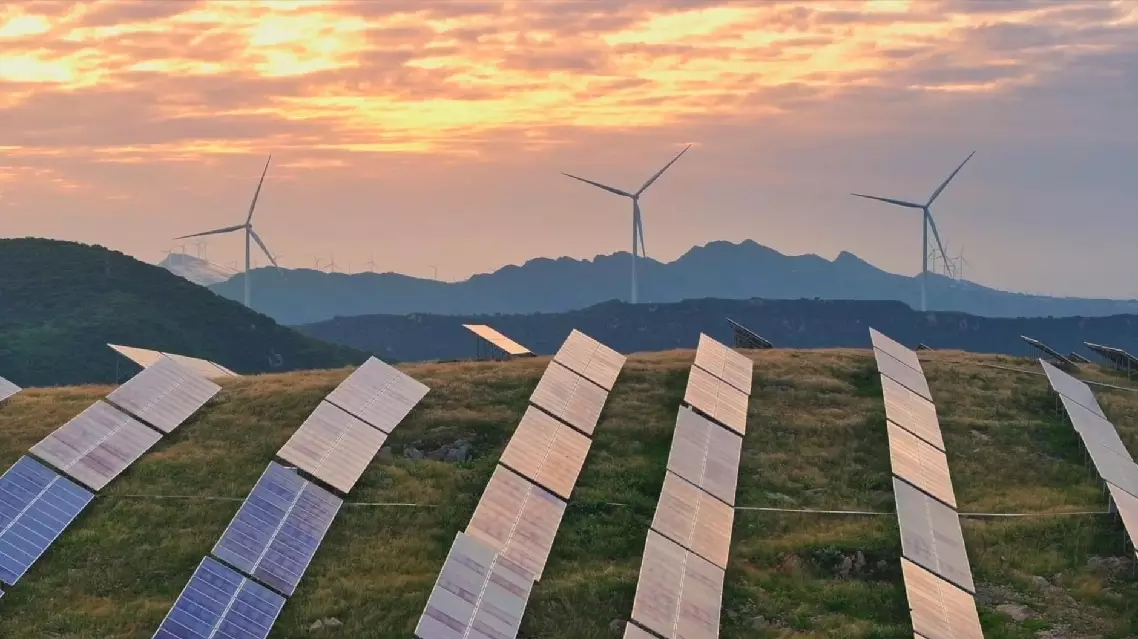
Within the State Grid's operating area, the installed capacity of wind power and photovoltaic new energy has so far reached 1.364 billion kilowatts, a year-on-year increase of 33 percent. At the same time, all provincial medium- and long-term markets have achieved continuous daily operation within the area, and an inter-provincial power mutual assistance trading model has been established to promote the optimal allocation of power resources among provinces.
"In terms of improving market mechanisms, we have innovatively launched multi-year green electricity agreements, which have now reached a scale of over 30 billion kilowatt-hours. The agreements provided long-term and stable revenue for new energy companies and a reliable source of green electricity for users," said Liu Shuo, director of the new energy trading department of the Beijing Power Exchange Center.
Currently, China's green electricity trading is using these market mechanisms to achieve optimized allocation of green electricity on a larger scale, ensuring large-scale grid connection and high-proportion consumption of new energy sources.
China's green electricity trade under State Grid hits record in first 10 months

The Chinese economy advanced with innovation-led, high-quality development despite mounting economic pressure in 2025, with stability, progress, resilience, and innovation standing out as distinguishing characteristics.
China's gross domestic product (GDP) grew 5 percent year on year in 2025 to a record of 140.1879 trillion yuan (about 20.01 trillion U.S. dollars), meeting the annual target of around 5 percent, data from the National Bureau of Statistics (NBS) revealed Monday.
The economy during the 14th Five-Year Plan period (2021-25) was marked by four consecutive leaps, surpassing 110, 120, 130, and 140 trillion yuan, despite multiple unexpected shocks, Kang Yi, head of the NBS, said at a press briefing on Monday, explaining last year's data.
"As the economic structure improved and upgraded, the value-added output of China's high-tech manufacturing firms above the designated size accounted for 17.1 percent of the total value-added industrial output above the designated size in 2025, and final consumption contributed more than 50 percent to economic growth," Kang said.
China's economy in 2025 showed a clear shift toward innovation-driven growth, with research and development spending intensity reaching 2.8 percent, up 0.11 percentage points from 2024 and exceeding the average of OECD (Organization for Economic Cooperation and Development) economies for the first time.
In 2025, the value added of digital products manufacturing among industrial enterprises above the designated size grew by 9.3 percent year on year, with output of servers and industrial robots posting rapid growth. Green electricity, renewable energy and the broader green economy expanded robustly, while new energy vehicles accounted for more than 50 percent of domestic new-car sales.
Last year, the country's per capita disposable income for residents was 43,377 yuan (about 6,224 U.S. dollars), up 5.0 percent year on year.
For many years, China has contributed roughly 30 percent of global economic growth, cementing its role as an indispensable "ballast" for the world economy.
"In a global context, China's economic growth rate ranks among the world's top major economies, making it the most stable and reliable engine of global economic growth, with its contribution to world economic growth estimated at around 30 percent," said Kang.
Industrial enterprises above the designated size are those with an annual main business revenue of at least 20 million yuan (about 2.84 million U.S. dollars).
Chinese economy in 2025 shows strong resilience bolstered by high-tech innovation