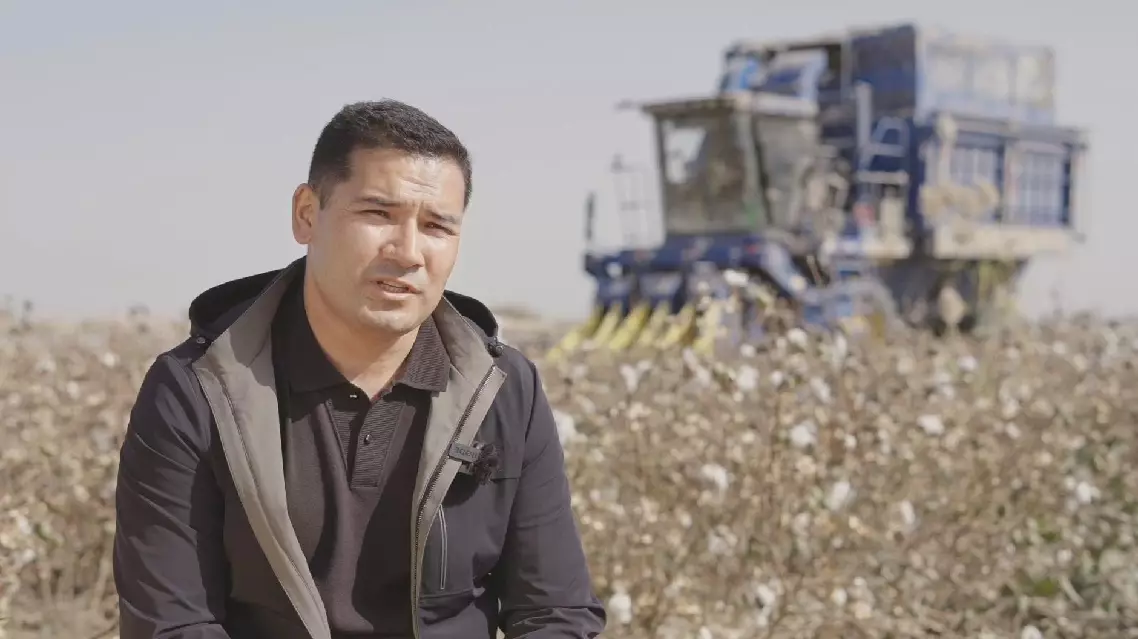
Gheni Emet, a young farmer from northwest China's Xinjiang Uygur Autonomous Region, has made news by helping his fellow cotton growers boost yields and income through bold experimentation with innovative planting techniques and new crop varieties.
After graduating from university, Emet chose to return to his hometown, where he now cultivates nearly 70 hectares of cotton. Yet, he never hesitates to help other farmers and often prioritizes their needs over his own.
"There are two busiest times of the year. The first is the planting season in early spring. This year, I've planted nearly 70 hectares of cotton. I do my own planting and also help others. The window's very short -- just 25 days to get everything done. The other farmers earn less than I do. If they don't manage the spring planting properly, a whole year of efforts will be wasted. That's why I help the other farmers first and do planting on my own fields later. I do my best to make sure the planting goes well and the quality is good," said Emet.
Emet's approach is rooted in continuous learning and careful adaptation to soil conditions, weather changes, and the evolving needs of the crop.
"Growing cotton is a constant learning process, from spring planting to autumn harvest. Whether the soil's sandy or muddy, every plot is different. I adjust the irrigation, fertilization and other aspects, based on the soil type, the weather and the plants' growth," said Emet.
His willingness to embrace agricultural experimentation has made him a rare figure in a region where many farmers are cautious about change.
Kong Xianhui, an expert from the institute of agricultural sciences of the third division of the Xinjiang Production and Construction Corps, commended Emet for his bold adoption of new cotton varieties.
"Most of them (other farmers) are hesitant. But if they see their neighbors trying it, and it works, they'll try it next year. Not many are as bold as him (Emet)," Kong said.
One major innovation Emet championed is drip irrigation, a water-saving technique initially met with skepticism.
"Some farmers were reluctant to adopt drip irrigation at first. The drip tape is buried beneath the soil, so there's no visible water on the surface. Many of them felt uneasy about not seeing any water. They thought there wasn't enough. Some even cut the drip tape open, so that they could see the water flowing into the soil," Kong said.
Emet took the leap and achieved very good results.
"In early spring, many of the farmers didn't understand the concept. I decided to try, even though it was a risk. Eventually, it saved us a lot of money and water. Most importantly, seedling emergence is much better now. In the past, on saline-alkali fields, the seedling emergence rate could only reach 70-80 percent. Now, using the same saline-alkali fields, but applying the 'dry sowing and wet emergence' technique, the seedling emergence rate can exceed 90 percent," said Emet.
Young Xinjiang farmer boosts cotton yields through bold experimentation