Skip to Content Facebook Feature Image

China's upcoming 15th National Games build momentum as athletes arrive in host cities

China

China

China

China's upcoming 15th National Games build momentum as athletes arrive in host cities

2025-11-07 01:58 Last Updated At:02:27

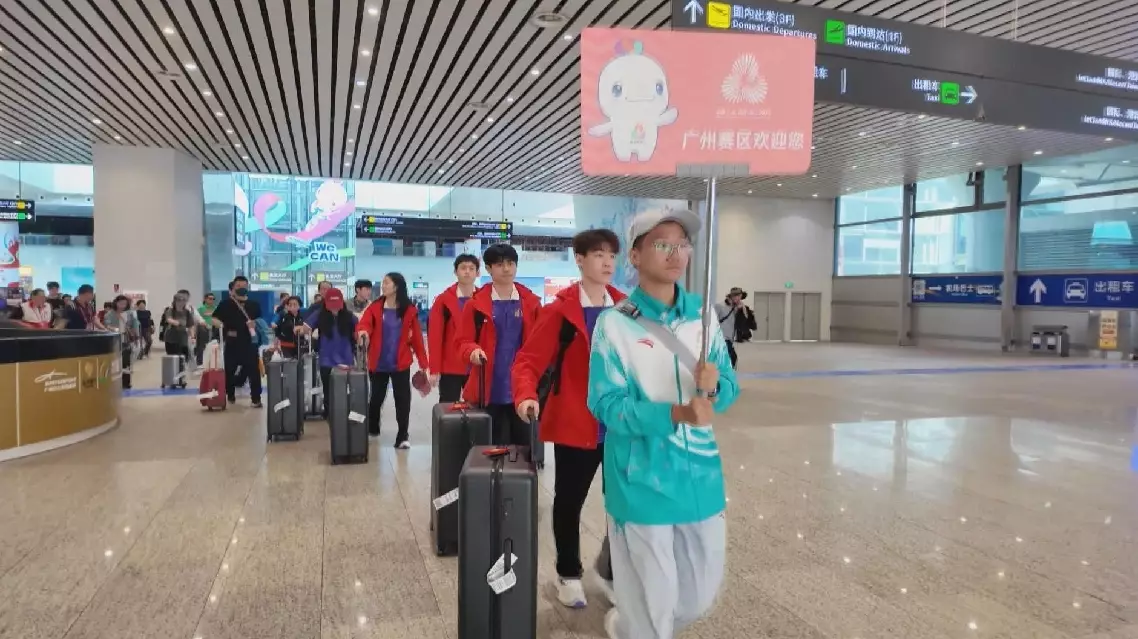
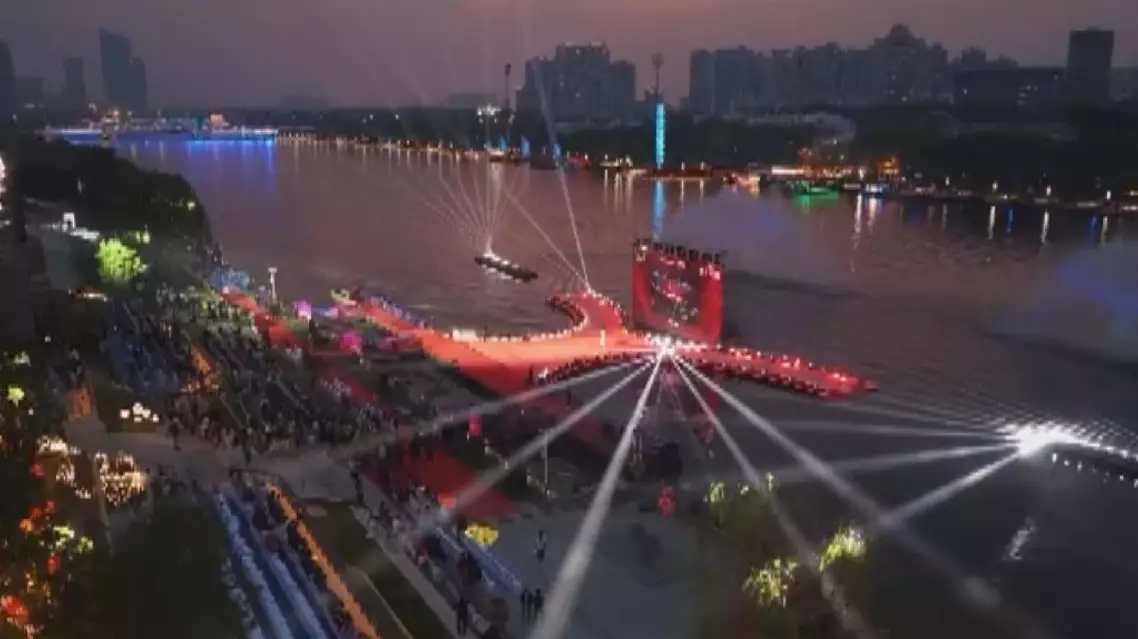
Host cities across south China's Guangdong Province, and the neighboring Hong Kong and Macao Special Administrative Regions are seeing a surge in arrivals of athletes and officials for the upcoming China's 15th National Games.

The Games, scheduled to run from Nov 9 to 21 and to be held across 105 venues in Guangdong, Hong Kong and Macao, feature 34 sports with 419 events in the competitive program and 23 sports with 166 events in the mass participation program.

More than 20,000 athletes are set to compete in the final phase.

On Thursday, Wushu athletes from east China's Fujian Province and members of Hong Kong's delegation, including athletes and technical officials, arrived in Guangzhou, capital of Guangdong.

The Guangzhou competition zone has so far handled arrivals and departures for about 1,600 groups of participants, organizers said.

In Shenzhen, Guangdong, teams competing in basketball, gymnastics and swimming have also begun arriving.

The city's airport has handled more than 1,600 competition-related flights and over 5,600 passengers linked to the Games.

At the Hengqin border checkpoint in Zhuhai City, around 1,300 athletes and staff have entered through special channels designated for the event as of Thursday, according to border authorities.

With the opening ceremony approaching, designated hotels for the 15th National Games, along with the 12th National Games for Persons with Disabilities and the 9th National Special Olympic Games, in Guangzhou are stepping up final preparations.

"We've prepared high-calorie meals for technical officials who have intense daily activities, and we've extended buffet service hours according to their schedules. Our dinner buffet, which used to close at 22:00, is now open until 23:30 in certain parts," said Peng Weidong, manager at a hotel in Guangzhou.

The National Games, held every four years, is China's highest level and largest national multi-sports event. The last edition in 2021 saw over 12,000 athletes compete in the northwestern province of Shaanxi.
China's upcoming 15th National Games build momentum as athletes arrive in host cities
China's upcoming 15th National Games build momentum as athletes arrive in host cities
Over a dozen Japanese scholars and former government officials held a press conference in Tokyo on Monday, urging Prime Minister Sanae Takaichi to immediately retract her earlier erroneous remarks on China's Taiwan region, warning the comments could further strain relations between China and Japan.

Takaichi's remarks in the Diet had clearly deviated from the basic position maintained by successive Japanese governments on the Taiwan question, said the attendees at the event held by the Association for Inheriting and Propagating the Murayama Statement, a Japanese civil group dedicated to upholding the 1995 Murayama Statement that acknowledges Japan's wartime mistakes.

"Takaichi's so-called 'survival-threatening situation' is extremely dangerous. It not only violates Article 9 of the Constitution but also breaches the international law. I want to emphasize that such statements will break the international trust Japan has built up to this point," said Kumiko Haba, professor emeritus at Aoyama Gakuin University.

"Following prime minister Takaichi's remarks on November 7, she claimed that her remarks did not represent the unified government position, and then said that they aligned with the Japan's long-held diplomatic stance. This is contradictory. I must say, this is an attempt to get away with it, or even to shift the argument," said Kazuhide Uekusa, a political economist.

"Prime minister Takaichi's remarks on November 7 have resulted in an exceptionally difficult period for China-Japan relations," said Kazuhiko Togo, former director-general of Treaties Bureau at Japan's Ministry of Foreign Affairs, and visiting professor of Kyoto Sangyo University.

Scholars at the event noted that since Takaichi took office, she has advocated for greatly increasing defense spending to acquire "the capability to strike enemy bases". Japanese society should be wary of the government going further down the path of military expansion.

"Revising the three major security documents, easing export restrictions on defense equipment, allowing free exports of weapons, bringing forward the military spending target -- originally projected to reach 2 percent of GDP by 2027 to this year -- and increasing the target to 3.5 percent of GDP, all these moves have shown that Takaichi's 'is eager to engage in war,'" said Masakatsu Adachi, an honorary professor of Kanto Gakuin University.

The association published a statement demanding Takaichi withdraw her comments.

The statement said her remarks in the Diet marked a clear departure from those of the previous government, and it is the first time in the Diet that a Japanese prime minister had indicated Japan would enter a wartime posture in the event of a "Taiwan contingency," which could be seen as a revival of Japanese militarism.

The statement also accused Japan of instigating the current tensions while portraying itself as a victim, and called on Takaichi to acknowledge that the Taiwan question is China's internal affair and immediately retract the remarks.

"Takaichi's remarks not only violate Article 9 of Japan's pacifist constitution but also breach the international law. Intervention in the Taiwan question and a lack of respect for the one-China principle are seen as attempts by Japan to meddle in China's affairs once again. Takaichi should realize that the Taiwan question is China's internal affairs. She should retract her remarks about the so-called 'Taiwan emergency' immediately," said Takakage Fujita, secretary-general of the association.

"Japan's current socioeconomic predicament sees wages stagnant amid climbing prices. Where do people vent their discontent? Politicians often seek out some weak links among certain so-called 'enemies' and shift the blame onto them," said Hiroshi Tanaka, professor emeritus of Hitotsubashi University.

"Her remarks almost overturned all the commitments Japan made to China after the war. It can only be understood in this way. I think she must retract her remarks," said Mieko Takenobu, professor emerita of Wako University.

Japanese public figures demand Takaichi retract Taiwan-related remarks

Japanese public figures demand Takaichi retract Taiwan-related remarks

Recommended Articles