NEW YORK (AP) — Not like us? More like him: Kendrick Lamar leads the 2026 Grammy Award nominations, announced Friday.
The rapper is up for nine trophies at February’s ceremony: record, song and album of the year — marking the third time he’s had simultaneous nominations in those big categories — as well as pop duo/group performance, melodic rap performance, rap song and rap album. He’s also nominated twice in the rap performance category.
Lamar, who is riding the success of last year’s blockbuster “GNX” album, has 22 Grammy career wins and 66 nominations. “GNX” is his fifth consecutive studio album to be nominated for album of the year, something no other artist has ever done. If it wins, it will be his first win in the category. And it will be only the third rap album to win the top prize, following Outkast in 2004 for “Speakerboxxx/The Love Below” and Lauryn Hill in 1999 for “The Miseducation of Lauryn Hill.”
Lady Gaga, Jack Antonoff and Canadian record producer/songwriter Cirkut follow Lamar with seven nominations each.
Lady Gaga is up for song, record and album of the year — her first time receiving nominations in all three categories simultaneously. She could also score potential wins in the pop solo performance, pop vocal album, dance pop recording and traditional pop vocal album categories.
Antonoff is nominated in the record, album and song of the year categories twice, for his work with Lamar and Sabrina Carpenter. He’s also nominated for rap song for the first time. That’s for “tv off” with Lamar, featuring Lefty Gunplay.
Antonoff and Cirkut will face off in the producer of the year, non-Classical category. If Antonoff wins, he will tie Babyface’s record of most career wins in the category, with four.
That’s not all. Cirkut is up for both record and song of the year, twice — for Lady Gaga’s “Abracadabra” and Rosé and Bruno Mars’ “APT.” — as well as album of the year and best dance pop recording.
In addition to Lady Gaga’s “Mayhem” and Lamar’s “GNX,” the album of the year category is rounded out by Carpenter’s “Man’s Best Friend,” Bad Bunny’s “Debí Tirar Más Fotos,” Justin Bieber’s “Swag,” Clipse, Pusha T & Malice’s “Let God Sort Em Out,” Leon Thomas’ “Mutt” and Tyler, the Creator’s “Chromakopia.”
This is the first time three albums have been up for both rap album and album of the year: “GNX,” “Let God Sort Em Out” and “Chromakopia.”
Additionally, Bad Bunny’s “Debí Tirar Más Fotos” is only the second time an all-Spanish language album has been nominated for the top prize. The first was also a Bad Bunny release — in 2023, for “Un Verano Sin Ti.” Harry Styles’ “Harry’s House” won that year.
Carpenter, Bad Bunny, Leon Thomas and Serban Ghenea all boast six nominations. Andrew Watt, Clipse, Doechii, Sounwave, SZA, Turnstile and Tyler, the Creator have five each.
Only recordings commercially released in the U.S. between Aug. 31, 2024 through Aug. 30, 2025 were eligible for nominations. The final round of Grammy voting, which determines its winners, will take place Dec. 12 through Jan. 5.
In the best new artist category, global girl group Katseye, Olivia Dean, The Marias, Addison Rae, sombr, Leon Thomas, Alex Warren and Lola Young will all go head-to-head.
The record of the year category is made up of Bad Bunny’s “DtMF,” Carpenter’s “Manchild,” Doechii’s “Anxiety,” Billie Eilish’s “Wildflower,” Lady Gaga’s “Abracadabra,” Lamar and SZA’s “luther,” Chappell Roan’s “The Subway” and Rosé and Bruno Mars’ “APT.”
Rosé, perhaps best known as one-fourth of the juggernaut girl group BLACKPINK, is the first K-pop artist to ever receive a nomination in the record of the year field.
Some may be surprised to see Eilish included in the bunch, as “Wildflower” was released on her spring 2024 album, “Hit Me Hard and Soft,” ahead of the eligibility window. However, there is a Recording Academy rule that allows albums released during the previous ceremony’s eligibility period to be considered, “provided the same tracks were not entered the previous year and the album did not win a Grammy,” with a few exceptions. By that rule, Eilish’s “Wildflower” — which was not previously entered — is eligible.
Song of the year — an award for a track’s songwriters, which sometimes include the performer but not always — is made up of an almost identical list to record of the year, except Roan is replaced by “Golden” from the “KPop Demon Hunters” soundtrack.
“The Grammy Awards are our opportunity to honor the people who make this community so vibrant and this year’s nominees remind us of the incredible talent that is driving music forward,” said Recording Academy CEO Harvey Mason jr. in a statement. “From emerging talent to influential icons, these nominees reflect today’s broad and diverse musical landscape, and I am excited to celebrate them in the coming weeks ahead.”
There are a number of first-time nominees as well this year, including Tate McRae, Zara Larsson, PinkPantheress, JID and Timothée Chalamet. You read that correctly.
The 2026 Grammy Awards will air Feb. 1 live on CBS and Paramount+ from the Crypto.com Arena in Los Angeles.
For more coverage of the 2026 Grammy Awards, visit: https://apnews.com/hub/grammy-awards

This combination of photos show Jack Antonoff, left, Kendrick Lamar, center, and Lady Gaga. (AP Photo)

FILE - Decorative Grammy Awards appear on the red carpet at the 64th annual Grammy Awards in Las Vegas on April 3, 2022. (Photo by Jordan Strauss/Invision/AP, File)
TRIKORFO, Greece (AP) — Can a centuries-old ritual of spiritual renewal rekindle a New Year’s resolution to build healthy eating habits before it fades in the spring?
For six weeks every year, millions of Orthodox Christians around the world adopt a largely vegan diet, abstaining from meat, dairy products, eggs, and fish with backbones. Oil and wine also are prohibited on weekdays during the 40-day Lenten period before Orthodox Easter, which often falls later than its Catholic and Anglican counterpart.
The annual adherence to a plant-based, Mediterranean-style meal plan drives a communal rediscovery of vegetables and oil-free cooking methods in majority-Orthodox countries.
In Greece, even McDonald’s franchises get into the lean Lent spirit by adding seasonal menu items that meet most of the proscriptions of the Greek Orthodox Church. The menu includes shrimp wraps, shrimp salad, vegetable spring rolls and plant-based McVeggie burgers but is not oil-free.
Although following Eastern Orthodox dietary guidelines before Easter is often referred to as fasting, the focus is on going without certain foods, not refraining from eating altogether. The rules are not rigid but can be adapted to account for personal needs.
Here’s a look at the annual alimentary tradition, along with reasons to consider sticking with a similar diet and cautionary advice from nutritionists.
Christian traditions diverge between East and West ahead of Easter, and not just in their methods for determining the most important date on their calendars. Catholics are encouraged to give up one or more personal indulgences during Lent but get to decide whether to deny themselves dessert, alcohol, video games, swearing or something else. Members of the Orthodox Church forgo animal products except for shellfish.
Gone are Greeks' beloved dishes like mousaka and souvlakia — grilled meat wrapped with toppings. So are dairy products like milk and cheese. Vertebrate fish like anchovies, mullet and hake are no-nos too, although shrimp, oysters and calamari are permitted.
On a lush coastal hillside in central Greece, 40 monks closely follow these rules at the Monastery of St. Augustine and Seraphim. The monks, who wear black robes and full beards, grow and harvest most of their own produce in the monastery's gardens, including an abudance of zucchini and tomatoes.
Their meals during Lent are basic but not bland. The monks have mastered methods to replicate familiar tastes and textures. Oven-roasted potatoes are coated with tahini instead of oil to preserve the crunch factor. Vegetable stock prepared from scratch gives lentil dishes a hearty flavor.
The monks listen to prayers read aloud as they eat.
Father Nektarios Moulatsiotis, the monastery's affable abbot, says the practice of fasting and following a restricted diet is essential for deep reflection and focus required for the spiritual preparation for Easter. He compares it to endurance training.
“In the same way someone goes to the gym to shape their body," Nektarios said, "the church is a gym for the soul.”
Occasional hunger pangs aren't something to resist; they are part of the plan. The idea is simple: less indulgence, more clarity.
“You cannot really pray, study, chant or do any spiritual exercise with a full stomach,” he said with a chuckle.
Nektarios argues that a nutritious yet disciplined diet can produce benefits that apply outside of a religious setting as much as inside of one, such as a sense of greater self-control and enhanced awareness.
Orthodox monks observe several fasting periods that limit what, when and how much they eat for most of the year. Researchers have studied their health and food intake for decades to determine if their customs hold any clues to preventing heart disease, type 2 diabetes and strokes.
However, the advantages of eating a balanced diet that includes whole grains, vegetables, fruits and legumes are well-established. Reduce consumption of meat, saturated fats and processed foods long enough, and the body typically responds.
“Fasting certainly has benefits, provided it’s done correctly,” Eirini Babaroutsi, a sports nutritionist at the Hellenic Athletics Federation, said. For example, Orthodox Christians tend to eat more fiber during Lent, which helps the digestive system function better, she said.
“It also matters what we do eat, not simply what we avoid," Babaroutsi said. "With the right combinations, we can get all the nutrients we need.”
Meals that meet the guidelines aren’t confined to the ingredients found in Orthodox-majority countries in Southern and Eastern Europe. Babaroutsi suggests porridge with oat milk, vegetable wraps with olive paste, and high-quality peanut butter as helpful international additions.
There are a few considerations.
A six-week fasting cycle is not advisable for older adults and young children, Babaroutsi said. The Eastern Orthodox church also exempts people with serious health conditions, special dietary requirements, and pregnant or nursing women from strict obedience.
Engaging in a post-Lent binge as a reward also is best avoided because loading up after a period of abstinence can strain the body, Babaroutsi said.
For those wary of making a full commitment, know that you're not alone. Orthodox Lent started on Feb. 23, but many Greeks participate only during Holy Week, which starts on April 5, Palm Sunday, and goes until April 11, the day before Orthodox Christians celebrate Easter this year.
Supermarkets and bakeries in Greece make it easier to abide by stocking fast, family-friendly meals and an assortment of seasonal goods.
These include jars of pickles and olives, bags of chickpeas and other pulses, squid sliced into rings in freezer cases, the creamy pink fish roe known as taramosalata, and slabs of unleavened bread shaped like small surfboards.
In central Athens, at the slippery-floored central fish market, vendors call out over piles of Lent-compliant clams, octopus and mussels, shoveling seafood into paper cones.
Gerasimos Mantalvanos, the market’s general manager, said many customers tend to overindulge when Easter Sunday's traditional lamb dishes and sweets arrive. For most, a spirit of moderation eventually returns, he said.
“It is good for eating habits to change from time to time during the year,” Mantalvanos said. “So a period of fasting, a little fish and some abstinence from meat, I think these are good for the body. It is a kind of small detox, a little break.”
–––
AP photographer Thanassis Stavrakis and videojournalist Srdjan Nedeljkovic contributed.
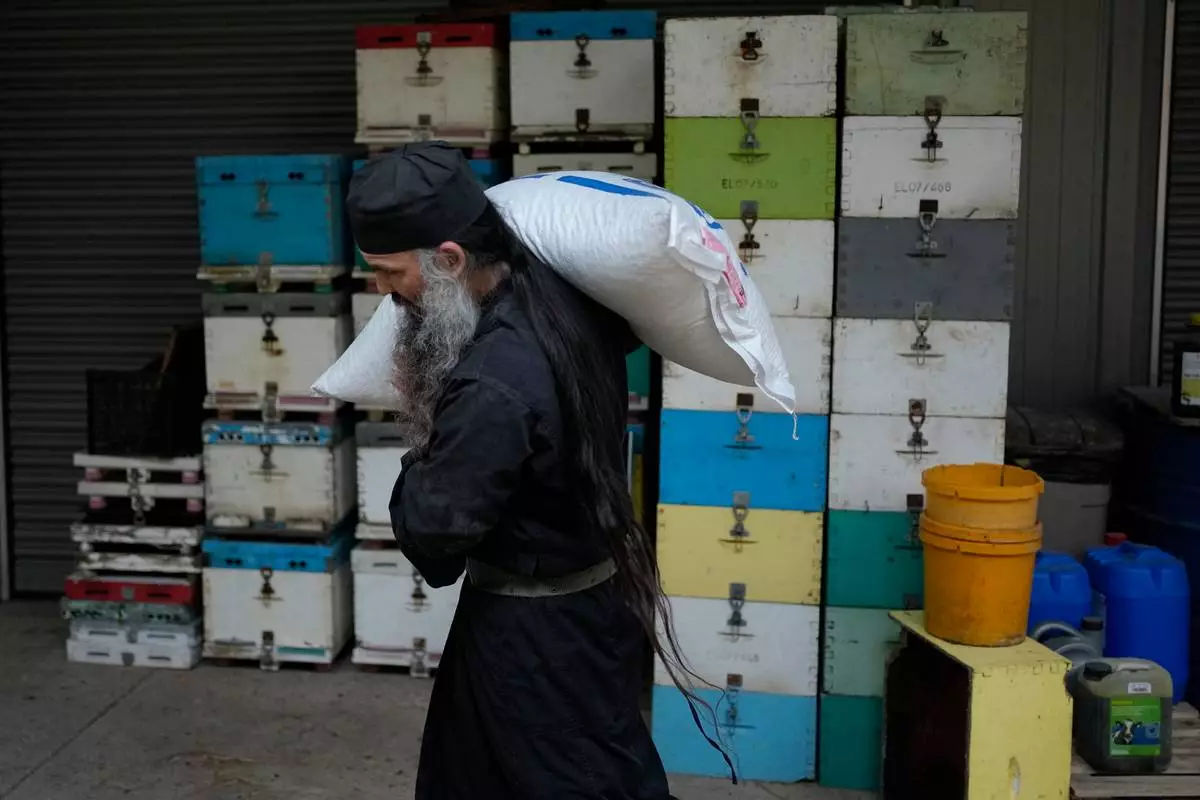
Father Seraphim carries a sack of feed for sheep at the Monastery of St. Augustine and Seraphim of Sarov in the village of Trikorfo, about 236 kilometers (147 miles) northwest of Athens, Friday, March 20, 2026. (AP Photo/Thanassis Stavrakis)

A monk tends to plants at the Monastery of St. Augustine and Seraphim of Sarov in the village of Trikorfo, about 236 kilometers (147 miles) northwest of Athens, Friday, March 20, 2026. (AP Photo/Thanassis Stavrakis)
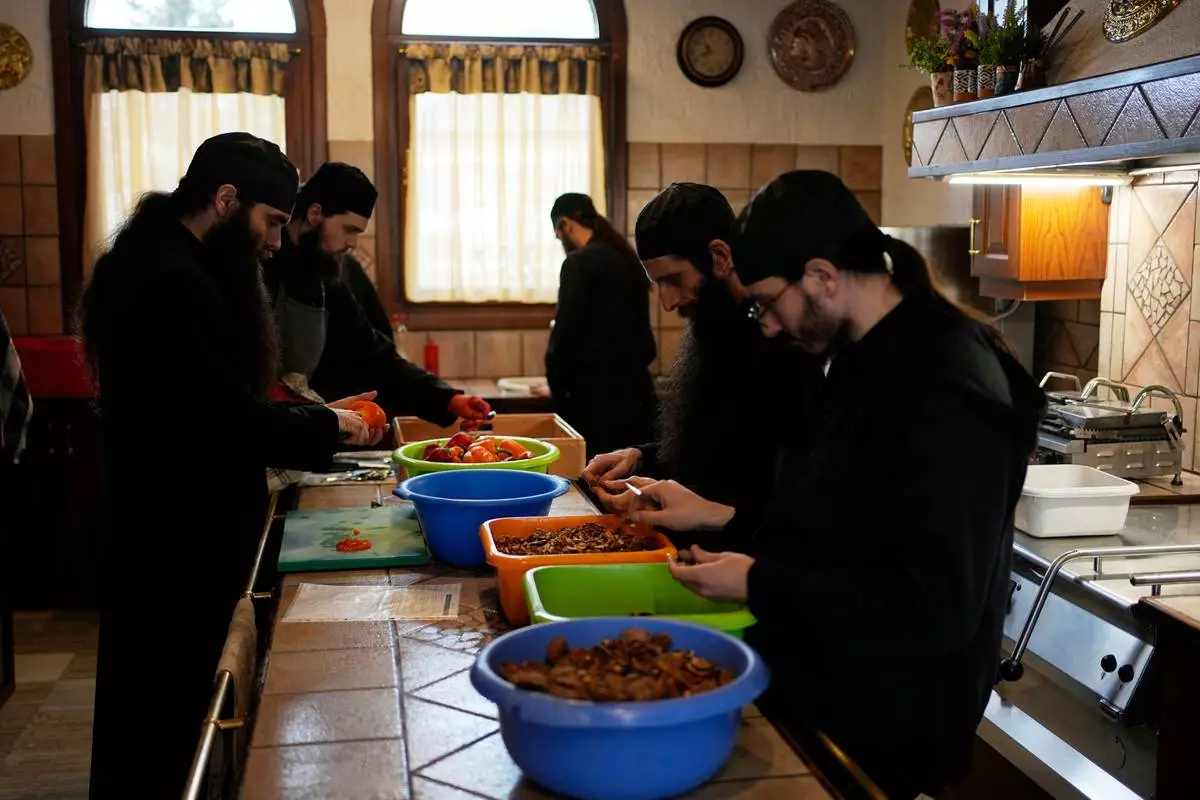
Monks prepare the meals at the Monastery of St. Augustine and Seraphim of Sarov in the village of Trikorfo, about 236 kilometers (147 miles) northwest of Athens, Friday, March 20, 2026. (AP Photo/Thanassis Stavrakis)

A monk prepares meals at the Monastery of St. Augustine and Seraphim of Sarov ahead of Easter as part of annual Lenten dietary restrictions in the village of Trikorfo, about 236 kilometers (147 miles) northwest of Athens, Friday, March 20, 2026. (AP Photo/Thanassis Stavrakis)
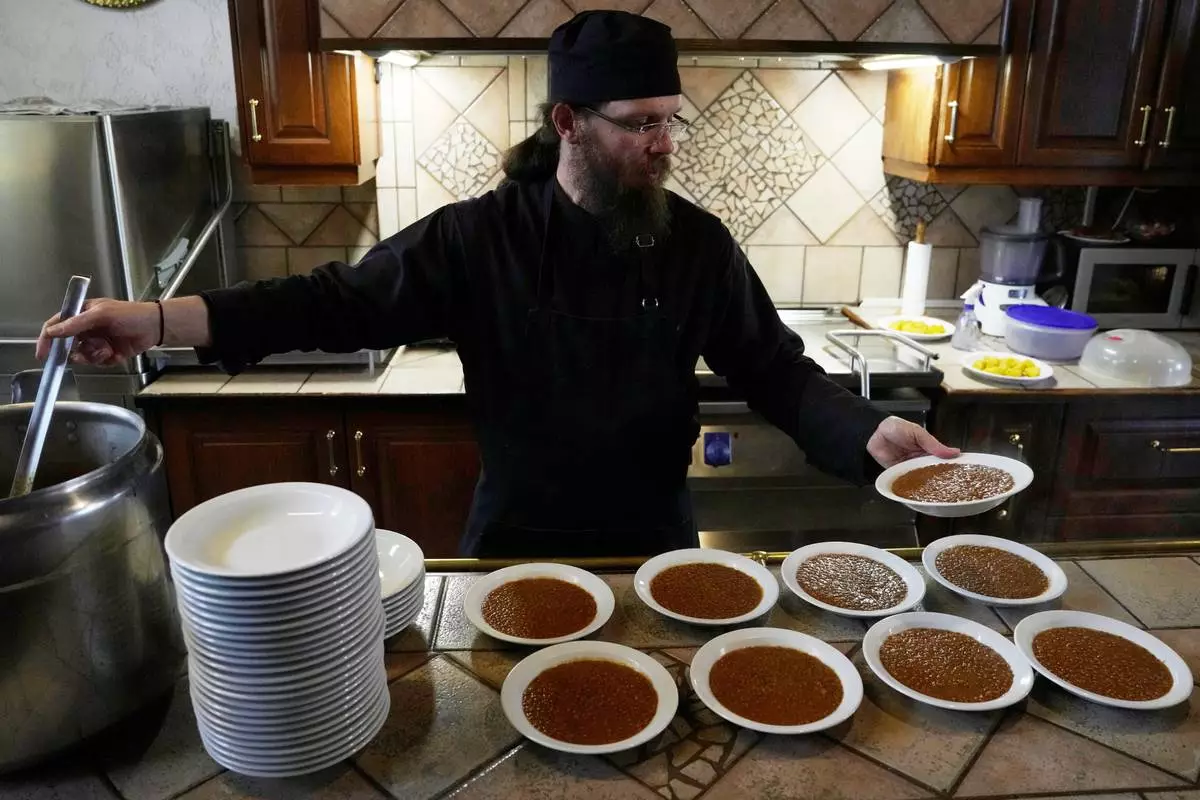
Father Isaac serves lentils for the midday meal at the Monastery of St. Augustine and Seraphim of Sarov in the village of Trikorfo, about 236 kilometers (147 miles) northwest of Athens, Friday, March 20, 2026. (AP Photo/Thanassis Stavrakis)