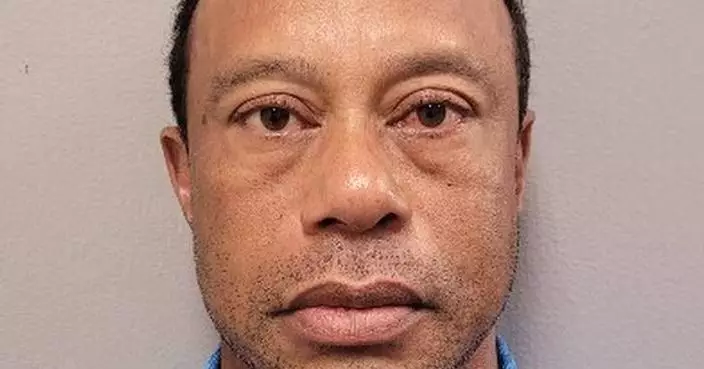
OSAKA, Japan (AP) — Ice dancers Alex and Maia Shibutani say there are no hard feelings between them after a video of Alex berating his sister in practice was leaked on social media.
In the video that surfaced last month, Alex can be heard directing an expletive-laced rant at his younger sister.
The American siblings are competing at this weekend’s NHK Trophy in Osaka, the fourth round of the ISU’s Grand Prix Series. They placed sixth in Friday’s rhythm dance.
Alex also addressed the video, saying “I feel terrible about it.”
“Unfortunately, I lost my temper in training and it shouldn’t have happened," he said. "I apologized to Maia right after our practice.”
Known as the “Shib Sibs,” the 2018 Winter Olympic bronze medalists are attempting a comeback after a break of seven years in the hopes of making the U.S. team for next year’s Milan-Cortina Games.
“The intensity of what we are trying to do and the standards that we have, the two of us, we both understand (the outburst) but it was wrong and I am committed to being a better teammate,” Alex said. “I’m so lucky to skate with Maia. We have a very unique, special relationship and we are committed to each other and to this process.”
Maia Shibutani also commented on the leaked video.
"When you are working toward being your best there are going to be intense moments, but for us we understand each other and the process and we work through it together like siblings do,” she said. “We continued practicing that day and we choose each other every time.”
Alex, 34, and Maia, 31, have skated together most of their lives, and for a long time were the dominant US ice dancers.
They are three-time world championship medalists and two-time Olympians, finishing ninth at the 2014 Olympics at Sochi and third at the 2018 Games at Pyeongchang, where they were also part of the U.S. squad that won a team bronze medal.
The Shibutani siblings took a break from elite-level skating after Pyeongchang to focus on school and other interests.
They extended their competitive hiatus when Maia was diagnosed with a malignant tumor on her kidney in 2019. She underwent surgery to remove the mass, and additional treatment resulted in a successful but long and painful recovery.
AP Winter Olympics at https://apnews.com/hub/milan-cortina-2026-winter-olympics

Maia Shibutani and Alex Shibutani, of the U.S. perform during the ice dance rhythm program at the ISU Grand Prix of Figure Skating - NHK Trophy in Kadoma, east of Osaka, western Japan, Friday, Nov. 7, 2025. (AP Photo/Hiro Komae)
NASHVILLE, Tenn. (AP) — The Tennessee Supreme Court on Wednesday temporarily blocked a lower court's order that would have let media witnesses view more parts of state-run executions.
The ruling restores the prior process ahead of the May 21 scheduled execution of Tony Carruthers, and it will remain in place during an ongoing appeal. The order expanding access had not yet been in effect during any execution.
In January, a Nashville judge issued a temporary injunction favoring a coalition of news organizations including The Associated Press. The group sued over claims that state execution protocols unconstitutionally limit thorough and accurate reporting.
The judge had ordered that the curtains to the official witness room be opened earlier during a lethal injection, allowing witnesses to observe the inmate being secured with restraints to a gurney and the IV insertion process itself. The curtains would have to remain open longer as well, until the pronouncement of death, under the judge's ruling.
The judge also had ruled that, in to protect execution team members' identities, they would have had to wear a disposable protective suit covering the members’ regular work uniform, identification badge and hair, and must be offered a mask to further conceal themselves.
While arguing to block the new rules during its appeal, the state attorney general's office has said the media plaintiffs don't have a right under the First Amendment to watch executions, let alone to see the additional segments ordered viewable by the trial court judge. The state also argued that the order that would have expanded the media's view significantly risks exposing the identities of execution team members, introduces “untested” procedures and relies on an erroneous analysis of state statutes.
In response, attorneys for the media organizations contended that blocking the expanded access would deprive the public of valuable information about upcoming scheduled executions. They have said they have a constitutional and statutory right to observe executions in their entirety and that wearing PPE would shield the execution team's identities.
The order reinstates the process from previous executions, when media members begin seeing what happens once the condemned person is already strapped to a gurney and hooked up to IV lines. Witnesses also don’t know at which precise moment the injections begin and those administering the injections are in a separate room.
The protocol says that after the syringes of saline and pentobarbital are administered, a team leader signals to the warden and a five-minute waiting period begins. After that period, the blinds are closed, the camera is turned off and then the doctor comes in to determine if the person is dead. If that is the case, the warden announces on the intercom system that the sentence was carried out and witnesses are directed to exit.
The camera and closed circuit TV are viewed by the execution team, not media witnesses.
In addition to AP, the media coalition includes Gannett Co., Inc.; Nashville Public Media, Inc.; Nashville Public Radio; Scripps Media, Inc.; Six Rivers Media, LLC; and TEGNA INC.
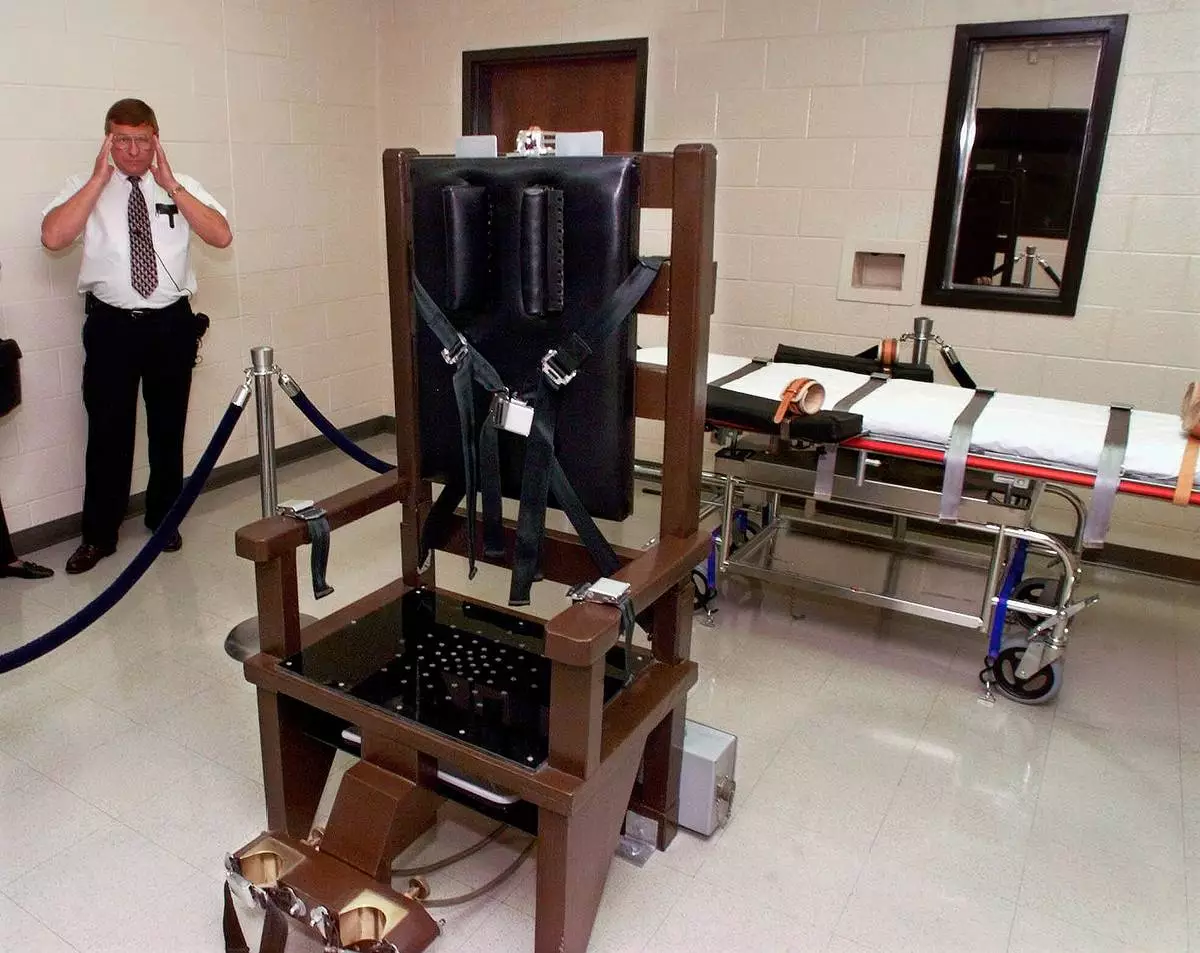
FILE - Ricky Bell, warden at Riverbend Maximum Security Institution in Nashville, Tenn., gives a tour of the prison's execution chamber, Oct. 13, 1999. (AP Photo/Mark Humphrey, File)