Skip to Content Facebook Feature Image

James Watson, co-discoverer of the double-helix shape of DNA, has died at age 97

News

James Watson, co-discoverer of the double-helix shape of DNA, has died at age 97
News

News

James Watson, co-discoverer of the double-helix shape of DNA, has died at age 97

2025-11-08 06:24 Last Updated At:06:30

James D. Watson, whose co-discovery of the twisted-ladder structure of DNA in 1953 helped light the long fuse on a revolution in medicine, crimefighting, genealogy and ethics, has died. He was 97.

The breakthrough — made when the brash, Chicago-born Watson was just 24 — turned him into a hallowed figure in the world of science for decades. But near the end of his life, he faced condemnation and professional censure for offensive remarks, including saying Black people are less intelligent than white people.

Watson shared a 1962 Nobel Prize with Francis Crick and Maurice Wilkins for discovering that deoxyribonucleic acid, or DNA, is a double helix, consisting of two strands that coil around each other to create what resembles a long, gently twisting ladder.

That realization was a breakthrough. It instantly suggested how hereditary information is stored and how cells duplicate their DNA when they divide. The duplication begins with the two strands of DNA pulling apart like a zipper.

Even among non-scientists, the double helix would become an instantly recognized symbol of science, showing up in such places as the work of Salvador Dali and a British postage stamp.

The discovery helped open the door to more recent developments such as tinkering with the genetic makeup of living things, treating disease by inserting genes into patients, identifying human remains and criminal suspects from DNA samples, and tracing family trees and ancient human ancestors. But it has also raised a host of ethical questions, such as whether we should be altering the body’s blueprint for cosmetic reasons or in a way that is transmitted to a person’s offspring.

“Francis Crick and I made the discovery of the century, that was pretty clear,” Watson once said. He later wrote: “There was no way we could have foreseen the explosive impact of the double helix on science and society.”

Watson never made another lab finding that big. But in the decades that followed, he wrote influential textbooks and a best-selling memoir and helped guide the project to map the human genome. He picked out bright young scientists and helped them. And he used his prestige and contacts to influence science policy.

Watson died in hospice care after a brief illness, his son said Friday. His former research lab confirmed he passed away a day earlier.

“He never stopped fighting for people who were suffering from disease,” Duncan Watson said of his father.

Watson's initial motivation for supporting the gene project was personal: His son Rufus had been hospitalized with a possible diagnosis of schizophrenia, and Watson figured that knowing the complete makeup of DNA would be crucial for understanding that disease — maybe in time to help his son.

He gained unwelcome attention in 2007, when the Sunday Times Magazine of London quoted him as saying he was “inherently gloomy about the prospect of Africa” because “all our social policies are based on the fact that their intelligence is the same as ours — where all the testing says not really.” He said that while he hopes everyone is equal, “people who have to deal with Black employees find this is not true.”

He apologized, but after an international furor he was suspended from his job as chancellor of the prestigious Cold Spring Harbor Laboratory in New York. He retired a week later. He had served in various leadership jobs there for nearly 40 years.

In a television documentary that aired in early 2019, Watson was asked if his views had changed. “No, not at all,” he said. In response, the Cold Spring Harbor lab revoked several honorary titles it had given Watson, saying his statements were “reprehensible” and “unsupported by science.”

Watson’s combination of scientific achievement and controversial remarks created a complicated legacy.

He has shown “a regrettable tendency toward inflammatory and offensive remarks, especially late in his career,” Dr. Francis Collins, then-director of the National Institutes of Health, said in 2019. “His outbursts, particularly when they reflected on race, were both profoundly misguided and deeply hurtful. I only wish that Jim’s views on society and humanity could have matched his brilliant scientific insights.”

Long before that, Watson scorned political correctness.

“A goodly number of scientists are not only narrow-minded and dull, but also just stupid,” he wrote in “The Double Helix,” his bestselling 1968 book about the DNA discovery.

For success in science, he wrote: “You have to avoid dumb people. ... Never do anything that bores you. ... If you can’t stand to be with your real peers (including scientific competitors) get out of science. ... To make a huge success, a scientist has to be prepared to get into deep trouble.”

It was in the fall of 1951 that the tall, skinny Watson — already the holder of a Ph.D. at 23 — arrived at Britain’s Cambridge University, where he met Crick. As a Watson biographer later said, “It was intellectual love at first sight.”

Crick himself wrote that the partnership thrived in part because the two men shared “a certain youthful arrogance, a ruthlessness, and an impatience with sloppy thinking.”

Together they sought to tackle the structure of DNA, aided by X-ray research by colleague Rosalind Franklin and her graduate student Raymond Gosling. Watson was later criticized for a disparaging portrayal of Franklin in “The Double Helix,” and today she is considered a prominent example of a female scientist whose contributions were overlooked. (She died in 1958.)

Watson and Crick built Tinker Toy-like models to work out the molecule’s structure. One Saturday morning in 1953, after fiddling with bits of cardboard he had carefully cut to represent fragments of the DNA molecule, Watson suddenly realized how these pieces could form the “rungs” of a double helix ladder.

His first reaction: “It’s so beautiful.”

Figuring out the double helix “goes down as one of the three most important discoveries in the history of biology,” alongside Charles Darwin’s theory of evolution through natural selection and Gregor Mendel’s fundamental laws of genetics, said Cold Spring Harbor lab's president, Bruce Stillman.

Following the discovery, Watson spent two years at the California Institute of Technology, then joined the faculty at Harvard in 1955. Before leaving Harvard in 1976, he essentially created the university’s program for molecular biology, scientist Mark Ptashne recalled in a 1999 interview.

Watson became director of the Cold Spring Harbor lab in 1968, its president in 1994 and its chancellor 10 years later. He made the lab on Long Island an educational center for scientists and non-scientists, focused research on cancer, instilled a sense of excitement and raised huge amounts of money.

He transformed the lab into a “vibrant, incredibly important center,” Ptashne said. It was “one of the miracles of Jim: a more disheveled, less smooth, less typically ingratiating person you could hardly imagine.”

From 1988 to 1992, Watson directed the federal effort to identify the detailed makeup of human DNA. He created the project’s huge investment in ethics research by simply announcing it at a news conference. He later said it was “probably the wisest thing I’ve done over the past decade.”

Watson was on hand at the White House in 2000 for the announcement that the federal project had completed an important goal: a “working draft” of the human genome, basically a road map to an estimated 90 percent of human genes.

Researchers presented Watson with the detailed description of his own genome in 2007. It was one of the first genomes of an individual to be deciphered.

Watson knew that genetic research could produce findings that make some people uncomfortable. In 2007, he wrote that when scientists identify genetic variants that predispose people to crime or significantly affect intelligence, the findings should be publicized rather than squelched out of political correctness.

James Dewey Watson was born in Chicago on April 6, 1928, into “a family that believed in books, birds and the Democratic Party,” as he put it. From his birdwatcher father he inherited an interest in ornithology and a distaste for explanations that didn’t rely on reason or science.

Watson was a precocious child who loved to read, studying books like “The World Telegraph Almanac of Facts.” He entered the University of Chicago on a scholarship at 15, graduated at 19 and earned his doctorate in zoology at Indiana University three years later.

He got interested in genetics at age 17 when he read a book that said genes were the essence of life.

“I thought, ‘Well, if the gene is the essence of life, I want to know more about it,’” he later recalled. “And that was fateful because, otherwise, I would have spent my life studying birds and no one would have heard of me.”

At the time, it wasn’t clear that genes were made of DNA, at least for any life form other than bacteria. But Watson went to Europe to study the biochemistry of nucleic acids like DNA. At a conference in Italy, Watson saw an X-ray image that indicated DNA could form crystals.

“Suddenly I was excited about chemistry,” Watson wrote in “The Double Helix.” If genes could crystallize, “they must have a regular structure that could be solved in a straightforward fashion.”

“A potential key to the secret of life was impossible to push out of my mind,” he recalled.

In the decades after his discovery, Watson’s fame persisted. Apple Computer used his picture in an ad campaign. At conferences, graduate students who weren’t even born when he worked at Cambridge nudged each other and whispered, “There’s Watson. There’s Watson.” They got him to autograph napkins or copies of “The Double Helix.”

A reporter asked him 2018 if any building at the Cold Spring Harbor lab was named after him. No, Watson replied, “I don’t need a building named after me. I have the double helix.”

His 2007 remarks on race were not the first time Watson struck a nerve with his comments. In a speech in 2000, he suggested that sex drive is related to skin color. And earlier he told a newspaper that if a gene governing sexuality were found and could be detected in the womb, a woman who didn’t want to have a gay child should be allowed to have an abortion.

More than a half-century after winning the Nobel, Watson put the gold medal up for auction in 2014. The winning bid, $4.7 million, set a record for a Nobel. The medal was eventually returned to Watson.

Both of Watson’s Nobel co-winners, Crick and Wilkins, died in 2004.

Ritter is a retired AP science writer. AP science writers Christina Larson in Washington and Adithi Ramakrishnan in New York contributed to this report.

The Associated Press Health and Science Department receives support from the Howard Hughes Medical Institute’s Department of Science Education and the Robert Wood Johnson Foundation. The AP is solely responsible for all content.
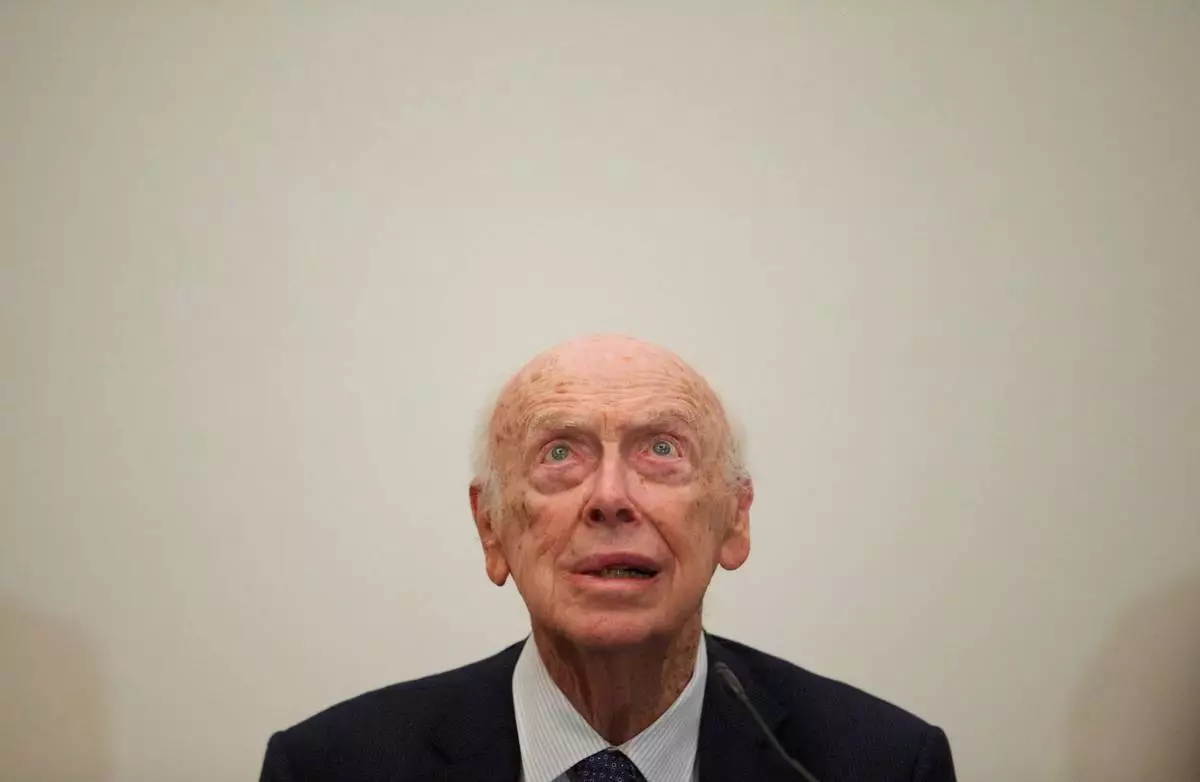
FILE - U.S. Nobel laureate, biologist James Watson speaks at the Russian Academy of Sciences, in Moscow, Russia, Wednesday, June 17, 2015. (AP Photo/Ivan Sekretarev, File)
FILE - U.S. Nobel laureate, biologist James Watson speaks at the Russian Academy of Sciences, in Moscow, Russia, Wednesday, June 17, 2015. (AP Photo/Ivan Sekretarev, File)

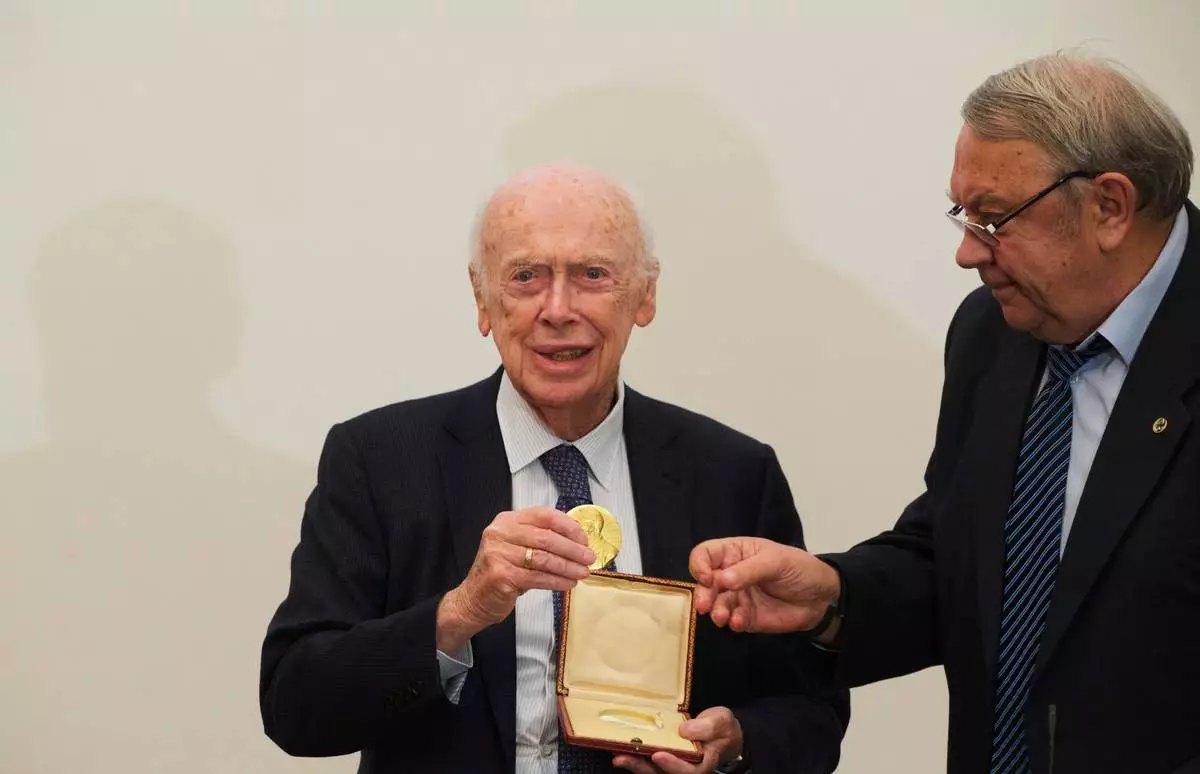
FILE - President of the Russian Academy of Sciences Vladimir Fortov, right, returns a Nobel prize medal which was sold at auction to a Russian businessman, to U.S. Nobel laureate, biologist James Watson in the Russian Academy of Sciences, in Moscow, Russia, Wednesday, June 17, 2015. (AP Photo/Ivan Sekretarev, File)

FILE - President of the Russian Academy of Sciences Vladimir Fortov, right, returns a Nobel prize medal which was sold at auction to a Russian businessman, to U.S. Nobel laureate, biologist James Watson in the Russian Academy of Sciences, in Moscow, Russia, Wednesday, June 17, 2015. (AP Photo/Ivan Sekretarev, File)

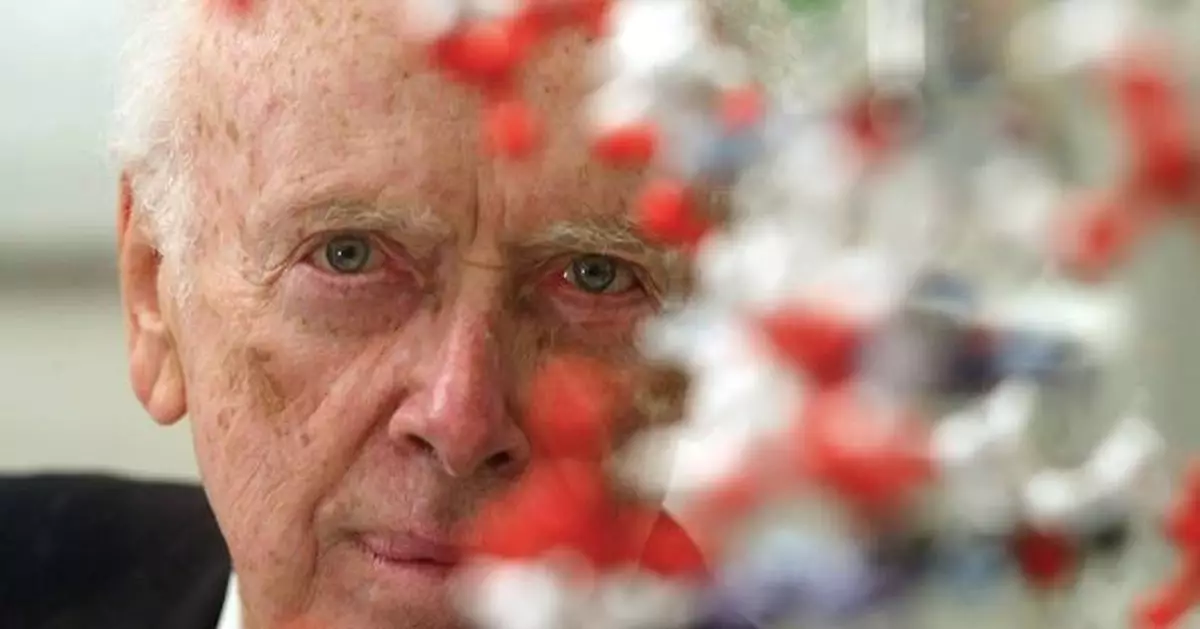
FILE - U.S. biologist James Watson, who shared a Nobel prize for helping discover the double-helix shape of the DNA molecule, poses for a portrait at an exhibition in Berlin on Monday, Oct. 11, 2004. (AP Photo/Markus Schreiber, File)
FILE - U.S. biologist James Watson, who shared a Nobel prize for helping discover the double-helix shape of the DNA molecule, poses for a portrait at an exhibition in Berlin on Monday, Oct. 11, 2004. (AP Photo/Markus Schreiber, File)

SYDNEY (AP) — A child is one of at least 16 people killed in an attack in Australia at one of the world’s most famous beaches, officials said Monday.

Hundreds of people had gathered at Bondi Beach in Sydney for an event to celebrate the first day of Hanukkah, when gunmen opened fire.

At least 16 people are dead and 38 others injured in a terrorist attack authorities say was designed to target the Jewish community.

New South Wales Health Minister Ryan Park said the death toll had risen from 12 to 16 overnight, including a 12-year-old child.

Three other children are being treated in hospital, he said.

THIS IS A BREAKING NEWS UPDATE. AP’s earlier story follows below.

SYDNEY (AP) — Two gunmen attacked a Hanukkah celebration on Sydney's Bondi Beach on Sunday, killing at least 11 people in what Australian Prime Minister Anthony Albanese called an act of antisemitic terrorism that struck at the heart of the nation.

The massacre at one of Australia’s most popular beaches followed a wave of antisemitic attacks that have roiled the country over the past year, although the authorities didn’t suggest those and Sunday’s shooting were connected. It is the deadliest shooting in almost three decades in a country with strict gun control laws.

One gunman was fatally shot by police and the second was arrested and in critical condition, authorities said. Police said one gunman was known to security services, but there was no specific threat.

At least 29 people were confirmed wounded, including two police officers, said Mal Lanyon, police commissioner for New South Wales state, where Sydney is located.

Police said officers were examining a number of suspicious items, including improvised explosive devices found in one of the suspect’s car.

“This attack was designed to target Sydney's Jewish community,” New South Wales Premier Chris Minns said.

The violence erupted at the end of a summer day when thousands had flocked to Bondi Beach, including hundreds gathered for the Chanukah by the Sea event celebrating the start of the eight-day Hanukkah festival.

Chabad, an Orthodox Jewish movement that runs outreach around the world and sponsors public events during major Jewish holidays, identified one of the dead as Rabbi Eli Schlanger, assistant rabbi at Chabad of Bondi and an organizer of the event.

Israel’s Foreign Ministry confirmed the death of an Israeli citizen, but gave no further details.

Police said emergency services were called to Campbell Parade in Bondi about 6:45 p.m. responding to reports of shots being fired. Video filmed by onlookers showed people in bathing suits running from the water as shots rang out. Separate footage showed two men in black shirts firing with long guns from a footbridge leading to the beach, as sirens wailed and people cried out in the background.

One dramatic clip broadcast on Australian television showed a man appearing to tackle and disarm one of the gunmen, before pointing the man’s weapon at him, then setting the gun on the ground.

Minns called the man, named by relatives to Australian media as fruit shop owner Ahmed al Ahmed, a “genuine hero.”

Arsen Ostrovsky, a lawyer attending the Hanukkah ceremony with his wife and daughters, was grazed in the head by a bullet. Ostrovsky said he moved from Israel to Australia two weeks ago to work for a Jewish advocacy group.

“What I saw today was pure evil, just an absolute bloodbath. Bodies strewn everywhere,” he told The Associated Press in an email from the hospital. “It was like reliving Oct. 7 all over."

"I never thought would be possible here in Australia."

Lachlan Moran, 32, from Melbourne, told the AP he was waiting for his family when he heard shots. He dropped the beer he was carrying and ran.

"I sprinted as quickly as I could," Moran said. He said he heard shooting off and on for about five minutes. “Everyone just dropped all their possessions and everything and were running and people were crying and it was just horrible."

Albanese told reporters in the capital, Canberra, that he was “devastated” by the massacre.

“This is a targeted attack on Jewish Australians on the first day of Hanukkah, which should be a day of joy, a celebration of faith. An act of evil, antisemitism, terrorism that has struck the heart of our nation,” Albanese said.

He vowed the violence would be met with “a moment of national unity where Australians across the board will embrace their fellow Australians of Jewish faith.”

King Charles III said he and Queen Camilla were “appalled and saddened by the most dreadful antisemitic terrorist attack.” United Nations Secretary-General António Guterres said on X he was horrified, and his “heart is with the Jewish community worldwide.”

U.S. Secretary of State Marco Rubio said in a post on X: “The United States strongly condemns the terrorist attack in Australia targeting a Jewish celebration. Antisemitism has no place in this world.”

Police in cities around the world, including London, said they would step up security at Jewish sites.

Australia, a country of 28 million people, is home to about 117,000 Jews, according to official figures. Antisemitic incidents, including assaults, vandalism, threats and intimidation, surged more than threefold in the country during the year after Hamas attacked Israel on Oct. 7, 2023, and Israel launched a war on Hamas in Gaza in response, the government's Special Envoy to Combat Antisemitism Jillian Segal reported in July.

Last year, the country was rocked by antisemitic attacks in Sydney and Melbourne. Synagogues and cars were torched, businesses and homes graffitied and Jews attacked in those cities, where 85% of the nation’s Jewish population lives.

Albanese in August blamed Iran for two of the attacks and cut diplomatic ties to Tehran.

Pastor Matt Graham was conducting a service at Bondi Anglican Church when panicked people began entering for shelter. He said antisemitism has been brewing in Sydney’s eastern suburbs including Bondi, where the Jewish community is centered.

"I’m surrounded by antisemitic graffiti constantly. I think for our community in the east (of Sydney), and as a Christian, I just want to declare I stand with the people of Israel,” Graham told the Australian Broadcasting Corp.

Israel urged Australia's government to address crimes targeting Jews. Prime Minister Benjamin Netanyahu said he warned Australia’s leaders months ago about the dangers of failing to take action against antisemitism. He claimed Australia's decision — in line with scores of other countries — to recognize a Palestinian state “pours fuel on the antisemitic fire.”

“Your government did nothing to stop the spread of antisemitism in Australia ... and the result is the horrific attacks on Jews we saw today,” Netanyahu said.

Mass shootings in Australia are extremely rare. A 1996 massacre in the Tasmanian town of Port Arthur, where a lone gunman killed 35 people, prompted the government to drastically tighten gun laws, making it much more difficult to acquire firearms.

Significant mass shootings this century included two murder-suicides with death tolls of five people in 2014 and seven in 2018, in which gunmen killed their own families and themselves.

In 2022, six people were killed in a shootout between police and Christian extremists at a rural property in Queensland state.

McGuirk reported from Melbourne, Australia, and Graham-McLay from Wellington, New Zealand. Associated Press writer Melanie Lidman in Tel Aviv, Israel, and Mustakim Hasnath in London contributed to this report.

A small Christmas tree is at the center of an abandoned holiday picnic at Bondi Beach after a reported shooting in Sydney, Sunday, Dec. 14, 2025. (AP Photo/Mark Baker)

A small Christmas tree is at the center of an abandoned holiday picnic at Bondi Beach after a reported shooting in Sydney, Sunday, Dec. 14, 2025. (AP Photo/Mark Baker)

Bystanders stay where police cordon off an area at Bondi Beach after a reported shooting in Sydney, Sunday, Dec. 14, 2025. (AP Photo/Mark Baker)

Bystanders stay where police cordon off an area at Bondi Beach after a reported shooting in Sydney, Sunday, Dec. 14, 2025. (AP Photo/Mark Baker)

Emergency workers transport a person on a stretcher after a reported shooting at Bondi Beach in Sydney, Sunday, Dec. 14, 2025. (AP Photo/Mark Baker)

Emergency workers transport a person on a stretcher after a reported shooting at Bondi Beach in Sydney, Sunday, Dec. 14, 2025. (AP Photo/Mark Baker)

Emergency workers standby at Bondi Beach after a reported shooting in Sydney, Sunday, Dec. 14, 2025. (AP Photo/Mark Baker)

Emergency workers standby at Bondi Beach after a reported shooting in Sydney, Sunday, Dec. 14, 2025. (AP Photo/Mark Baker)

Emergency workers transport a person on a stretcher after a reported shooting at Bondi Beach in Sydney, Sunday, Dec. 14, 2025. (AP Photo/Mark Baker)

Emergency workers transport a person on a stretcher after a reported shooting at Bondi Beach in Sydney, Sunday, Dec. 14, 2025. (AP Photo/Mark Baker)

Emergency workers transport a person on a stretcher after a reported shooting at Bondi Beach in Sydney, Sunday, Dec. 14, 2025. (AP Photo/Mark Baker)

Emergency workers transport a person on a stretcher after a reported shooting at Bondi Beach in Sydney, Sunday, Dec. 14, 2025. (AP Photo/Mark Baker)

Emergency workers transport a person on a stretcher after a reported shooting at Bondi Beach in Sydney, Sunday, Dec. 14, 2025. (AP Photo/Mark Baker)

Emergency workers transport a person on a stretcher after a reported shooting at Bondi Beach in Sydney, Sunday, Dec. 14, 2025. (AP Photo/Mark Baker)

Emergency workers transport a person on a stretcher after a reported shooting at Bondi Beach in Sydney, Sunday, Dec. 14, 2025. (AP Photo/Mark Baker)

Emergency workers transport a person on a stretcher after a reported shooting at Bondi Beach in Sydney, Sunday, Dec. 14, 2025. (AP Photo/Mark Baker)

Emergency workers transport a person on a stretcher after a reported shooting at Bondi Beach in Sydney, Sunday, Dec. 14, 2025. (AP Photo/Mark Baker)

Emergency workers transport a person on a stretcher after a reported shooting at Bondi Beach in Sydney, Sunday, Dec. 14, 2025. (AP Photo/Mark Baker)

Emergency workers transport a person on a stretcher after a reported shooting at Bondi Beach, in Sydney, Sunday, Dec. 14, 2025. (AP Photo/Mark Baker)

Emergency workers transport a person on a stretcher after a reported shooting at Bondi Beach, in Sydney, Sunday, Dec. 14, 2025. (AP Photo/Mark Baker)

Recommended Articles