KANSAS CITY, Mo. (AP) — Patrick Mahomes tore the ACL in his left knee while trying to keep the Kansas City Chiefs' postseason hopes alive in the waning seconds of a 16-13 loss to the Los Angeles Chargers on Sunday, and the two-time MVP quarterback was considering surgical options.
It's the most significant injury of a superlative nine-year career for Mahomes, who has led the Chiefs to three Super Bowl titles and reached the AFC championship game in each of his seven previous seasons as the starter in Kansas City.
Click to Gallery
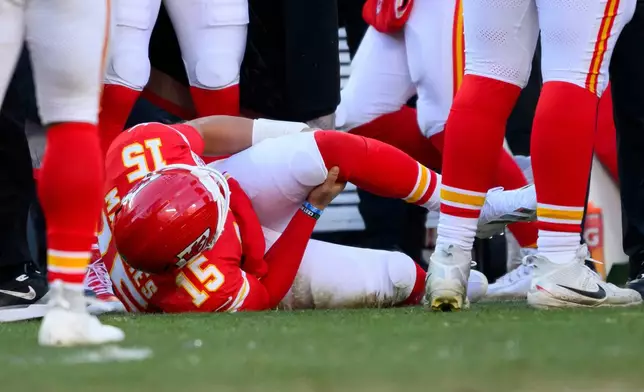
Kansas City Chiefs quarterback Patrick Mahomes grabs his knee after being injured during the second half of an NFL football game against the Los Angeles Chargers, Sunday, Dec. 14, 2025 in Kansas City, Mo. (AP Photo/Reed Hoffmann)
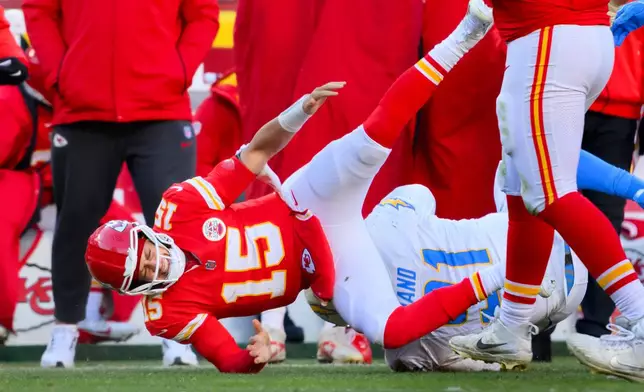
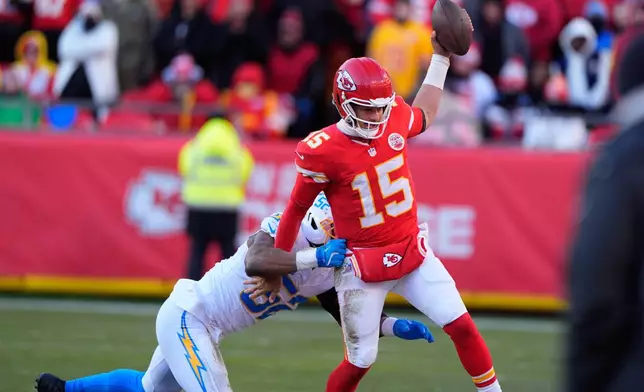
Kansas City Chiefs quarterback Patrick Mahomes (15) is injured after being tackled by Los Angeles Chargers defensive tackle Da'Shawn Hand (91) during the second half of an NFL football game, Sunday, Dec. 14, 2025 in Kansas City, Mo. (AP Photo/Reed Hoffmann)
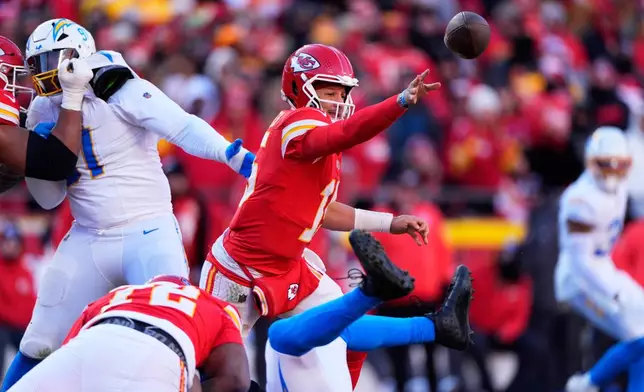
Kansas City Chiefs quarterback Patrick Mahomes (15) gets rid of the ball during the second half of an NFL football game against the Los Angeles Chargers Sunday, Dec. 14, 2025, in Kansas City, Mo. (AP Photo/Charlie Riedel)
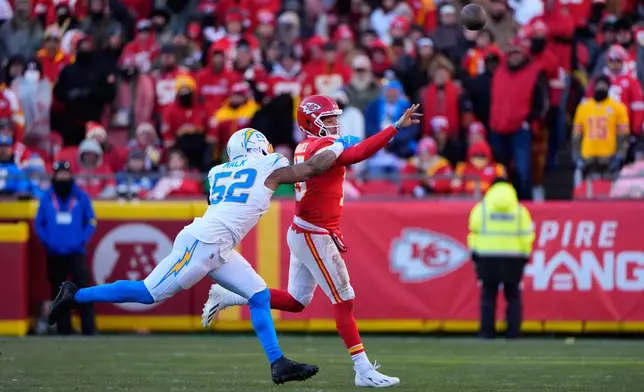
Kansas City Chiefs quarterback Patrick Mahomes, right, throws the ball away under pressure from Los Angeles Chargers outside linebacker Khalil Mack (52) during the second half of an NFL football game Sunday, Dec. 14, 2025, in Kansas City, Mo. (AP Photo/Charlie Riedel)
Kansas City Chiefs quarterback Patrick Mahomes (15) is pushed out of bounds by Los Angeles Chargers outside linebacker Khalil Mack, left, during the second half of an NFL football game Sunday, Dec. 14, 2025, in Kansas City, Mo. (AP Photo/Charlie Riedel)
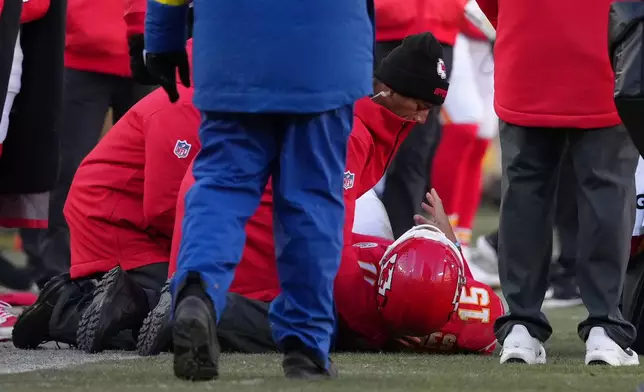
Kansas City Chiefs quarterback Patrick Mahomes (15) is checked on after being injured during the second half of an NFL football game against the Los Angeles Chargers Sunday, Dec. 14, 2025, in Kansas City, Mo. (AP Photo/Ed Zurga)
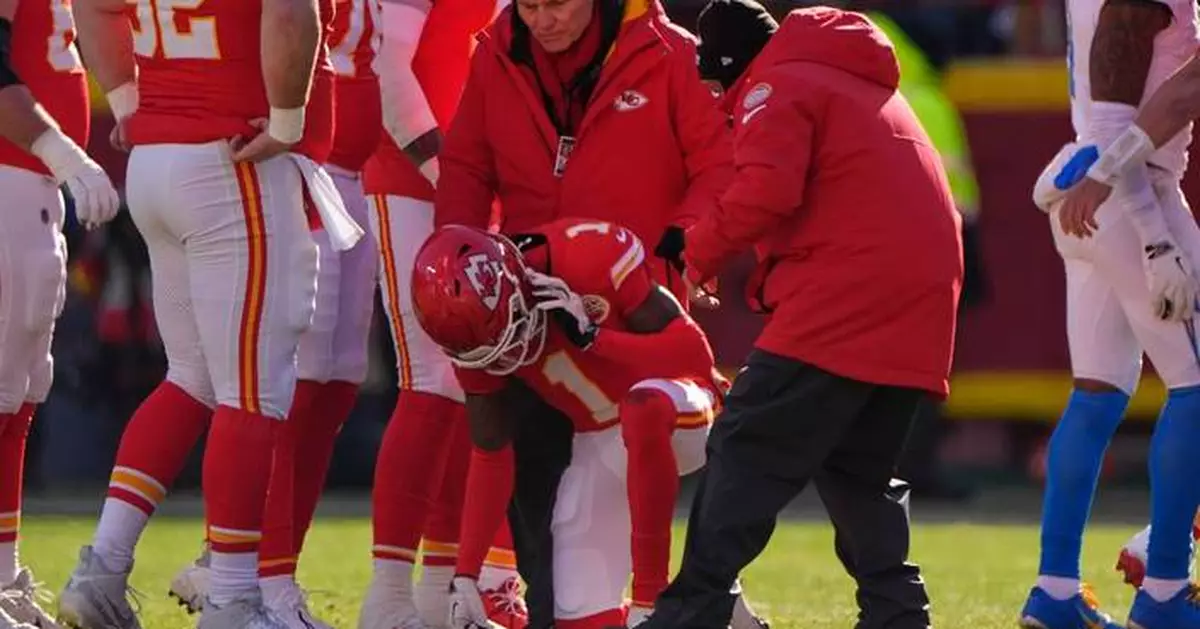
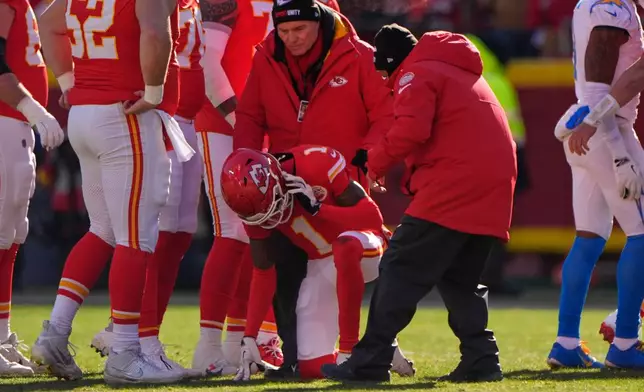
Kansas City Chiefs wide receiver Xavier Worthy (1) is checked on after being injured during the first half of an NFL football game against the Los Angeles Chargers Sunday, Dec. 14, 2025, in Kansas City, Mo. (AP Photo/Charlie Riedel)
This year, the Chiefs won't even make the playoffs, and Mahomes won't be back on the field until sometime in 2026.
“Don’t know why this had to happen,” Mahomes posted on social media before the diagnosis was announced. “And not going to lie it hurts. But all we can do now is trust in God and attack every single day over and over again. Thank you Chiefs kingdom for always supporting me and for everyone who has reached out and sent prayers. I Will be back stronger than ever.”
The Chiefs had just crossed midfield with less than two minutes to go Sunday when Mahomes scrambled toward the Kansas City sideline, then tried to get rid of the ball. He was spun to the ground upon release by Chargers defensive lineman Da'Shawn Hand, and Mahomes immediately grabbed at his left knee while trainers converged on him.
He was eventually helped to the blue injury tent on the sideline, but Mahomes only stayed there for a few moments. He soon emerged with staff members on either side of him, limping toward the locker room with a white towel draped over his head.
“He will get an MRI tomorrow or this evening,” Chiefs coach Andy Reid said, “whenever we can.”
It turned out to be Sunday night. And the news was what everyone in Kansas City had feared.
“I just hugged him, man,” Chiefs defensive tackle Chris Jones said. “That’s my brother. We’ve been through so much. We love Pat.”
Gardner Minshew entered the game and completed three straight passes to give the Chiefs a chance. But he was picked off by Derwin James on a jump ball intended for Travis Kelce with 14 seconds remaining, sealing the Chargers' season sweep of Kansas City.
“I hate the situation. I hate that I couldn’t deliver the win and keep our hopes alive,” Minshew said.
The loss, along with wins by Jacksonville, Buffalo and Houston, eliminated the defending AFC champs from playoff contention.
“It’s very frustrating, man. It’s been hard to watch for Pat, a dude that puts so much into it,” Minshew said. “I’ve never seen someone give so much of themselves to the team. I have confidence in him and his ability to come back better than ever.”
The 30-year-old has dodged severe injuries for most of his career.
The worst previous injury may have come in 2019, when Mahomes dislocated his right kneecap on a quarterback sneak against the Broncos, a fluke injury that may be why Reid has not called another traditional QB sneak in years.
Mahomes has dealt with a concussion, turf toe and other minor injuries, but his most famous may have occurred during the 2022 playoffs, when he sustained a severe high ankle sprain. Questions swirled around whether Mahomes would be able to play the next week, and he not only was on the field but the led the Chiefs to victory, and then to an eventual Super Bowl title.
The injury to Mahomes, who threw for just 189 yards with an interception, was merely the latest — and most severe — in a series of setbacks that had turned what had been one of the NFL's best offenses for the better part of a decade into a shadow of itself.
Kansas City started the game with left tackle Josh Simmons on injured reserve with a fractured wrist, backup Wanya Morris out with a knee injury, right tackle Trey Smith inactive with an ankle injury and right tackle Jawaan Taylor dealing with a triceps injury.
Backup right tackle Jaylon Moore hurt his knee during the game, too, leaving journeyman Esa Pole and Chukwuebuka Godrick — an international pathway player who had never appeared in an NFL game — to protect Mahomes down the stretch.
The Chiefs also were missing Marquise Brown, who was inactive while dealing with a family matter, and fellow wide receiver Tyquan Thornton, who was crushed by Chargers cornerback Tony Jefferson after a 20-yard catch and was evaluated for a concussion.
Another receiver, Xavier Worthy, missed part of the game while clearing the concussion protocol.
It hasn't just been the Chiefs' offense where the injuries have mounted.
They began the game without Trent McDuffie, who was inactive with a knee injury. Then in a span of three straight plays, they lost linebacker Nick Bolton, defensive tackle Chris Jones and cornerback Jaylen Watson, though each of them eventually returned.
“We have a lot of guys who are very resilient in our locker room,” Jones said. “We all knew what was at stake. We all wanted to be part of this game. We were looking forward to it. Unfortunately, we didn't get the outcome we hoped for, but everyone battled.”
AP NFL: https://apnews.com/hub/nfl
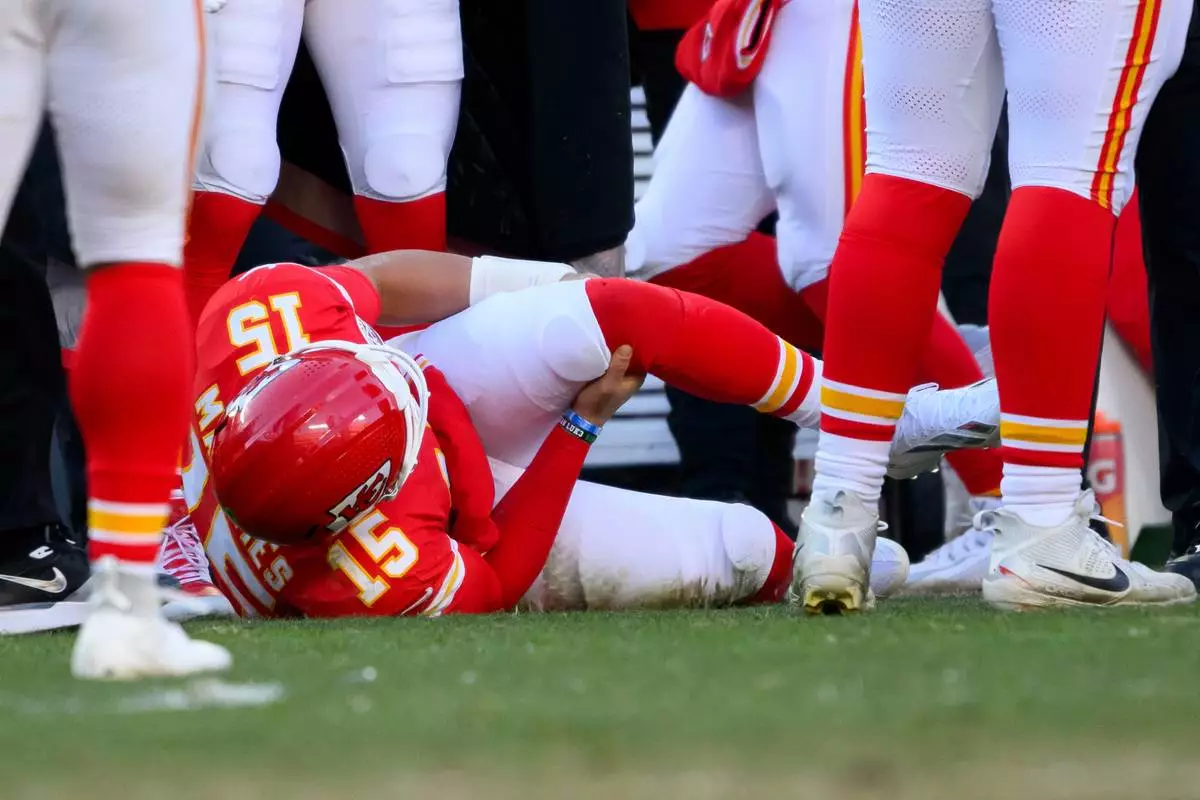
Kansas City Chiefs quarterback Patrick Mahomes grabs his knee after being injured during the second half of an NFL football game against the Los Angeles Chargers, Sunday, Dec. 14, 2025 in Kansas City, Mo. (AP Photo/Reed Hoffmann)
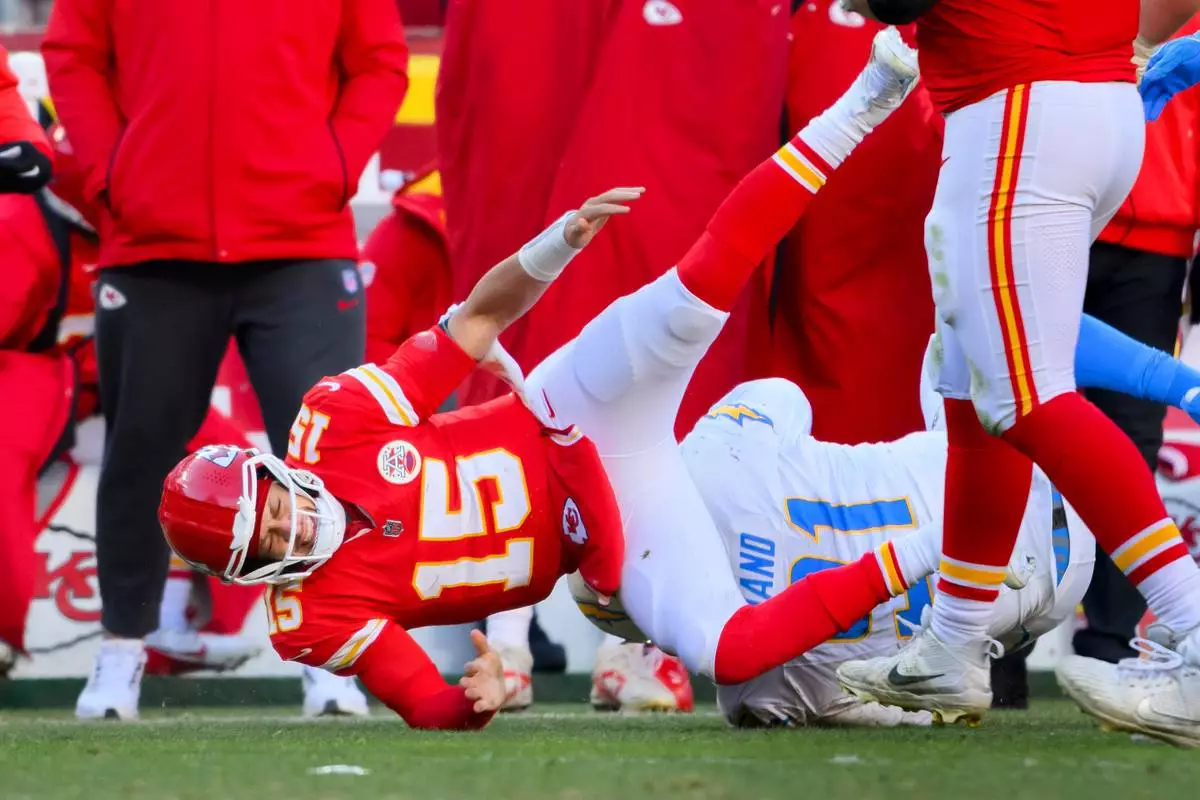
Kansas City Chiefs quarterback Patrick Mahomes (15) is injured after being tackled by Los Angeles Chargers defensive tackle Da'Shawn Hand (91) during the second half of an NFL football game, Sunday, Dec. 14, 2025 in Kansas City, Mo. (AP Photo/Reed Hoffmann)
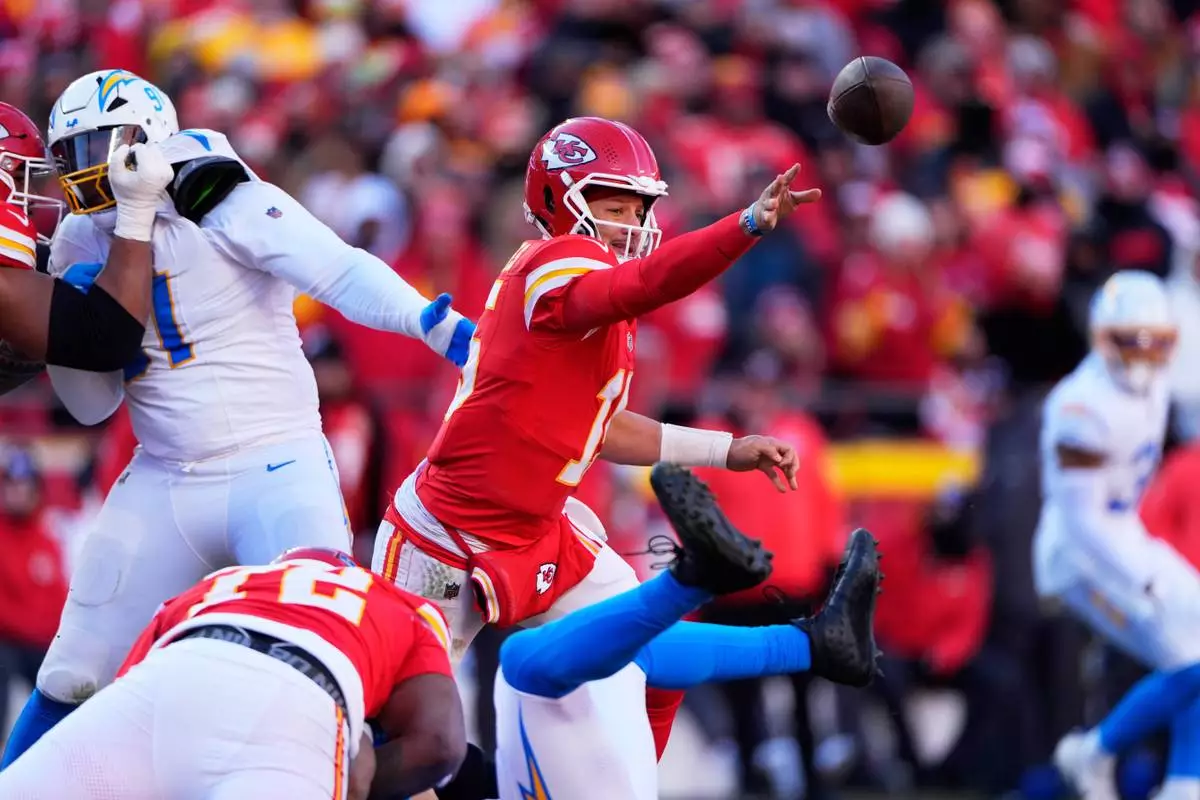
Kansas City Chiefs quarterback Patrick Mahomes (15) gets rid of the ball during the second half of an NFL football game against the Los Angeles Chargers Sunday, Dec. 14, 2025, in Kansas City, Mo. (AP Photo/Charlie Riedel)
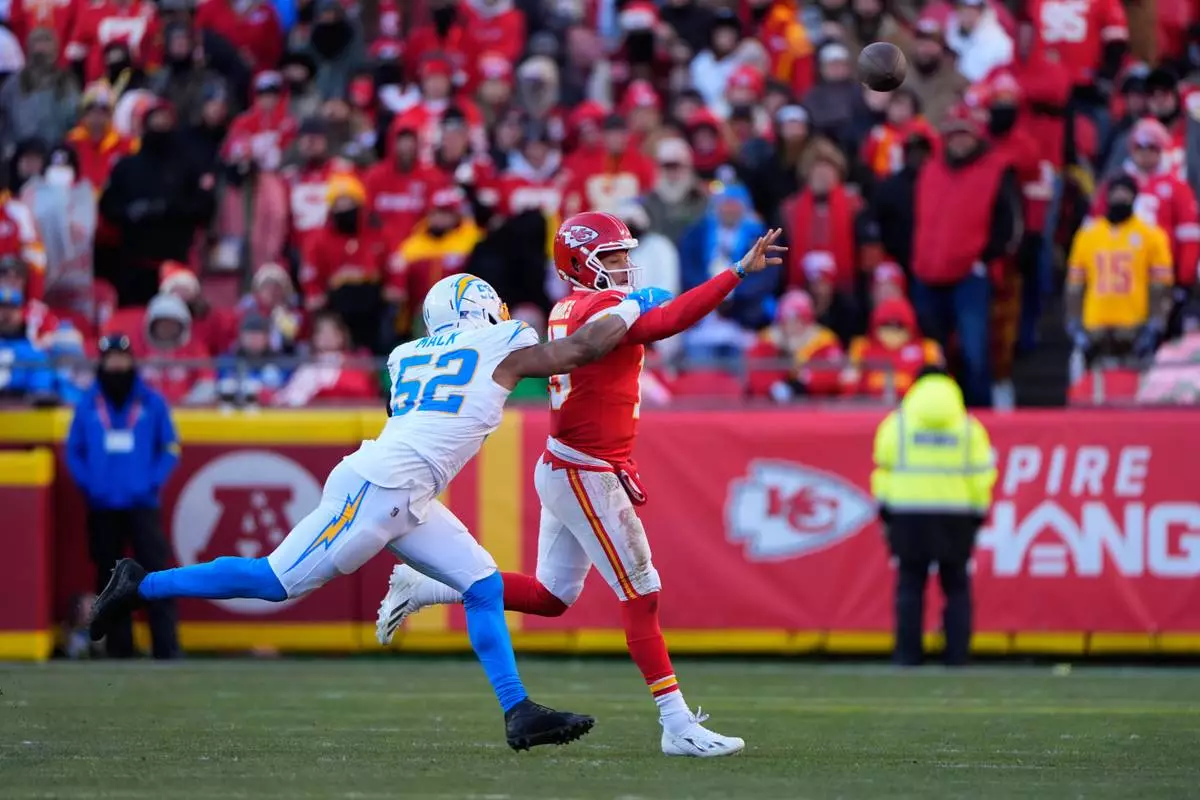
Kansas City Chiefs quarterback Patrick Mahomes, right, throws the ball away under pressure from Los Angeles Chargers outside linebacker Khalil Mack (52) during the second half of an NFL football game Sunday, Dec. 14, 2025, in Kansas City, Mo. (AP Photo/Charlie Riedel)
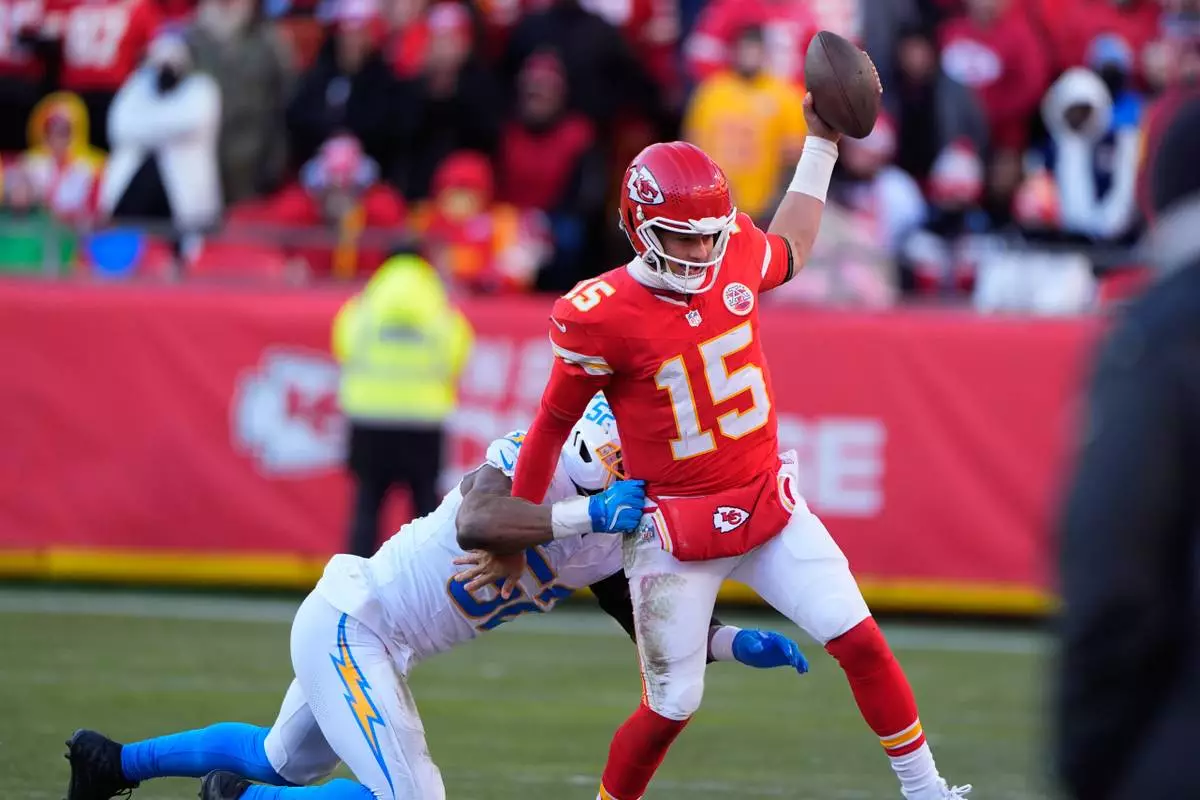
Kansas City Chiefs quarterback Patrick Mahomes (15) is pushed out of bounds by Los Angeles Chargers outside linebacker Khalil Mack, left, during the second half of an NFL football game Sunday, Dec. 14, 2025, in Kansas City, Mo. (AP Photo/Charlie Riedel)
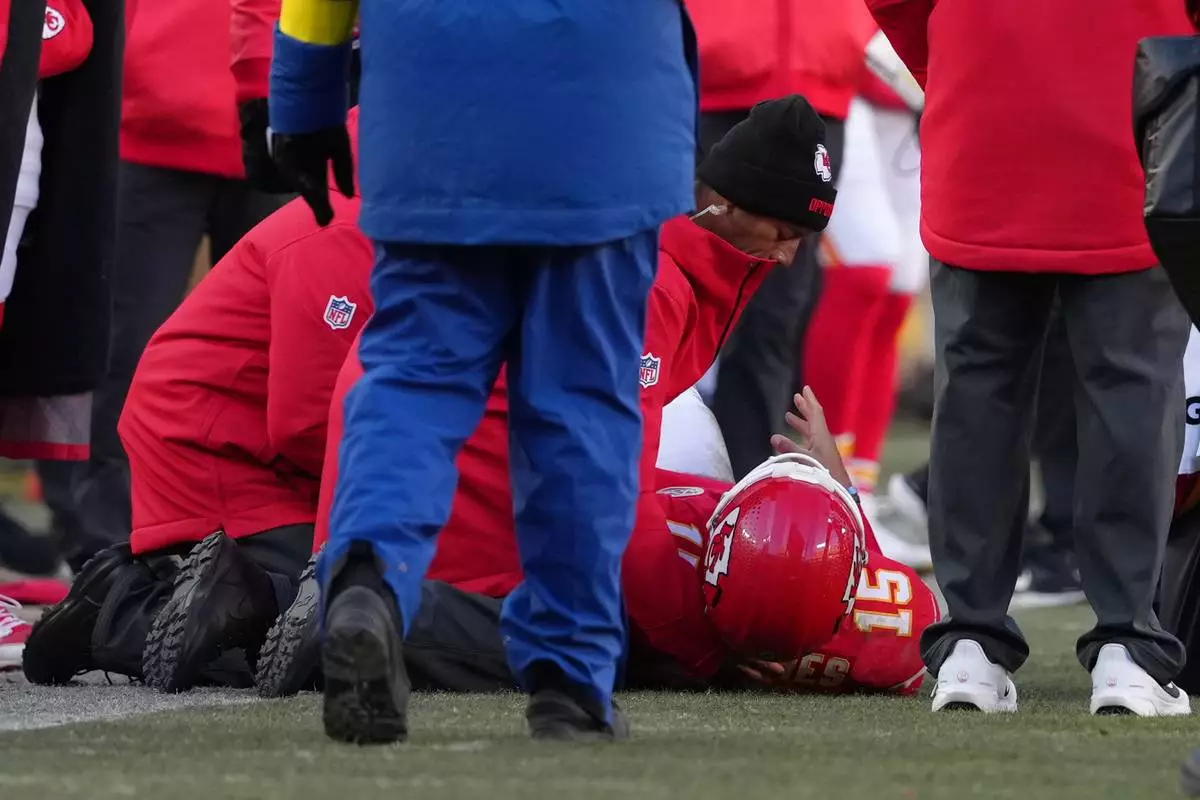
Kansas City Chiefs quarterback Patrick Mahomes (15) is checked on after being injured during the second half of an NFL football game against the Los Angeles Chargers Sunday, Dec. 14, 2025, in Kansas City, Mo. (AP Photo/Ed Zurga)
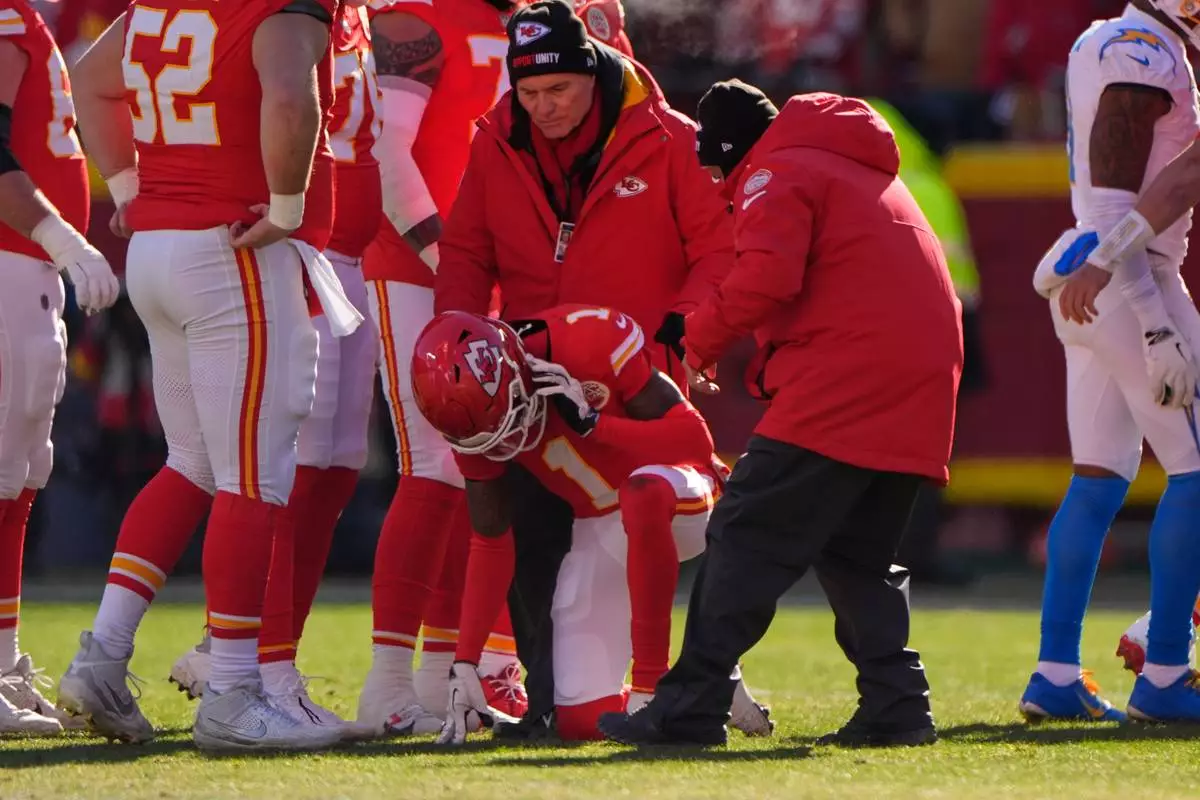
Kansas City Chiefs wide receiver Xavier Worthy (1) is checked on after being injured during the first half of an NFL football game against the Los Angeles Chargers Sunday, Dec. 14, 2025, in Kansas City, Mo. (AP Photo/Charlie Riedel)
LOS ANGELES (AP) — Many in the Iranian American diaspora spent several days glued to their televisions, watching the news of U.S. and Israeli bombs falling on Iran, some clinging to hope it might bring a brighter future to their homeland but terrified their relatives will suffer in a new Middle East war with no certain end.
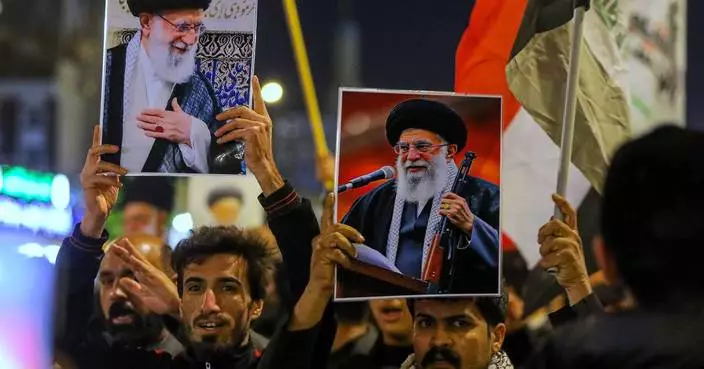
Ayatollah Ali Khamenei, who ruled Iran for decades while violently crushing dissent, was killed early in the attack. In the United States, many celebrated, some popped Champagne, some downed shots of tequila, some took to the streets to cheer the toppling of a ruler they considered a tyrant.
“We are happy, we are happy that he is gone and he can’t kill our innocent people anymore,” said Ava Farhadi, 33, an electrical engineer in Indiana. In January, Farhadi’s family participated in protests against their government, which were met with a brutal crackdown. While her immediate family was unhurt, Farhadi said, friends and close loved ones were among the thousands killed when security forces opened fire on peaceful protesters.
Many said they are worried for their families still there and what the future holds.
Roozbeh Farahanipour, a Los Angeles restaurant owner who was jailed and tortured following the 1999 student protests in Iran, said he's felt a swirl of emotions.
He celebrated when he heard Khamenei was killed in the initial U.S. and Israeli strikes. “I open a bottle of Champagne and drink it up,” he said. “That was a happy moment but we are looking at what happens next.”
Deaths have mounted as the bombardment continued into Monday, claiming U.S. service members and Iran civilians. Farahanipour said he mourns for them.
Between 400,000 and 620,000 people of Iranian ancestry live in the U.S., according to the University of California Los Angeles, the vast majority of them in California. Farahanipour's restaurant is in a part of Los Angeles nicknamed Tehrangeles — the heart of the Iranian diaspora in the U.S. — where Iranian flags hang outside shops selling everything from books to rugs.
Nearby, Todd Khodadadi, the 47-year-old owner of Tochal Market, said he and his family lived under the regime in Iran until they fled more than two decades ago and started over in the U.S.
Khodadadi said he’s been glued to news apps and group chats with friends in Iran. Even as bombs rained down, the weekend’s violence still doesn’t compare to the scale and severity of what Iranians have suffered for years on end, he said, surrounded in his store by boxes of date-filled pastries and rice cookies affixed with stickers reading “Free Iran.”
“The people in Iran, they live in hell,” he said. “We want democracy, we don’t want one person sitting in one chair for decades and decades and control everything.”
It has been difficult for many to communicate with their loved ones still in their homeland. Phone and internet connections aren’t reliable.
“It’s eerie, it’s very eerie to see these terrible scenes of Iranians crying over dead relatives and their destroyed homes,” said Shahed Ghoreishi, 34, a foreign policy analyst whose parents fled Iran and still has many relatives there. “And you’re like, wait, does my family live on that street? How close are they to that bomb? Then you try to geolocate where your family lives and where the bombs are dropping on TV at the same time.”
His mother told him she hasn’t slept because she can’t reach her sister, who recently had back surgery. The Iranian people were already suffering shortages of food and medicine because of strict sanctions imposed on the country and Ghoreishi worries not only that they could be killed by the bombardment, but also that they won’t be able to access life-sustaining necessities as the war drags on.
Ghoreishi, who was fired from his role at the U.S. State Department last year after some questioned his loyalty to the administration's policies in the Middle East, said he doesn’t see how this will end with lasting change for the Iranian people.
“I don’t see a clear strategy and I see a lot of violence, and those two things make me pessimistic for this moment,” he said.
He hopes that he’s wrong. So does Mahdis Keshavarz, 49, who fled Iran as a child and works now in social justice advocacy in Los Angeles.
“My people deserve to be happy, and I understand fully why they would be happy and hopeful for a tyrant to be out of commission,” she said. “We have dreamed of the day where we would be rid of them so that we can have the homeland and the peace we all deserve.”
Keshavarz still has many loved ones in Iran, and says she’s worried “day and night” for them. In war, she said, ordinary people always pay the highest price.
To her, this moment recalls the region’s long history of intractable wars that cost hundreds of thousands of lives but failed to deliver on promises of democratic stability, sometimes creating power vacuums filled by rulers just as bad or worse.
She cannot see now how this time will be any different.
“This is where I hope I’m wrong,” she said. “I hope that a month from now, or two weeks from now, that joy remains because there is something positive that comes out of this. Because at the moment I don’t see it.”
Many said they hope that the Trump administration has a more solid plan for a transition than is clear right now.
Roya Boroumand’s father helped form the National Movement of the Iranian Resistance, one of the first opposition parties fighting for democracy. He was stabbed to death in the lobby of his Paris apartment by agents of the Islamic Republic in 1991. Boroumand said that those celebrating should remember the sacrifices that people of previous generations have made to advance human rights in the country — and recognize how much work is required to realize those rights now that the regime has been weakened.
“You can’t just bomb your way out of a totalitarian regime,” said Boroumand, who co-founded the Abdorrahman Boroumand Foundation in 2001 to promote human rights in Iran. She emphasized that any military operation needs to be supplemented by significant structural and economic transformation led by Iranian civilians.
“This is the time to make sure what needs to happen happens so that what we have endured for the past 45-60 years doesn’t happen again,” she said.
Some others said they saw no other way to forge a better path forward than to cut off the regime at its head.
“In Iran we cannot accept that murderers can control the country. When they start to kill people just because of their voices, there is no choice but to start a war,” said Soheila Boojari, 47, a native of Iran and engineer in suburban Detroit, who took to the streets this weekend to celebrate the strikes. “I don’t want a war for any people. I am very worried about my family there. But who can help us?”
At Colbeh, a Persian restaurant in Great Neck, New York, staff downed shots of tequila Saturday night to celebrate the attacks. Restaurant partner Pejman Touby said he walked over the mountains at age 12 to escape Iran in 1984.
“A lot of our employees came out of Iran the same way. We left everything we had there,” Touby, 53, said. “We had shots in honor of the U.S. government, Israel government for standing on their word and doing whatever they can to get rid of this evil regime.”
Many said they are hopeful that maybe, soon, they can return to Iran to see the family they left behind decades ago.
Gita Zarnegar, a 63-year-old psychoanalyst, said she and her Jewish family left Iran in 1979 when the regime took over.
“I’m elated that my country of origin is going to be free from 47 years of enslavement to a tyrannical and cruel regime that took away people’s freedom and liberty,” she said.
She will visit as soon as it is safe enough, she said.
“I will be the first person on that plane.”
__
Associated Press reporter Krysta Fauria contributed from Los Angeles. Galofaro reported from Louisville, Kentucky, Riddle from New York and White from Detroit.
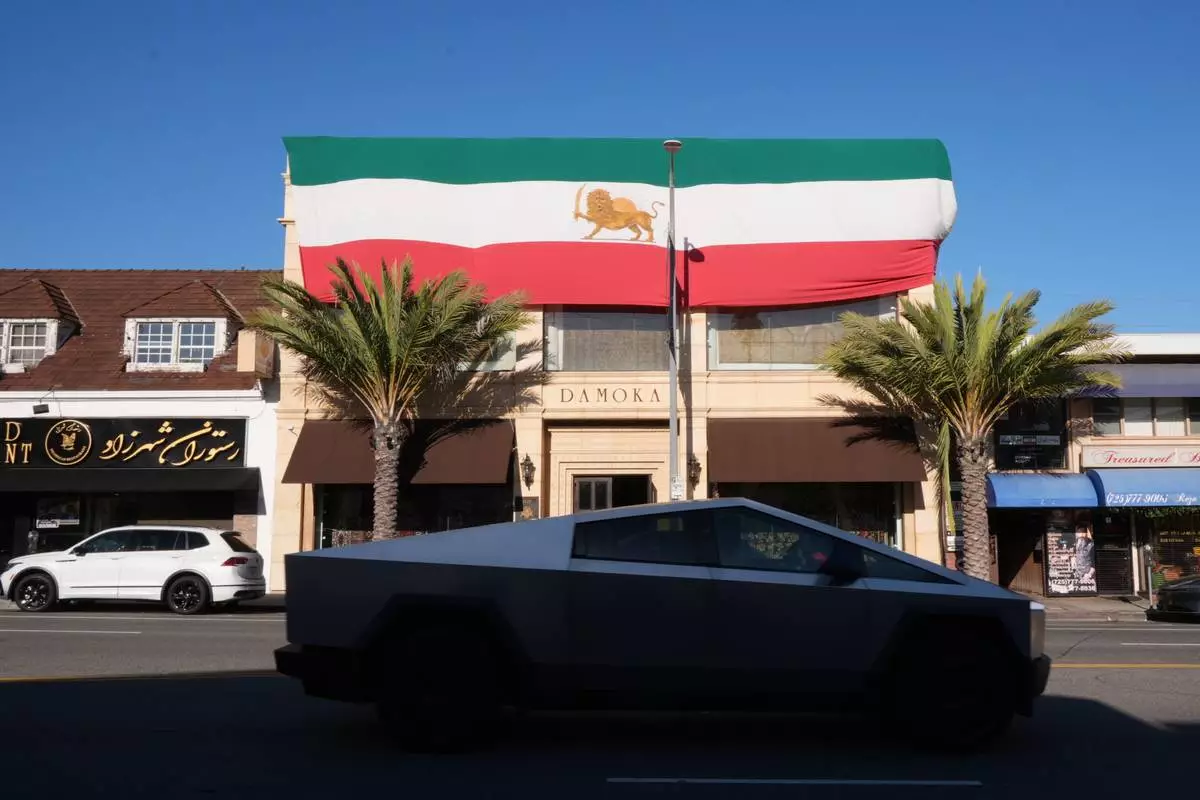
A giant The Lion and Sun flag, the pre-revolution Iranian national flag, decorates the exterior of Damoka rug store along Westwood Boulevard, in the Westwood neighborhood of Los Angeles, at the heart of the largest Iranian diaspora community in the United States, Monday, March 2, 2026. (AP Photo/Damian Dovarganes)
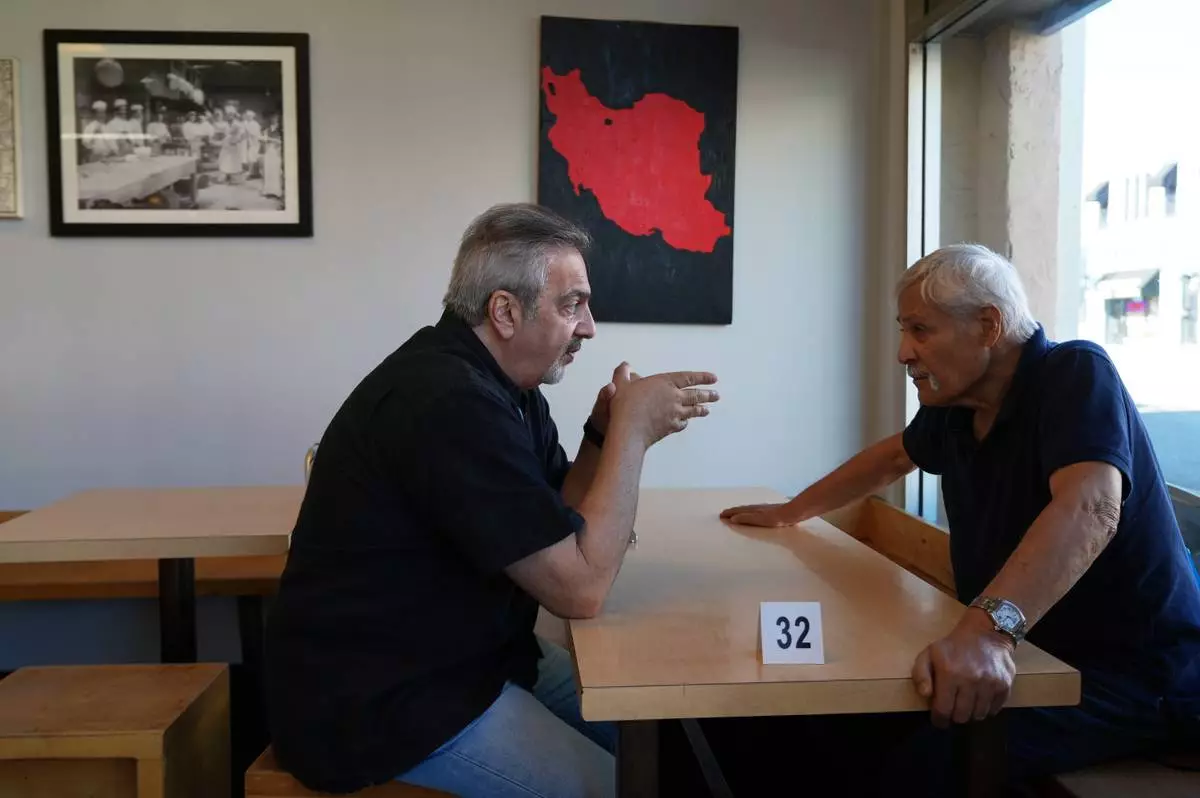
Customers talk inside the Taste of Tehran restaurant at the area known Little Tehran" or "Tehrangeles," the heart of the largest Iranian diaspora community in the United States, in Los Angeles, Monday, March 2, 2026. (AP Photo/Damian Dovarganes)
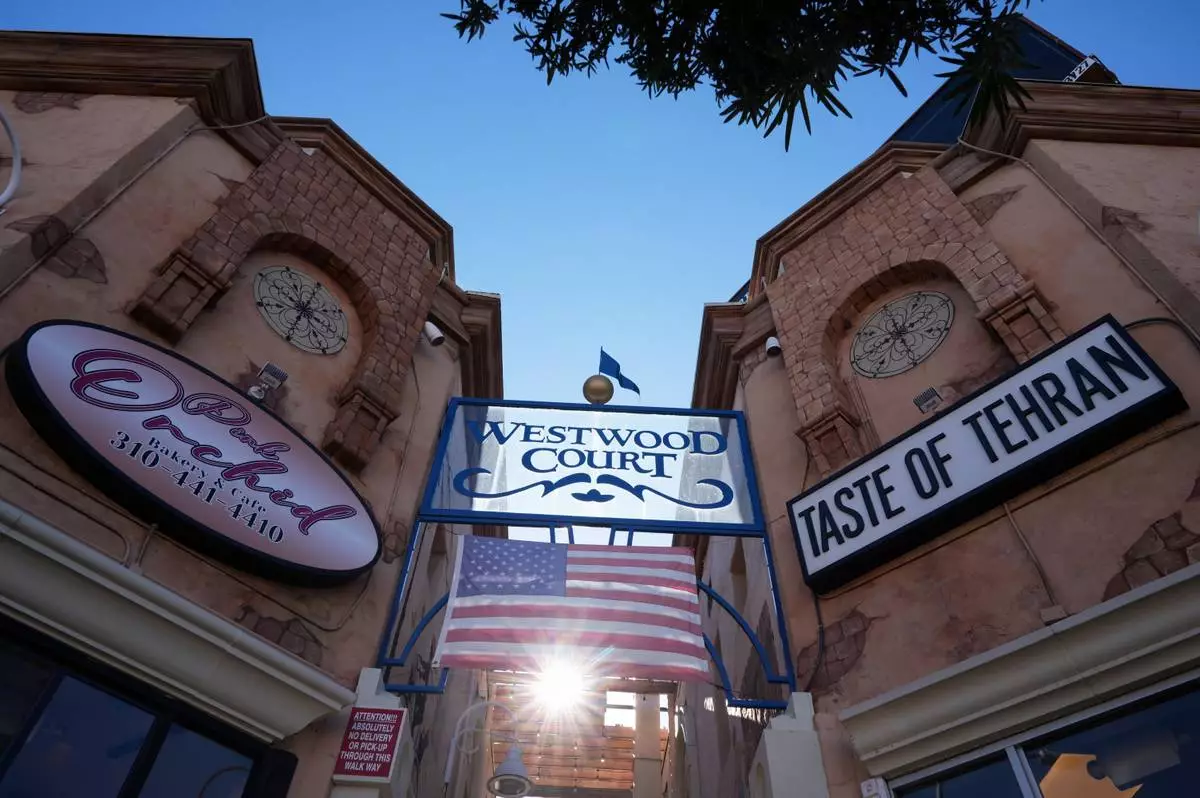
The area commonly known as "Little Tehran" or "Tehrangeles" is seen at the Westwood Court along Westwood Boulevard, the heart of the largest Iranian diaspora community in the United States, in Los Angeles, Monday, March 2, 2026. (AP Photo/Damian Dovarganes)
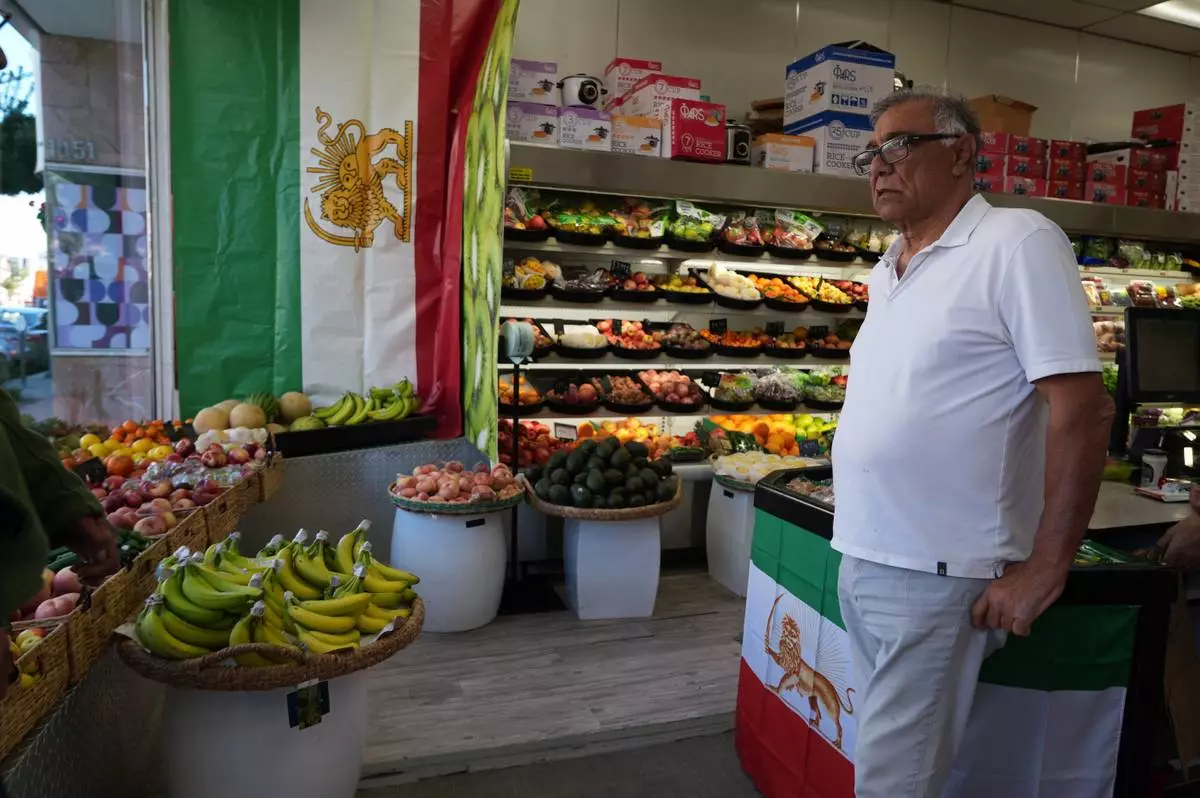
Farid, who gave only his first name, from Iran, works at Jordan Market, a Middle Eastern and Persian market along Westwood Boulevard, in the Westwood neighborhood of Los Angeles, pauses next to The Lion and Sun flags, the pre-revolution Iranian national flag, at the heart of the largest Iranian diaspora community in the United States, Monday, March 2, 2026. (AP Photo/Damian Dovarganes)
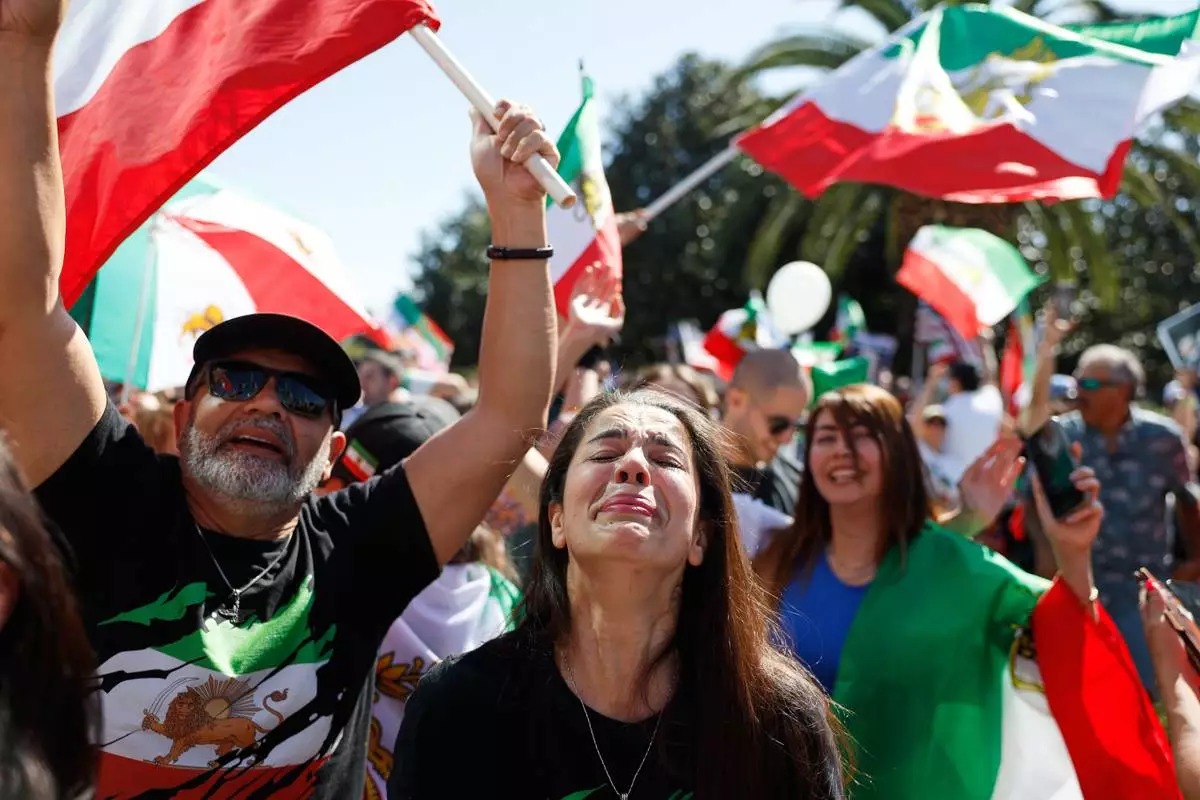
Demonstrators gather in reaction to the U.S. and Israeli strikes on Iran on Saturday, Feb. 28, 2026, in Los Angeles. (AP Photo/Caroline Brehman)
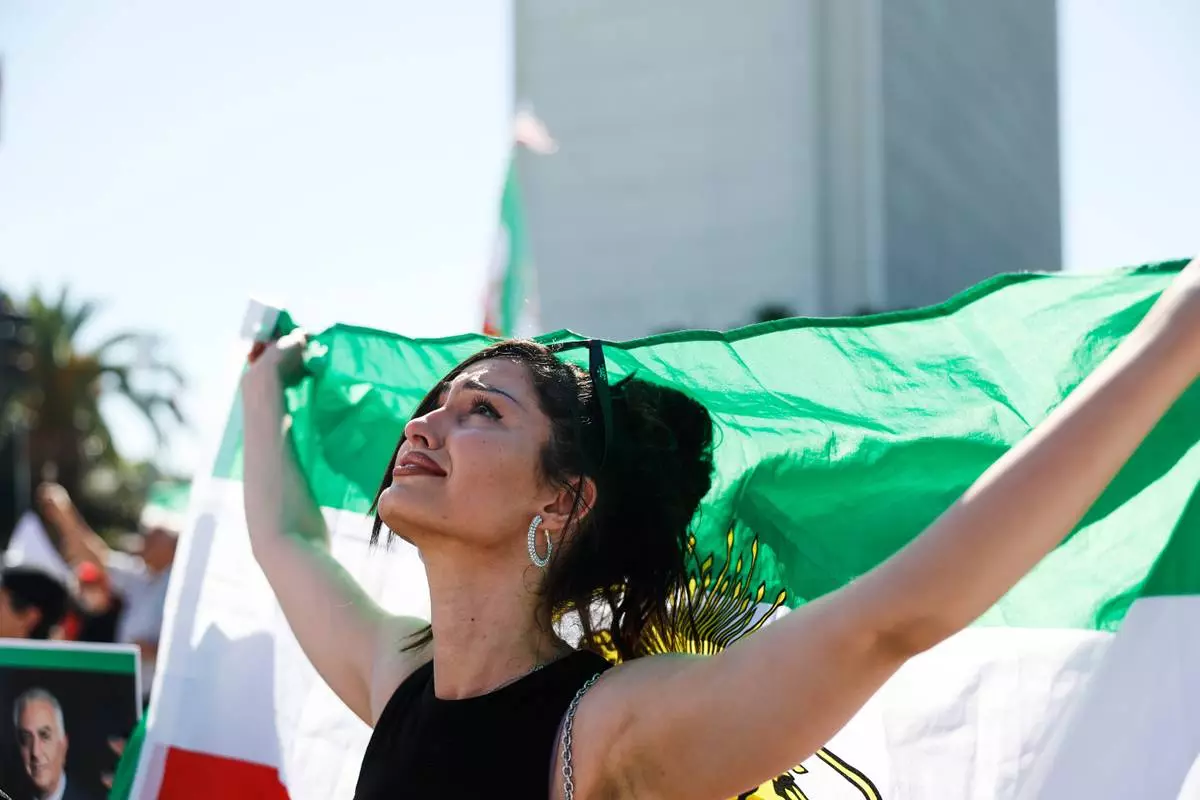
A demonstrator carries an Iranian flag during a march in reaction to the U.S. and Israeli strikes on Iran on Saturday, Feb. 28, 2026, in Los Angeles. (AP Photo/Caroline Brehman)
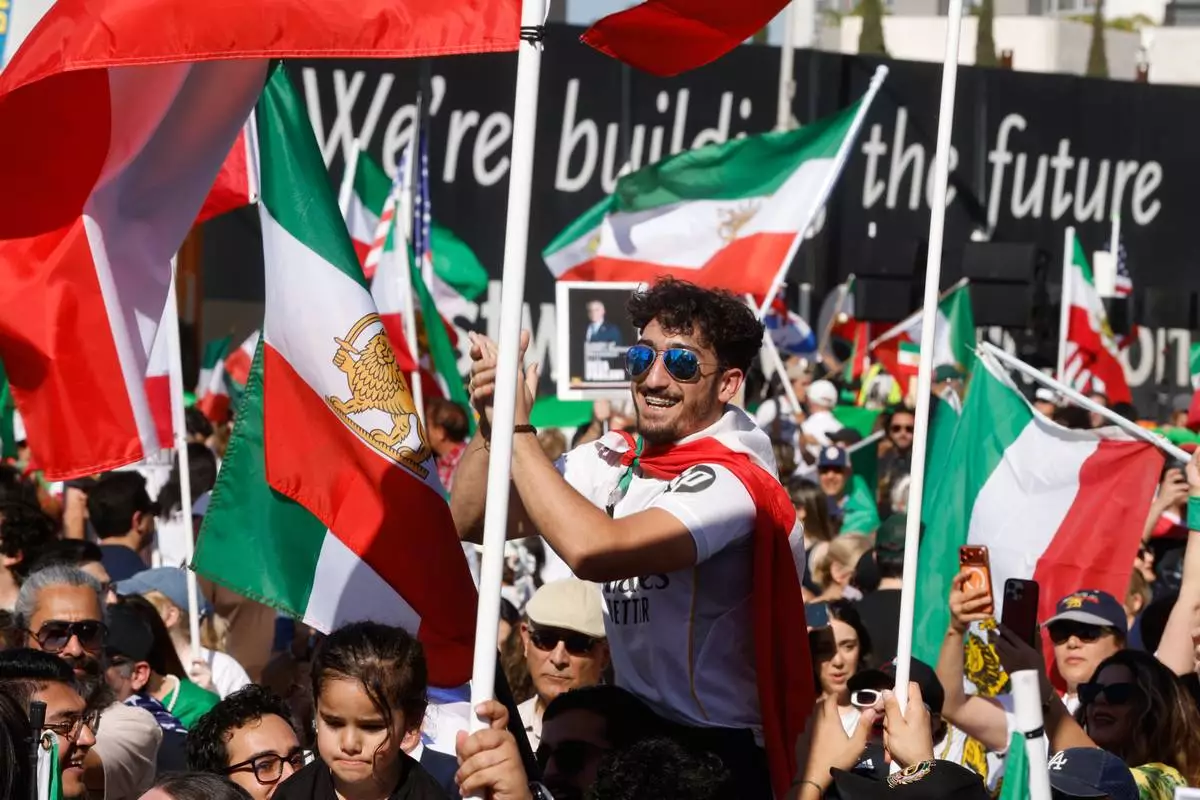
People chat slogans during a demonstration in support of the U.S. and Israeli strikes on Iran on Sunday, March 1, 2026, in Los Angeles. (AP Photo/Jill Connelly)